• Get involved.
    We want your input!
    Apply for Membership and join the conversations about everything related to broadcasting.

    After we receive your registration, a moderator will review it. After your registration is approved, you will be permitted to post.
    If you use a disposable or false email address, your registration will be rejected.

    After your membership is approved, please take a minute to tell us a little bit about yourself.
    https://www.radiodiscussions.com/forums/introduce-yourself.1088/

    Thanks in advance and have fun!
    RadioDiscussions Administrators

KYA or KFRC

J

JoeLouis

Guest
In the 60s which station was king of the hill in S.F. (KYA or KFRC) I hear old programs on various internet sources from both stations, I wasn't in S.F. then but I would have probably gone with KYA, better jingles and selection.
 
In the 60s which station was king of the hill in S.F. (KYA or KFRC) I hear old programs on various internet sources from both stations, I wasn't in S.F. then but I would have probably gone with KYA, better jingles and selection.
Neither. It was KSFO.

KFRC did not switch to Top 40 until the year after KHJ started. So it was KYA and KEWB up till then, with KEWB, Color Channel 91, winning. Once KFRC switched under Drake and Tom Rounds, it was all over for the other two, ratings wise.

However, the champ during most of that decade was 560 KSFO. In the 70's, it was a flip-flop between KSFO, KCBS and KGO with the decade ending with the start of a 38 year #1 run for KGO
 
Thanks David, I never realized those other stations did top 40, now KSFO is a big conservative talker in a huge liberal city, I imagine their ratings aren't too high.
 
Thanks David, I never realized those other stations did top 40, now KSFO is a big conservative talker in a huge liberal city, I imagine their ratings aren't too high.
And before those two, 1550 KOBY was Top 40, but they were very inconsistent and eventually changed format.
 
It seems a lot of places had multiple top 40 type stations, but there always the '2' big ones example: Baltimore WCAO & WFBR, and there were other smaller entries, NY is the best example WABC and WMCA, yet there were other smaller signals that came in from NJ and CT.
 
It seems a lot of places had multiple top 40 type stations, but there always the '2' big ones example: Baltimore WCAO & WFBR, and there were other smaller entries, NY is the best example WABC and WMCA, yet there were other smaller signals that came in from NJ and CT.
Remember, besides WMCA and WABC, both 1050 and 1010 had Top 40 periods in the "early days". Both were and are 50 kw AM signals.
 
Absolutely right, WHN had a nice format, and 1010 WINS now an all news station does very well in the NY market, what I'll never understand is why Audacy and the owners before them run two stations that compete against each other (1010 usually comes out higher) but they have their transmitters in different spots 880 in the Bronx and 1010 in NJ, so I only go with 880 because I'm in CT and 1010 signal is poor.
 
You seem to know a lot about radio in just about every city, are you familiar with WAVZ vs WNHC in New Haven? huge rivalry in the 60s (with WDEE in Hamden bringing up the rear in top 40)
 
Whenever someone brings up KYA, I always love to get the chance to mention the name Tom Donohue. Tom was The Big Daddy at KYA in the early-60s. Tom was the Dick Clark of San Francisco. There was an exploding local music scene happening, and Tom was a big part of it. He promoted the last concert by The Beatles at Candlestick Park. Not long after that, he went to a fledgling FM station (KMPX) and began the first underground rock station, where he got to play a lot of local rock music. He was a great example of what radio people were like at the time. Here's his story from the Bay Area Radio Museum:

 
Whenever someone brings up KYA, I always love to get the chance to mention the name Tom Donohue. Tom was The Big Daddy at KYA in the early-60s. Tom was the Dick Clark of San Francisco. There was an exploding local music scene happening, and Tom was a big part of it. He promoted the last concert by The Beatles at Candlestick Park. Not long after that, he went to a fledgling FM station (KMPX) and began the first underground rock station, where he got to play a lot of local rock music. He was a great example of what radio people were like at the time. Here's his story from the Bay Area Radio Museum:

I still have a r-r tape with an aircheck of Tom Donahue on KMPX that also has a promo for the Blue Cheer album "Vincebus Eruptum." I vague remember something about "spew forth and live" as something they said in that promo. My r-r deck went away years ago, so I haven't played that tape in 20+ years. It may have neutralized itself by now. That tape also had the Doors playing live at KQED-TV in 1967. I watched it and recorded it then. Hearing Tom Donahue's voice gave me goosebumps. Immediate recognition as well. Thinking about that reminds me of Russ Syracuse and the All Night Flight on KYA. Ah, the good old days!
 
In the 60s which station was king of the hill in S.F. (KYA or KFRC) I hear old programs on various internet sources from both stations, I wasn't in S.F. then but I would have probably gone with KYA, better jingles and selection.
David's right about KSFO's dominance of the market, but there was a legitimate Top 40 battle between KYA and KFRC.

KFRC switched to Top 40 in the spring of 1966. KYA was dominant and KEWB, about to change ownership and call letters, was in decline. On the surface, that seems similar to KRLA's dominance and KFWB's decline when KHJ flipped in the spring of 1965.

But unlike Los Angeles, where KHJ was number one within six months, KFRC had a battle on its hands. One year in (the May, 1967 Hooper ratings) KYA had a 9.5 to KFRC's 8.1. That summer (June-July 1967 Hooper), KFRC scored its first win---a huge surge to 11.9 with KYA dropping to a 7.4.

By May-June of 1968, it was neck and neck...KFRC with an 8.6, KYA at an 8.4. And that fall (in the October 1968 Pulse---sorry for all the changes, but it's hard to put together a complete set of SF ratings for the 60s), KYA beat KFRC 7.0 to 6.1.

By the August-September 1969 Pulse, KYA was not just beating KFRC, it was number one in the market overall---a 12.0 to KSFO's 11.0 and KFRC's 10.0.

The battle continued into the 70s, with KFRC beating KYA by only a tenth of a point---8.0 to 7.9---in the October/November 1970 Arbitron.

A year later, the October-November 1971 Pulse shows KFRC pulling ahead with a 9.3 to KYA's 8.3, and that was the last time KYA got within a point of KFRC.
 
I still have a r-r tape with an aircheck of Tom Donahue on KMPX that also has a promo for the Blue Cheer album "Vincebus Eruptum." I vague remember something about "spew forth and live" as something they said in that promo. My r-r deck went away years ago, so I haven't played that tape in 20+ years. It may have neutralized itself by now. That tape also had the Doors playing live at KQED-TV in 1967. I watched it and recorded it then. Hearing Tom Donahue's voice gave me goosebumps. Immediate recognition as well. Thinking about that reminds me of Russ Syracuse and the All Night Flight on KYA. Ah, the good old days!
There's a fair amount of early KMPX (as well as of its Big Band incarnation in the 70s) at Archive.org:

 
David's right about KSFO's dominance of the market, but there was a legitimate Top 40 battle between KYA and KFRC.

KFRC switched to Top 40 in the spring of 1966. KYA was dominant and KEWB, about to change ownership and call letters, was in decline. On the surface, that seems similar to KRLA's dominance and KFWB's decline when KHJ flipped in the spring of 1965.

But unlike Los Angeles, where KHJ was number one within six months, KFRC had a battle on its hands. One year in (the May, 1967 Hooper ratings) KYA had a 9.5 to KFRC's 8.1. That summer (June-July 1967 Hooper), KFRC scored its first win---a huge surge to 11.9 with KYA dropping to a 7.4.

By May-June of 1968, it was neck and neck...KFRC with an 8.6, KYA at an 8.4. And that fall (in the October 1968 Pulse---sorry for all the changes, but it's hard to put together a complete set of SF ratings for the 60s), KYA beat KFRC 7.0 to 6.1.

By the August-September 1969 Pulse, KYA was not just beating KFRC, it was number one in the market overall---a 12.0 to KSFO's 11.0 and KFRC's 10.0.
And one of the issues here was Drake's refusal to accept what Tom Rounds discovered: that San Francisco wanted a more rock and less "Boss" (beach and surfers) sound. Even the huge success of Round's first multi-artist event (coordinated by the guy he brought from Hawai'i to be show runner who went on to do that little gathering on a farm in Woodstock) did not convince Drake that this was not San Diego or LA or Fresno (no place is like Fresno, thank goodness).

I heard the whole story at dinner one night at TR's place with Mel Lawrence (good story at https://en.wikipedia.org/wiki/Mel_Lawrence ) and some of the other San Francisco folks. As a spectator, I just sat and listened to people who truly made history.
 
And one of the issues here was Drake's refusal to accept what Tom Rounds discovered: that San Francisco wanted a more rock and less "Boss" (beach and surfers) sound. Even the huge success of Round's first multi-artist event (coordinated by the guy he brought from Hawai'i to be show runner who went on to do that little gathering on a farm in Woodstock) did not convince Drake that this was not San Diego or LA or Fresno (no place is like Fresno, thank goodness).

I heard the whole story at dinner one night at TR's place with Mel Lawrence (good story at https://en.wikipedia.org/wiki/Mel_Lawrence ) and some of the other San Francisco folks. As a spectator, I just sat and listened to people who truly made history.

Drake told me (and said it in at least one interview) that he didn't understand San Francisco and the counterculture.

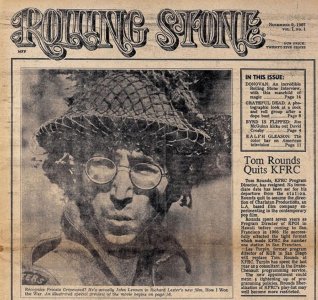
Rounds' departure was a big enough deal that it made the front page of Issue number one of Rolling Stone---above the fold:

Screenshot 2022-12-22 at 10.24.33 AM.jpg
 
Drake told me (and said it in at least one interview) that he didn't understand San Francisco and the counterculture.

On the other hand, Donohue seemed to love the counter culture, and helped promote it. Legend has it that he quit KYA because he hated the music he was playing. My guess it had more to do with all the extra-curricular work he was doing as a concert promoter and record label head. I doubt he could have started Autumn records while he was a DJ at KYA.
 
And one of the issues here was Drake's refusal to accept what Tom Rounds discovered: that San Francisco wanted a more rock and less "Boss" (beach and surfers) sound. Even the huge success of Round's first multi-artist event (coordinated by the guy he brought from Hawai'i to be show runner who went on to do that little gathering on a farm in Woodstock) did not convince Drake that this was not San Diego or LA or Fresno (no place is like Fresno, thank goodness).

I heard the whole story at dinner one night at TR's place with Mel Lawrence (good story at https://en.wikipedia.org/wiki/Mel_Lawrence ) and some of the other San Francisco folks. As a spectator, I just sat and listened to people who truly made history.
While KFRC ultimately succeeded by not playing to local musical tastes, the fact is that it only became truly dominant in the ratings (beating KYA by multiple points and having no real Top 40 challenger afterward for many years) after Drake left RKO. One of the few RKO stations to do better in the Paul Drew era than in the Bill Drake years.
 
The other factor in the KYA-KFRC battle's early days was listener loyalty. KYA's air talent, Gene Nelson, Mike Cleary, Johnny Holliday, Sean O'Callaghan, Ed Heider, Tony Bigg---all were involved in the community. They'd show up at local high schools---in fact, their basketball team, the KYA Oneders, would regularly play local high school faculty teams.

KFRC had exactly one local name jock when it debuted---Bobby Dale, who'd been at KEWB three years before and was never gonna last in a Drake station.

Even when KYA swapped out most of its air staff and brought in hired guns like Tom Campbell and Chris Edwards, job one for them was community involvement and engagement. And that's something that, with very few exceptions, KFRC didn't really pick up until Dr. Don Rose and John Mack Flanagan in the 70s.

You can give away a Jaguar XK-E (or you could, until Howard Clark totaled it), but for a lot of the Bay Area (which, really, in those days, apart from San Francisco and Oakland were small towns) showing up at things that mattered to you mattered more.

 
The other factor in the KYA-KFRC battle's early days was listener loyalty. KYA's air talent, Gene Nelson, Mike Cleary, Johnny Holliday, Sean O'Callaghan, Ed Heider, Tony Bigg---all were involved in the community. They'd show up at local high schools---in fact, their basketball team, the KYA Oneders, would regularly play local high school faculty teams.

KFRC had exactly one local name jock when it debuted---Bobby Dale, who'd been at KEWB three years before and was never gonna last in a Drake station.

Even when KYA swapped out most of its air staff and brought in hired guns like Tom Campbell and Chris Edwards, job one for them was community involvement and engagement. And that's something that, with very few exceptions, KFRC didn't really pick up until Dr. Don Rose and John Mack Flanagan in the 70s.

You can give away a Jaguar XK-E (or you could, until Howard Clark totaled it), but for a lot of the Bay Area (which, really, in those days, apart from San Francisco and Oakland were small towns) showing up at things that mattered to you mattered more.
 
Status
This thread has been closed due to inactivity. You can create a new thread to discuss this topic.


Back
Top Bottom