I visited the bay area in early 1970 and flipped back and forth between KYA and KDIA. I occasionally went down the dial to KFRC but it was easier to switch back and forth among the first two. I was 16 and the music seemed the same to me. I was wondering if KDIA was actually Top 40 at the time.Just remembered I think for a short while KDIA (1310) Oakland actually called itself "K-DAY" about the time KDAY Santa Monica changed its format to R & B.

-
Get involved.
We want your input!
Apply for Membership and join the conversations about everything related to broadcasting.
After we receive your registration, a moderator will review it. After your registration is approved, you will be permitted to post.
If you use a disposable or false email address, your registration will be rejected.
After your membership is approved, please take a minute to tell us a little bit about yourself.
https://www.radiodiscussions.com/forums/introduce-yourself.1088/
Thanks in advance and have fun!
RadioDiscussions Administrators
You are using an out of date browser. It may not display this or other websites correctly.
You should upgrade or use an alternative browser.
You should upgrade or use an alternative browser.

But he was the Boss of Firebaugh 🙄Great thread. I'm sure Verne will be by in a minute to remind everyone that I'm a wannabe who never worked in radio and I have a fake radio museum and that he's just one of 86 jocks who used the name "Chris Edwards" on the air...
I was in the Bay Area through most of the 70s, and KDIA wasn't considered Top 40. At the risk of sounding politically incorrect, it was the "black station." And had damn good music.I visited the bay area in early 1970 and flipped back and forth between KYA and KDIA. I occasionally went down the dial to KFRC but it was easier to switch back and forth among the first two. I was 16 and the music seemed the same to me. I was wondering if KDIA was actually Top 40 at the time.
Thank you for your reply. I know that KDIA wasn't Top 40 later. I was wondering if they were in early 1970.I was in the Bay Area through most of the 70s, and KDIA wasn't considered Top 40. At the risk of sounding politically incorrect, it was the "black station." And had damn good music.

And now he's the CEO of KMBY (1240) in Monterey, because Saul Levine donated it to Hanford Youth Services. And he's back to using "Chris Edwards":But he was the Boss of Firebaugh 🙄
https://kmbyradio.com/whats-the-difference-between-am-fm-and-tv/
R&B stations in that time had a lot in common with Top 40 in terms of formatics. In L.A., KHJ always defended against KGFJ---and KDAY's success after flipping to R&B in 1974 had to do with it being very much like a top 40---just with a playlist that only shared some records with Top 40.Thank you for your reply. I know that KDIA wasn't Top 40 later. I was wondering if they were in early 1970.
Thank you for your reply. I know that KDIA wasn't Top 40 later. I was wondering if they were in early 1970.
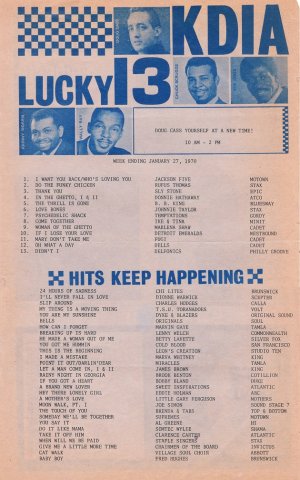
Semoochie, the only "early 1970" playlist I could find for KDIA was the week of January 27.
KFRC's for the same week:
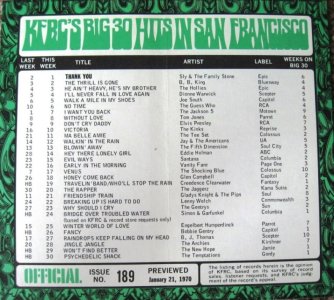
KFRC's hitbounds that week included Brook Benton's "Rainy Night in Georgia", so there were eight songs that week that KFRC and KDIA had in common---but if you look at KDIA's top ten---presumably the heaviest rotation---four of those songs were also on KFRC. In fact, three of them were in KFRC's top four.
Plus---KFRC was still on "Friendship Train", and Stevie Wonder's "Never Had A Dream Come True" was hitbound, (but not on the KDIA chart---was KFRC late or early?) giving it still more R&B flavor. And KDIA was still on the Supremes' "Someday We'll Be Together", which had just dropped off the KFRC chart.
And, if you look at the rest of the KDIA chart, there are songs that KFRC soon would be playing---The Delfonics' "Didn't I (Blow Your Mind This Time)", The Originals' "The Bells", and the Chairmen of the Board's "Give Me Just A Little More Time". So, if you were listening a couple of weeks after this, the stations would have had eleven songs in common on their charts.
Put that together with whatever Gold the two stations had in common, and how KDIA rotated its records, and it's not at all unreasonable to wonder, while listening, at that time, if you could be hearing a Top 40 station with a harder R&B lean---which in Oakland, would not be out of the question.
Attachments
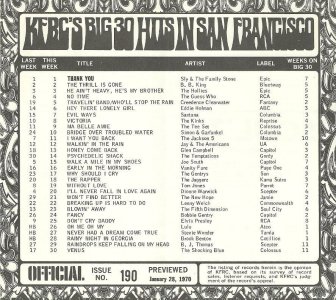
Thank you Michael, that clears it up. The KDIA chart alone was conclusive. After I think about it, it seems like there was a fourth station in the mix, the one in Vallejo. I was surprised to see Lenny Welch make the KFRC chart!Semoochie, the only "early 1970" playlist I could find for KDIA was the week of January 27.
View attachment 4318
KFRC's for the same week:
View attachment 4320
KFRC's hitbounds that week included Brook Benton's "Rainy Night in Georgia", so there were eight songs that week that KFRC and KDIA had in common---but if you look at KDIA's top ten---presumably the heaviest rotation---four of those songs were also on KFRC. In fact, three of them were in KFRC's top four.
Plus---KFRC was still on "Friendship Train", and Stevie Wonder's "Never Had A Dream Come True" was hitbound, (but not on the KDIA chart---was KFRC late or early?) giving it still more R&B flavor. And KDIA was still on the Supremes' "Someday We'll Be Together", which had just dropped off the KFRC chart.
And, if you look at the rest of the KDIA chart, there are songs that KFRC soon would be playing---The Delfonics' "Didn't I (Blow Your Mind This Time)", The Originals' "The Bells", and the Chairmen of the Board's "Give Me Just A Little More Time". So, if you were listening a couple of weeks after this, the stations would have had eleven songs in common on their charts.
Put that together with whatever Gold the two stations had in common, and how KDIA rotated its records, and it's not at all unreasonable to wonder, while listening, at that time, if you could be hearing a Top 40 station with a harder R&B lean---which in Oakland, would not be out of the question.

I believe that in 1970 Vallejo was in the Arbitron metro but not the Pulse and Hooper zones.Thank you Michael, that clears it up. The KDIA chart alone was conclusive. After I think about it, it seems like there was a fourth station in the mix, the one in Vallejo. I was surprised to see Lenny Welch make the KFRC chart!
And—-you’re right. It’s nine. Three sets of three towers. Two sets just east pd the toll plaza, one set just west.I remember NINE towers, with the additional set of three belonging to 960 AM. Did one set of towers get demolished recently? I know a different thread discussed 1310's CP to move slightly inland, so they can diplex with 1510. Have 1310's toll plaza sticks been removed?
I’d love to hear that Doors tape if you’re able to find it. Would you be open to digitizing it? I’m sure others would be interested in listening to a piece of radio history!I still have a r-r tape with an aircheck of Tom Donahue on KMPX that also has a promo for the Blue Cheer album "Vincebus Eruptum." I vague remember something about "spew forth and live" as something they said in that promo. My r-r deck went away years ago, so I haven't played that tape in 20+ years. It may have neutralized itself by now. That tape also had the Doors playing live at KQED-TV in 1967. I watched it and recorded it then. Hearing Tom Donahue's voice gave me goosebumps. Immediate recognition as well. Thinking about that reminds me of Russ Syracuse and the All Night Flight on KYA. Ah, the good old days!

Drake told me (and said it in at least one interview) that he didn't understand San Francisco and the counterculture.
I wonder if his image of San Francisco was based on his original time there, doing mornings and programming 1260 KYA.
The Sixties evolved quickly, especially after the arrival of The Beatles – and especially in San Francisco, where it seems that the counterculture went at lightning speed from beatniks to hippies, from the hungry i to Haight-Ashbury, from the Kingston Trio to the Grateful Dead.
The route that Drake took from San Francisco to Fresno (and a bit of Stockton) on the way to Boss Angeles may have used a road map that he designed himself, but by the time RKO General gave him the keys to KFRC (barely three years after he left KYA), San Francisco had changed drastically.
The contrast-and-compare between 93/KHJ and KFRC in that 1966-1967 period shows (through airchecks) two amazingly tight radio stations with similar DNA, but they were more fraternal twins than identical twins.
Exactly, And Drake personally was the squarest of square Southern boys. The changes in SF were too much, too soon, for his sensibilities. Which is probably why he gravitated towards Paul Drew and Ted Atkins after Rounds and Turpin. Paul and Ted programmed to the suburbs, not the City. And eventually, that won.I wonder if his image of San Francisco was based on his original time there, doing mornings and programming 1260 KYA.
The Sixties evolved quickly, especially after the arrival of The Beatles – and especially in San Francisco, where it seems that the counterculture went at lightning speed from beatniks to hippies, from the hungry i to Haight-Ashbury, from the Kingston Trio to the Grateful Dead.
The route that Drake took from San Francisco to Fresno (and a bit of Stockton) on the way to Boss Angeles may have used a road map that he designed himself, but by the time RKO General gave him the keys to KFRC (barely three years after he left KYA), San Francisco had changed drastically.
The contrast-and-compare between 93/KHJ and KFRC in that 1966-1967 period shows (through airchecks) two amazingly tight radio stations with similar DNA, but they were more fraternal twins than identical twins.
San Francisco had changed drastically.
Tom Donohue was the canary in the coal mine. He saw it in 1966.
And part of why it won was the increasing dominance of Arbitron... and its eventual total conquest over The Pulse and Hooperatings.Exactly, And Drake personally was the squarest of square Southern boys. The changes in SF were too much, too soon, for his sensibilities. Which is probably why he gravitated towards Paul Drew and Ted Atkins after Rounds and Turpin. Paul and Ted programmed to the suburbs, not the City. And eventually, that won.
For those unfamiliar with that period, the two earlier leaders in ratings had limited survey areas, restricted by the toll-free telephone service areas or home to home in person interviewing. Arbitron recruited by mail, sent a diary by mail, and had it returned by mail. They changed the survey areas to whole counties and sets of counties.
So winning based on far suburbs did not work in the 60's and into the 70's. But when Arbitron won by selling to agencies, not radio, they changed the radio industry in a way that has not been fully covered anywhere.
And then there is the way that radio's refocusing on full and large metro areas changed news and political focus "on the radio". There is a book there, Michael.
- Status
- This thread has been closed due to inactivity. You can create a new thread to discuss this topic.