• Get involved.
    We want your input!
    Apply for Membership and join the conversations about everything related to broadcasting.

    After we receive your registration, a moderator will review it. After your registration is approved, you will be permitted to post.
    If you use a disposable or false email address, your registration will be rejected.

    After your membership is approved, please take a minute to tell us a little bit about yourself.
    https://www.radiodiscussions.com/forums/introduce-yourself.1088/

    Thanks in advance and have fun!
    RadioDiscussions Administrators

Best Sounding AM Stations?

I've been exploring the sound of various AM stations, past and present, to sort of get an idea of how my Part 15 station should sound, and I came across one that sounds far and away better than any others I've heard in a while: KVOL 1330 AM out of the Lafayette, LA metro area broadcasting MeTV radio, a "soft oldies" format.

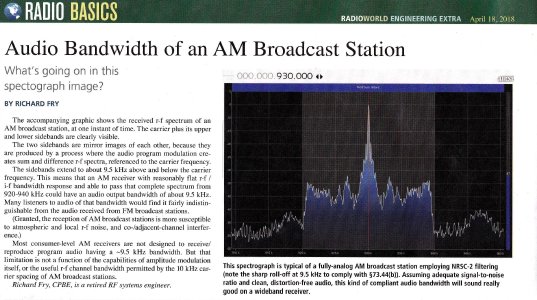
I'm listening to it through a KiwiSDR out of Maurice, LA, which is configured with a 20kHz bandwidth, and unusually for an AM station nowadays, KVOL seems to be using the full +/- 10 kHz allowed by the FCC, and it sounds fantastic. Almost FM like. Many, if not most other AM stations I've listened to have a fairly narrow range, with a lowpass set somewhere between 5-7.5 kHz, no doubt to prevent from stepping on other stations in a tightly crowded market.

It goes to show that, under favorable conditions in a relatively uncrowded market, AM can still sound pretty decent.

Are there any other stations that sound this good anywhere?

c
 
cc333- Yes, there are AM stations out there with good sounding audio. Perhaps there is an AM station nearby you could be involved in, instead of Part 15 operation. If you are working with audio, adjusting processing and trying to make a Part 15 station sound good on the dial, you might as well do it with a licensed station.
 
Last edited:
@Greg Strickland I would consider it if there were any stations nearby that broadcast a format I'd like working with (though at the bottom rungs of the "career ladder", I suppose I can't be very choosy if I want to get anywhere). Also, I'm not yet sure I want to pursue a career in radio, though I have seriously considered it.

And besides, apart from being an interesting hobby, Part 15 broadcasting is an easy, relatively low risk (provided I follow the legal guidelines) and low cost entry into the field without having to make a full commitment to anything in particular, which satisfies my curiosity adequately for the time being.

c
 
Kelly A- if you mean sounding like unprocessed full fidelity audio, none is essentially correct. If you mean sounding musical and perfectly listenable on the station's programming, I disagree.

Bob Orban once used the term "entertainment quality" and I think he was making a good point there. Audio is a funny thing. I'm not so sure "Louie Louie" or "Wooly Bully" need to sound any better than they do now. The feel, emotion and point of the song is abundantly clear as they were recorded. There is magic in a mix.

The other night I was listening to talk programming on WGY via skywave. It sounded fine. Not over compressed, it was balanced and easy to listen to.
 
Last edited:
Audio is a funny thing. I'm not so sure "Louie Louie" or "Wooly Bully" need to sound any better than they do now. The feel, emotion and point of the song is abundantly clear as they were recorded. There is magic in a mix.
That point is very strong with me. In the late 60's I built Quito, Ecuador's first discotheque and named it "Louie, Louie". The distorted sound of the song said something about "hip" music at the time, and the doubly un-undersandable lyrics (English song in a Spanish speaking country and lyrics you really could not understand anyway) said something about pop culture.

Many songs are final mixed to add dimensions, sounds and effects that are not natural. The overdubbiing of Les Paul and Mary Ford showed that sound enhancement, often using distortion, effects and EQ, become part of a song itself.

Songs don't have to be clean and clear like a Glen Miller band tune in its era. The term "quality" in radio does not mean "just how it was recorded". In many cases, we looked at how much compression and AGC were needed to make in-car listening pleasurable above road noise without damaging the listening in mom's kitchen radio or in dad's unit in the workshop.

So radio intentionally change the original recording (likely already aurally modified in true Phil Spector fashion) to make the medium fit the listening environment.
 
In recorded music, the mix is crucial. Sometimes carefully calculated, sometimes a fortuitous occurrence, unplanned and impossible to recreate. In broadcasting we have our own mix. It is the audio processing, which happens linearly on program material that repeats and changes (even though that is an incongruous turn of words).

I think engineering's task is adjusting audio processing to help programming convey their desired programming sound to the audience, through the "pipeline" of the transmission medium.

Sometimes the pipeline is narrow, like the mono channel of AM. But listen to the genuine Motown "Hitsville USA" CD. Those songs sound like a million bucks, in mono. How did they do that in that house in Detroit? It's the magic of entertainment.

Radio is truly in the golden age of audio quality. Today radio broadcasters are blessed with streaming, which has the potential to deliver nearly the full listening experience to the audience as it was mixed by the performing artist.

It's all about making the audience happy.
Your move.
 
Last edited:
It's all about making the audience happy.
Your move.
I find interesting, and generally a good idea, the variety of audio options most contemporary televisions have. We can emulate sound environments as well as adjust sound to personal preferences and have it automatically process just like Optimod presets.

Every room is different. Every environment is different. Every person's hearing can be different. The idea of just having adjustable treble and bass is a bit old school.
 
David, I agree. Particularly with room acoustics. When recording, broadcasting or listening, sound is profoundly affected by acoustics. Room dimensions, absorption/reflection and relationship of sound sources to destinations. Sadly, acoustic treatment is a major "snake-oil" scam product. I recommend going to basics, read some old textbooks and don't buy something expensive that promises a miracle.

Choose the larger room. They are easier to fix/mitigate.
 
Last edited:
Kelly A- if you mean sounding like unprocessed full fidelity audio, none is essentially correct. If you mean sounding musical and perfectly listenable on the station's programming, I disagree.

Bob Orban once used the term "entertainment quality" and I think he was making a good point there. Audio is a funny thing. I'm not so sure "Louie Louie" or "Wooly Bully" need to sound any better than they do now. The feel, emotion and point of the song is abundantly clear as they were recorded. There is magic in a mix.

The other night I was listening to talk programming on WGY via skywave. It sounded fine. Not over compressed, it was balanced and easy to listen to.
Most of us heard those songs on our one-inch transistor radio speaker, and the records were engineered as such.
 
Kelly A- if you mean sounding like unprocessed full fidelity audio, none is essentially correct. If you mean sounding musical and perfectly listenable on the station's programming, I disagree.
So, what you're saying is: Frequency response of 100Hz through 5Khz, THD exceeding 10%, and a signal to noise ratio of -40dB sounds good?
I suppose people used to think Gramophones sounded 'musical' too. But just like AM; compared to just about anything else in the 21st Century, not 1970, AM is entirely inferior.
Bob Orban once used the term "entertainment quality" and I think he was making a good point there. Audio is a funny thing. I'm not so sure "Louie Louie" or "Wooly Bully" need to sound any better than they do now. The feel, emotion and point of the song is abundantly clear as they were recorded. There is magic in a mix.
That's called nostalgia, not quality.
The other night I was listening to talk programming on WGY via skywave. It sounded fine. Not over compressed, it was balanced and easy to listen to.
Again, as compared with anything else it competes with?
 
I don't have anything to do with the station, but there is an AM station in Ionia, Michigan (1430 WION) that is AM stereo and sounds pretty decent for AM. According to the guy that runs it, their stream is actually taken right off the AM tuner https://www.i1430.com/
 
Ah, I've always thought AM stereo was neat!

I remember when KABL 960 broadcast in AM Stereo. It still sounded like AM, but better. I only ever heard it in the car, so I never had the opportunity to hear it on a really nice C-QUAM Capable system (they are quite uncommon, but they do exist).

Fun fact: I got a C-QUAM transmitter for my Part 15 station, because I could and I enjoy the novelty factor, despite the fact that I still don't have a way to actually hear anything in stereo.

c
 
I don't have anything to do with the station, but there is an AM station in Ionia, Michigan (1430 WION) that is AM stereo and sounds pretty decent for AM. According to the guy that runs it, their stream is actually taken right off the AM tuner https://www.i1430.com/
Here's a link to a video that gives a tour of the station and the transmitter site. If you go about halfway through, that's where the transmitter tour starts, including a look at their audio chain which includes a "highly modified" Optimod.

 
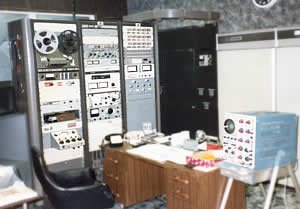
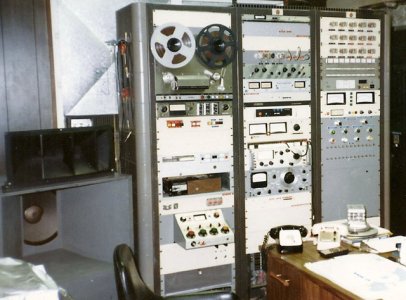
Back in the early '80s, I was the Chief Engineer for WGTO, Cypress Gardens, FL.
They had a Gates (Harris) MW-50 transmitter. This was before the FCC mandated a 10kHz high frequency cutoff for AM stations.
The transmitter and antenna system were essentially flat to 15kHz. Many have reported that the MW-50 exhibited high IM distortion. This particular transmitter did not suffer from that. I'm not sure why. Perhaps it was because the antenna system had a flat, symmetrical response. The transmitter sounded spectacular! These are photos of a portion of the transmitter plant. Notice the Altec 'Voice of the Theatre' air monitor speaker system.
WGTOday.jpg
WGTO_Transmitter_Processing_1982.jpg
 
So, what you're saying is: Frequency response of 100Hz through 5Khz, THD exceeding 10%, and a signal to noise ratio of -40dB sounds good?
I suppose people used to think Gramophones sounded 'musical' too. But just like AM; compared to just about anything else in the 21st Century, not 1970, AM is entirely inferior.

That's called nostalgia, not quality.

Again, as compared with anything else it competes with?
Indeed the original minimum performance specs for AM were 100hz to 5 kHz but with THD not exceeding 5 %. However, since at least the early 1950s major market stations took pains to make their facilities sound as good as possible, which meant audio with the maximum freq response possible from about 30 Hz to 15 kHz with THD not exceeding 1 % and S/N better than 60 dB. Depending on the program material this produces Hi-Fi perfomance in wide band radios. And since the response of most wide band radios max out at just over 10 kHz, the fact that the FCC rule change in the 1980s reducing AM audio from 15 kHz to 10 kHz made little difference in these receivers - they still sound good even today. As I have said on other posts, in general, if your AM sounds bad it usually because your radio sounds bad, maybe like the AM tuner of my Kenwood car stereo: all the stations sound the same regardless of the station's processor settings. The radio's IF bandpass is so narrow that it's hard to hear the letter "s" at the end of spoken words, not to mention significant distortion that's introduced.

By the way you mentioned: "people used to think gramophones sounded musical". You have to put this in perspective of the technology of the times, as well as an individual's personal taste. You would be amazed at what a mint condition 78 RPM record sounds like when played through a modern system fitted with a high quality diamond stylus designed for 78 RPM playback...no it's obviously not up to modern standards but it's perfectly "musical" and pleasant to listen to...I have a couple of Glenn Miller records on the original Blue Bird label I found in a thrift store that I discovered had probably never been played (at least not with a "steel needle"). I never though a 78 could be so quiet...
 
Last edited:
Ah, I've always thought AM stereo was neat!

I remember when KABL 960 broadcast in AM Stereo. It still sounded like AM, but better. I only ever heard it in the car, so I never had the opportunity to hear it on a really nice C-QUAM Capable system (they are quite uncommon, but they do exist).

Fun fact: I got a C-QUAM transmitter for my Part 15 station, because I could and I enjoy the novelty factor, despite the fact that I still don't have a way to actually hear anything in stereo.

c
Try and find a Sony SRF-A100. It's a portable AM Stereo/FM Stereo radio. I bought one back in the 80s and still use it today. The AM is dual IF bandwidth, and in the wide band mode it's HI-FI, depending on the station/program material of course.
There is a mode switch on the side of the radio to select between Leonard Kahn's Independent Sideband System (sel "B") and C-Quam and everyone else (sel "A").
 
Last edited:
Back in the early '80s, I was the Chief Engineer for WGTO, Cypress Gardens, FL.
They had a Gates (Harris) MW-50 transmitter. This was before the FCC mandated a 10kHz high frequency cutoff for AM stations.
The transmitter and antenna system were essentially flat to 15kHz. Many have reported that the MW-50 exhibited high IM distortion. This particular transmitter did not suffer from that. I'm not sure why. Perhaps it was because the antenna system had a flat, symmetrical response. The transmitter sounded spectacular! These are photos of a portion of the transmitter plant. Notice the Altec 'Voice of the Theatre' air monitor speaker system.
View attachment 4046
View attachment 4047
I'm sure it did sound spectacular ! As I mention in a subsequent post that change to 10 kHz from 15 kHz made little difference as the best wide band radios response maxes out at just over 10 kHz anyway. They would still sound great !
 
Status
This thread has been closed due to inactivity. You can create a new thread to discuss this topic.


Back
Top Bottom