
• Get involved.
    We want your input!
    Apply for Membership and join the conversations about everything related to broadcasting.

    After we receive your registration, a moderator will review it. After your registration is approved, you will be permitted to post.
    If you use a disposable or false email address, your registration will be rejected.

    After your membership is approved, please take a minute to tell us a little bit about yourself.
    https://www.radiodiscussions.com/forums/introduce-yourself.1088/

    Thanks in advance and have fun!
    RadioDiscussions Administrators

The Expanded AM Band

I started a thread about this on the Michigan board, but I thought I'd ask you DXing experts here also. I was fascinated when I picked up Stereo 1680 Jamz out of Grand Rapids, MI around '99 or '00! I've learned that DXers around the globe also picked up WJNZ because they've posted confirmation letters they received from the station.

Stereo 1680 Jamz was, briefly, the only station on that frequency so, could it have been considered a sort of "clear channel" station? A traveler's information station from Florida debuted on 1680 shortly thereafter and the two stations battling it out made it impossible to continue listening in Williamsburg, VA.

I'd never heard about the expanded AM band before the night I stumbled across WJNZ as I scanned the dial in my mother's new car. I realize AM is pretty much over now, but did y'all consider the project to be successful at the time? I also thought these were new stations, but I recently realized that each expanded band station had a "twin" somewhere lower on the dial. Did most broadcasters choose the new frequency or continue with the old one?

Thank you for your help!
 
Stereo 1680 Jamz was, briefly, the only station on that frequency so, could it have been considered a sort of "clear channel" station?
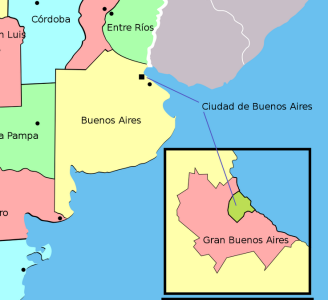
Prior to that station and even today there are several stations in the greater Buenos Aires area (the city and the Province of Buenos Aires) on that channel. Argentina beat the US in placing stations up to 1700, and several used to be well heard by US DXers back then.

If you look at an Argentine map, you can see how big that Province is and how multiple stations on the same high AM band channel were possible. The province and the city of Buenos Aires have a population of about 21 million.

1674180855006.png
 
Last edited:
I started a thread about this on the Michigan board, but I thought I'd ask you DXing experts here also. I was fascinated when I picked up Stereo 1680 Jamz out of Grand Rapids, MI around '99 or '00! I've learned that DXers around the globe also picked up WJNZ because they've posted confirmation letters they received from the station.

Stereo 1680 Jamz was, briefly, the only station on that frequency so, could it have been considered a sort of "clear channel" station? A traveler's information station from Florida debuted on 1680 shortly thereafter and the two stations battling it out made it impossible to continue listening in Williamsburg, VA.

I'd never heard about the expanded AM band before the night I stumbled across WJNZ as I scanned the dial in my mother's new car. I realize AM is pretty much over now, but did y'all consider the project to be successful at the time? I also thought these were new stations, but I recently realized that each expanded band station had a "twin" somewhere lower on the dial. Did most broadcasters choose the new frequency or continue with the old one?

Thank you for your help!
The original idea of the expanded band was to clean up the 540-1600 part of the band. Certain stations would be able to build a facility on the X-band with 10,000 watts day and 1000 watts night. Because of the high frequency (almost shortwave) these stations can get out, especially on winter days. I used to be able to get the Michigan and Wisconsin X-banders in Southwest Ohio during the day in he winter.
The "twin" was supposed to go off the air after five years, but often it didn't.
The only real successful X-bander is KCJJ-1630 in Iowa.
 
The original idea of the expanded band was to clean up the 540-1600 part of the band. Certain stations would be able to build a facility on the X-band with 10,000 watts day and 1000 watts night. Because of the high frequency (almost shortwave) these stations can get out, especially on winter days.
Those stations also got out because there were so few of them and on a clear AM channel, low power goes a long way.

From Ohio, I got KIKI in Honolulu on 830 with 250 watts. 50 watt AFRTS from Ramey AFB in Puerto Rico.

And several times I moved my station in Quito licensed to 570 AM to 565 and got dozens of reports from all over the US, Canada and Australia. My station on 805, also in Quito, got reports from the US, Oceania and even Europe quite often. Both were about 1.25 kw.
 
I realize AM is pretty much over now, but did y'all consider the project to be successful at the time? I also thought these were new stations,
Unfortunately, most of them struggled from the get-go, and sooner or later changed formats , Usially to no avail. As , gr8oldies pointed out, KCJJ ( 1630)in Iowa City is perhaps the lone exception. Owner, Steve Bridges, had the advantage of being well known and respected in his market by both listeners and local advertisers.
 
I always thought that adding the X band was a good idea, but there have never been any stations added or moved there in TN, and IIRC there are no more new stations being allowed there. So for my area it has been useless except for DXing at night, which I rarely do.
 
Dallas-Fort Worth airport TIS stations on 1640 and 1680 were heard on the west coast in the late '90s. And so was WRNC-1670 in GA, WJDM-1660 NJ, etc. Likewise, KXBT-1630/1640 (now KDIA) in CA was heard all over the east coast at the same time. KGXL-1650 (K-Traffic) was also a common DX catch for east coasters.
 
Argentina beat the US in placing stations up to 1700, and several used to be well heard by US DXers back then.
I didn't have fancy equipment or an antenna so I don't know if I could have DXed stations from that far away! I never heard anyone mention the X band, so how did non-radio people find out about it? Did announcers on the older "twin" direct listeners to it?

Isn't this similar to what's been said on this board about people not embracing AM stereo or digital radio because they don't have the means to do so? I didn't have a way to listen to the X band until a few years later when I bought a new car.
 
Dallas-Fort Worth airport TIS stations on 1640 and 1680 were heard on the west coast in the late '90s. And so was WRNC-1670 in GA, WJDM-1660 NJ, etc. Likewise, KXBT-1630/1640 (now KDIA) in CA was heard all over the east coast at the same time. KGXL-1650 (K-Traffic) was also a common DX catch for east coasters.
Two Texas X-Band stations on 1700—KKLF in DFW and KVNS in Brownsville—have been heard in Western Australia, over 10,000 miles away.
 
^^^
Frequency range
AM: 530–1605 kHz


I bought a couple of these Sony radios as part of my severe weather preparedness kit, at first I thought that Sony was selling out of their existing stock, but this radio was for sale for many, many years after AM stations went OTA in the extended band (1660 here in KC).

Other off brand pocket AM/FM radios for sale at the same time as this Sony did/do tune in the extended AM band.

I thought there was a requirement for radios (and TVs) to receive all possible transmitted stations (in the bands they tune in).


Kirk Bayne
 
I thought there was a requirement for radios (and TVs) to receive all possible transmitted stations (in the bands they tune in).
IIRC, the requirement to tune to 1700 was for radios beginning in 1990, although radios without it were still on the shelves for several years thereafter, until stocks were depleted.

The first X-band stations in the US appeared in 1995. Then, as now, few listeners noticed. Fewer cared. Most X-band stations that I've heard over the years were either the now-gone Radio Disney or Spanish-language. The exceptions that I remember were TIS stations on 1610, 1660 in SLC (oldies) and 1700 in San Diego (sports). It was a good idea that didn't work out.
 
^^^
Date First Available May 29, 2011


It looks like Sony continued to make new ICF-S10MK2s after 1990/95 (until 2011), I wonder how they got away with it?


Kirk Bayne
 
And of course, KYIZ-1620 Renton/Seattle is currently a mix of The Touch R&B network and various Black-orientated shows (Rev. Al Sharpton I believe is one of them).
 
I do not believe there is, or ever was, a legal requirement that AM tuners sold in the US receive up to 1705 kHz. What existed was a "handshake agreement", as near I can tell.
 
I've tested many stock radios from the 1970s and early 1980s as to what the highest frequency they would receive without modification. I found that many of the analog tuned radios tuned up to 1660-1680 kHz. That's how I first heard WJDM 1660, knowing that the expanded band stations were coming, but that one reportedly required an act of Congress to come on early, with the NY/NJ Regional Oldies Format, as verified now by ARSA Charts. It reflected WMCA and WABC charts for what seemed to be songs that barely made the Top 30 elsewhere, if at all. The Sony SRF-A100 and early GE SuperRadios only got up to 1630 kHz as I recall. That may be another reason why KCJJ 1630 has been more successful. Of all stations on the Expanded Band, I can't believe the 1620 in South Bend went off the air permanently, with no clear possibility of another station on 1620 anytime soon. They were already used to tuning to 1580 for years. And of course 1610 is only used in Canada, except for TIS stations.
 
Last edited:
The first X-band stations in the US appeared in 1995. Then, as now, few listeners noticed. Fewer cared. Most X-band stations that I've heard over the years were either the now-gone Radio Disney or Spanish-language. The exceptions that I remember were TIS stations on 1610, 1660 in SLC (oldies) and 1700 in San Diego (sports). It was a good idea that didn't work out.
Not to mention, it's the absolute worst end of the band from a propagation perspective. Except for the crappy band conditions, the lack of interest in the AM-X band is a look into the future of any potential expansion of the FM band.
 
I've tested many stock radios from the 1970s and early 1980s as to what the highest frequency they would receive without modification. I found that many of the analog tuned radios tuned up to 1660-1680 kHz.
Back in the 1970s and 80s I had a Sansui stereo receiver that could tune up to around 1750 kHz on its AM band, and this was long before the X-Band came into existence. And that meant it was able to receive the base stations of the early generation of home cordless telephones which used frequencies between 1665 and 1770 kHz. The handsets used frequencies around 49 MHz, so a hybrid system.

Users of those phones were likely unaware that their conversations could be heard on an AM radio, or on a multiband receiver that tuned those frequencies. There was a lot of phone activity in that frequency range, and those base units put out a signal that could carry quite a distance. Later in the 80s the newer cordless phones began using frequencies around 46 MHz for the base station. Nonetheless those could still be received by anyone with a VHF lowband receiver.

The eventual adoption of digital transmission on much higher frequency bands (900 MHz, 2.4 and 5.8 GHz, and then the DECT 6.0 standard on 1.92 GHz) solved the privacy issues.
 
Back in the 1970s and 80s I had a Sansui stereo receiver that could tune up to around 1750 kHz on its AM band, and this was long before the X-Band came into existence. And that meant it was able to receive the base stations of the early generation of home cordless telephones which used frequencies between 1665 and 1770 kHz. The handsets used frequencies around 49 MHz, so a hybrid system.

Users of those phones were likely unaware that their conversations could be heard on an AM radio, or on a multiband receiver that tuned those frequencies. There was a lot of phone activity in that frequency range, and those base units put out a signal that could carry quite a distance. Later in the 80s the newer cordless phones began using frequencies around 46 MHz for the base station. Nonetheless those could still be received by anyone with a VHF lowband receiver.

The eventual adoption of digital transmission on much higher frequency bands (900 MHz, 2.4 and 5.8 GHz, and then the DECT 6.0 standard on 1.92 GHz) solved the privacy issues.
I had a table radio from the late 1930s that had the 1610-1720 kHz Police Band, and I could hear many of those phone frequencies. However, the signals were Narrow Band FM, and I could hear it by detuning it and using slope detection. The transmissions used Carrier Current transmission, so you could conceivably be an a hot spot in the outdoor wiring perhaps as far as a few wavelengths away. I could never figure out where the signals were coming from, as the standing waves did not behave in the usual inverse field strength relationship, much like Carrier Current radio stations did.
 
Back in the 1970s and 80s I had a Sansui stereo receiver that could tune up to around 1750 kHz on its AM band, and this was long before the X-Band came into existence. And that meant it was able to receive the base stations of the early generation of home cordless telephones which used frequencies between 1665 and 1770 kHz. The handsets used frequencies around 49 MHz, so a hybrid system.

Users of those phones were likely unaware that their conversations could be heard on an AM radio, or on a multiband receiver that tuned those frequencies. There was a lot of phone activity in that frequency range, and those base units put out a signal that could carry quite a distance.
Baby monitors also used those frequencies. I remember coming across a strong signal with the sound of crying one evening, followed by the footsteps and comforting voice of the mother. I knew who it was -- the couple a few doors down the street had recently had a baby -- but I never told them I could hear everything going on in baby's bedroom on my radio.
 
I had a table radio from the late 1930s that had the 1610-1720 kHz Police Band, and I could hear many of those phone frequencies. However, the signals were Narrow Band FM, and I could hear it by detuning it and using slope detection. The transmissions used Carrier Current transmission, so you could conceivably be an a hot spot in the outdoor wiring perhaps as far as a few wavelengths away. I could never figure out where the signals were coming from, as the standing waves did not behave in the usual inverse field strength relationship, much like Carrier Current radio stations did.
Carrier Current on AM can have some odd distribution characteristics.

Back in the 1980s when we had newborns, we had a Radio Shack baby monitor. Transmit and receive units that plugged into the usual wall sockets, so carrier current transmission (no external antennas). What was interesting was that the frequency was 260 kHz (yes, longwave) and used narrowband FM.

One day I was curious how far the 260 kHz signal would go. I took a portable radio that included longwave and walked up and down our street. No signal in open spaces. But when I held it near an electric service junction box (underground utilities in an alley so at ground level) I could hear a weak signal.

I then held it close to cable TV junction boxes and was surprised to have a very good signal from the baby monitor up and down the street. I suspect the signal got into our own cable box through the power cord and then into the shielding of the cable coax which carried it further into the system. I never did check it along adjacent streets; would have been interesting to see how far it actually went.
Baby monitors also used those frequencies. I remember coming across a strong signal with the sound of crying one evening, followed by the footsteps and comforting voice of the mother. I knew who it was -- the couple a few doors down the street had recently had a baby -- but I never told them I could hear everything going on in baby's bedroom on my radio.
Was not aware that baby monitors ever used frequencies around 1700 kHz in those days. Most of them at the time used the 49 MHz band, along with other Part 15 devices. Today I believe they use the DECT 6.0 standard, like cordless home phones.

When my kids were little (early 1990s) they had toy walkie-talkies that operated on 49.860 MHz. One day one of the kids came in the house and said with a concerned voice: “Dad, I can hear a baby crying on my walkie-talkie.” I had to explain that he was hearing someone’s baby monitor!
 
Status
This thread has been closed due to inactivity. You can create a new thread to discuss this topic.


Back
Top Bottom