
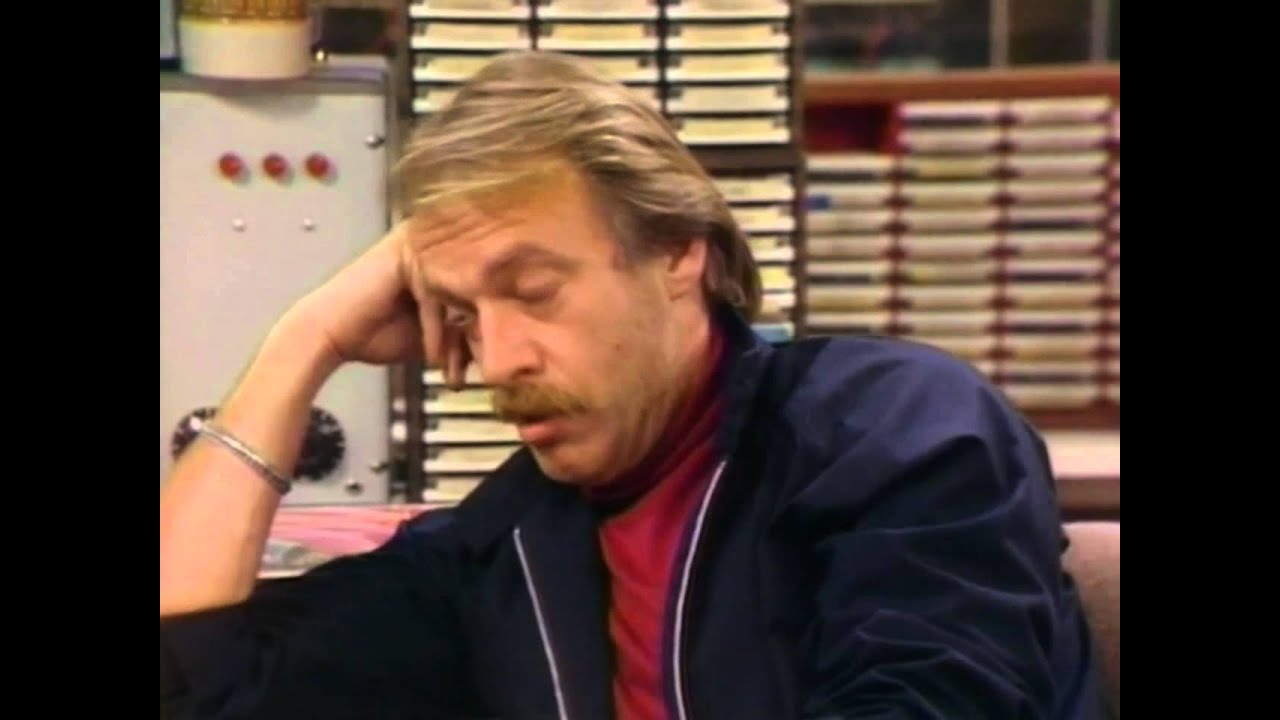
âœ‚ï¸ WKRP You’re Having Our Baby
15 seconds · Clipped by Chris Ellis · Original video "WKRP Dr. Johnny Fever Awakens From The Dead" by SindyCozzi
 youtube.com

youtube.com

And 1975 was the approximate year that PDs in Phoenix and San Diego developed call-out research in its most primitive pre-minicomputer era where pages were torn out of the phone book and high-school kids did calls to "every 5th number" and tabulation was done by hand.It also ignores that, from 1974 on, singles sales were in freefall while album sales were building to historic levels. And that, from roughly 1977 on, record-buying audiences were increasingly listening to stations that weren't singles-focused and those that were increasingly played the album versions of hits, because that's what people were buying.
If you think of it, when we hum a song (but not when we play our magnificent Air Guitar) we are often doing a Shulke version in our mind. A lot of those rock or rock-ish songs have a strong hook and a good melody line and made surprisingly good Beautiful Music tunes.Oh. Dear. God.
A classic. But my all-time cringe moment is a real record. Played in the final hour of beautiful music on KFOG, San Francisco, before they went rock.âœ‚ï¸ WKRP You’re Having Our Baby
15 seconds · Clipped by Chris Ellis · Original video "WKRP Dr. Johnny Fever Awakens From The Dead" by SindyCozzi
Im talking more about chr/hot ac stations.Not really. Trends in music are cyclical. There's a reason in the Top 40 years (60s/70s) the vast majority of oldies played were between three and five years old (not counting special "Golden Weekends", where they'd go back further).
Same point. A couple of years after it was a hit, current sounds have changed enough that it may or may not be compatible on-air. Most songs that disappear from the air do so within three to five years of when they first hit.Im talking more about chr/hot ac stations.
I believe we have to look at the social environment outside of radio to answer that question. We can see that the Vietnam conflict flavored Top 40 and built an environment for free-form album rock. I'm not a sociologist, other than that having been my split major in college, but I see environmental issues that made the country ripe for disco... and then set it up for a big crash five years later when to many people REO Speedwagon was the epitome of rock.The question is---and I don't have an easy answer for this---how early is too early?
Part of what dragged AOR down in the early 80s was a perception that it was stale. By 1985, there was an audience that was missing the 60s/70s music that became Classic Rock. But I'm not sure that appetite was there as early as '82, which is when KMET's fortunes began to slip.
Kinda weird how you can go from hearing a song 100 times a week to it being a recurrent for 1-2 years maybe to POOF! its gone.
Im talking more about chr/hot ac stations.
Remember, "CHR" is just a "new" term for Top 40, created by R&R after the 70's were over to differentiate their playlist from the lists in Billboard, Cash Box, Record world and the existing "Tip Sheets" of the time.Im talking more about chr/hot ac stations.
KMET DJ Jim Ladd's perspective was the suits at Metromedia micromanagement of the station did it in. His story is fascinating:Btw, it's refreshing to have a factual conversation in these forums in contrast to participants who are all about their own emotions and feelings who then get frustrated when they step into hypocrisy and dishonesty traps of their own makings, so thanks for that.
So, in Winter 1984 KMET had a 3.9 and KLOS a 3.3.
Spring 1984 KMET was 3rd 18-34 and 18-49, and #2 behind the monster KIIS men 25-34.
So I would say that late 84 early 85 was the time to transition to Classic Rock as their ratings were beginning to slip and yet they still had positive rock heritage.
KLOS had a better product in that time so KMET was getting the listeners, they were just losing tsl to 95.5 and yes 102.7 as KIIS with the height of top 40 was getting everyone.
KLSX was the nail in the coffin in 1986, maybe even 93.1 but they would have had an extremely minimal part.
Also, young males were being taken by strong chr product and then it got worse with KPWR that young males liked even more than KIIS.
I was surprised that KMET was still pretty strong into 84 too. They pretty much were the 2nd rock station to KLOS by 83, even if they won a book or two, but really up until 1985, both stations were in a good battle where they both were getting very good numbers, just KMET was no longer the dominating force that they were before 83.
Hindsight is not totally fair. KMET could've spent millions in research and that wouldn't guarantee them the ability to foresee how it would all play out. But, I think the writing was on the wall and it was a biased wish that we were always on the verge of a new rock revolution that KMET wanted to play a part in. Funny, those old tracks they didn't want to be totally defined by back then are still viable and popular today, with people who love them today who weren't even alive in 1985. LMFAO 🤣
Except that from March, 1986 on, that would have had them scrapping with the re-born KNX-FM, which didn't get much traction from that approach.KMET DJ Jim Ladd's perspective was the suits at Metromedia micromanagement of the station did it in. His story is fascinating:
https://worldradiohistory.com/BOOKSHELF-ARH/Biography/Radio-Waves-on-the-FM-Dial-Ladd-1991.pdf
IMHO, KMET could have went more "Full Spectrum" rock and leaned a bit more toward classic rock while adding alternative rock into the mix without ignoring new songs and new rock artists.
It seems like I've heard the chainsmokers and halsey song "closer" continuously in some form since it came out in 2016 (pretty good song though, IMO.)We shouldn't ignore the role that record labels have in this. The reason a CHR station is playing a current song 100 times a week is because that song's label is going for #1, and there's a push to get it there. The relationship between radio & records is a partnership. They provide the content, we provide the exposure. So when they're going for #1, our role is to help. The current situation is more complicated than it used to be because of streaming. While this is going on, as the song works its way up the chart, the radio station or its ownership or its consultant or maybe even all three are doing research on how people are reacting to that song. That research feeds the drive to get it to #1. After that goal is reached, the songs that inspired the most passion continue to research well, so those are the ones that get re-current play. And the recurrents that continue to research well, even after 5 or 6 years, go into gold. All the rest go POOF.
That means so far, it's made the cut. Maybe it'll still be getting play five years from now. Maybe not. It's going to depend on things that haven't happened yet.It seems like I've heard the chainsmokers and halsey song "closer" continuously in some form since it came out in 2016 (pretty goid song though imo.)
On some canadian stations I've streamed, hideaway by kiesza and several tegan and sara songs are in rotation still, but theres a mandate for a certain number of canadian artists there per hour.That means so far, it's made the cut. Maybe it'll still be getting play five years from now. Maybe not. It's going to depend on things that haven't happened yet.
It’s still cyclical.Im talking more about chr/hot ac stations.
A different set of circumstances in a different country that (by law) has some different hits.On some canadian stations I've streamed, hideaway by kiesza and several tegan and sara songs are in rotation still, but theres a mandate for a certain number of canadian artists there per hour.
It's a little more complicated in Canada: https://en.wikipedia.org/wiki/Canadian_contentOn some canadian stations I've streamed, hideaway by kiesza and several tegan and sara songs are in rotation still, but theres a mandate for a certain number of canadian artists there per hour.
It seems like I've heard the chainsmokers and halsey song "closer" continuously in some form since it came out in 2016 (pretty good song though, IMO.)
And some nations, even with a common language, have different hits and even different hit artists. Good example: Cliff Richard who was huge in the UK yet had minimal impact in the US.A different set of circumstances in a different country that (by law) has some different hits.


