• Get involved.
    We want your input!
    Apply for Membership and join the conversations about everything related to broadcasting.

    After we receive your registration, a moderator will review it. After your registration is approved, you will be permitted to post.
    If you use a disposable or false email address, your registration will be rejected.

    After your membership is approved, please take a minute to tell us a little bit about yourself.
    https://www.radiodiscussions.com/forums/introduce-yourself.1088/

    Thanks in advance and have fun!
    RadioDiscussions Administrators

93 KHJ Radio Aircheck

KRLA's last book above a 2.0 share was fall of 1985. It bumped along in the low-mid 1s for the rest of the 80s and rarely got whole numbers in the 90s.

As for affording the talent, the high-dollar guys bailed out---Tuna and Steele for KODJ in 1989. Humble Harve came back from Seattle around the same time and may have agreed to work for less money. He jumped to KRTH in 1991.

I can't find documentation online, but I remember hearing that in his last round at KRLA and at KIEV, Harve was actually buying the airtime and then selling ads himself in hopes of a profit or at least breaking even. It's possible other KRLA jocks had the same arrangement in that era.
Thank you- That’s fascinating. It’s tough when well known talents like Harv have to sell the ads themselves.
 
One thing I forgot to mention about the possible economics of KRLA was that it likely would have been sold in combination with KLSX (97.1) from 1985-1995 (during its Classic Rock years). It would then be up to Greater Media's management as to how much of that income they'd actually devote to a budget for KRLA.
 
Charlie Tuna got into some kind of difference of opinion with KRLA's management in those years, and he suddenly stopped appearing on the air. One morning, Charlie just wasn't there, and nobody exactly explained what happened. *Maybe* (speculating) it was a lack of finances.( If anyone is doing academic research and reading this, just ignore my opinion, which is completely irrelevant). They must have been operating on a shoestring, if the ratings were less than 1. Jim O'Neill, whom I always listened to, was brought in to sub for Charlie in the mornings, then he was made permanent when it was determined that Charlie wouldn't return to mornings. He lasted until 1993.
Being only a listener, I did not realize it back in the 90's, but that was really the last gasp for AM music radio in Los Angeles. It was a historic time, because AM would be all news, chat, or political talk forever. No going back.
 
Last edited:
Charlie Tuna got into some kind of difference of opinion with KRLA's management in those years, and he suddenly stopped appearing on the air. One morning, Charlie just wasn't there, and nobody exactly explained what happened. *Maybe* (speculating) it was a lack of finances. They must have been operating on a shoestring, if the ratings were less than 1. Jim O'Neill, whom I always listened to, was brought in to sub for Charlie in the mornings, then he was made permanent when it was determined that Charlie wouldn't return to mornings. He lasted until 1993.

A more likely explanation, borne out by items in R&R in January and March of 1990:

Tuna's contract was up at KRLA and he'd been approached by KODJ. Greater Media responded by putting Tuna "on vacation" while negotiating. CBS made the better offer, Tuna accepted it and never went back on air at KRLA. While KRLA was ratings challenged by that point, as I said, it almost certainly was sold as a combo buy with Classic Rock on KLSX. They had the money for Tuna---but CBS had more.

Taking talent off the air during salary and contract negotiation is fairly common practice in that kind of situation---happens with TV anchors, too.
 
KEZY-AM peaked with a 2.5 in the LA book in Summer 1972, and averaged a 0.9 from 1976-80. It averaged a 3.0 in the Anaheim book in the same span.
We interrupt this thread to say "Welcome" to RadioDiscussion's new ratings and research moderator, Chris Huff. Chris will be watching for ratings-based questions, and those about ratings history in particular.
 
... KHTZ, which was the direct descendant of KTNQ, but morphed away from Top 40 all too rapidly IMO.

I just looked and man, did that pay off for them. In the Winter 1982 book (Jan/Feb), KHTZ was #4 overall:

1. KABC: 5.7
2. KBIG: 4.6
3. KFWB: 4.3
4. KHTZ: 4.0
5. KMET: 3.9
6. KLOS: 3.8
7. KNX: 3.7
8. KJOI: 3.5
9. KRTH: 3.3
10. KNX-FM: 3.2

Given that they were 19th with a 2.2 in the fall '79 book (before the corporate shoves toward AC began), that result is hard to argue with. It didn't last long. KOST came right after them---but they got that 4th place ranking and four share before it could happen.
 
By December of 1977, the stations that mattered in L.A. Top 40 were KHJ, KFI, KTNQ and KIIS-FM. K-100 was floundering. All that really happened after that was attrition---KIIS-FM going disco in '78, KTNQ going Spanish in July of 1979, KHJ going Country in November of 1980. That left KFI and K-100 until KIIS's rebirth in 1982.
Sometime in the late 70's or early 80's KWVE 107.9 was MOR I believe. They did play some currents I recall. Do you have any ratings info on that station before they changed format? And at that time, who were their competitors?
 
Sometime in the late 70's or early 80's KWVE 107.9 was MOR I believe. They did play some currents I recall. Do you have any ratings info on that station before they changed format? And at that time, who were their competitors?
The stick is in San Clemente. I don’t think they ever showed up in an L.A. book. If Huff has Orange County numbers for them, perhaps he can answer.
 
The stick is in San Clemente. I don’t think they ever showed up in an L.A. book. If Huff has Orange County numbers for them, perhaps he can answer.
What was the station with the country/western format that blanketed Orange Co. in the 90's when country music was in a revival time? Craig Powers was the afternoon DJ, and the signal was strong in OC beach cities. Maybe that was KWVE, if the transmitter was in San Clemente. Or it might have been KZLA 93.9, although the list of DJ's is incomplete on the world radio history. There's a quote from their PD, who says that their ratings were fairly strong ( speaking of ratings of L.A. stations). Thank you to anyone. - D.

KZLA formats
 
The stick is in San Clemente. I don’t think they ever showed up in an L.A. book. If Huff has Orange County numbers for them, perhaps he can answer.
I don't know when the OC book was begun. I don't know when the OC was added to the Arbitron LA MSA. I don't remember when the embedded OC market was cancelled.

-> "Your Honor, please instruct the defendant to answer the question."
-> "If he doesn't know, he does not know."

(Being old is not an excuse for ignorance)
 
What was the station with the country/western format that blanketed Orange Co. in the 90's when country music was in a revival time? Craig Powers was the afternoon DJ, and the signal was strong in OC beach cities. Maybe that was KWVE, if the transmitter was in San Clemente. Or it might have been KZLA 93.9, although the list of DJ's is incomplete on the world radio history. There's a quote from their PD, who says that their ratings were fairly strong ( speaking of ratings of L.A. stations). Thank you to anyone. - D.

KZLA formats
KIKF 94.3 Garden Grove. Charlie Tuna did mornings there for awhile.
 
I don't know when the OC book was begun. I don't know when the OC was added to the Arbitron LA MSA. I don't remember when the embedded OC market was cancelled.

-> "Your Honor, please instruct the defendant to answer the question."
-> "If he doesn't know, he does not know."

(Being old is not an excuse for ignorance)

Yeah, but Huff told us…

“OC (Anaheim), which was surveyed as a separate embedded market from 1976 to 1994…”
 
Yeah, but Huff told us…

“OC (Anaheim), which was surveyed as a separate embedded market from 1976 to 1994…”
But... did Arbitron include the OC when it began to survey LA a decade before?
 
KWVE:
Didn't show up in the LA book until 1988, with a 0.3 (already Calvary by then).
In the Anaheim book, it first showed in Fall '82 with a 0.5, which remained the largest share it would ever score before going religious.

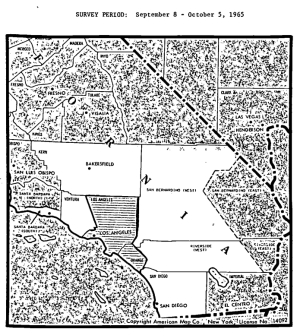
Orange County was a part of the LA metro for Arbitron from the very beginning (1965).
 

Attachments

  • Screenshot 2023-02-25 092914.png
    Screenshot 2023-02-25 092914.png
    304.7 KB · Views: 5
Status
This thread has been closed due to inactivity. You can create a new thread to discuss this topic.


Back
Top Bottom