
-
Get involved.
We want your input!
Apply for Membership and join the conversations about everything related to broadcasting.
After we receive your registration, a moderator will review it. After your registration is approved, you will be permitted to post.
If you use a disposable or false email address, your registration will be rejected.
After your membership is approved, please take a minute to tell us a little bit about yourself.
https://www.radiodiscussions.com/forums/introduce-yourself.1088/
Thanks in advance and have fun!
RadioDiscussions Administrators
You are using an out of date browser. It may not display this or other websites correctly.
You should upgrade or use an alternative browser.
You should upgrade or use an alternative browser.
Happy Birthday FM radio
- Thread starter sm01845
- Start date

From the FCC:
The first decade of FM broadcasting, starting in 1936 to 1946, occurred in the 42 - 50 MHz band. The frequency band was changed to the current 88 to 108 MHz band in 1946. FM stations operating in the old frequency band were required to move to the higher frequencies and most did so before 1948.

 www.fcc.gov
The first decade of FM broadcasting, starting in 1936 to 1946, occurred in the 42 - 50 MHz band. The frequency band was changed to the current 88 to 108 MHz band in 1946. FM stations operating in the old frequency band were required to move to the higher frequencies and most did so before 1948.
FM Radio Stations, 1936 to 1947
The first decade of FM broadcasting, starting in 1936 to 1946, occurred in the 42 - 50 MHz band. The frequency band was changed to the current 88 to 108 MHz band in 1946. FM stations operating in the old frequency band were required to move to the higher frequencies and most did so before 1948.
...but was anything actually on the air before 1941?From the FCC:
The first decade of FM broadcasting, starting in 1936 to 1946, occurred in the 42 - 50 MHz band. The frequency band was changed to the current 88 to 108 MHz band in 1946. FM stations operating in the old frequency band were required to move to the higher frequencies and most did so before 1948.
FM Radio Stations, 1936 to 1947
The first decade of FM broadcasting, starting in 1936 to 1946, occurred in the 42 - 50 MHz band. The frequency band was changed to the current 88 to 108 MHz band in 1946. FM stations operating in the old frequency band were required to move to the higher frequencies and most did so before 1948.
Yes. The link that I provided has a list of very early FM stations....but was anything actually on the air before 1941?


The original WDRC-FM became WFMQ in 1955, and then WHCN a year later.WDRC-FM in Hartford, CT used to call itself "America's first FM." An FCC query, however, reveals that "WDRC-FM's first license was granted 05-17-1960." Did WDRC-FM broadcast without a license initially?
The WDRC-FM call letters were then revived when 102.9 signed on.
The first CPs for commercial FM stations were issued on 10/31/1940. The first commercial license issued was W47NV Nashville on 3/1/1941. Stations before that date were either experimental FM stations, that later were commercially licensed, or apex (AM) stations that were gone by 1940.

1941 was an important year for both FM and TV. Commercial operation on FM became legal on March 1, followed by TV on July 1. If the war hadn't started later in the year, who knows how much faster both would have developed.
There was plenty of "experimental" operation before that, though, with everything except actual commercials. There was regularly scheduled FM programming in many cities as early as 1939 (we had two FMs here in Rochester, for instance), some of it simulcast with AM and much of it independently scheduled, including a few FMs that didn't have an AM partner at all (W47A/WBCA Albany, for instance).
There was plenty of "experimental" operation before that, though, with everything except actual commercials. There was regularly scheduled FM programming in many cities as early as 1939 (we had two FMs here in Rochester, for instance), some of it simulcast with AM and much of it independently scheduled, including a few FMs that didn't have an AM partner at all (W47A/WBCA Albany, for instance).
Thanks, Frank. I don't know about anybody else, but I learned something new today here.From the FCC:
The first decade of FM broadcasting, starting in 1936 to 1946, occurred in the 42 - 50 MHz band. The frequency band was changed to the current 88 to 108 MHz band in 1946. FM stations operating in the old frequency band were required to move to the higher frequencies and most did so before 1948.
FM Radio Stations, 1936 to 1947
The first decade of FM broadcasting, starting in 1936 to 1946, occurred in the 42 - 50 MHz band. The frequency band was changed to the current 88 to 108 MHz band in 1946. FM stations operating in the old frequency band were required to move to the higher frequencies and most did so before 1948.
Sounds right, when a station either takes the spot of an older station, or assumes the identity of a defunct station. In 2009, when Mix moved to 104.1, I heard a few broadcasts where they states that they were the station that broke U2 in America. Where technically right, as they took over the license for WBCN, Mix had nothing to do with breaking U2 in America. Fun with twisting facts. The story of WDRC-FM reminded me of that.

This link doesn't say where the 100kW limit came from.
Kirk Bayne
....but most cars just came standard AM, for quite a while.
And some cars didn't even have that!

The 50kW and 100kW power limits were enacted in the early 60s by the FCC. I don't think there was anything special about the number. They just felt they needed to have power limits and spacing rules as the band was getting more authorizations.

In Cincy...(on AM...)
>>WLW's 500,000-watt "RCA 1" transmitter was in operation between 1934 and 1939, and was the highest power ever used in the United States for public, domestic radio broadcasting. It was designed as an amplifier of the regular 50 kW transmitter.
>>WLW's 500,000-watt "RCA 1" transmitter was in operation between 1934 and 1939, and was the highest power ever used in the United States for public, domestic radio broadcasting. It was designed as an amplifier of the regular 50 kW transmitter.
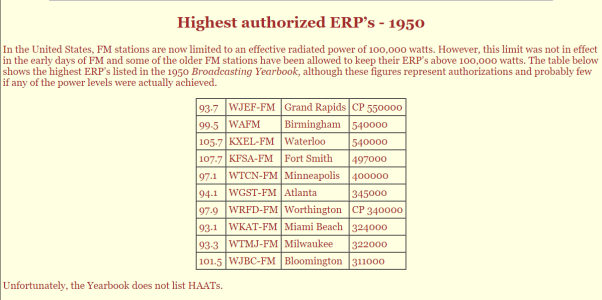
You know, there were a handful of heritage "super-powered" FM stations in the US, too. I think most eventually found the wattage a wasteful expense since line of sight carriage depends more on the antenna height, and still has its limits. Perhaps this part of my brain is coming up for another round of memories, but I believe the Grand Rapids Michigan station that put out more than 300,000 watts was called WJFM on 93.7. Until the 1980, I think. There might have been a second one in that market, too. But those signals still couldn't carry all the way to Detroit.
Might have been another one just outside Cleveland that ran way about 100kw for a time?
Look into Colonel Armstrong's lament about the future of FM radio that he's credited with starting.
Might have been another one just outside Cleveland that ran way about 100kw for a time?
Look into Colonel Armstrong's lament about the future of FM radio that he's credited with starting.
There have been reports that, during WWII, WLW actually broadcast during certain (nighttime) hours with up to 750 kw......
The station was used to send coded messages to Allied troops....
Anyone remember "Pelican"....????!
Some of this info is STILL listed as "classified" by Uncle Sam, I understand......
RE: WJFM, Grand Rapids, MI. ---- IIRC, it was once listed in Broadcasting's Annual publication as operating at 497000 watts....!!!
Whether that was actual power output or ERP.....I draw a blank!!
The station was used to send coded messages to Allied troops....
Anyone remember "Pelican"....????!
Some of this info is STILL listed as "classified" by Uncle Sam, I understand......
RE: WJFM, Grand Rapids, MI. ---- IIRC, it was once listed in Broadcasting's Annual publication as operating at 497000 watts....!!!
Whether that was actual power output or ERP.....I draw a blank!!

WJFM, I was told long ago, used a modified low-band TV transmitter to develop the near-50 kw of RF needed to get that high ERP from the antenna.RE: WJFM, Grand Rapids, MI. ---- IIRC, it was once listed in Broadcasting's Annual publication as operating at 497000 watts....!!!
Whether that was actual power output or ERP.....I draw a blank!!
- Status
- This thread has been closed due to inactivity. You can create a new thread to discuss this topic.