
-
Get involved.
We want your input!
Apply for Membership and join the conversations about everything related to broadcasting.
After we receive your registration, a moderator will review it. After your registration is approved, you will be permitted to post.
If you use a disposable or false email address, your registration will be rejected.
After your membership is approved, please take a minute to tell us a little bit about yourself.
https://www.radiodiscussions.com/forums/introduce-yourself.1088/
Thanks in advance and have fun!
RadioDiscussions Administrators
You are using an out of date browser. It may not display this or other websites correctly.
You should upgrade or use an alternative browser.
You should upgrade or use an alternative browser.
The Original KOST vs. KBIG Rivalry
- Thread starter Gregg.
- Start date


Definitely among the top ten most memorable transmitter visits I've ever had!
KOST is still among the top 5 to 10 stations in LA today (along with KBIG) though some AC stations play more newer songs than they do. KOST used to be a “soft rock” station before evolving to the pop mix they have today.
Robert Douglas
Banned
Anybody here old enough to remember 103.5 as KADS? All classified adds, all the time. Didn't last long.KOST is still among the top 5 to 10 stations in LA today (along with KBIG) though some AC stations play more newer songs than they do. KOST used to be a “soft rock” station before evolving to the pop mix they have today.

It would surprise me that a major market station used the Pepper-Tanner jingles, although anything was possible. Nearly all the Pepper-Tanner stuff was trade and mostly in smaller markets.I took a tour of 740 in 1973, and I'm pretty sure the call letters were KBIG at that time. I too recall their jingles, which I believe were from Pepper Tanner. "KBIG, radio Catalina, 26 miles across the sea."
Production music libraries were one of their big items, as well as overpriced merchandise for contests or the station owner's home.
The jingles I heard were all an "F" to PAMS' "A" grade.
Currently 5th in 25-54, and have been anywhere from 1st to 6th over the last 11 books excluding December and Holiday. As they are programmed in tandem with KBIG and KIIS, they are designed for any two of them to compensate if one station has a weak period due to music production or even market mood.KOST is still among the top 5 to 10 stations in LA today (along with KBIG) though some AC stations play more newer songs than they do.
KOST was Beautiful Music which moved to AC as Beautiful Music (never abbreviated as "BM" for obvious reasons) aged out and died. After that, it just adapted the mix based on extensive music testing.KOST used to be a “soft rock” station before evolving to the pop mix they have today.
It was one of McLendon's "ideas" along with his first all-news station for the U.S., X-tra News for Los Angeles, XETRA 690 from Baja California.Anybody here old enough to remember 103.5 as KADS? All classified adds, all the time. Didn't last long.
IIRC, the idea came about due to a newspaper strike when classifieds had no place to go.
The station didn't last long because at the time the FCC rules only permitted a certain number of minutes of advertising per hour. The stations format violated the rules and had to be discontinued.Anybody here old enough to remember 103.5 as KADS? All classified adds, all the time. Didn't last long.
They got a year out of it—-1966-67. Someone rolled tape on a few minutes in the final week:Anybody here old enough to remember 103.5 as KADS? All classified adds, all the time. Didn't last long.
Mixcloud
No, Tomas, McClendon included the plan for the format as part of his application to buy KGLA. The FCC approved it, with conditions. McClendon made the decision to discontinue a year later based on performance.The station didn't last long because at the time the FCC rules only permitted a certain number of minutes of advertising per hour. The stations format violated the rules and had to be discontinued.
Also, there is not and never was an FCC limit on commercial time. The National Association of Broadcasters' recommended maximum was 18 minutes per hour, but many stations that didn't care about NAB Code membership went over that.
In 1967, the FCC adopted the NAB Code as a "benchmark" for stations---but there was no enforcement, just a requirement that stations that exceeded 18 minutes per hour file a report on their commercial policies every six months.
Last edited:
David, all of the Plough, Inc stations—WPLO, WCAO, WMPS, WCOP, WJJD—used Pepper-Tanner jingles. That the company was headquartered in Memphis might have had something to do with it.It would surprise me that a major market station used the Pepper-Tanner jingles, although anything was possible. Nearly all the Pepper-Tanner stuff was trade and mostly in smaller markets.
Production music libraries were one of their big items, as well as overpriced merchandise for contests or the station owner's home.
The jingles I heard were all an "F" to PAMS' "A" grade.

KBIG was the first FM station to hit #1 in the LA ratings (Jan/Feb 1976).
They had a 6.5 share, which was fueled by 50+ numbers (a 14.3 share in Men 50-64 and 13.1 share in Women 50-64) - even in 1976 the format was heavy on upper demos. KJOI had a 4.6 and KOST had a 2.4 in this book... KHJ was second with a 6.0.
As an aside, Arbitron didn't start breaking out 25-54 as a separate demo until 1977, so buys before then were largely 18-49 or any other combination of "non-teen" demos.
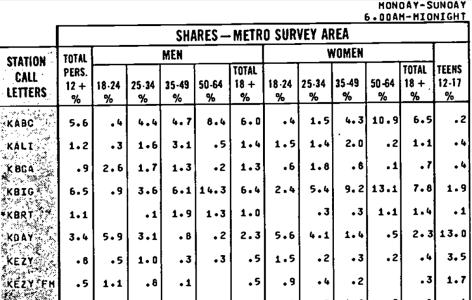
They had a 6.5 share, which was fueled by 50+ numbers (a 14.3 share in Men 50-64 and 13.1 share in Women 50-64) - even in 1976 the format was heavy on upper demos. KJOI had a 4.6 and KOST had a 2.4 in this book... KHJ was second with a 6.0.
As an aside, Arbitron didn't start breaking out 25-54 as a separate demo until 1977, so buys before then were largely 18-49 or any other combination of "non-teen" demos.
Thanks, I stand corrected ! I always thought that back then idea of the FCC or any gov't agency actually limiting ad time was a violation of the 1st Amendment. I do remember at one point after this time that certain community groups complained to the FCC that certain stations were broadcasting, in their opinion, far too much advertising along with "crappy" programming which they thought that did not serve in the community interest. The FCC then informed them that sorry "we have no authority over program content".No, Tomas, McClendon included the plan for the format as part of his application to buy KGLA. The FCC approved it, with conditions. McClendon made the decision to discontinue a year later based on performance.
Also, there is not and never was an FCC limit on commercial time. The National Association of Broadcasters' recommended maximum was 18 minutes per hour, but many stations that didn't care about NAB Code membership went over that.
In 1967, the FCC adopted the NAB Code as a "benchmark" for stations---but there was no enforcement, just a requirement that stations that exceeded 18 minutes per hour file a report on their commercial policies every six months.
Last edited:
And that got, at renewal time and "if not, why not" inquiry from the FCC.Also, there is not and never was an FCC limit on commercial time. The National Association of Broadcasters' recommended maximum was 18 minutes per hour, but many stations that didn't care about NAB Code membership went over that.
And most radio law firms in DC had a pocket full of letters of justification for running more than 18 minutes, but it was mostly in much smaller markets that this was an issue.In 1967, the FCC adopted the NAB Code as a "benchmark" for stations---but there was no enforcement, just a requirement that stations that exceeded 18 minutes per hour file a report on their commercial policies every six months.
I recall a renewal for WCCW in Traverse City, MI, in the 60's where they explained that they had to do a year's business in the 3 months of summer when the "fudgies" were in town.
I did not know that... and those were really good stations in their time.David, all of the Plough, Inc stations—WPLO, WCAO, WMPS, WCOP, WJJD—used Pepper-Tanner jingles. That the company was headquartered in Memphis might have had something to do with it.
KGBS, which was Storer, used Pepper-Tanner as well.I did not know that... and those were really good stations in their time.
pepper-tanner we know a riddle jingle - Google Search
Last edited:
That said, there were some hideous Pepper-Tanner jingles, such as this epic we had at KIBS in Bishop, California (it had been on the air for many years when I got there in 1971:
Male singers: "We know a riddle!"
Female singers: "They know a riddle!"
Male singers: "What starts with a K, ends with an S, has an I and a B in the middle?"
Female singers: "K-I-B-S?"
Male singers: "You're right!"
Should I ever develop memory issues, please, Lord, let that be the first to go...
Male singers: "We know a riddle!"
Female singers: "They know a riddle!"
Male singers: "What starts with a K, ends with an S, has an I and a B in the middle?"
Female singers: "K-I-B-S?"
Male singers: "You're right!"
Should I ever develop memory issues, please, Lord, let that be the first to go...
That looks like it might be as bad as the out of tune (amateur) singers that did the KUTY Palmdale jingles !That said, there were some hideous Pepper-Tanner jingles, such as this epic we had at KIBS in Bishop, California (it had been on the air for many years when I got there in 1971:
Male singers: "We know a riddle!"
Female singers: "They know a riddle!"
Male singers: "What starts with a K, ends with an S, has an I and a B in the middle?"
Female singers: "K-I-B-S?"
Male singers: "You're right!"
Should I ever develop memory issues, please, Lord, let that be the first to go...
WCAO in my hometown of Baltimore once used a Pepper-Tanner package with the theme “the station that’s all heart.” Even as a young kid but already interested in radio, I recall thinking the jingles had no relevance to anything else on the station.
KCBS signed off for maintenance Saturday night/Sunday mornings from 2 AM - 5 AM instead of the more traditional Sunday night downtime. It was done that way so if we ran into an unexpected problem we'd trash some of the less critical Sunday schedule instead of intruding into Monday morning drive time. After we returned to the air I'd have a leisurely breakfast at a local restaurant and then spend the rest of Sunday morning driving through the Sonoma County countryside taking the day and night pattern monitor point measurements. We'd stay on night pattern until I completed those monitor points, then I'd call the studio and have them switch to day pattern.KBIG-740 seemed to be a big player when I was a kid. I can still sing their jingles. They covered San Diego to Santa Barbara from Catalina Island. Signal was a little light in Pasadena or the SF valley, but still very viable. Around 1962 they changed from MOR to Beautiful as KGLM. My cousin lived in Avalon and got us a tour of the new studio and a ride up to the transmitter on Sunday night to watch the transmitter maintenance. It had to be done when KCBS was also on a maintenance schedule.
I was the transmitter tech for KCBS and my work schedule was Sunday-Thursday with Friday and Saturday off. I liked it because it meant I could visit the more popular Bay Area destinations on Friday and miss the weekend crowds.
During the winter months we'd wipe out KBRT at their Costa Mesa studios during the last hour or so of their broadcast day. At one point the person who bought that time on KBRT couldn't hear his program on the mainland and called our newsroom line claiming we were operating illegally, which got our news crew all upset. I had to contact KBRT's engineer and he told them to knock it off.
Last edited:
- Status
- This thread has been closed due to inactivity. You can create a new thread to discuss this topic.