• Get involved.
    We want your input!
    Apply for Membership and join the conversations about everything related to broadcasting.

    After we receive your registration, a moderator will review it. After your registration is approved, you will be permitted to post.
    If you use a disposable or false email address, your registration will be rejected.

    After your membership is approved, please take a minute to tell us a little bit about yourself.
    https://www.radiodiscussions.com/forums/introduce-yourself.1088/

    Thanks in advance and have fun!
    RadioDiscussions Administrators

Got a new digital TV antenna

For a long time, I had no reception issues with my antenna but for the past couple months for some reason, channel 13.1 (NBC), 13.3 (CBS), and 6.1 (K5 independent programming and local news) vanish even with the slightest amount of rain and I get the 'No Signal' message.

So I found the GE Outdoor Yagi HDTV antenna.

There were more expensive more powerful antennas to choose from but I didn't want to spend too much money.

I now can get all the above mentioned channels even when it rains.

One reason I picked this antenna is because it has more elements for the part of UHF where the actual radio frequency is for 13.1, 13.3, and 6.1 which is 22.

This guy does interesting TV antenna reviews and in this one, he shows and compares the signals that the TV registers on this antenna to a couple other TV antennas that are supposed to be better.


Here it is at the top of my room.
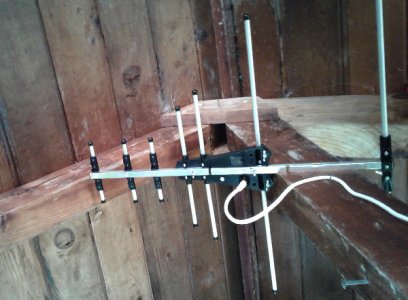
antenna.jpg

I like the shape of it too because it looks like an old time analog TV antenna.
 
For a long time, I had no reception issues with my antenna but for the past couple months for some reason, channel 13.1 (NBC), 13.3 (CBS), and 6.1 (K5 independent programming and local news) vanish even with the slightest amount of rain and I get the 'No Signal' message.

So I found the GE Outdoor Yagi HDTV antenna.

There were more expensive more powerful antennas to choose from but I didn't want to spend too much money.

I now can get all the above mentioned channels even when it rains.

One reason I picked this antenna is because it has more elements for the part of UHF where the actual radio frequency is for 13.1, 13.3, and 6.1 which is 22.

This guy does interesting TV antenna reviews and in this one, he shows and compares the signals that the TV registers on this antenna to a couple other TV antennas that are supposed to be better.


Here it is at the top of my room.

View attachment 5151

I like the shape of it too because it looks like an old time analog TV antenna.

Ah so you're on the island of Hawaii... okay.

So you're talking about KSIX 13.1 (NBC), 13.3 (CBS), and KFVE 6.1 (Ind / K5)?
 
I don't recall the actual call letters used for the transmitters used here but it is KHNL 13.1, KGMB 13.3, and K5 6.1 broadcasting from Hilo about 12 miles away.

They also broadcast from a different location much lower in elevation than our ABC channel 4 and their sub channels and Fox 11 and their sub channels.
 
For a long time, I had no reception issues with my antenna but for the past couple months for some reason, channel 13.1 (NBC), 13.3 (CBS), and 6.1 (K5 independent programming and local news) vanish even with the slightest amount of rain and I get the 'No Signal' message.

So I found the GE Outdoor Yagi HDTV antenna.

There were more expensive more powerful antennas to choose from but I didn't want to spend too much money.

I now can get all the above mentioned channels even when it rains.

One reason I picked this antenna is because it has more elements for the part of UHF where the actual radio frequency is for 13.1, 13.3, and 6.1 which is 22.

This guy does interesting TV antenna reviews and in this one, he shows and compares the signals that the TV registers on this antenna to a couple other TV antennas that are supposed to be better.


Here it is at the top of my room.

View attachment 5151

I like the shape of it too because it looks like an old time analog TV antenna.
There is no difference whatsoever between this antenna and an old Channel Master of similar construction, other than the lack of elements cut for VHF channels 2-6, where only a handful of stations exist.

Looks like this one has (L-R) three directors that favor UHF (awfully short, though), two UHF driven elements (probably cut for channels 14-25 and 25-36), one driven element for VHF channels 7-13 (possibly cut for Channel 10 since that's mid-band), and a reflector for VHF-Hi.

There's no such thing as a "digital antenna." RF is RF as far as the antenna is concerned. Digital or analog video or any other type of transmission doesn't matter. As long as the elements are cut for the desired bands/channels and you have a clear shot, it should work fairly well.

The problems with ATSC 1.0 are related to the lack of error correction in the receiver decoding firmware, and the bill of goods that stations were sold regarding transmitter output (it's way too low in many cases). Rain, thick clouds, buildings, trees with leaves blowing in the wind, aircraft between you and the transmitter (a huge problem at my house, even with single-engine planes) -- any of them will kill an ATSC 1.0 broadcast even when the signal level is good.
 
There's no such thing as a "digital antenna." RF is RF as far as the antenna is concerned. Digital or analog video or any other type of transmission doesn't matter. As long as the elements are cut for the desired bands/channels and you have a clear shot, it should work fairly well.

I know that.

I just use the term digital because that's what TVs are now.

Just knowing what actual radio frequencies the stations broadcast on is enough to know that old analog TV antennas will do just fine as long as they have elements that cover the proper frequencies and don't have to many low channel VHF elements.
 
There is no difference whatsoever between this antenna and an old Channel Master of similar construction, other than the lack of elements cut for VHF channels 2-6, where only a handful of stations exist.

It's actually made by Winegard, essentially a rebadged model YA-7000. Excellent performer.

Winegard's model YA-7000C (note the 'C' suffix) is the same antenna with additional VHF element extensions cut for reception of VHF channels 2-6.

Antennaman, who runs that YouTube channel, is a member here at RadioDiscussions.
 
I don't recall the actual call letters used for the transmitters used here but it is KHNL 13.1, KGMB 13.3, and K5 6.1 broadcasting from Hilo about 12 miles away.

They also broadcast from a different location much lower in elevation than our ABC channel 4 and their sub channels and Fox 11 and their sub channels.

It is KHBC 13.3 (KHNL), KHBC 13.3 (KGMB), and KFVE 6.1 (KHNL 13.6).
 
It's actually made by Winegard, essentially a rebadged model YA-7000. Excellent performer.

Winegard's model YA-7000C (note the 'C' suffix) is the same antenna with additional VHF element extensions cut for reception of VHF channels 2-6.

Antennaman, who runs that YouTube channel, is a member here at RadioDiscussions.

Wow, I didn't know that.

Cool!

His review of that antenna was straight forward and the impression I got is that it's a good antenna for the size and price and distance.

And I learned back in the analog days growing up in New Jersey that you would probably need a super antenna to get UHF stations from 80 miles away.

I could get the New York VHF stations easily 80 miles away though not completely clear but we also had a UHF antenna with several elements in a row in the attic for our local Philly UHF Channels which did a good job at almost completely getting rid of the 'ghosts' from the picture that were really an issue with the little round UHF antenna on the portable TV.

But we once turned the UHF antenna in the attic towards New York and we couldn't pick up any of their UHF stations.

They would only come in during tropo events.
 
These web sites might help with antenna selection and orientation:


Kirk Bayne
I kind of knew what I'd get, but I entered my location and got this:
Up to 1 channels from 1 over-the-air stations may be received at this location.

LOL. The station is an LPTV eight miles away, and the site recommends a "large directional antenna w/pre-amp" to get an acceptable signal. Hard pass on OTA TV from me!
 
I kind of knew what I'd get, but I entered my location and got this:
Up to 1 channels from 1 over-the-air stations may be received at this location.

LOL. The station is an LPTV eight miles away, and the site recommends a "large directional antenna w/pre-amp" to get an acceptable signal. Hard pass on OTA TV from me!
TVFool is erratic; slow as molasses. Sometimes it's completely dead.

I was able to put my address in there a few minutes ago and got a pretty accurate picture of what I can receive, but only with an outdoor antenna. Any station received at my location with a signal strength less than 50 dBm in their chart, when using an an indoor antenna at 25 miles from the South Mountain transmitters in Phoenix, is erratic.
 
These web sites might help with antenna selection and orientation:


Kirk Bayne
Antennaweb says I should only get 1 station, even though I normally get over 50 channels. TV Fool hasn't been updated since before the repack, so it's not accurate.
RabbitEars.Info is the best site to use as it provides signal strength and direction for all signals in your area and has Longley-Rice maps for each station that show exactly how the signal is at any location.
 
Antennaweb says I should only get 1 station, even though I normally get over 50 channels. TV Fool hasn't been updated since before the repack, so it's not accurate.
RabbitEars.Info is the best site to use as it provides signal strength and direction for all signals in your area and has Longley-Rice maps for each station that show exactly how the signal is at any location.
RabbitEars comes up with two "fair" signals for me -- the LPTV mentioned in the original post (a religious station) and a relay of the Vermont Public TV network. And they are only "fair" with an outdoor antenna, which is not possible for me due to the terms of my lease. All the other stations are "bad." My location is in east-central Vermont, in a valley with hills and mountains impeding line-of-sight reception from pretty much all directions but due north and south, and there's a pesky little mountain to the south that cuts off signals from the southwest. Unless OTA TV goes analog again, I am never going to be able to watch it without paying for it through cable or streaming again.
 
Rain, thick clouds, buildings, trees with leaves blowing in the wind, aircraft between you and the transmitter (a huge problem at my house, even with single-engine planes) -- any of them will kill an ATSC 1.0 broadcast even when the signal level is good.
Something of note too, is that "signal level" on all flat panel TV setup menu, isn't actually showing level/signal strength, but received signal quality. One can have plenty of signal in reality, but multipath caused by putting the antenna up in an attic, makes some channel reception inconsistent, or impossible. Sticking up a high gain antenna with an amp trying to get that signal strength bar longer, likely makes matters worse.
 
I agree that RabbitEars.Info is the most up to date.

Some of the others still show Hilo as having a digital channel 2 and there hasn't been a channel 2 at least since I've been here.
 
Status
This thread has been closed due to inactivity. You can create a new thread to discuss this topic.


Back
Top Bottom