• Get involved.
    We want your input!
    Apply for Membership and join the conversations about everything related to broadcasting.

    After we receive your registration, a moderator will review it. After your registration is approved, you will be permitted to post.
    If you use a disposable or false email address, your registration will be rejected.

    After your membership is approved, please take a minute to tell us a little bit about yourself.
    https://www.radiodiscussions.com/forums/introduce-yourself.1088/

    Thanks in advance and have fun!
    RadioDiscussions Administrators

DX Across The Great Lakes

During a recent FM scan, I picked up WOOD-FM 106.9 (Muskegon, MI, 50KW) nearly as strong as a local from Chicago's West Loop, around 118 miles away. It's not typically there. During the same scan, I attempted to get the two "super power" FMs from Grand Rapids (WSRW and WBCT) but came up empty (despite those frequencies being open here).

Considering the height of Chicago's FM towers, I was wondering how easily/often they are received on the Michigan shores in places like Holland and Muskegon (same for Milwaukee FMs).

Also, I know that AM propagation is excellent across salt water. But I believe that's not so much the case with fresh water? How does AM propagation across a Great Lake lake compare to land?

In addition to commenting on the above, please post any interesting cross-lake DX you've experienced.
 
I can't speak to the Michigan shoreline, but I distinctly remember hearing Chicago FM stations during the 80s in the daytime in northern Door County, Wisconsin, about 250 miles north of Chicago. I listened to WBBM-FM and remember catching several other stations. I don't remember whether I could hear Milwaukee FMs. The path likely favored Chicago stations (mostly over water) over Milwaukee stations (part land, part water). Of course, the FM dial was not as crowded then as it is today.
 
Chicago FMs and TVs used to be easily heard along the Southern Lake Michgan coastline in Michigan, until all the drop ins and upgrades came on the air. You could get them inland regularly to the points where the terrain dropped off. The higher ERP FMs and TVs came in further East, WMBI-FM, WYEN, WYCA, and WGCI, WLS-TV 7 316 kW on Marina City, and WTTW 11 316 kW from nearby, WFLD 32 from Marina City for examples. The newer facilities that moved to Sears/Willis, and Hancock/Whatever they call it this week were a lot less ERP, and faded soon beyond the inland hills.

IBOC blocks out a lot of first adjacents now, like WJFM/WBCT 93.7, and the previous WOOD-FM/WSRW 105.7, near Chicago and the Western shoreline nearby. So that's probably why you can't hear them. A good Panasonic portable from circa 1980 would pull those in in the first suburban ring on a regular basis before IBOC.
 
Last edited:
You must be close to Sheboygan, WI. When I told someone that WIND 560 came in stronger than the Clear Channels South of there, they doubted me. Newer unofficial maps show the conductivity as close to 15 over Lake Michigan vs. 8. on M-3, and the WIND signal path is largely over Lake Michigan.
 
I can't comment that much on Lake Michigan, but I've spent some time on the Lake Erie shoreline, in the Vermillion and Lorain areas of Ohio, and the cross-lake stuff is generally southwest Ontario, and at least on the map Vermillion looks to be adjacent to Leamington, ONT. Indeed one of the strongest signals is the CBC French/SRC station on 103.1 in Leamington. CKSY Chatham would come in pretty well but not all the time. English Radio 2 (CBC) came in, I think from Windsor, and as I recall, CIDR on 93,9was better with some morning/evening enhancement. The only Detroit FM that stood out was WRIF. I won't be in that spot anytime soon but will be in Windsor and SW Ontario in September, maybe I'll see if I can get to the shoreline.
 
The conductivity can vary a few points up or down depending on the season and water temperature.

The Nation Bureau of Standards did a comprehensive study in 1963 and published the results.

Essentially --

Erie & Ontario 16-28 mS/m
Huron 11-18 mS/m
Superior 5-7 mS/m

Lake Michigan doesn't seem to be mentioned...

Here, in .PDF form:

NBS Study

Bill, WE7W
RADIO-TIMETRAVELLER
 
There are quite a few studies found on a google search of Conductivity of Lake Michigan. I think the ones that don't have Lake Michigan were mainly done in Canada. Here's one, but it's very confusing.


To convert uS/cm to mS/m, divide by 1000 and then multiply by 100. So divide by 10 to get the comparable units.

The place where WIND was the strongest of Chicago signals was near Cedar Grove, near where the "Peninsula" sticks out into Lake Michigan, giving nearly an all water path from the Griffith, IN site.
 
Last edited:
For Michigan inland areas conductivity, I have found that this link and measured radials on recent applications on the FCC.gov website, which is presently largely unavailable due to database revisions, are more predictive than M-3. Select a county. County names have been known for misspellings, so you may have to edit county links to correct it. Rock, gravel, sand is worst, lacustrine clay and silt is best. Lacustrine sand and gravel is in between.


I find that the surface geology features correspond well to decades of empirical observation and to the measured radial conductivities on the AM APPs.

And for AM DXer extraordinaire David Eduardo, Grand Traverse Bay shows 27.7 mS/m on the Watershed monitoring study linked in a previous post. Inland surrounding areas around the original and present WCCW 1310 site measured close to 0.1 mS/m recently.
 
Last edited:
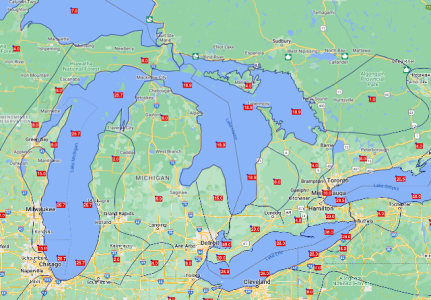
Unofficial Revised Great Lakes Conductivity. Lake Michigan shows 25.7. Thumbnail resolution only. Timetraveller may know how to find the original high resolution file.

1689371012335.png
 
Last edited:
The big Chicago AMs along with some smaller ones (560, 640, 670, 720, 780, 890, 1000, 1160, and others) can be heard nearly 24/7 along the western shoreline of Lake Michigan. In fact, there is a decent chunk of western Michigan where 620 WTMJ is the strongest AM signal.

On the FM side, Chicago is rare, especially since (a) they don't run much power due to their high HAATs and (b) many of the Chicago stations have co-channels (including several 100kW'ers) in either western or northern Michigan or northern Wisconsin. On the other hand, Milwaukee and Green Bay are common between about Montague/Whitehall and Frankfort. I've never been on the Wisconsin side to see if stations from Michigan can be heard regularly.
 
Unofficial Revised Great Lakes Conductivity. Lake Michigan shows 25.7. Thumbnail resolution only. Timetraveller may know how to find the original high resolution file.

That would be my map. It's actually an .HTML file like my pattern maps are, interactive Google Map. You can download this file and click on it any time you'd like to browse the US, Canada, and Mexican ground conductivity. Zoom in/zoom out.

The link to it is on my blog. Find the link at the upper right - US Ground Conductivity Map V2 2018:


Otherwise the direct link is here: (may change at any time though):


Bill
 
I can't comment that much on Lake Michigan, but I've spent some time on the Lake Erie shoreline, in the Vermillion and Lorain areas of Ohio, and the cross-lake stuff is generally southwest Ontario, and at least on the map Vermillion looks to be adjacent to Leamington, ONT. Indeed one of the strongest signals is the CBC French/SRC station on 103.1 in Leamington. CKSY Chatham would come in pretty well but not all the time. English Radio 2 (CBC) came in, I think from Windsor, and as I recall, CIDR on 93,9was better with some morning/evening enhancement. The only Detroit FM that stood out was WRIF. I won't be in that spot anytime soon but will be in Windsor and SW Ontario in September, maybe I'll see if I can get to the shoreline.

My in-laws live in the northeast corner of Ohio, albeit about three miles inland, and I've caught several Canadian stations in their area. I think the lake is about 70 or more miles across at their location, so those aren't short hikes. I don't remember hearing any Detroit FM stations around Conneaut.
WJR and CKLW blast into that area at all hours to the point that other than local WWOW, they might be the two strongest AM signals in town at night. WTAM phases badly up there.
I will say that driving home to Columbus yesterday, Lake Erie must have been enhancing WSCR's signal. It was coming in very well for that distance between downtown Cleveland and Madison on I-90, much better than I would expect for this time of year. But of course once the Cubs game started, I was south of downtown on 71 and the signal was much worse, aka more typical for how one might expect a Chicago station to sound around Cleveland in July.
 
My in-laws live in the northeast corner of Ohio, albeit about three miles inland, and I've caught several Canadian stations in their area. I think the lake is about 70 or more miles across at their location, so those aren't short hikes. I don't remember hearing any Detroit FM stations around Conneaut.
WJR and CKLW blast into that area at all hours to the point that other than local WWOW, they might be the two strongest AM signals in town at night. WTAM phases badly up there.
I will say that driving home to Columbus yesterday, Lake Erie must have been enhancing WSCR's signal. It was coming in very well for that distance between downtown Cleveland and Madison on I-90, much better than I would expect for this time of year. But of course once the Cubs game started, I was south of downtown on 71 and the signal was much worse, aka more typical for how one might expect a Chicago station to sound around Cleveland in July.
There is Critical Hours skywave some days, even in the Summer. It's just much later than in the Winter, beginning around 7:00 PM. I hear the 50000 watt directionals from Southeast Michigan near Pellston beginning around 3 hours before Sunset in some cases. Depending on reference efficiency, these are around 500 kW "ERP" maximum to the North. Closer to Sunset, Daytimers that actually signed off then every night, I've heard 500 watt stations with DAs favoring that direction near Frankfort, MI.
 
My in-laws live in the northeast corner of Ohio, albeit about three miles inland, and I've caught several Canadian stations in their area. I think the lake is about 70 or more miles across at their location, so those aren't short hikes. I don't remember hearing any Detroit FM stations around Conneaut.
WJR and CKLW blast into that area at all hours to the point that other than local WWOW, they might be the two strongest AM signals in town at night. WTAM phases badly up there.
I will say that driving home to Columbus yesterday, Lake Erie must have been enhancing WSCR's signal. It was coming in very well for that distance between downtown Cleveland and Madison on I-90, much better than I would expect for this time of year. But of course once the Cubs game started, I was south of downtown on 71 and the signal was much worse, aka more typical for how one might expect a Chicago station to sound around Cleveland in July.
There's a part of the Ohio turnpike where I got CHWO (now CFZM) and CHOK in Sarnia strong in the middle of the day.
 
I was getting that better reception for WSCR at about 2 p.m. yesterday. It was about as strong as it usually would be in, say, Lima. It could have been skywave, but the reception was very consistent, much more like groundwave. Zero fading.
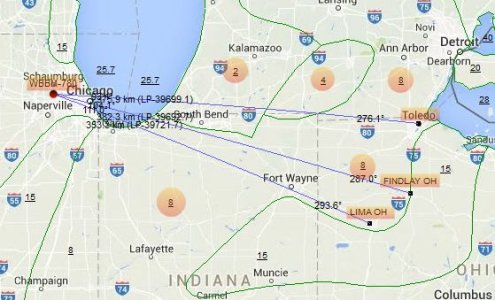
One hole in my theory is that the line between my location and Chicago would cross southwest Michigan and its poorer ground conductivity. That's why the Chicago 50Ks come in notably worse around Toledo (at least in my experience) than around Lima and Findlay.
 
I think you're on to something there schmave. I plotted WBBM out on a map and superimposed ground conductivity segments on it.

Looks like for Toledo, the signal traverses quite a bit of 2 and 4 mS/m ground, then a little bit of 8 mS/m. For Lima and Findlay, it's all 8 mS/m.

WBBM.jpg

Bill
 
From empirical observation, the Quaternary Geology, and many applications showing measured radials that are available at FCC.gov, the 2 mS/m area roughly would stretch much further to the East, and North of Clare, MI. The 15 mS/m area would hug the shores of Lake Erie, the Detroit River, Lake St. Clair, the St. Clair River, and the shores of Lake Huron around the Thumb and Saginaw Bay. Much of the higher elevation areas in the Lower Peninsula, even in parts of SE Michigan, are 2 or less. Inland around Grayling and Gaylord, many radials show 0.1 mS/m.

A WJBK/WDEE/WLQV 1500 radial measurement online shows 25 mV/m curve matching near and over the Detroit River East of the towers in Lincoln Park.

Long Island in NY shows 0.5 mS/m on the M-3 Map, but some recent radial measurements show all the data dots BELOW the 0.1 mS/m curve, the lowest on the Groundwave Graphs.

M-3 was constructed from technical Clear Channel station measured contours, and DA Proofs of Performance from early Directional Antennas that began to spring up in the 1940s. Many Proofs have occurred since that show other areas. The late Glen Clark, station engineer at WLS in the 1970s, and who designed extremely complex dogleg DAs since they allowed up to 50 kW on Regional Frequencies, said the Chicago Area was one of the few places that matched M-3 closely. That's probably from measured data from WIND, WMAQ, WGN, WBBM, WLS, WCFL, WJJD, and WGES at the time the antennas were built.
 
Excellent illustration. Thanks sir.
When I lived in Toledo 25~ years ago, it drove me nuts that I couldn't get a better signal from WGN and then-WMAQ daytime, especially as a Cubs fan so I could listen to the non-WGN day games. I figured it was all the interference in the city. This was a few years before I knew much about ground conductivity.
I do think the lake enhanced WSCR the other day. I wish I'd have tried WGN as well. Next time maybe!
 
Status
This thread has been closed due to inactivity. You can create a new thread to discuss this topic.


Back
Top Bottom