I don’t think anyone really cared about that especially listenersYeah surely they cared about call letters in the 1950s. I’m surprised they weren’t changed by the government

-
Get involved.
We want your input!
Apply for Membership and join the conversations about everything related to broadcasting.
After we receive your registration, a moderator will review it. After your registration is approved, you will be permitted to post.
If you use a disposable or false email address, your registration will be rejected.
After your membership is approved, please take a minute to tell us a little bit about yourself.
https://www.radiodiscussions.com/forums/introduce-yourself.1088/
Thanks in advance and have fun!
RadioDiscussions Administrators
You are using an out of date browser. It may not display this or other websites correctly.
You should upgrade or use an alternative browser.
You should upgrade or use an alternative browser.
KGB
- Thread starter Yabadabado1
- Start date
Call letters were the primary identifiers of the stations so I think the listeners DID care! I can't think of any stations where their nickname didn't correspond to their call letters! I'd say that it was that way until at least well into the 1970s.I don’t think anyone really cared about that especially listeners
But did the listeners in San Diego care when "KGB," the call letters of the station they'd been listening to for 30 years, began turning up in newspapers and on radio and TV news in connection with the Soviet Union? Did the FCC care? Did the FCC start getting complaints? I find all that highly unlikely.Call letters were the primary identifiers of the stations so I think the listeners DID care! I can't think of any stations where their nickname didn't correspond to their call letters! I'd say that it was that way until at least well into the 1970s.
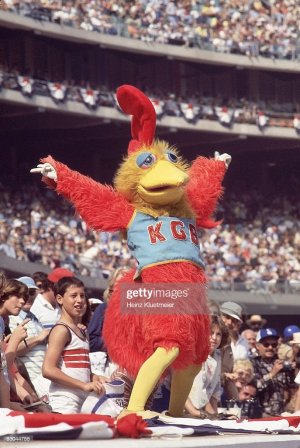
KGB's mascot, "the chicken" was well-known in SoCal in the 70's. As a young person, I loved the KGB chicken , who had one of the funniest faces I'd ever seen on a mascot. I first saw him in person at a L.A. Dodgers game. Here he is in 1977 at Dodger Stadium. 😃
Attachments

But did the listeners in San Diego care when "KGB," the call letters of the station they'd been listening to for 30 years, began turning up in newspapers and on radio and TV news in connection with the Soviet Union? Did the FCC care? Did the FCC start getting complaints? I find all that highly unlikely.
IF anyone thought of it at all, it would have been when the Soviets first used KGB for its intelligence agency---at the height of the Red Scare.
And IF it had been a big deal in 1954, San Diego, being a Navy town, would no doubt have pressured KGB's then-owner, General Tire and Rubber, a defense contractor, to change the call letters.
And that didn't happen.
My bet is, if anyone in San Diego noticed the coincidence, they probably said "We had it first."
In the early days, the KGB chicken was usually portrayed by Ted Giannoulos, who wore the chicken uniform. He used to walk up and down the aisles at San Diego Padres baseball games, as well as Clippers basketball games. When he became more famous, the name was changed to the San Diego Chicken.
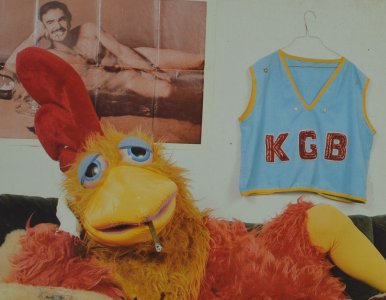
In the photo below, he is doing a spoof of a centerfold pose that actor Burt Reynolds did as sort of a joke for a women's magazine. That is why some of the early images of the chicken show him lying on his side like this.
In the photo below, he is doing a spoof of a centerfold pose that actor Burt Reynolds did as sort of a joke for a women's magazine. That is why some of the early images of the chicken show him lying on his side like this.
Attachments
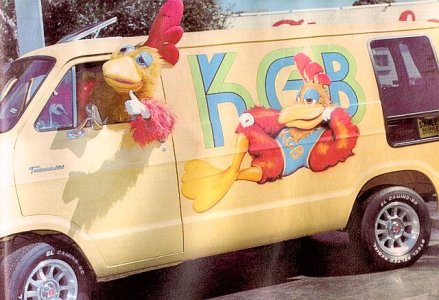
The station used the Chicken's sideways pose on the van that they drove to promotional events. As a young person, I went through a phase where I became interested in graphic art and designing mascots for radio stations. All of that was inspired by the Chicken.
Attachments
So, I went looking because of course I did and in the peak "red scare" years where San Diego's KGB and the Soviet intelligence agency KGB both existed, The Los Angeles Times referred to "the KGB". But the San Diego Tribune, from a cursory search of its archives from 1953-1957, appears to always have simply written "the Soviet intelligence agency."
Perhaps the editors pre-emptively avoiding confusion and controversy.
Perhaps the editors pre-emptively avoiding confusion and controversy.
So along with today, call letters weren’t on people’s minds then?IF anyone thought of it at all, it would have been when the Soviets first used KGB for its intelligence agency---at the height of the Red Scare.
And IF it had been a big deal in 1954, San Diego, being a Navy town, would no doubt have pressured KGB's then-owner, General Tire and Rubber, a defense contractor, to change the call letters.
And that didn't happen.
My bet is, if anyone in San Diego noticed the coincidence, they probably said "We had it first."

They were not paying any attention to the coincidental calls of a radio station and the name of a Soviet agency.So along with today, call letters weren’t on people’s minds then?
In all the material on radio history I have access to, I can not find a single negative comment about that coincidence.
Through the 50's, call letters were the main identifier of radio stations. In the 60's, they started changing to slogans, often accompanied by "phonetic" calls that became names or matched the slogan. WIBG in Philly was "wibbage" and WIXY in Cleveland was "Wixxy" and KIIS in LA was Kiss. By the 70's, while stations tried to match calls with their name, lots had moved on to strong names with only coincidental call letter matching: WZNT was Z-93. Now, stations don't even bother to change calls when changing the on-air name.
Gradually, calls became less and less important.
But in the 60's, Drake emphasized calls at stations ranging from KGB to CKLW to KFRC and KHJ. Obviously, nobody thought the name of some Soviet agency was important. I don't think the KGB because even an issue generally until all the 70's spy movies and TV series made it better known.
What David said.So along with today, call letters weren’t on people’s minds then?
I did learn something in the course of looking that stuff up that I never knew, and that was that KGB was owned by General Tire. I knew it was a Don Lee station, but somehow I thought it, like KDB in Santa Barbara, had been sold to a different buyer when General Tire, under the name General Teleradio, bought KHJ and KFRC in 1952. Nope. KGB was part of the deal.
Willet Brown, whose dad founded Hillcrest Cadillac in Beverly Hills, was General Manager under the Don Lee ownership, and stayed on when General Teleradio took over.
General spun off KGB in 1954 to a sole owner, Marion Harris. Willet Brown got a seat on the board of General Teleradio, which became RKO General with the purchase of the movie studio in 1955.
Flush with money from the sale of Cadillacs, Brown bought KGB from Marion Harris in 1961.
The part of the story I knew was that Brown wanted to turn KGB from a sleepy MOR into a competitive Top 40, and on the recommendation of his friend Gene Chenault, who owned KYNO in Fresno, hired Gene's PD, Bill Drake to consult KGB in 1964.
Under Drake, KGB beat longtime leader KCBQ and runner-up KDEO.
In early 1965, RKO was about to try yet another format to turn underdog KHJ into a winner---a high-dollar personality MOR that would put it head-to-head against KMPC. The board essentially said that if that didn't work within a year, they'd put KHJ up for sale. Brown said he would buy KHJ if RKO sold it, but suggested that RKO hire Drake as a consultant to work his magic.
And the rest is history.
If General Teleradio hadn't divested KGB, if Willet Brown had stayed there as GM and not owner, it might have worked out the same way---he would still have been friends with Gene Chenault---but Brown would have had to convince the board in 1964 to do something on their station in San Diego that there was only a track record for in Fresno. As owner of KGB, Brown was able to simply make the decision, and as an RKO General board member, Brown had input on what to do with KHJ that ultimately re-made the entire chain of stations.
Willet Brown, whose dad founded Hillcrest Cadillac in Beverly Hills, was General Manager under the Don Lee ownership, and stayed on when General Teleradio took over.
General spun off KGB in 1954 to a sole owner, Marion Harris. Willet Brown got a seat on the board of General Teleradio, which became RKO General with the purchase of the movie studio in 1955.
Flush with money from the sale of Cadillacs, Brown bought KGB from Marion Harris in 1961.
The part of the story I knew was that Brown wanted to turn KGB from a sleepy MOR into a competitive Top 40, and on the recommendation of his friend Gene Chenault, who owned KYNO in Fresno, hired Gene's PD, Bill Drake to consult KGB in 1964.
Under Drake, KGB beat longtime leader KCBQ and runner-up KDEO.
In early 1965, RKO was about to try yet another format to turn underdog KHJ into a winner---a high-dollar personality MOR that would put it head-to-head against KMPC. The board essentially said that if that didn't work within a year, they'd put KHJ up for sale. Brown said he would buy KHJ if RKO sold it, but suggested that RKO hire Drake as a consultant to work his magic.
And the rest is history.
If General Teleradio hadn't divested KGB, if Willet Brown had stayed there as GM and not owner, it might have worked out the same way---he would still have been friends with Gene Chenault---but Brown would have had to convince the board in 1964 to do something on their station in San Diego that there was only a track record for in Fresno. As owner of KGB, Brown was able to simply make the decision, and as an RKO General board member, Brown had input on what to do with KHJ that ultimately re-made the entire chain of stations.
Uh,no. There were a lot of stations that had call letters randomly assigned to them by the FCC. And others changed ownership so that the original calls no longer meant what they once did. In still other cases, people have assumed that randomly assigned call letters meant something when they did not. KFI is one famous example- a lot of people have assumed that the “FI” meant “farmers information” but it never did. KFI wasn’t the only station in Southern California which broadcast farm reports.Call letters were the primary identifiers of the stations so I think the listeners DID care! I can't think of any stations where their nickname didn't correspond to their call letters! I'd say that it was that way until at least well into the 1970s.
Uh,no. There were a lot of stations that had call letters randomly assigned to them by the FCC. And others changed ownership so that the original calls no longer meant what they once did. In still other cases, people have assumed that randomly assigned call letters meant something when they did not. KFI is one famous example- a lot of people have assumed that the “FI” meant “farmers information” but it never did. KFI wasn’t the only station in Southern California which broadcast farm reports.
In those days, people saw call letters as what they were---a means of identification. This was a generation that grew up with movies showing airplanes, ships, police, all using radio and all giving a "call sign".
It wasn't "93/KHJ"....it was "Station KHJ, Los Angeles. A Don Lee Station, operating at 930 kilocycles."
Branding came later---arguably hitting its stride in the 1950s. I'm not familiar enough to know if Todd Storz, Gordon McLendon or someone else started putting local station call letters to music (the NBC chimes date back to 1929), but I know that by 1958 and Chuck Blore, jingles and clever tie-ins to the call letters ("K-F-W-B Alert on your way to school") were an art form.
After that point, it increasingly became important for the call letters to have an image, an attribute---"KHJ plays more music" as opposed to "KHJ is the station that carries programs from the Mutual Network."
Last edited:
Please correct me if I'm wrong but I think that the format on KHJ just before Boss Radio was called "Hit Parade". I remember it sounding really hokey. It was if they were trying to create an MOR Top 40 station. It just didin't work, I remember Robert Q Lewis sounding kind of unintentially foolish on that station.I did learn something in the course of looking that stuff up that I never knew, and that was that KGB was owned by General Tire. I knew it was a Don Lee station, but somehow I thought it, like KDB in Santa Barbara, had been sold to a different buyer when General Tire, under the name General Teleradio, bought KHJ and KFRC in 1952. Nope. KGB was part of the deal.
Willet Brown, whose dad founded Hillcrest Cadillac in Beverly Hills, was General Manager under the Don Lee ownership, and stayed on when General Teleradio took over.
General spun off KGB in 1954 to a sole owner, Marion Harris. Willet Brown got a seat on the board of General Teleradio, which became RKO General with the purchase of the movie studio in 1955.
Flush with money from the sale of Cadillacs, Brown bought KGB from Marion Harris in 1961.
The part of the story I knew was that Brown wanted to turn KGB from a sleepy MOR into a competitive Top 40, and on the recommendation of his friend Gene Chenault, who owned KYNO in Fresno, hired Gene's PD, Bill Drake to consult KGB in 1964.
Under Drake, KGB beat longtime leader KCBQ and runner-up KDEO.
In early 1965, RKO was about to try yet another format to turn underdog KHJ into a winner---a high-dollar personality MOR that would put it head-to-head against KMPC. The board essentially said that if that didn't work within a year, they'd put KHJ up for sale. Brown said he would buy KHJ if RKO sold it, but suggested that RKO hire Drake as a consultant to work his magic.
And the rest is history.
If General Teleradio hadn't divested KGB, if Willet Brown had stayed there as GM and not owner, it might have worked out the same way---he would still have been friends with Gene Chenault---but Brown would have had to convince the board in 1964 to do something on their station in San Diego that there was only a track record for in Fresno. As owner of KGB, Brown was able to simply make the decision, and as an RKO General board member, Brown had input on what to do with KHJ that ultimately re-made the entire chain of stations.
And by the way, I've always thought it was cool to hear air personalities on 101.5 refer to their station as "The KGB".
You're wrong.Please correct me if I'm wrong but I think that the format on KHJ just before Boss Radio was called "Hit Parade". I remember it sounding really hokey. It was if they were trying to create an MOR Top 40 station. It just didin't work, I remember Robert Q Lewis sounding kind of unintentially foolish on that station.
After a brief attempt at Top 40 in 1963, with future KMPC star Geoff Edwards as morning man and PD, KHJ went to a blend of MOR and talk---Robert Q. Lewis, Paul Compton, Jack Wagner, Michael Jackson and, in very early 1965, Jayne Meadows and Steve Allen (Jayne got top billing).
There was no name for the format. It didn't do well, and it was not the high-dollar personality MOR format that RKO was considering. The only person in that lineup that would have carried over to the assault on KMPC would have been Paul Compton. Dan Sorkin had already been hired from WCFL in Chicago for mornings.
When Drake was tapped for KHJ, they were all gone---Sorkin's contract was honored by RKO by sending him to KFRC in San Francisco, instead (he never got on the air at KHJ)---putting him against Don Sherwood on KSFO. After less than a year, with Drake about to take over KFRC, Sorkin jumped ship to KSFO.
The placeholder format Drake used at KHJ was called "The Cavalcade of Hits" (he renamed it the "Parade of Hits" when he used it at KFRC in 1966). It was the biggest hit records from 1950 to 1964. It may have launched jockless at KHJ, but as Drake hired the future "Boss Jocks", they served as unnamed announcers for that format either before or after going into another studio and rehearsing and perfecting the upcoming "Boss" format every day for weeks.
"The Cavalcade of Hits" was intended to lead up to "The Million Dollar Battle" starting at 6:00 p.m. on Thursday, April 29, which would run from then through the weekend, with Boss Radio starting Monday morning, May 3 with Robert W. Morgan. But a disgruntled, recently fired newsman went to KFWB, told them what he knew, and on Tuesday, the 27th, Morgan heard KFWB use the term "Boss". Morgan told Ron Jacobs, who told Drake, and they decided they needed to get on the air sooner. That day at 3:00 p.m., "The Cavalcade of Hits" ended, and a "Sneak Preview" of Boss Radio ran until "The Million Dollar Battle" began Thursday at 6.
I think you may be thinking of "Hitparade", which was Drake's automated early Adult Contemporary format on KHJ-FM from 1968 through 1970.
Last edited:
And by the way, I've always thought it was cool to hear air personalities on 101.5 refer to their station as "The KGB".
That's actually something that started on the AM, with Ernesto Gladden, during the Ron Jacobs era. A few other jocks (Larry Himmel, Wizard Lew Rogers and Jesse Bullet) picked it up and started using it, not constantly, but here and there). Eventually the talent on the FM (which had been very intentional about always saying "KGB-FM" to differentiate it from the AM, started using it too, but that was years later.
Thanks for sorting this out, Both Cavacade of Hits, and Hit Parade are terms I remember from the early 60s. Guess I forgot which one I heard on 93KHJ.You're wrong.
After a brief attempt at Top 40 in 1963, with future KMPC star Geoff Edwards as morning man and PD, KHJ went to a blend of MOR and talk---Robert Q. Lewis, Paul Compton, Jack Wagner, Michael Jackson and, in very early 1965, Jayne Meadows and Steve Allen (Jayne got top billing).
There was no name for the format. It didn't do well, and it was not the high-dollar personality MOR format that RKO was considering. The only person in that lineup that would have carried over to the assault on KMPC would have been Paul Compton. Dan Sorkin had already been hired from WCFL in Chicago for mornings.
When Drake was tapped for KHJ, they were all gone---Sorkin's contract was honored by RKO by sending him to KFRC in San Francisco, instead (he never got on the air at KHJ)---putting him against Don Sherwood on KSFO. After less than a year, with Drake about to take over KFRC, Sorkin jumped ship to KSFO.
The placeholder format Drake used at KHJ was called "The Cavalcade of Hits" (he renamed it the "Parade of Hits" when he used it at KFRC in 1966). It was the biggest hit records from 1950 to 1964. It may have launched jockless at KHJ, but as Drake hired the future "Boss Jocks", they served as unnamed announcers for that format either before or after going into another studio and rehearsing and perfecting the upcoming "Boss" format every day for weeks.
"The Cavalcade of Hits" was intended to lead up to "The Million Dollar Battle" starting at 6:00 p.m. on Thursday, April 29, which would run from then through the weekend, with Boss Radio starting Monday morning, May 3 with Robert W. Morgan. But a disgruntled, recently fired newsman went to KFWB, told them what he knew, and on Tuesday, the 27th, Morgan heard KFWB use the term "Boss". Morgan told Ron Jacobs, who told Drake, and they decided they needed to get on the air sooner. That day at 3:00 p.m., "The Cavalcade of Hits" ended, and a "Sneak Preview" of Boss Radio ran until "The Million Dollar Battle" began Thursday at 6.
I think you may be thinking of "Hitparade", which was Drake's automated early Adult Contemporary format on KHJ-FM from 1968 through 1970.
I remember hearing Paul Compton years later on I think KFI. Unbelievably smooth, I always thought he should be on a Jazz station.
I'm sorry but I don't understand how what you said pertains to what I said. Call letters were the primary positioners. They were sometimes pronounceable but always used to promote the stations. There might also be a frequency tie-in to the calls but under no circumstances would WABC refer to itself as, "The Flounder"!Uh,no. There were a lot of stations that had call letters randomly assigned to them by the FCC. And others changed ownership so that the original calls no longer meant what they once did. In still other cases, people have assumed that randomly assigned call letters meant something when they did not. KFI is one famous example- a lot of people have assumed that the “FI” meant “farmers information” but it never did. KFI wasn’t the only station in Southern California which broadcast farm reports.
People back then were much smarter. If they noticed at all, they correctly identified the calls as an unrelated coincidence, nothing more.What David said.
That was one of the great things about the past. People engaged in much less tedious and ridiculous discourse.
- Status
- This thread has been closed due to inactivity. You can create a new thread to discuss this topic.