• Get involved.
    We want your input!
    Apply for Membership and join the conversations about everything related to broadcasting.

    After we receive your registration, a moderator will review it. After your registration is approved, you will be permitted to post.
    If you use a disposable or false email address, your registration will be rejected.

    After your membership is approved, please take a minute to tell us a little bit about yourself.
    https://www.radiodiscussions.com/forums/introduce-yourself.1088/

    Thanks in advance and have fun!
    RadioDiscussions Administrators

Why Does iHeart Simulcast KIIS-FM and KYSR in The High Desert?

Top 40 KIIS-FM has a full time simulcast Class A station licensed to Rosamond, 105.5 KVVS, about 50 miles away. Alternative Rock KYSR has a full time simulcast Class A station licensed to Tehachapi, 103.1 KSRY, about 60 miles away. From what I've read, the only thing these two stations do is play their own legal I.D.s at the top of the hour, which you don't hear on the main stations in Los Angeles. They don't run their own spots for Antelope Valley or High Desert advertisers. It's all Los Angeles commercials.

I know what the theory is. A sliver of Los Angeles County is part of the Antelope Valley and High Desert. Even if it gets KIIS and KYSR an extra .1 or .2 in the Los Angeles ratings, it still helps those stations look good.

About half of KVVS's signal hits Los Angeles County, although the tower is in Kern County. KSRY's tower is even further north in Kern County. Maybe a quarter of KSRY's signal falls on Los Angeles County. I don't know of any other large markets that have simulcast stations so far from the population center, hoping a handful of listeners will boost its main signal's ratings.
 
Top 40 KIIS-FM has a full time simulcast Class A station licensed to Rosamond, 105.5 KVVS, about 50 miles away. Alternative Rock KYSR has a full time simulcast Class A station licensed to Tehachapi, 103.1 KSRY, about 60 miles away. From what I've read, the only thing these two stations do is play their own legal I.D.s at the top of the hour, which you don't hear on the main stations in Los Angeles. They don't run their own spots for Antelope Valley or High Desert advertisers. It's all Los Angeles commercials.
Lancaster / Palmdale are in LA County. The Metro Survey Area includes all of Los Angeles County and all of Orange County. But the LA FM signals are not superb in the High Desert areas of LA County, so those two simulcasts add about a half million potential listeners to the coverage of those stations.

The current metro area population of Lancaster-Palmdale in 2023 is 528,000, a 2.13% increase from 2022. The metro area population of Lancaster-Palmdale in 2022 was 517,000, a 2.58% increase from 2021. The metro area population of Lancaster-Palmdale in 2021 was 504,000, a 2.65% increase from 2020.
(population lancaster palmdale california area - Google Search)

I know what the theory is. A sliver of Los Angeles County is part of the Antelope Valley and High Desert. Even if it gets KIIS and KYSR an extra .1 or .2 in the Los Angeles ratings, it still helps those stations look good.
Actually, it adds about 5% to 6% to the covered population areas of each of the stations which, with fewer competitive signals, could add 0.3 to 0.4 to the share of each.
About half of KVVS's signal hits Los Angeles County, although the tower is in Kern County. KSRY's tower is even further north in Kern County. Maybe a quarter of KSRY's signal falls on Los Angeles County. I don't know of any other large markets that have simulcast stations so far from the population center, hoping a handful of listeners will boost its main signal's ratings.
But, since radio is being bought more and more by "persons" rather than rating, this could be a significant advantage.
 
You answered your own question...

Many people in the Antelope Valley commute into Los Angeles, but the mountains block the Los Angeles signals from being heard there.
In fact, the LA light rail called Metrolink goes all the way out there. The whole area starting just east of Santa Clarita depends either on boosters or local signals for FM.

Some of the LA FMs which are shadowed in Santa Clarita have boosters, as that area is now over 300,000 persons.
 
Top 40 KIIS-FM has a full time simulcast Class A station licensed to Rosamond, 105.5 KVVS, about 50 miles away. Alternative Rock KYSR has a full time simulcast Class A station licensed to Tehachapi, 103.1 KSRY, about 60 miles away. From what I've read, the only thing these two stations do is play their own legal I.D.s at the top of the hour, which you don't hear on the main stations in Los Angeles. They don't run their own spots for Antelope Valley or High Desert advertisers. It's all Los Angeles commercials.

I know what the theory is. A sliver of Los Angeles County is part of the Antelope Valley and High Desert. Even if it gets KIIS and KYSR an extra .1 or .2 in the Los Angeles ratings, it still helps those stations look good.

About half of KVVS's signal hits Los Angeles County, although the tower is in Kern County. KSRY's tower is even further north in Kern County. Maybe a quarter of KSRY's signal falls on Los Angeles County. I don't know of any other large markets that have simulcast stations so far from the population center, hoping a handful of listeners will boost its main signal's ratings.
A few decades ago after Antelope Valley Broadcasting sold the KAVL(AM) 610 KAVS(FM) 97.7 Combo, KIIS-FM was simulcast on 97.7, while 103.1 KTPI was still the Antelope valley country station. Now KTPI country is on 97.7, KYSR is simulcast on 103.1, and of course KIIS-FM is simulcast on 105.5 KVVS, and to make things even more interesting 105.5 used to be KAVC, the Antelope Valley Christian station. And that's not all! Lancaster's 1380, now news/talk KOSS was KHJJ, that's right the legal calls were KHJJ. The station played pop music and used a pirated copy of a Boss radio jingle "93KHJ" edited with the "93" part removed. Yes, this station was pretty tacky. I asked a friend of mine who worked there how he liked it, his only answer was "Well, I like the shift". (It was mid-days), And BTW this station was 1 kW daytime and 10 Watts at night (not a typo!)
 
KIIS and KVVS listening is combined as "total line simulcasts," as are KYSR and KSRY, so all the listening for the simulcast stations is included in the primary signal's listening and cannot be broken out separately (except by special request for subscribers.)

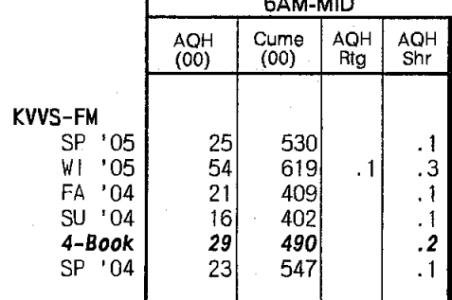
In the days before Total Line reporting, KVVS would regularly show up with a 0.1 share, which in a market as compressed as LA can make a big difference.
1693419342149.png


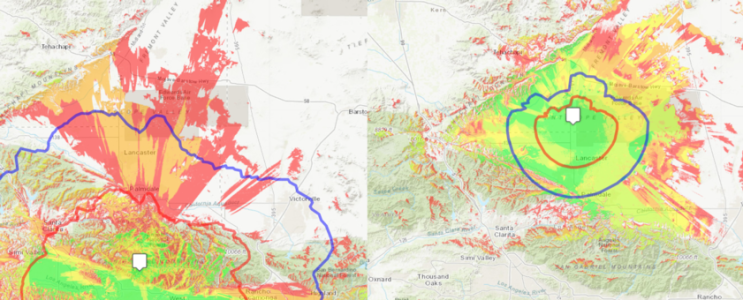
You can see how the KIIS actual coverage (left) is shadowed north of the mountains, and KVVS (right) fills in the area nicely.
1693419877098.png
 
In fact, the LA light rail called Metrolink goes all the way out there. The whole area starting just east of Santa Clarita depends either on boosters or local signals for FM.

Some of the LA FMs which are shadowed in Santa Clarita have boosters, as that area is now over 300,000 persons.
Yeah, it seemed like at one point overnight, a bunch of Mt Wilson stations put on-channel boosters on Oat Mt. over looking Santa Clarita.

In the years before 94.3 in the SFV became KBUA (Que Buena) when the station was KVFM and Later KGIL-FM, some interested broadcasters up in the Antelope Valley wanted to know what exactly the folks in Greater Santa Clarita were listening to, so they enlisted the help of a couple of car dealers in the area who would make a note of what station cars coming in for service were tuned to, the overwhelming freq was 94.3. This station whose main transmitter is in Granada Hills, had previously established a booster on Oat Mt.to serve Santa Clarita, adding at least a couple of hundred thousand potential listeners. This survey was many, many years before any LA station established their own boosters on Oat Mt.
 
KIIS and KVVS listening is combined as "total line simulcasts," as are KYSR and KSRY, so all the listening for the simulcast stations is included in the primary signal's listening and cannot be broken out separately (except by special request for subscribers.)
By bringing up Total Line Reporting, you open up a broad subject that is not understood either: the fact that Nielsen measures radio station streams.

When a stream is a pure, ads and all, simulcast, the stream and the over-the-air signals are combined. If separate stopset content is run on the stream, they are listed separately. And if the station Geozones and gives a "pure" simulcast in the Nielsen metro but a different ad content outside the metro, it can still be eligible for MSA (Metro Survey Area) Total Line Reporting.

So for those proclaiming the death of radio, this inclusion of streams by radio stations is an important complication to that mistaken conclusion.

And, deserving of a separate thread, it's worth mentioning again that commercial station translators are not listed in the ratings as Nielsen lists the originating source, an AM, FM or HD channel. So the vast majority of "HD2" and "HD3" listings are actually numbers for the translator. But since a translator can't operate on its own (except for rule 73.6969, the "Houston Exception"*), those HD ratings are usually for a translator.

A final ratings clarification for radio fans who don't work every day with the data: Nielsen does not measure cities. It measures metro areas that are almost always one or more full counties. A couple of counties are split (Riverside and San Bernardino in CA, Fairfield in CT for example) because they straddle multiple market edges or are so big various metros fit in them.

I think Chris should do ratings Q&A and brief "think pieces" as the world's foremost ratings historian and analyst! First subject: what are 12+ ratings good for and why are they given away for free?


** Tongue firmly inserted in cheek.
 
Last edited:
There's an Edwin Starr lyric that answers the first question.
We have been through this before and I guess we need to again.

Just because they are not used for direct sales, that does not mean they have no value. Many stations trumpet their #1 status to reinforce to existing listeners that they have made the "right" choice, which may lead to less futuere listener erosion. I have seen many stations do this over the years, especially KIIS-FM, KOST, and KBIG. I remember years ago Robin B. at KFI had a field day with this when KFI unexpectedly topped the chart. She publicized for all it was worth. You think it didn't mean anything to her?

But otherwise it is simply good advertising for the industry. Radio isn't what it once was, there are so many other entertainment options competing for its audience. Anything that publicizes the industry as a whole and gets people talking about it is a good thing.

This is also reflected in weekly news stories about movie grosses, which oftentimes have little to do with the actual profitability of the specific movies listed. Similarly college football polls don't "mean anything" until the final one is released at the end of the year, but they still publish weekly polls and even pre-season polls, again just to get people talking and interested in the industry as a whole, which indirectly benefits the specific industry participants.

That is why they do it, and the answer is most definitely not nothing.
 
Last edited:
We have been through this before and I guess we need to again.

Just because they are not used for direct sales, that does not mean they have no value. Many stations trumpet their #1 status to reinforce to existing listeners that they have made the "right" choice, which may lead to less futuere listener erosion. I have seen many stations do this over the years, especially KIIS-FM, KOST, and KBIG.
In the LA market, there are several sets of combined FM just in the closer central zone. KRCD/KRCV from Univision use two Class A FMs to better cover much of the population. K-Buena has three FMs, in the OC, the San Fernando Valley and the LA Basin. Entravision has had more combinations that I can recall of simulcasts of its Class A stations and the Inland Empire rimshot.

The purpose, of course, is to aggregate the audience of separate signals in Arbitron / Nielsen ratings so that the combo rates higher than separate signals would. Since agency buys are usually 3-deep or 5-deep or 10-deep (or some other quantity of total stations that are the objective of the buy), combining signals give a better chance of being inside the cutoff point for a buy.
But otherwise it is simply good advertising for the industry. Radio isn't what it once was, there are so many other entertainment options competing for its audience. Anything that publicizes the industry as a whole and gets people talking about it is a good thing.
I don't see that combining signals is a promo for the industry. Combining signals has one goal: higher reach and ratings. I managed several 3-station FM simulcasts in Puerto Rico and even one 5 station AM news simulcast, as well as the KRCD/KRCV combo in LA. They were all configured to make the ratings higher enabling getting on more buys at a higher rate.
 
Probably cause they don’t work in the desert.
What does not work in the desert?

(Please cite the post you are responding to when replying. Just use the "Reply" button and it will quote the original post)
 
In the LA market, there are several sets of combined FM just in the closer central zone. KRCD/KRCV from Univision use two Class A FMs to better cover much of the population. K-Buena has three FMs, in the OC, the San Fernando Valley and the LA Basin. Entravision has had more combinations that I can recall of simulcasts of its Class A stations and the Inland Empire rimshot.

The purpose, of course, is to aggregate the audience of separate signals in Arbitron / Nielsen ratings so that the combo rates higher than separate signals would. Since agency buys are usually 3-deep or 5-deep or 10-deep (or some other quantity of total stations that are the objective of the buy), combining signals give a better chance of being inside the cutoff point for a buy.

I don't see that combining signals is a promo for the industry. Combining signals has one goal: higher reach and ratings. I managed several 3-station FM simulcasts in Puerto Rico and even one 5 station AM news simulcast, as well as the KRCD/KRCV combo in LA. They were all configured to make the ratings higher enabling getting on more buys at a higher rate.
David , please read the thread more carefully. You are making points about something I was not posting about.

I properly included johndavis' quote in my response.
 
David , please read the thread more carefully. You are making points about something I was not posting about.

I'm sorry, but the post reads the in the manner in which I responded: the value of having more than one simulcast signal in a market.
I properly included johndavis' quote in my response.

And I have no idea what the preceding post means. The reference is meaningless to me.
 
I'm sorry, but the post reads the in the manner in which I responded: the value of having more than one simulcast signal in a market.


And I have no idea what the preceding post means. The reference is meaningless to me.
Sorry, David, you still need to read the thread more carefully again - John responded to your own post that read: First subject: what are 12+ ratings good for and why are they given away for free?

John responded with the witty comment: There's an Edwin Starr lyric that answers the first question.

The lyric John is referring to is "ABSOLUTELY NOTHING" from his hit song "War", and I included his post in my reply and proceeded to describe why 12+ numbers are not worth nothing, they are worth something, and gave several examples. You responded with some information about Neilson combing rating lines for small stations.
 
Alright. I tried searching every way I could to figure this out. What's the "Houston Exception"?
(I think this is gonna be good)

Dave B.
Houston is full of translator with no originating station and translators with higher power, the "wrong" antenna and even the wrong transmitter location.
 
Sorry, David, you still need to read the thread more carefully again - John responded to your own post that read: First subject: what are 12+ ratings good for and why are they given away for free?

John responded with the witty comment: There's an Edwin Starr lyric that answers the first question.

The lyric John is referring to is "ABSOLUTELY NOTHING" from his hit song "War", and I included his post in my reply and proceeded to describe why 12+ numbers are not worth nothing, they are worth something, and gave several examples. You responded with some information about Neilson combing rating lines for small stations.
And, like many people in this country, I have no idea what that song is about. So there is no way I could capture the reference, so I ignored it.

Then, I assumed that the text of the message had to do with "what are 12+ ratings good for?" and responded.
 
Top 40 KIIS-FM has a full time simulcast Class A station licensed to Rosamond, 105.5 KVVS, about 50 miles away. Alternative Rock KYSR has a full time simulcast Class A station licensed to Tehachapi, 103.1 KSRY, about 60 miles away.
Another advantage of these two simulcast signals: since they're licensed to cities in Kern County, they don't count towards IHeart's ownership caps in the L.A. market.
 
Status
This thread has been closed due to inactivity. You can create a new thread to discuss this topic.


Back
Top Bottom