• Get involved.
    We want your input!
    Apply for Membership and join the conversations about everything related to broadcasting.

    After we receive your registration, a moderator will review it. After your registration is approved, you will be permitted to post.
    If you use a disposable or false email address, your registration will be rejected.

    After your membership is approved, please take a minute to tell us a little bit about yourself.
    https://www.radiodiscussions.com/forums/introduce-yourself.1088/

    Thanks in advance and have fun!
    RadioDiscussions Administrators

KFXR with 12 night towers and 4 day towers

KFXR has two transmitter sites. The day site has a four tower array and the night site has a 12 tower array. How can an AM station that does not even show up in the ratings be profitable while maintaining such an expensive plant(s)?

I am going to make an assumption that the 12 tower array is finicky and needs a lot of TLC. Or, they don't care and just let it go. A lot of AM stations are doing that nowadays as the FCC does not seem to care much about enforcing minor issues on the AM band.

I know this is out of the blue, but I came across KFXR on radio-locator.com today and was just surprised.
 
A quick look at the nighttime site shows a huge piece of land surrounded by half million dollar houses. That land it is probably worth many multiples more than the station is.

And 12 towers has to be the record for an AM station, right?
 
The 12 tower night array goes back to 1970 and the KLIF glory days. Still seems to be in tolerance; many of the northern areas of the DFW urban sprawl have no night signal on 1190, due to the null towards KEX.

The old joke was that the 1190 night array was so directional that, if you were listening to it on Elm Street in downtown Dallas, you would lose the signal if you drove up on the sidewalk. Night reception of 1190 in Tarrant County is no better than the skywave coming in from WOAI 10 kHz up.

Day signal from the four tower site in the middle of the Metroplex is quite solid.
 
In all likelihood the two tower sites for 11~Ninety are owned by someone else and leased to I Heart. Makes things a little more complicated when it comes to selling the land. McLendon wanted KLIF to reach Ft Worth at nite, thus the elaborate array to protect co and adjacent frequencies. While he went west with the signal, growth on the Dallas side went north...and the Mighty 11~Ninety just wasn't there at night.
 
In all likelihood the two tower sites for 11~Ninety are owned by someone else and leased to I Heart. Makes things a little more complicated when it comes to selling the land. McLendon wanted KLIF to reach Ft Worth at nite, thus the elaborate array to protect co and adjacent frequencies. While he went west with the signal, growth on the Dallas side went north...and the Mighty 11~Ninety just wasn't there at night.
In the mid-90s if you drove north on 75 you had a good signal until State Hwy 121. When you went under that overpass the signal just disappeared.
 
Given what you guys have said about the land values in the area for the night site, I would say 1190's 12 tower site is probably not long for this world.

I have searched and cannot find another pattern in the USA with more than 12 towers. I thought years ago there was talk about a 16 tower array somewhere up north. But I cannot find it or references to an old station with that many towers.
 
WISN and WLQV have 9 and their patterns are just about as tight as KFXR's in some respects

I heard a joke years ago that KFXR's pattern was so tight, that on some particular street, it would go down the middle of the street and not touch either side.

I once visited KHMO, 1070 with 10kw/3 towers day and 1 kw/6 towers night.. and on the back of the pattern, you could see the tower lights, be like a mile by air and drive into and out of a null in like 10 seconds.....the engineer who maintained the site took me to see it and purposely drove that way to the site to show me the null at work
 
  • Like
Reactions: HTX
Given what you guys have said about the land values in the area for the night site, I would say 1190's 12 tower site is probably not long for this world.

I have searched and cannot find another pattern in the USA with more than 12 towers. I thought years ago there was talk about a 16 tower array somewhere up north. But I cannot find it or references to an old station with that many towers.
My recollection was that it was Toledo Ohio but it was never built.
 
I once visited KHMO, 1070 with 10kw/3 towers day and 1 kw/6 towers night.. and on the back of the pattern, you could see the tower lights, be like a mile by air and drive into and out of a null in like 10 seconds.....the engineer who maintained the site took me to see it and purposely drove that way to the site to show me the null at work
Yes, it's quite an array...minor point...5 kw daytime.

Jerrell Shepherd, a legend in Missouri broadcasting, came up with that one. Later he made Moberly his base of operations and made piles of money with a very local-intensive approach to programming.
 
From the legendary Steve Eberhart's (unfortunately defunct) KLIF tribute site:

"McLendon and KLIF had been attempting to upgrade the nighttime pattern for some time. The daytime pattern was excellent, but the nighttime pattern at the time was limited with only 1000 watts on a directional tower located on Scyene Road between Fair Park and Pleasant Grove (southeast of downtown).

In 1970, after extensive engineering studies, the FCC finally approved a new nighttime pattern with an upgrade to 5000 watts. The transmitter was installed in Rockwall, TX, some 30 miles northeast of downtown Dallas.

KLIF's nighttime tower arrangement is one of the more unique in the country. To protect other stations on the 1190 frequency, most notably WOWO in Fort Wayne, IN, KLIF had to install a twelve tower directional system. The array is 1/2 mile long with two rows of towers 200 feet apart.

At the time, the FCC required meter readings every 30 minutes. There was no way to read all tower meters within the allotted time, so the station built a road between the towers with a turnaround on each end. A Jeep was purchased for engineers to drive from tower to tower to read the meters.

From the air, the tower arrangement resembles a landing strip. If fact, a plane actually tried to land there once thinking it was an airfield be fore realizing the error at the last minute and pulling up! Huge X's were painted on the paved strip between the towers, so that no future pilot would be mistaken.

KLIF's daytime coverage area was HUGE! This was not a station that just reached Dallas by any means. The daytime pattern was with the maximum allowable 50,000 watts. It featured a directional array with four towers located in south Irving. The pattern beamed north to up I-35 to Sulpher, Oklahoma; east to Longview; west to almost Abilene; and the south contour reached almost to Waco. KLIF had a city-grade signal over the entire north central Texas and southern Oklahoma map.

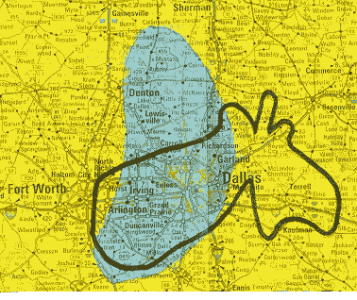
The nighttime pattern with 5000 watts was very narrow, appearing like a Zeppelin with a fish tails. The larger part aimed directly at and covered the city of Dallas and extended through the mid-cities of Grand Prarie, Irving, Arlington, and on to Fort Worth. The smaller "fishtails" reached Plano to the North, and the communities of Oak Cliff, Duncanville, and Lancaster to the South. To the east it reached the town of Terrel, but left much of its previously covered night pattern to the north to McKinney, Lewisville and Denton out of coverage. Not unlike many stations attempting to upgrade coverage areas, KLIF made a critical mistake with their new nighttime pattern. In the years since 1970, the population growth areas in the Dallas Fort Worth area have been to the north through Plano to McKinney and the corridor from Carrolton to Lewisville to Denton. All of that area had been covered with a city-grade signal in the previous 1000 watt pattern. No one could have predicted the growth to these areas which at the time were basically small farming communities. The 1000 watt pattern did not give coverage to Fort Worth prior to 1970 and McLendon wanted to blanket Dallas AND Fort Worth first and and had no reason to believe the population growth would be outside of the major cities of Dallas and Fort Worth. It was a gamble that in retrospect was successful in one way (achieving coverage in Fort Worth), but an error in another (not covering areas to the north which experienced growth in the coming years after 1970).

KLIF promos were immediately put on the air, "KLIF now with five times the nighttime power. If you live in Plano, Arlington, or Fort Worth, now you can get with KLIF night and day. KLIF, number one in Dallas...now number one in other cities!"

KLIF coverage map showing the two different nighttime patterns for KLIF's signal. The blue area is the original 1000 watt night pattern prior to 1970. The area within the black line is the 5000 watt pattern put on the air in 1970:

1699848610332.png
 
KNTH down in Houston uses 11 towers at night.
Actually KNTH uses 11 towers during the day. Nine 196 degree sticks in a 3x3 arrangement, plus two 90 degree sticks interspersed to provide minor fill-in. 10kw daytime power.

At night only the nine 196 degree sticks are used at 5kw.

Both patterns throw a huge amount of ERP to the SSE, and very little in other directions. There is a very deep null at all times towards KOPY in Alice, Texas.

KNTH has a huge amount of “steel in the air”. Amazing to look at, but also bizarre and archaic, given modern technology.
 
Actually KNTH uses 11 towers during the day. Nine 196 degree sticks in a 3x3 arrangement, plus two 90 degree sticks interspersed to provide minor fill-in. 10kw daytime power.

At night only the nine 196 degree sticks are used at 5kw.

Both patterns throw a huge amount of ERP to the SSE, and very little in other directions. There is a very deep null at all times towards KOPY in Alice, Texas.

KNTH has a huge amount of “steel in the air”. Amazing to look at, but also bizarre and archaic, given modern technology.
This is one of the few times that throwing all the power towards the ocean/gulf works and is not wasted. The transmitter is north of Houston.

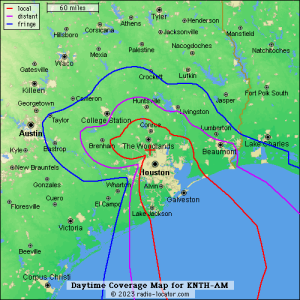
According to radio-locator.com (link below) they are 11 towers day and 9 towers night. As I said earlier in the thread, how are these AM stations even viable? The cost of land and the labor to maintain the field. Tower painting, lights, grass cutting, engineer to keep tweaking the equipment (you cannot tell me that a 12/11 tower array doesn't need significant tweaking to stay aligned) .... etc.


1699911506641.png
 
According to radio-locator.com (link below) they are 11 towers day and 9 towers night. As I said earlier in the thread, how are these AM stations even viable? The cost of land and the labor to maintain the field. Tower painting, lights, grass cutting, engineer to keep tweaking the equipment (you cannot tell me that a 12/11 tower array doesn't need significant tweaking to stay aligned) .... etc.
While the installation costs are huge, maintenance is not extremely expensive.

A greater consideration is property tax increases for the land. Painting is infrequent, as is tower lighting. Field maintenance is generally having a contractor drive a mower around the lot a few times a year.

Unless a directional system is unstable or buildings or electric transmission lines are built nearby, "tuning" the array does not happen often or ever, once licensed. Even systems that change a little between the wet season and the dry one or winter and summer just need tiny adjustments, often predictable and doable very quickly once the first year is experienced.

Again, the real cost is property tax increases as cities move towards that "distant rural land" where the station was built many decades ago.
 
This is one of the few times that throwing all the power towards the ocean/gulf works and is not wasted. The transmitter is north of Houston.

According to radio-locator.com (link below) they are 11 towers day and 9 towers night. As I said earlier in the thread, how are these AM stations even viable?
Because somebody in 1959 had an idea and thought it was worthwhile enough to stick with it until construction was completed in 1967 (it was fully licensed in 1970). So those costs have long been amortized.

In the mid-1980s, it worked well enough to carry an AM stereo signal, carrying an early classic-rock format that had low vanity numbers but sold well on the demographics. Times have changed, of course, but KNTH is probably in way better shape in terms of facility and in terms of economics than some shoehorned ex-daytimer in a distant suburb that's barely scraping by. They're at least capable of covering the market.

The more amazing thing to me is that radio-locator.com actually has accurate information in this instance.
 
In all likelihood the two tower sites for 11~Ninety are owned by someone else and leased to I Heart. Makes things a little more complicated when it comes to selling the land. McLendon wanted KLIF to reach Ft Worth at nite, thus the elaborate array to protect co and adjacent frequencies. While he went west with the signal, growth on the Dallas side went north...and the Mighty 11~Ninety just wasn't there at night.
IIRC, iHeart sold off all their towers and tower land to Vertical Bridge a year or two before they filed for Chapter 11. Unless it was sold after the fact, they own the tower site for WWRL after buying that station.
 
From the legendary Steve Eberhart's (unfortunately defunct) KLIF tribute site:

"McLendon and KLIF had been attempting to upgrade the nighttime pattern for some time. The daytime pattern was excellent, but the nighttime pattern at the time was limited with only 1000 watts on a directional tower located on Scyene Road between Fair Park and Pleasant Grove (southeast of downtown).

In 1970, after extensive engineering studies, the FCC finally approved a new nighttime pattern with an upgrade to 5000 watts. The transmitter was installed in Rockwall, TX, some 30 miles northeast of downtown Dallas.

KLIF's nighttime tower arrangement is one of the more unique in the country. To protect other stations on the 1190 frequency, most notably WOWO in Fort Wayne, IN, KLIF had to install a twelve tower directional system. The array is 1/2 mile long with two rows of towers 200 feet apart.

At the time, the FCC required meter readings every 30 minutes. There was no way to read all tower meters within the allotted time, so the station built a road between the towers with a turnaround on each end. A Jeep was purchased for engineers to drive from tower to tower to read the meters.

From the air, the tower arrangement resembles a landing strip. If fact, a plane actually tried to land there once thinking it was an airfield be fore realizing the error at the last minute and pulling up! Huge X's were painted on the paved strip between the towers, so that no future pilot would be mistaken.

KLIF's daytime coverage area was HUGE! This was not a station that just reached Dallas by any means. The daytime pattern was with the maximum allowable 50,000 watts. It featured a directional array with four towers located in south Irving. The pattern beamed north to up I-35 to Sulpher, Oklahoma; east to Longview; west to almost Abilene; and the south contour reached almost to Waco. KLIF had a city-grade signal over the entire north central Texas and southern Oklahoma map.

The nighttime pattern with 5000 watts was very narrow, appearing like a Zeppelin with a fish tails. The larger part aimed directly at and covered the city of Dallas and extended through the mid-cities of Grand Prarie, Irving, Arlington, and on to Fort Worth. The smaller "fishtails" reached Plano to the North, and the communities of Oak Cliff, Duncanville, and Lancaster to the South. To the east it reached the town of Terrel, but left much of its previously covered night pattern to the north to McKinney, Lewisville and Denton out of coverage. Not unlike many stations attempting to upgrade coverage areas, KLIF made a critical mistake with their new nighttime pattern. In the years since 1970, the population growth areas in the Dallas Fort Worth area have been to the north through Plano to McKinney and the corridor from Carrolton to Lewisville to Denton. All of that area had been covered with a city-grade signal in the previous 1000 watt pattern. No one could have predicted the growth to these areas which at the time were basically small farming communities. The 1000 watt pattern did not give coverage to Fort Worth prior to 1970 and McLendon wanted to blanket Dallas AND Fort Worth first and and had no reason to believe the population growth would be outside of the major cities of Dallas and Fort Worth. It was a gamble that in retrospect was successful in one way (achieving coverage in Fort Worth), but an error in another (not covering areas to the north which experienced growth in the coming years after 1970).

KLIF promos were immediately put on the air, "KLIF now with five times the nighttime power. If you live in Plano, Arlington, or Fort Worth, now you can get with KLIF night and day. KLIF, number one in Dallas...now number one in other cities!"

KLIF coverage map showing the two different nighttime patterns for KLIF's signal. The blue area is the original 1000 watt night pattern prior to 1970. The area within the black line is the 5000 watt pattern put on the air in 1970:

View attachment 6005

I grew up in Grand Prairie about halfway between Dallas and Ft. Worth and was 13 years old when the change was made. As long as you were not too near another station on an adjacent frequency, KLIF could easily be heard all over North, Northeast and Central Texas and over a good part of Oklahoma. On road trips, KLIF's daytime signal was reliable south to Austin and southwest easily to Brownwood and even farther. The big problem going south or southwest was bleed-over from WOAI's blowtorch signal. Of course, at night KLIF's signal just didn't exist much outside the core of Dallas and barely into eastern Ft. Worth. It was a bold move trying to gain market share away from KFJZ in Ft. Worth. Within just a few years, however, FM became the dominant place for music radio and KLIF became a much diminished legend. :(
 
I grew up in Grand Prairie about halfway between Dallas and Ft. Worth and was 13 years old when the change was made. As long as you were not too near another station on an adjacent frequency, KLIF could easily be heard all over North, Northeast and Central Texas and over a good part of Oklahoma. On road trips, KLIF's daytime signal was reliable south to Austin and southwest easily to Brownwood and even farther. The big problem going south or southwest was bleed-over from WOAI's blowtorch signal. Of course, at night KLIF's signal just didn't exist much outside the core of Dallas and barely into eastern Ft. Worth. It was a bold move trying to gain market share away from KFJZ in Ft. Worth. Within just a few years, however, FM became the dominant place for music radio and KLIF became a much diminished legend. :(
True, dat. Another factor that affected KLIF was the consolidation of the Dallas and Ft Worth Arbitron ratings. The MSA grew to double digit counties and only three AM's could provide a listenable nighttime signal. The Mighty 11~Ninety was NOT one of them.
 
KLIF made a critical mistake with their new nighttime pattern. In the years since 1970, the population growth areas in the Dallas Fort Worth area have been to the north through Plano to McKinney and the corridor from Carrolton to Lewisville to Denton. All of that area had been covered with a city-grade signal in the previous 1000 watt pattern. No one could have predicted the growth to these areas which at the time were basically small farming communities. The 1000 watt pattern did not give coverage to Fort Worth prior to 1970 and McLendon wanted to blanket Dallas AND Fort Worth first and and had no reason to believe the population growth would be outside of the major cities of Dallas and Fort Worth. It was a gamble that in retrospect was successful in one way (achieving coverage in Fort Worth), but an error in another (not covering areas to the north which experienced growth in the coming years after
There was a reason for that “mistake.” As I recall reading, the impetus for McClendon to build the site was Arbitron had combined Dallas and Ft. Worth into 1 market, making it necessary to have a decent size audience in both cities to get good ratings.
 
Correct - the Dallas and Fort Worth metros were combined effective with the Oct/Nov 1973 survey, although Arbitron would continue to produce separate Dallas and Fort Worth ratings reports for clients for the rest of the decade.
The fact that DFW had been a single market for TV since its arrival, along with the impending growth of FM made it obvious where things were headed. FMs that weren't already on Cedar Hill scrambled to move their transmitters there (eg. several stations had to move in order for Susquehanna to move 99.5 to Cedar Hill.) It was also why former KLIF morning star Irving Harrigan (aka Ron Chapman) was willing to ride things out at a bottom-dwelling FM (and sister daytimer AM) for a couple of years until the market caught up. His timing proved impeccable, as KVIL quickly capitalized on both the combination of the markets and the rise of FM.
 
Status
This thread has been closed due to inactivity. You can create a new thread to discuss this topic.


Back
Top Bottom