• Get involved.
    We want your input!
    Apply for Membership and join the conversations about everything related to broadcasting.

    After we receive your registration, a moderator will review it. After your registration is approved, you will be permitted to post.
    If you use a disposable or false email address, your registration will be rejected.

    After your membership is approved, please take a minute to tell us a little bit about yourself.
    https://www.radiodiscussions.com/forums/introduce-yourself.1088/

    Thanks in advance and have fun!
    RadioDiscussions Administrators

Where Have All The UHF Parabolics Gone?

Back in the early 70s I had a 5-foot diameter parabolic.....it worked GREAT, pulling in stations over 60 miles away with excellent signal strength!! BUT -- living in New England, this "minster' was subject to not only wind, but sometimes VERY heavy snow and ice buildup... being on the roof, I wasn't able to get to it to clean it off...IIRC, it lasted about 4 or 5 years....
This was before my town even DREAMED of cable tv......!:)
 
Oooh, this is near to my DXing heart. Some 40 years ago, I got a deal on a two-section 50-foot tilt-over tower from a local ham. Sold! Planted it in concrete behind the house, worked perfectly up and down. But you couldn't find a 7-foot Finco or the equivalent to plop atop it for anything. Some bars still had them but that was it. (If only the Internet and eBay existed then.) I settled for the biggest UHF-only antenna Radio Shack had (at least at my local store) at the time, which was all right but didn't do what a parabolic would have done. That's a bit tattered these days and I haven't had the tower up past 25 feet for maybe 15 years. Cable and satellite, y'know.
 
Last edited:
I had a Channel Master 4251 7' parabolic on a 50' tower in the late 70s. It was quite an antenna, performance wise. It was also quite a handful to install (and I worked as an antenna installer) and yes, wind loading was an issue. I took it down when I moved in '78, folded it up and stored it. I never put it up again.

The 4251 has been out of production since 2001

About 10 years ago during a garage purge, I took it out of the garage attic, cleaned it up, and put it on Craigslist. A guy from the NW Chicago suburbs (Arlington Heights rings a bell) drove up to Kenosha and bought it on the spot, for a not insignificant sum.

BTW, I just saw one side-mounted on a tower near Vernon Hills last week. Aimed at Milwaukee, and I bet he gets it.
 
I had a Channel Master 4251 7' parabolic on a 50' tower in the late 70s. It was quite an antenna, performance wise. It was also quite a handful to install (and I worked as an antenna installer) and yes, wind loading was an issue. I took it down when I moved in '78, folded it up and stored it. I never put it up again.

The 4251 has been out of production since 2001

About 10 years ago during a garage purge, I took it out of the garage attic, cleaned it up, and put it on Craigslist. A guy from the NW Chicago suburbs (Arlington Heights rings a bell) drove up to Kenosha and bought it on the spot, for a not insignificant sum.

BTW, I just saw one side-mounted on a tower near Vernon Hills last week. Aimed at Milwaukee, and I bet he gets it.
Wade Antenna in Ontario still makes several parabolics and other large antennas - but they are not cheap. Some US distributors add huge markups.

UHF Broadband Dual 8 Foot Parabolic Antenna: WADE Antenna
WADE CATV Antennas
 
I had a Channel Master 4251 7' parabolic on a 50' tower in the late 70s. It was quite an antenna, performance wise. It was also quite a handful to install (and I worked as an antenna installer) and yes, wind loading was an issue. I took it down when I moved in '78, folded it up and stored it. I never put it up again.

The 4251 has been out of production since 2001

About 10 years ago during a garage purge, I took it out of the garage attic, cleaned it up, and put it on Craigslist. A guy from the NW Chicago suburbs (Arlington Heights rings a bell) drove up to Kenosha and bought it on the spot, for a not insignificant sum.

BTW, I just saw one side-mounted on a tower near Vernon Hills last week. Aimed at Milwaukee, and I bet he gets it.
The 4251 is indeed one of the best UHF television antennas ever made. I've always wanted one, and I'm still on the lookout for an old one on a tower in someone's backyard that I can offer to remove.

Unfortunately these larger antennas are mostly a thing of the past. While DXers (Like us) view them as a thing of beauty, consumers at large regard them as bulky, obtrusive, and unnecessary. Blame the proliferation of cable TV in the 80s, DBS services in the 90s, and availability of broadband internet in the 00s. Think of the consumer antenna manufacturers that have gone by the wayside in the past 20-30 years: Finco, Antennacraft, others? The Channel Master catalog used to be huge. Now their entire product lineup could fit on a single sheet of paper. Time marches on. It's a shame 😔
 
On the tech side-

Typical and approximate gain for antennas in 470 to 890 MHz band-

Yagi: 6 to 10 dB
Parabolic: 12 to 25 dB

Generally speaking, creating higher gain antenna means larger physical size and reducing vertical elevation and/or horizontal azimuth beam width. This means a big antenna with weight and wind load to consider, and likely need for a reliable and precision rotor system to "aim" the antenna (unless desired signals are from one heading). One has to consider polarization and probability of of polarization changing over the propagation path.
 
A Radio Software developer designed and built a 16 foot dish with furring strips, chicken wire, and a small Radio Shack antenna driven element at the focal point, which he shared in response to an inquiry about the ultimate FM DX Antenna. He mounted it so that it could be rotated for both azimuth and elevation angle. He said that despite antenna theory as to parabola size vs. wavelength, it seems like theory said that it had to be 10 X lowest wavelength in diameter, it worked well down to at least 54 MHz. He said that within a short time after he started experimenting with it, he identified 35 analog Channel 2s under fairly ordinary conditions. If you look at the 1960 NAB Engineering Handbook, you'll find the statistical probability curves for Channels 2-4 Sporadic E. The gain was high enough that Sporadic E was present for a considerable percentage of the time.

Apparently at some point, a rare F2 VHF propagation opening made a TV station from England receivable in the US, so as to give a US TV Network a reporting scoop advantage. There's a big story I read about it somewhere online. It was an elaborate and time sensitive set up as I recall. Seems like it was around 1957. And this is different from the KLEE story, which turned out to be a hoax years later.

Oddly enough, while I was composing this, my wife was watching Dateline, and they had a report on the episode from KPRC-TV, which took over the vacated facilities of KLEE, and got the first report of the alleged viewing of KLEE.

 
Last edited:
I wonder if that potential 1950s F2 pickup was NBC’s attempt to pick up BBC the day of the queen’s coronation in 1953. Dave Garroway explained the attempt on “Today.” They would have used RCA’s Long Island facilities, which had famously filmed BBC from Alexandra Palace in the 1930s. The ionosphere did not cooperate on Q Day.
 
Identifying use, task and goal of an antenna system helps reach the best outcome. That is, depending on those factors, the "best" antenna system may be different. Fundamental question is exactly what are you interested in receiving? "Everything" is not an acceptable answer because it is not compatible with reality of most situations.

For UHF use, let's say you have no hope achieving line-of sight in the propagation path. Then you need gain, and reasonable height adjustment range for the incoming propagation mode. You need a big antenna, but maybe not much height.

If what you want to receive is largely coming in at low angles, you may only need enough height to clear close-in obstructions that attenuate incoming signal. If you are fortunate and live on a bluff or hill with a good slope (and a friendly domestic situation) you could build a large array slightly elevated in the back yard. If you are on a substantial hill top or mountain, you may have line-of-sight (or close to it) to several markets already.

On the other hand, if you determine height will help, you could choose a lower gain antenna, with a pre-amp and front end band pass filter, with rotor, and mount that as high as you can. Like a properly guyed heavy-duty telescoping mast, mounted on the roof or a home-made frame that elevates it a bit higher.Unless there is a zoning, neighbor, panic over safety, or domestic factor, it could be pretty rickety. Unlike an expensive, "big deal" massive dish, who cares if a modest light weight yagi comes down.

The part about height connects to transmission line loss. Consider your coax loss, since this is not an antenna, it is an antenna system. Could much less expensive up-sizing coax than antenna.

Consider the bandwidth (channel range) needed. Some time on LMS or TV Query could provide an idea of the in-core channels and frequencies you are designing for.

Consider antenna impedance. Not because of power transfer, etc. But because of the feed method and if balun or transformer is necessary. Part of this is if you want coax center conductor to be at DC ground (so to speak). If you want to go hard-core on this, might want to go to 50 ohm antenna and coax, with a transformer-balun or matching network on the ground at the receiver. And many receivers have unbalanced coax input anyway. If you want to make a network to transform unbalanced 50 ohm to unbalanced 70 ohm, this is not a big deal.

Try L-network with 35 nH across receiver input to ground, and 10 pF in series to the antenna. That is for 500 MHz
Wind a coil on a drinking glass from the kitchen, buy an RF rated silver mica capacitor (CDE) and you are done.

Consider purchasing a coax switch or use build out connectors, and disconnecting the antenna from your receiver when you are not using it. I think just disconnecting the coax is more to the point and less expensive and risky of trusting someone's surge protector.

I would enjoy spending Sunday morning thinking about this, but domestic duties await. Cats must be fed. etc.

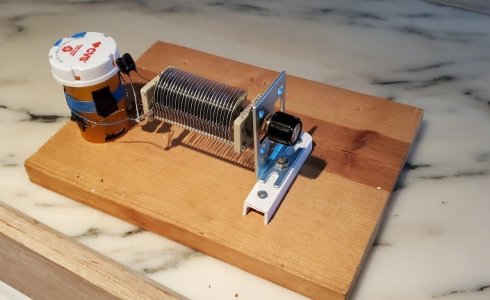
btw- here is an example of a home made network. I bought a high quality variable capacitor instead of spending money on a commercial product.
 

Attachments

  • GS.jpg
    GS.jpg
    88.7 KB · Views: 8
Last edited:
A Radio Software developer designed and built a 16 foot dish with furring strips, chicken wire, and a small Radio Shack antenna driven element at the focal point, which he shared in response to an inquiry about the ultimate FM DX Antenna. He mounted it so that it could be rotated for both azimuth and elevation angle. He said that despite antenna theory as to parabola size vs. wavelength, it seems like theory said that it had to be 10 X lowest wavelength in diameter, it worked well down to at least 54 MHz. He said that within a short time after he started experimenting with it, he identified 35 analog Channel 2s under fairly ordinary conditions. If you look at the 1960 NAB Engineering Handbook, you'll find the statistical probability curves for Channels 2-4 Sporadic E. The gain was high enough that Sporadic E was present for a considerable percentage of the time.

Apparently at some point, a rare F2 VHF propagation opening made a TV station from England receivable in the US, so as to give a US TV Network a reporting scoop advantage. There's a big story I read about it somewhere online. It was an elaborate and time sensitive set up as I recall. Seems like it was around 1957. And this is different from the KLEE story, which turned out to be a hoax years later.

Oddly enough, while I was composing this, my wife was watching Dateline, and they had a report on the episode from KPRC-TV, which took over the vacated facilities of KLEE, and got the first report of the alleged viewing of KLEE.
Reminds me of the experimenter who built a 24ft dish specifically for TV channel 68 and was able to receive KVST Los Angeles, CA and WBTB Newark, NJ from his home in western PA via EME. The article states channel 68 was chosen because there were only two known station operating on it in the early 1970s.

 
Status
This thread has been closed due to inactivity. You can create a new thread to discuss this topic.


Back
Top Bottom