• Get involved.
    We want your input!
    Apply for Membership and join the conversations about everything related to broadcasting.

    After we receive your registration, a moderator will review it. After your registration is approved, you will be permitted to post.
    If you use a disposable or false email address, your registration will be rejected.

    After your membership is approved, please take a minute to tell us a little bit about yourself.
    https://www.radiodiscussions.com/forums/introduce-yourself.1088/

    Thanks in advance and have fun!
    RadioDiscussions Administrators

Country Radio Attacked Again

Here we go again. The same two Canadian sociologists have attacked country radio again for not playing enough women.

If it sounds familiar, these are the same people who've been saying the same thing about country radio for years. They think country radio is sexist. In a way it is. Country radio tends to appeal to women. Women apparently don't want to hear other women. Country radio stands out among the formats in terms of listener loyalty at a time when radio is losing listeners to other platforms and streaming. BTW, when country listeners stream music, the data is pretty similar,

Meanwhile, country radio is coming off one of its strongest years ever, led by Morgan Wallen and Luke Combs, each of whom had songs cross over to other formats. Note that these two crossover artists are men.

What's missing is data that compares country radio to rock or alternative radio. Are those formats any more balanced? No. In fact they're worse. But no research studies about them. Just country.
 
Country radio tends to appeal to women. Women apparently don't want to hear other women.

It's exactly what I was told when I started in 1971 (no two female artists back to back) and again in 1974 when we started hiring women as talent ("never in middays---housewives don't want to hear another woman's voice.").

I thought we'd disproven and gotten past that.

Legitimate question: Is that format-specific or in general?
 
Legitimate question: Is that format-specific or in general?

Hard to say since the study only looks at country radio. The fact is that the way music is scheduled today, it's far less likely that it's a rule of some sort. The reason it was done in the 70s was there were only two women having hits, so you wanted to spread them out rather than play them together. It wasn't a negative thing, but that's how it's being presented.

My view is you can come up with whatever facts you want to prove an agenda. This study just looks at the Billboard chart. Country radio stations only play about 25% currents. The rest is recurrent and gold. Looking at Mediabase, country radio plays a lot of women who are not current. But if you only look at the Top 30, you don't see that. As I said, selective research. It gets back to the number of women currently on record labels releasing singles. Based on what I see, there are more men on country record labels than women. Radio can't play more women if they aren't signed to record labels.
 
It's exactly what I was told when I started in 1971 (no two female artists back to back) and again in 1974 when we started hiring women as talent ("never in middays---housewives don't want to hear another woman's voice.")
No housewives in my anecdotal sampling, but I worked with several young female country fans before my retirement and they were all about Luke Bryan and Thomas Rhett, not Miranda Lambert or Carrie Underwood. (This was before Carly Pearce and Lainey Wilson became big stars.)
 
Was the "no two women back to back" rule in effect when the Billboard top 5 was all-female for one week back in 1980? And note the amazing variety in those five songs, from pop to traditional.

I was referring to how you play them, not how Billboard charted them. And I never worked Country. In A/C, the rule was long gone by 1980.
 
Hard to say since the study only looks at country radio. The fact is that the way music is scheduled today, it's far less likely that it's a rule of some sort. The reason it was done in the 70s was there were only two women having hits, so you wanted to spread them out rather than play them together.

I'm not trying to argue here, BigA, but, when I was told that (1971), these women all went top ten:

  • Carole King
  • Melanie
  • Cher
  • Janis Joplin
  • The Honey Cone (all-girl group)
  • Jean Knight
  • Aretha Franklin
  • Carpenters (lead vocals were Karen)
  • Lynn Anderson
  • Joan Baez
  • Tina Turner (with Ike)
  • Barbra Streisand
  • The Bells (lead vocal was female)
  • Sammi Smith
  • Gladys Knight
  • Carly Simon
 
Was the "no two women back to back" rule in effect when the Billboard top 5 was all-female for one week back in 1980?
It was an informal behind-the-scenes music scheduling rule based on audience research at the time. I do think the rule is valid even today, but adjusted to no three female artists back-to-back.
 
I was referring to how you play them, not how Billboard charted them. And I never worked Country. In A/C, the rule was long gone by 1980.
I was referring to airplay, too. But with the five most popular country songs that week all being by women, and with country radio presumably being current-focused then, it would seem strange for a station to tell its jocks not to play the Dottie West song after the Emmylou Harris song just because both were sung by women. I was a country listener in 1980 but had no idea about radio's inner workings, so I never noticed whether the stations I was listening to were following the "rule."
 
It was an informal behind-the-scenes music scheduling rule based on audience research at the time. I do think the rule is valid even today, but adjusted to no three female artists back-to-back.
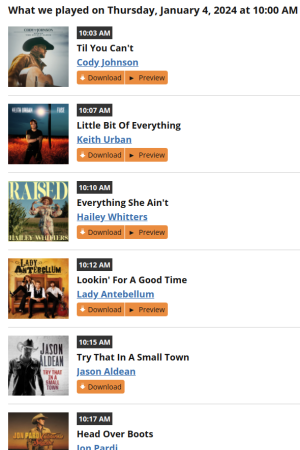
Just checked the playlist of WJEN Killington, VT, and immediately found a back-to-back (Hailey Whitters and Lady A, a group with a female singer). But no third song, emphatically.
 

Attachments

  • Screenshot 2024-01-04 at 11.13.01 AM.png
    Screenshot 2024-01-04 at 11.13.01 AM.png
    260.2 KB · Views: 2
I was referring to airplay, too. But with the five most popular country songs that week all being by women, and with country radio presumably being current-focused then, it would seem strange for a station to tell its jocks not to play the Dottie West song after the Emmylou Harris song just because both were sung by women.

You're overlooking rotations.

Assuming that the top five were all in the power rotation, there are unlikely to be back-to-back powers on the format clock. If there are seven powers and you're trying to rotate every (for example) two hours and ten minutes, you're only going to play three powers an hour.
 
I'm not trying to argue here, BigA, but, when I was told that (1971), these women all went top ten:

I was talking about country. There it was mainly Loretta Lynn and Dolly Parton, with an occasional Tammy Wynette.

I don't have my Joel Whitburn handy, but I think it will confirm that.
 
I was referring to airplay, too. But with the five most popular country songs that week all being by women, and with country radio presumably being current-focused then, it would seem strange for a station to tell its jocks not to play the Dottie West song after the Emmylou Harris song just because both were sung by women. I was a country listener in 1980 but had no idea about radio's inner workings, so I never noticed whether the stations I was listening to were following the "rule."
'The rule' was because of the assumption that female listeners tune away with too many back-to-back female artists.
 
Used to live with a Gen X woman who listened to country and she only listened to Luke Bryan, Keith Urban, etc. I never even thought about asking her why she didn't listen to female artists as much, though she did like Dolly Parton. We made quite a pair....and so did Dolly!
 
Last edited:
I was talking about country. There it was mainly Loretta Lynn and Dolly Parton, with an occasional Tammy Wynette.

I don't have my Joel Whitburn handy, but I think it will confirm that.

mmmmm.....Lynn Anderson, Sammi Smith, Donna Fargo, Barbara Fairchild, Tanya Tucker, Jeanne Pruett, Marie Osmond, Melba Montgomery, Anne Murray, Billie Jo Spears, Jessi Colter....and that's just the first half of the decade.

I mean, yeah, absolutely more male than female hit artists, but not only a couple of female hitmakers.
 
'The rule' was because of the assumption that female listeners tune away with too many back-to-back female artists.

Maybe. Here's the story that led to the controversy:


mmmmm.....Lynn Anderson, Sammi Smith, Donna Fargo, Barbara Fairchild, Tanya Tucker, Jeanne Pruett, Marie Osmond, Melba Montgomery, Anne Murray, Billie Jo Spears, Jessi Colter....

A lot of one-hit wonders in that list. Whitburn has a great table in the back of his book with the artists who dominated the decades. I just don't have my copy handy.

The study mainly talks about Lainey Wilson. But there were individual songs last year by Megan Moroney, Hailey Whitters, Carly Pearce, and Ashley McBryde. They all charted. Just didn't dominate like Lainey.
 
Back in 2006 Georgia State University published a paper addressing country music and gender roles:

However, in my view whatever trends tracked for the music industry don't directly correlate with gender listening trends for radio or streaming. It's been a long-held belief that adult females who listen to country music outwardly prefer listening to male country artists.
 
My blood pressure rises incrementally every time I encounter yet another think piece on country music, country fans, country radio. I feel like I'm living in a Petri dish.
Discussing race and gender when it relates to country music is the third rail for the music industry, but an opportunity for others looking to publically pick a fight.
 
Status
This thread has been closed due to inactivity. You can create a new thread to discuss this topic.


Back
Top Bottom