Maybe we will have robot jocks?
Or AI jocks. It's already happening on Spotify with DJ AI

Maybe we will have robot jocks?
Or AI jocks. It's already happening on Spotify with DJ AI
I’m also sure KLAC uses an AI voice for their afternoon traffic updatesIt's also happening on radio. Alpha's Live 95.5 in Portland uses an AI version of one of the company's jocks.
I'm pretty sure that WXNY uses an AI voice for EVERY traffic update.I’m also sure KLAC uses an AI voice for their afternoon traffic updates
I think finally, Louisiana will give Shreveport to Texas, its rightful birthplaceMay not be the DFW market, by 2043, with the way the Metroplex is continuously growing. Something like Waco-Sherman-Denison-Dallas-Fort Worth-Waxahachie-Greenville will be more of a real representation by then.
But unlike some other folks here, I don't believe that FM radio will be dead and abandoned in twenty years. It may be substantially altered from what it is today, but I do expect it will be around in some form.
i can see the entire market be consolidated to the "Northern Texas/Southwest Arkansas/Southern Oklahoma" market.May not be the DFW market, by 2043, with the way the Metroplex is continuously growing. Something like Waco-Sherman-Denison-Dallas-Fort Worth-Waxahachie-Greenville will be more of a real representation by then.

Doubtful. Media-defined metros for both TV and radio are set by Nielsen and use metrics that include commuting patterns. And those by-and-large follow metro definitions set forth by the US Census Bureau. Despite massive growth, the DFW Nielsen-defined radio metro has not been expanded since the late 70s.i can see the entire market be consolidated to the "Northern Texas/Southwest Arkansas/Southern Oklahoma" market.
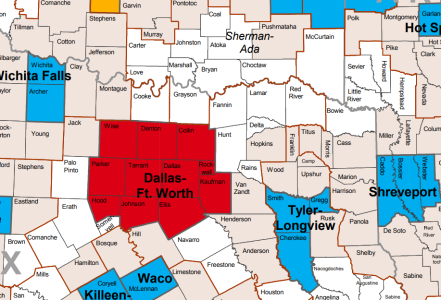
The DFW urban sprawl is continuing to explode north of the Highway 380 corridor between Denton and McKinney, so the Red River boundary isn’t hyberpole. I wonder if those northern counties including Cooke, Grayson, and perhaps Montague and Fannin will essentially become what Orange County is to the greater Los Angeles market…somewhat “their own thing” but still part of a huge demographic area.It's been said that the DFW area will quit growing north when the North Dallas suburbs hit the Red River, and I think that is likely true (although it may take more than another twenty years for that to happen).
If the trend continues towards national networks for various formats (as is the case in most other countries) simulcasts between the Cedar Hill sticks and the northern rimshots are most likely. EMF is light years ahead of everyone else in this regard.one possibility is that the stations broadcasting from Cedar Hill will start buying up the multitude of rimshots that broadcast from the northern edge of the metro area. Those stations cover well into Oklahoma, so the combined coverage would be sufficient to cover the entire metro no matter how far north is grows.

There are two different "market" standards. The Census and OMB metros are based on commerce and the concept of commercial hubs. They are called Metropolitan Statistical Areas, or MSAs.i can see the entire market be consolidated to the "Northern Texas/Southwest Arkansas/Southern Oklahoma" market.
Important to explain: TV metros are very different as they include areas where the principal cable viewing was always to stations that can only be viewed via cable. That is why you have the Salt Lake City metro with hunks of Wyoming and Montana in it and the Denver metro with bits of Wyoming and Montana as well.Doubtful. Media-defined metros for both TV and radio are set by Nielsen and use metrics that include commuting patterns. And those by-and-large follow metro definitions set forth by the US Census Bureau. Despite massive growth, the DFW Nielsen-defined radio metro has not been expanded since the late 70s.
Absolutely. The radio basis for market definitions is "majority of listening". But with OTA listening declining, we are likely to see the Census definition take precedent over the listening criteria. That would make the two market definitions easier to "match" with marketing plans by advertisers, which is what it is all about.There aren't a lot of people making daily commutes into the DFW area from Texarkana or Hugo. (Yes, I'm sure anecdotally someone can give an example of such a commute, but statistically speaking those are anomalies.)
While not every county in the US is part of a radio metro, every county does belong to a specific TV DMA, and the Tyler, OKC and Shreveport DMAs that make up much of those areas aren't going anywhere... and yes, the Sherman-Ada DMA still holds its own thanks to KXII and KTEN. What is more likely is that the media landscape is redefined and reshaped over the next 20 years in ways we can't presently imagine. There may not even be local "markets" the way we know them today.
Anyone who does not think that audio without pictures in any form is not "radio" is not listening to what consumers are doing, thinking and buying.Correct. In some form, radio will always be around. The way we are consuming it and the way it is defined, however, are evolving and will continue to do so. As an example, I don’t remember anyone considering Pandora to be radio 20 years ago. Today, most everyone sees it that way and doesn’t even slow down to think about it. Music and talk as entertainment will always have a place in the market, probably a strong one, but they may well not be places on the public airwaves.


