• Get involved.
    We want your input!
    Apply for Membership and join the conversations about everything related to broadcasting.

    After we receive your registration, a moderator will review it. After your registration is approved, you will be permitted to post.
    If you use a disposable or false email address, your registration will be rejected.

    After your membership is approved, please take a minute to tell us a little bit about yourself.
    https://www.radiodiscussions.com/forums/introduce-yourself.1088/

    Thanks in advance and have fun!
    RadioDiscussions Administrators

Stories About BUDs (Big Ugly Dishes)

I always wanted one but my parents would never have forked out the money. Plus I doubt it could've gotten any decent reception.

Anyone on on this board, care to tell me how exactly they worked. The ones I saw rotated, so I take it, it would take some time, in some cases to choose channels. I also assume you could hook more than one TV to it, but does that mean each TV watched the same satellite channel?

Any info you'd care to share would be appreciated.
 
I always wanted one but my parents would never have forked out the money. Plus I doubt it could've gotten any decent reception.

Anyone on on this board, care to tell me how exactly they worked. The ones I saw rotated, so I take it, it would take some time, in some cases to choose channels. I also assume you could hook more than one TV to it, but does that mean each TV watched the same satellite channel?

Any info you'd care to share would be appreciated.
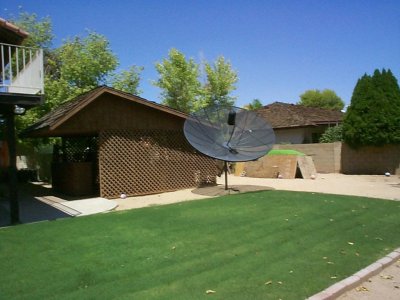
I've had several BUD's. One in Northern California and the other two here in the Phoenix area. Began with C-band then a combo C & Ku band. I think the original cost for antenna, cable and receiver was in the neighborhood of $1,700 in 1988 money. Installation for the support post was another $100 or so.

C-band was the frequency range for most commercial services and Ku for backhauls. You had to have a dedicated LNA or LNB for each range but could use the same antenna (usually 3 meters or larger in my neck of the woods). A small motor on the support post would control the sweep of the antenna (east to west) to track the satellites. C band had 24 transponders (channels) per bird and Ku 36.

The receivers of the day could store satellite positions so acted much like a modern TV remote. From an eastern to western bird sweep it took about one minute. Changing between transponders was almost immediate.

One of the big drawbacks of the BUD was that you could watch only one transponder/sat at a time (unless you had a signal splitter) but you were still limited to one specific sat. When the pizza pan sat receivers came out you could watch multiple channels on multiple TV's because they operated on one sat each.

I loved the first decade of the BUD - especially the backhauls (live sports, open news mic's etc.). Over time the satellite industry turned into the cable industry and the fun faded.
 
I remember going to a county fair in Arkansas in the late '70s and seeing an early home satellite TV unit being demonstrated. Big dish, bigger price tag. Fascinating, but not something a one-man sports department for a small-town newspaper could possibly afford. Heck, I was just getting by on my $115 a week paycheck with an $85 a month rent payment. (What was I doing at the fair? Covering the big annual tractor pull, of course!)
 
When they first came out, they were about $5,000 to $10,000...most early customers were the cable companies, so they could use a channel for HBO, and another channel for WTCG/WTBS. Or CBN, or ESPN when it first came out.
Then they became more affordable for the average Joe, in the middle 1980s. Rural viewers relied on them more than anybody else. You'll still see worn-out C-Band dishes on the prairies in MT, WY, and eastern WA even though they aren't used anymore. The days of watching a distant 10-watt VHF translator whose reception was variable day to day were over. Network feeds were clear until the early 1990s, when ABC went to Leitch scrambling, CBS went to Videocipher, and Fox also scrambled eventually. But a lot of the rural viewers subscribed to Primetime 24, which provided multiple local stations on ET/CT time; or the Denver 5. All the Denver TV stations were uplinked starting in 1987, including KWGN.

Receivers eventually had the motor that would automatically change the azimuth for another satellite, but early C-Band subscribers had to go out and rotate the dish manually!

Telstar 301, 302, 401, 402, and Westar 5, Galaxy 4, were the big "backhaul/wild feed" sats in the olden days. Galaxy 1, then Galaxy 5, had most of the cable networks (HBO, ESPN, TBS, WGN, TNT, CNN, ESPN, etc.) with others still on Satcom C4/C3. C1 was the Denver satellite. Most of those wild feeds were wide open, in the clear in those days. You could see Star Trek TNG 2-3 days before air. If you set a VCR for the middle of the night, and you were a soap junkie, the *next day's* Young and the Restless and Days of Our Lives fed back-to-back for Canadian use, often with no ads. Wheel and Jeopardy fed 2 or 3 days before air. Most syndicated shows kept the national spots in the feed, and had 1-2 minutes of 'black' that the local stations would use to fill with local spots. The talk shows used satellite as did most of the weekend shows (e.g., Siskel & Ebert's movie reviews went out to satellite before the films opened in the theatres that Friday).
Sports backhauls were common on C-Band, including (sometimes) raunchy and R-rated announcer commentary during commercial breaks.

Many C-Band junkies used Satellite TV Week or OnSat Magazine for listings and wild feed times.

There were also the Morelos satellites for Mexican TV (XEW, Azteca, etc.) and the Anik satellites for CBC North, CBMT Montreal, and CBFT Montreal ALL in the clear for years and years. Several radio stations from Canada were also uplinked and with a special receiver, you could listen to them...I think in stereo too. The satellite radio formats (Jones, Starstation, ABC, and talk shows/sports feeds) also went out by C or KU, some of which were scrambled to the public.

By the early '00s, C-Band's heyday had faded. Cable networks left analog, one by one, and the wild feeds went digital, to Digicypher, and not available to the public anymore. Even the current digital C-Band feeds are being converted to fiber and nowhere near available to the general public. I think a lot of that was due to DirecTV/Dish Network.

 
did your HOA allow them?
I don't have an HOA but do have a "neighborhood association" that regulates items of general interest. As there was no visibility from the street (house front) there was not an issue. Also, the black mesh design of the antenna blends into the landscape very peacefully.

It is my understanding that HOA's, at least in AZ, are not permitted to prevent satellite antennas.
 
Stupid question, maybe, but can you still subscribe to any of those package services (I recall something called Turnervision), or is it all just DirecTV and Dish Network these days? Are any other providers still in existence?


Wow the last time I heard of Big Dishes was when KU-band and C-Band were on their final days of Analog Television in the 2000's being sold on Skyvision. If anybody is looking at Big Ugly Dishes today for TV or Internet some of the ones I seen were dismantled in the 2000's as soon as the Analog TV shutdown took place.
 
That's actually pretty reasonable for what you get. Dumb question, maybe, how big does a C-band dish have to be? In my case, the smaller, the better, as long as quality wouldn't suffer. I have to hide it behind a fence.
It all depends upon your location (geographic (N, S, E or W), and line of sight to the satellites (they are in a parabolic line above the equator). If you have a clear southern exposure you should be ok. My antenna was 3 meters (10 feet) across but I had friends who got away with 7 footers. Depends upon your weather as well. Cloudy ski's (rain, snow etc.) need more gain, hence larger antennas.

Your best bet is to find a local sat club and ask those people what works best in your area. They also might be able to turn you on to someone who is taking their equipment down.

As a hobby it was a lot of fun. I would not want to depend upon it for scheduled TV entertainment though.
 
Telstar 301, 302, 401, 402, and Westar 5, Galaxy 4, were the big "backhaul/wild feed" sats in the olden days. Galaxy 1, then Galaxy 5, had most of the cable networks (HBO, ESPN, TBS, WGN, TNT, CNN, ESPN, etc.) with others still on Satcom C4/C3. C1 was the Denver satellite. Most of those wild feeds were wide open, in the clear in those days.
What is a wild feed?
 
Wild feed = an in-the-clear feed for either a syndicated show that local stations would air, a sports backhaul (a feed without commentary or with commentary, depending on the transponder, with no ads), random news feeds with or without commentary, maybe a news reporter waiting for a live shot via a satellite uplink (and you got to hear random conversations or even swear words before she/he went 'live') etc.
 
Several issues with new C-band installation hopes:
* Smaller spectrum thanks to repack.
* Adjacent cellular interference now requires filters
* Larger dish size needed now with digutal.xmsn (> 10')
* No mesh dishes made in the USA.. One has to go fiberglass (heavy).

My one go-to Ku satellites on the East Coast is Hispasat . However, the footprint ends at the Rockies.. West Coast radio junkies are forced to C-band if they want RTVE Spanish language radio for example. That's why the Internet is so much better...
 
Landtuna, do you remember the Morelos satellites? That's where most of the Mexican channels were. XEW, Azteca, several others. I'm not sure if you had access to Satcom F5/C5 that far south, but Alaska's ARCS (then-Alaska Satellite TV Project) was on transponder 24, feeding those low-power TV translators in the Bush and indigenous communities. :)

Some people had the C-Band dishes for the raunchy XXX channels. Which made Playboy look like Disney Channel in comparison. I won't say anything more, other than there were 6-8 different p*rn channels available for subscription.
 
Landtuna, do you remember the Morelos satellites? That's where most of the Mexican channels were. XEW, Azteca, several others. I'm not sure if you had access to Satcom F5/C5 that far south, but Alaska's ARCS (then-Alaska Satellite TV Project) was on transponder 24, feeding those low-power TV translators in the Bush and indigenous communities. :)

Some people had the C-Band dishes for the raunchy XXX channels. Which made Playboy look like Disney Channel in comparison. I won't say anything more, other than there were 6-8 different p*rn channels available for subscription.
It's been too many years for me to remember all of the different sat names. Being in the Phoenix metro though I could barely get the Anik birds from Canada. I don't remember ever trying for Mexican sources because I was not a fan of their novellas or futball.

The p*rn channels were a big draw initially, according to my programmer, but not my cup of tea. Apparently I had exhausted my curiosity while in the Navy in SE Asia earlier in life.
 
Wild feed = an in-the-clear feed for either a syndicated show that local stations would air, a sports backhaul (a feed without commentary or with commentary, depending on the transponder, with no ads), random news feeds with or without commentary, maybe a news reporter waiting for a live shot via a satellite uplink (and you got to hear random conversations or even swear words before she/he went 'live') etc.
Correct. Back in the nineties I had a BUD system and as much as possible I tried to catch the wild feeds for the shows that were of interest to me. A bunch of friends were fans of "Star Trek: The Next Generation", so I would get a group together each Saturday and we'd watch the episode that was going to air the following Saturday.

Another form of wild feeds were the commercial-free feeds of primetime network programs a day or two before they would air.


Back
Top Bottom