• Get involved.
    We want your input!
    Apply for Membership and join the conversations about everything related to broadcasting.

    After we receive your registration, a moderator will review it. After your registration is approved, you will be permitted to post.
    If you use a disposable or false email address, your registration will be rejected.

    After your membership is approved, please take a minute to tell us a little bit about yourself.
    https://www.radiodiscussions.com/forums/introduce-yourself.1088/

    Thanks in advance and have fun!
    RadioDiscussions Administrators

DFW is now Market #4

  • Thread starter Deleted member 76036
  • Start date

D

Deleted member 76036

Guest
The City and County of San Francisco are one in the same and they are landlocked. No room to expand except upward and the threat of The Big One will probably keep those potential residents grounded. The MSA is larger but is already built out so no real room for population growth there either. Then there are the natural barriers to radio signals (buildings, mountains, cost etc.) which also limit signal range and quality. Not like Dallas or Phoenix where lots of suburban flat land still exists.
 
The City and County of San Francisco are one in the same and they are landlocked. No room to expand except upward and the threat of The Big One will probably keep those potential residents grounded. The MSA is larger but is already built out so no real room for population growth there either. Then there are the natural barriers to radio signals (buildings, mountains, cost etc.) which also limit signal range and quality. Not like Dallas or Phoenix where lots of suburban flat land still exists.
The radio (and TV for that matter) markets are not centered on the main city (or cities) but rather on the market as a whole. For SF that includes not only the city but also Oakland, San Jose, Santa Clara, Marin County and a number of wider locales. So don't concentrate on a city alone.
 
The City and County of San Francisco are one in the same and they are landlocked. No room to expand except upward and the threat of The Big One will probably keep those potential residents grounded. The MSA is larger but is already built out so no real room for population growth there either. Then there are the natural barriers to radio signals (buildings, mountains, cost etc.) which also limit signal range and quality. Not like Dallas or Phoenix where lots of suburban flat land still exists.
Nielsen (and radio) don't use the Metropolitan Statistical Area from the Census. We use Nielsen's Metro Survey Area, based on where core city(ies) stations are listened to the most.

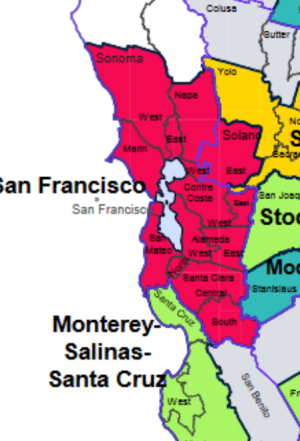
San Francisco's radio market extends from Santa Rosa to the north down to Gilroy to the south. There is lots of room for (expensive) growth.

Again... go to ARBITRON NIESEN Market Maps - Methodlogy - Market Data

... and get the latest market map. It is a PDF and infinitely expandable.

Or:

1712294414771.png
 
Last edited:
People have been leaving California and moving to Texas. So it makes sense that Dallas would pass San Francisco
But they are replaced by new immigrants. But California's growth rate is slower than Texas, and San Francisco's MSA is growing slower than the survey area of Dallas.
 
But they are replaced by new immigrants. But California's growth rate is slower than Texas, and San Francisco's MSA is growing slower than the survey area of Dallas.
True too sometimes we do not get the full extent of this because the ones that grab national attention are Tech Workers and Venture Capitalists from San Jose, San Francisco, San Mateo move to Austin, TX type stories and the focus is on Elon Musk and allies moving to the Austin area specifically.


True too sometimes we do not get the full extent of this because the ones that grab national attention are Tech Workers and Venture Capitalists from San Jose, San Francisco, San Mateo move to Austin, TX type stories and the focus is on Elon Musk and allies moving to the Austin area specifically.
The real issue… and this affects radio revenue and programming… is that a lot of middle class and professional class folks are moving to TX, FL, GA, NV, AZ and others due to taxes and high cost of living. They are “replaced” numerically by new immigrants who are generally unskilled workers.

For radio, the change is felt when more limited format like Alternative can’t survive in markets that are well over 50% ethnic where such formats have little or no appeal. Combined with decreases in radio revenue overall, this leads to more ethnic stations and mor religious ones.
 
That seems to be at variance with the article linked by the OP wherein San Jose appears as a separate PPM market.
San Jose is not a separate market; it is an embedded market which is a portion of a larger one issued separately. The San Francisco book includes San Jose.
 
True too sometimes we do not get the full extent of this because the ones that grab national attention are Tech Workers and Venture Capitalists from San Jose, San Francisco, San Mateo move to Austin, TX type stories and the focus is on Elon Musk and allies moving to the Austin area specifically.
Pretty soon we'll begin seeing stories of mainstream Tejas (not Austin) wanting to form their own state (Old Texas?). ;)
 
San Francisco's radio market extends from Santa Rosa to the north down to Gilroy to the south. There is lots of room for (expensive) growth.
I used MSA by mistake. Sorry.

I haven't lived or visited in the Bay Area for quite some time but that map looks a lot larger than I would have guessed back in the day. In Marin County for instance we used to get SF's big AM stations during the daytime but struggled overnight. FM's came in a bit better. Oakland based stations were much better. I haven't tried listening since the Sutro tower was built so don't know, but assume, the signals are much better now than they used to be.

My point was Marin used to be very marginal and it was very difficult to receive a quality radio signal in Sonoma County north. I could get Sacramento stations better than those in SF (this is going back multiple decades).
 
Last edited:
I used MSA by mistake. Sorry.

That's a common confusion.

Metro Survey Area: Nielsen's county based metro areas determined by levels of radio listening.
Metropolitan Statistical Area: Census and OMB definition of a trade based population center
I haven't lived or visited in the Bay Area for quite some time but that map looks a lot larger than I would have guessed back in the day. In Marin County for instance we used to get SF's big AM stations during the daytime but struggled overnight. FM's came in a bit better. Oakland based stations were much better. I haven't tried listening since the Sutro tower was built so don't know, but assume, the signals are much better now than they used to be.
In the period before Arbitron began measuring radio (1965-66 in major markets) survey areas were much smaller based on where a toll free call could be placed from the central city or cities.

The Arbitron area was based on the majority of radio listening, and was principally determined by the coverage of the big signals such as 560, 610, 680, 740, 810. FMs barely showed up in the early ARB surveys.
My point was Marin used to be very marginal and it was very difficult to receive a quality radio signal in Sonoma County north. I could get Sacramento stations better than those in SF (this is going back multiple decades).
Yet, in 1965, Arbitron determined that a majority of listening went to the San Francisco "central core" market stations. It may have been that stations you liked, such as KYA, KEWB or even (going back to the late 50's) KOFY-1550 were big Top 40 stations but got clobbered when KFRC went Top 40 on its monster signal.
 
The real issue… and this affects radio revenue and programming… is that a lot of middle class and professional class folks are moving to TX, FL, GA, NV, AZ and others due to taxes and high cost of living. They are “replaced” numerically by new immigrants who are generally unskilled workers.

For radio, the change is felt when more limited format like Alternative can’t survive in markets that are well over 50% ethnic where such formats have little or no appeal. Combined with decreases in radio revenue overall, this leads to more ethnic stations and more religious ones.
True and also in the article I seen a similar situation where Sacramento goes from 28th to 29th radio market and Austin overtakes Sacramento for 28th spot.
 
Yet, in 1965, Arbitron determined that a majority of listening went to the San Francisco "central core" market stations. It may have been that stations you liked, such as KYA, KEWB or even (going back to the late 50's) KOFY-1550 were big Top 40 stations but got clobbered when KFRC went Top 40 on its monster signal.
The original San Francisco Metro Survey Area as defined by the American Research Bureau (ARB) in 1965 consisted of five counties:
Alameda, Contra Costa, Marin, San Francisco and San Mateo
 
It is the Dallas-Fort Worth area, but it's mostly Collin County that's growing rapidly no thanks to Frisco (or what I like to call it Arlington II or New Plano), Prosper, and Celina whom are once rural cities expanding to growing suburban status.
 
Since moving back, last being here in 2001, it is UNBELIEVABLE how much this area has grown. It's dumbfounding. I feel so damn old when I drive here because it's so effing confusing, and people can't drive AND people drive 100MPH.

Having said that, it doesn't matter how big the market is if you only have less than 200,000 cume. (Laughing at KEGL.)
 
Status
This thread has been closed due to inactivity. You can create a new thread to discuss this topic.


Back
Top Bottom