• Get involved.
    We want your input!
    Apply for Membership and join the conversations about everything related to broadcasting.

    After we receive your registration, a moderator will review it. After your registration is approved, you will be permitted to post.
    If you use a disposable or false email address, your registration will be rejected.

    After your membership is approved, please take a minute to tell us a little bit about yourself.
    https://www.radiodiscussions.com/forums/introduce-yourself.1088/

    Thanks in advance and have fun!
    RadioDiscussions Administrators

Worst TV stations ever

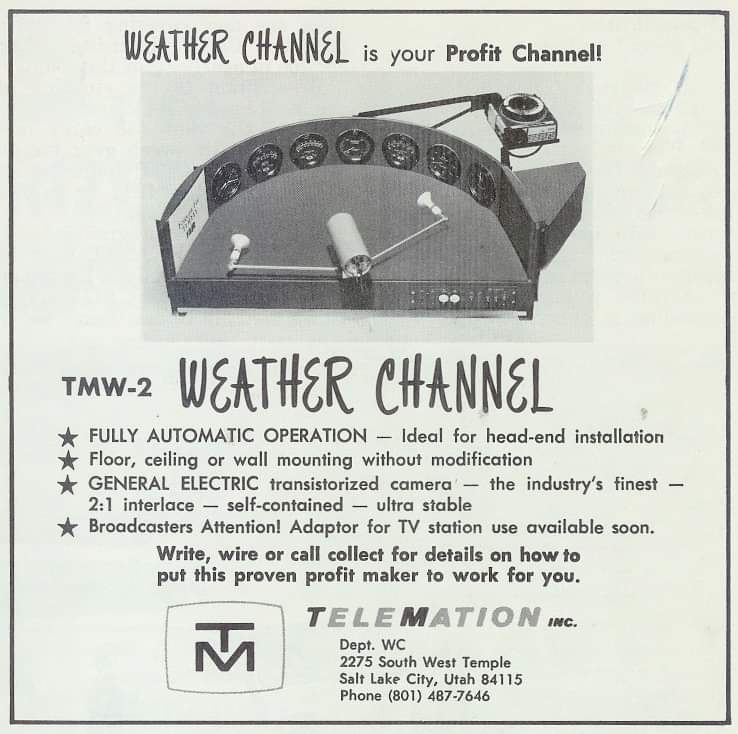
My introduction to cable TV was August 1966 in Gatlinburg. I was seven years old. For some reason I always found that local cable access channel with the "weather wheel" fascinating. Grainy black and white picture. Moving left to right and then back right to left. An analog thermometer for the temps ... a card with a local ad ... then the barometer ... another ad ... finally the wind speed. At night they had pre-recorded video full of local ads and an interview show where some old character with a plaid woolen shirt and a bolo tie would interview local merchants. It seemed like one interview in particular aired for years. A husband and wife who operated the "Paintin' Place." Get it? A play off of "Peyton Place" the novel / movie / TV series.
I recall that they did some kind of local origination in Gatlinburg, not just the weather wheel, but I don't recall details. Gatlinburg was a cool place to visit in the 1970s, but now it's so congested that it's barely recognizable as the same place. Much of the tourist trade has migrated out to Pigeon Forge and Sevierville, with Dollywood being the catalyst.

My son and I took a long weekend trip to Travelers Rest last week, and if you really use your imagination, you can get a small-scale version of a mountain resort vibe. Don't ever take US 176 up to Sassafras Mountain, it's a horribly winding and twisty road with two very narrow lanes, and for some crazy reason, they allow trucks 30 feet or shorter to use it (thankfully, we didn't encounter any). Quite the white-knuckle experience, and we couldn't wait to get off of it, and over the mountain into the relatively flat North Carolina High Country. I didn't even attempt to make it up to the top of the mountain so I could do some DX with my Zapperbox and small RCA yagi antenna.
 
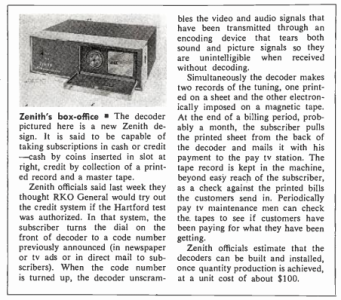
Yes, I know, I saw that, and it didn't make sense to me. Given this scenario, it looks as though the decoder acted as a kind of piggy bank, with insertion of the coins both activating the decoder, and allowing the viewer to collect enough money to pay the bill. At the risk of sounding like more of an idiot than I have already sounded like so far, did the decoder have some kind of mechanism (like a jack-in-the-box, no pun intended) to open up once a month and allow the viewer to retrieve the coins?

Okay, let's try it again. Quoting directly from the Broadcasting article:

" ... the subscriber turns the dial on the front of the decoder to a code number previously announced ... When the code number is turned up, the decoder unscrambles the video and audio signals ..."

I don't know how one could think there were coins involved after that description.

Linked from the article, here is the Phonevision program guide for June 1966, giving subscribers said codes.
 
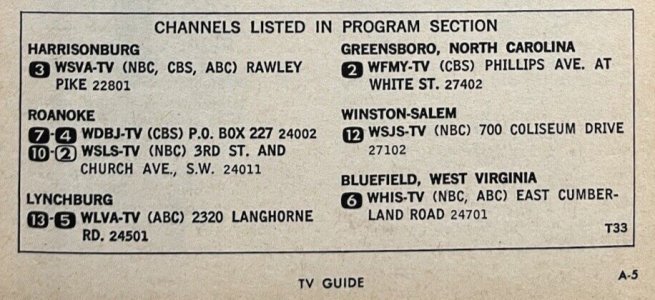
Do you mean that they converted 7 to 4, and 10 to 2, or did they have some kind of subchannel setup, similar to what we have with digital TV today? That would have been very odd in the analog era, not sure how they'd have done that.
I don't really know what it meant, but I think it might have been like a translator.
And do you mean that you were only able to get audio from WLVA? Was this OTA or on cable?
Antenna. No one had cable back then.
 
My introduction to cable TV was August 1966 in Gatlinburg. I was seven years old. For some reason I always found that local cable access channel with the "weather wheel" fascinating. Grainy black and white picture. Moving left to right and then back right to left. An analog thermometer for the temps ... a card with a local ad ... then the barometer ... another ad ... finally the wind speed. All with the music of WLOS-FM Ashville NC for sound. At night they had pre-recorded video full of local ads and an interview show where some old character with a plaid woolen shirt and a bolo tie would interview local merchants. It seemed like one interview in particular aired for years. A husband and wife who operated the "Paintin' Place." Get it? A play off of "Peyton Place" the novel / movie / TV series.
In Myrtle Beach they had the wind speed and direction, barometer, and probably temperature, all shown on gauges that looked about the same, with an ad on one side. The camera moved back and forth and the audio was NOAA Weather Radio.
 
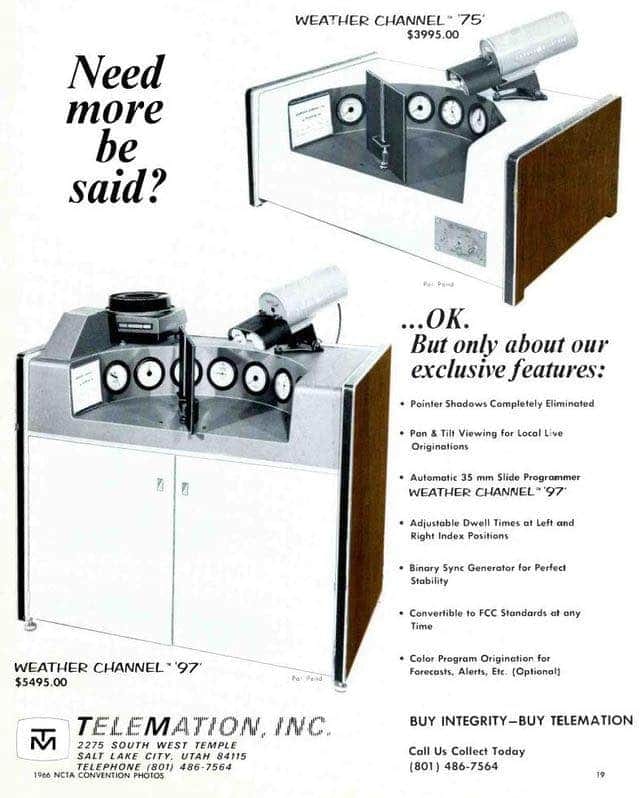
And here is how the "weather wheel" (as Ma Gee called it) was originated:

tele2.jpg


A later incarnation rotated a mirror instead of the camera (presumably to reduce stress to the latter) and then reversed the video image:
tele-1.jpg
 
Okay, let's try it again. Quoting directly from the Broadcasting article:

" ... the subscriber turns the dial on the front of the decoder to a code number previously announced ... When the code number is turned up, the decoder unscrambles the video and audio signals ..."

I don't know how one could think there were coins involved after that description.

Linked from the article, here is the Phonevision program guide for June 1966, giving subscribers said codes.

Okay, I see now, the boxes gave the option of using either coins or credit, and the provider chose the credit option. But here's what I'm going by:

1716229480687.png
So the second sentence says that coins can be an option, but presumably not used in the scenario you describe (third sentence beginning with "Zenith officials said..."). My question then would be, okay, let's say that a provider did go with the coin option. How, then, would the provider collect the money?

Pretty cumbersome scenario, and I have to wonder (a) "why did Zenith ever design it this way?" and (b) whether the coin option was meant for hotels and the like, with the hotel proprietor periodically going to rooms, unlocking the boxes, and retrieving the coins, then forwarding payment to the cable company. Way, way back when, I recall staying in a couple of hotels where they did have coin-operated TV sets, as well as those "Magic Fingers" where you could deposit coins and the bed would vibrate, providing a massage of sorts. I'm wondering if the coin option for the descramblers operated the same way.
 
So the second sentence says that coins can be an option, but presumably not used in the scenario you describe (third sentence beginning with "Zenith officials said..."). My question then would be, okay, let's say that a provider did go with the coin option. How, then, would the provider collect the money?

I think that we'll never know, since Phonevision only ever operated in Hartford.
 
Do you mean that they converted 7 to 4, and 10 to 2, or did they have some kind of subchannel setup, similar to what we have with digital TV today? That would have been very odd in the analog era, not sure how they'd have done that.

And do you mean that you were only able to get audio from WLVA? Was this OTA or on cable?
Low-power VHF (analog) translator stations.
Channel 2 in Lynchburg for WSLS-TV (10●–2○)
Channel 4 in Lynchburg for WDBJ-TV (7●–4○)
Channel 5 in Roanoke for WLVA-TV/WSET-TV (13●–5○)
 
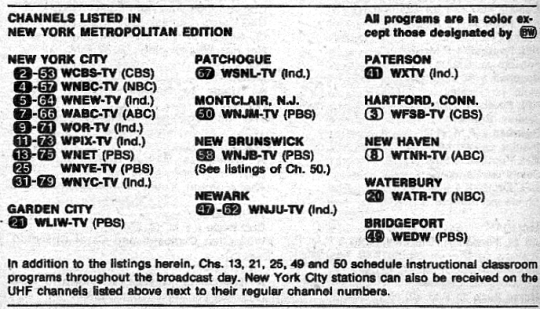
Given this side discussion, I thought you all would appreciate this scan of the New York Metropolitan Edition of TV Guide from the period in 1974-75 when all the VHFs operated UHF translators to continue serving viewers who experienced multipath during the construction of the first World Trade Center tower.

tvguide_92174.png
 
It was in older issues of the edition. This is the May 1967 channel lineup. Don't know when it happened exactly but the satellite station bullets were dropped a few years later.
The Central Virginia TV Guide later added WRAL-5 and WTVD-11, and before TVG discontinued regional editions in 2005, the full complement of Bluefield-Beckley-Oak Hill stations as well.

Side note, about a year before TVG did away with regional editions, they totally changed around a lot of those editions, creating a "Virginia State" edition that had Richmond, Roanoke/Lynchburg, and Hampton Roads stations, as well as Harrisonburg and Charlottesville. They eliminated the North Carolina and West Virginia stations. Towards the end, they didn't put a channels listed guide in the magazine, you were just supposed to know or guess what stations were being signified. Hard to imagine how they thought that was a good move, it's as though they were deliberately trying to make the editions difficult to use.
 
Last edited:
I recall that they did some kind of local origination in Gatlinburg, not just the weather wheel, but I don't recall details. Gatlinburg was a cool place to visit in the 1970s, but now it's so congested that it's barely recognizable as the same place. Much of the tourist trade has migrated out to Pigeon Forge and Sevierville, with Dollywood being the catalyst.

My son and I took a long weekend trip to Travelers Rest last week, and if you really use your imagination, you can get a small-scale version of a mountain resort vibe. Don't ever take US 176 up to Sassafras Mountain, it's a horribly winding and twisty road with two very narrow lanes, and for some crazy reason, they allow trucks 30 feet or shorter to use it (thankfully, we didn't encounter any). Quite the white-knuckle experience, and we couldn't wait to get off of it, and over the mountain into the relatively flat North Carolina High Country. I didn't even attempt to make it up to the top of the mountain so I could do some DX with my Zapperbox and small RCA yagi antenna.
There is still a Smoky Mountain Internet Visitor's Channel and a Gatlinburg Visitor's Channel, at least the latter on cable. Though working over there, I didn't live there but spent a night in the hospital and watched quite a bit of it. It was mostly Allewine Pottery commercials and skits, including about chickens
 
Given this side discussion, I thought you all would appreciate this scan of the New York Metropolitan Edition of TV Guide from the period in 1974-75 when all the VHFs operated UHF translators to continue serving viewers who experienced multipath during the construction of the first World Trade Center tower.

tvguide_92174.png
That's the first one I remember seeing.
 
There is still a Smoky Mountain Internet Visitor's Channel and a Gatlinburg Visitor's Channel, at least the latter on cable. Though working over there, I didn't live there but spent a night in the hospital and watched quite a bit of it. It was mostly Allewine Pottery commercials and skits, including about chickens
Did you fly the coop after watching it?
 
In the days before detent tuners (and the first of those were pretty hinky), UHF translators crowded this close together would have been very difficult to tune in. Got to wonder how it worked in actual practice.
What I remember–and I was four or five years old when I first learned how to tune to a UHF station–from where I lived, the signals were spotty.

The WCBS-TV repeater on 53 gave me a picture with no audio. Same with WNBC-TV on 57. It got better with WNEW-TV on 64, and WABC-TV on 66.

WWHT's channel 60 repeater was the best in signal quality–probably even better than the main signal on 68, which still emanated from West Orange at the time.

Don't remember much about the channels 62, 71, 73, 75 and 79 translators, though.
 
The Central Virginia TV Guide later added WRAL-5 and WTVD-11, and before TVG discontinued regional editions in 2005, the full complement of Bluefield-Beckley-Oak Hill stations as well.

Side note, about a year before TVG did away with regional editions, they totally changed around a lot of those editions, creating a "Virginia State" edition that had Richmond, Roanoke/Lynchburg, and Hampton Roads stations, as well as Harrisonburg and Charlottesville. They eliminated the North Carolina and West Virginia stations. Towards the end, they didn't put a channels listed guide in the magazine, you were just supposed to know or guess what stations were being signified. Hard to imagine how they thought that was a good move, it's as though they were deliberately trying to make the editions difficult to use.
And WGHP in High Point also. It was probably added alongside WRAL and WTVD.


Back
Top Bottom