• Get involved.
    We want your input!
    Apply for Membership and join the conversations about everything related to broadcasting.

    After we receive your registration, a moderator will review it. After your registration is approved, you will be permitted to post.
    If you use a disposable or false email address, your registration will be rejected.

    After your membership is approved, please take a minute to tell us a little bit about yourself.
    https://www.radiodiscussions.com/forums/introduce-yourself.1088/

    Thanks in advance and have fun!
    RadioDiscussions Administrators

TV Guide editions and online resources

As I indicated in the "worst TV stations ever" thread, I'm starting a new thread devoted solely to TV Guide. I have been a TVG collector for many years, sadly, though, most of my collection had to be discarded, as they were stored in a garage for a couple of years and they developed a mold problem. I saved a few, as well as channels listed pages for all the editions I had to dispose of.

Matt Sittel's TVG channels listed site is a good place to start:

TV Guide Channels Listed Scans

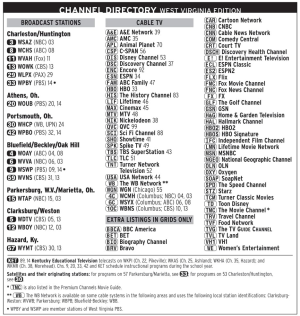
One thing I noticed on this page, is that on the 2004 map, issued a year before TVG gave up on regional editions and replaced them with two national editions (Eastern/Central and Mountain/Pacific), the Columbus and West Virginia editions were collapsed into a single West Virginia edition, making the WV TVG the default edition for the Columbus market. That would actually have been workable (if Columbus viewers didn't mind having to wade through all those West Virginia stations), in that the previous Columbus edition only contained Columbus-area stations along with WHIZ Zanesville and WOUB Athens, the latter already being in the WV TVG. Moreover, Columbus 4/6/10 appeared for decades in the WV TVG as "cable channels" 4C/6C/10C, and were widely carried throughout far southeastern Ohio all the way to the Ohio River (and even in Point Pleasant and Parkersburg). The channels listed page doesn't include WHIZ, but that could have easily been added (don't know if that ever actually happened or not), and for uniformity, as well as to keep from duplicating WOAY-4 and WVVA-6, Columbus and Zanesville stations could have been listed with white bullets minus the "C" designation (or "Z" for Zanesville, I guess).

Hope it's okay under "fair use" to post the WV TVG channels listed page here:
1716313234076.png
 
Other interesting editions (IMO), in no particular order:

Montana: a hodgepodge of black bullets, white bullets, and split bullets (black/white), with no rhyme or reason as to markets. It had three channel 4s, three channel 6s, and three channel 8s, again, without regard to markets. By the time you get to the point of listing three channels with the same channel number, you really need a separate edition.

South Georgia: an ambitious little edition that tried to cover everything from Atlanta to Tallahassee to Jacksonville (4/12 only) and Savannah. It was the default edition for Tallahassee. Interestingly, its coverage area extended all the way from the Gulf of Mexico to the Atlantic coast of Georgia.

Northern Colorado: kind of a misnomer, its coverage area was actually large portions of South Dakota , Nebraska, and Wyoming, as well as a tier of counties in extreme northern Colorado. Back in the 1970s, I got a TVG circulation map (long since lost) that showed much of this area as simply not having a TVG edition. IIRC (I could be totally wrong on this) any subscribers there got the New York Metropolitan edition. That whole area historically had widespread viewership of Denver stations; it would have made more sense simply to send them the Denver edition and let them figure out which local stations corresponded to Denver network schedules.

Carolina-Tennessee: the default edition for the Knoxville, Tri-Cities, and Greenville-Spartanburg-Asheville markets. Its coverage area stretched all the way from southeastern Kentucky to Newberry County SC, and it contained Charlotte listings as well. Newberry County, despite being in the Columbia market (from the mid-1980s on), stayed in the GSA edition (one of the successors to the C-T edition) coverage area all the way to the end of regional TVGs in 2005. Viewers there get stations from both markets OTA, not sure whether Newberry cable carries GSA anymore.
 
The edition that I encountered that made the least sense was the "Missouri" edition. It did not include Kansas City or St. Louis, nor anything north of Columbia. It included Columbia-Jefferson City; Springfield; Joplin-Pittsburg, KS; Fort Smith, AR; and Tulsa, OK. But Tulsa itself got the Oklahoma edition. Since there were so many two-station markets in Missouri up until 1969-1971, I always wondered if Tulsa was included just to get a full-time ABC affiliate in there.

Sedalia was in the Kansas City edition until 1961, due to KMOS-TV (6) being a full-time ABC affiliate, even though it broadcast at fairly low power (16 kW visual). Then it was bought by Jefferson City's KRCG-TV (13) and used mostly to repeat KRCG* - though with some local newscasts - and brought into the Columbia-Jefferson City market. There were never separate listings for KMOS after KRCG purchased it, and not until the station was donated to Central Missouri State University, brought up to full power, and became a PBS member station late in 1979.

* It was commonly assumed in Columbia that KRCG did this to keep a full-time ABC affiliate (the fear was that this would have been on channel 6) from moving into the central Missouri market, which worked until 1971 when KCBJ (17) came on the air in Columbia.

When cable TV came to mid-Missouri cities, the TV Guide was not all that helpful, since those systems imported either Kansas City or St. Louis stations, which were not listed in the Missouri edition. The Kansas City edition covered Topeka, KS and St. Joseph, MO as well as KC; the St. Louis edition had only St. Louis stations.
 
The edition that I encountered that made the least sense was the "Missouri" edition. It did not include Kansas City or St. Louis, nor anything north of Columbia. It included Columbia-Jefferson City; Springfield; Joplin-Pittsburg, KS; Fort Smith, AR; and Tulsa, OK. But Tulsa itself got the Oklahoma edition. Since there were so many two-station markets in Missouri up until 1969-1971, I always wondered if Tulsa was included just to get a full-time ABC affiliate in there.

Sedalia was in the Kansas City edition until 1961, due to KMOS-TV (6) being a full-time ABC affiliate, even though it broadcast at fairly low power (16 kW visual). Then it was bought by Jefferson City's KRCG-TV (13) and used mostly to repeat KRCG* - though with some local newscasts - and brought into the Columbia-Jefferson City market. There were never separate listings for KMOS after KRCG purchased it, and not until the station was donated to Central Missouri State University, brought up to full power, and became a PBS member station late in 1979.

* It was commonly assumed in Columbia that KRCG did this to keep a full-time ABC affiliate (the fear was that this would have been on channel 6) from moving into the central Missouri market, which worked until 1971 when KCBJ (17) came on the air in Columbia.

When cable TV came to mid-Missouri cities, the TV Guide was not all that helpful, since those systems imported either Kansas City or St. Louis stations, which were not listed in the Missouri edition. The Kansas City edition covered Topeka, KS and St. Joseph, MO as well as KC; the St. Louis edition had only St. Louis stations.

Tulsa stations were receivable, and carried on cable (I assume), throughout southwestern Missouri as well as northwestern Arkansas (I saw them on Fort Smith hotel cable in 1985). It was very common for a TVG edition to carry full network listings from an adjacent market, where that market enjoyed wide viewership in the home edition's circulation area. Actually, Tulsa had its own edition that carried Tulsa stations as well as Ada-Ardmore-Sherman-Denison. The Missouri edition was also the default edition for northwestern Arkansas.

It was common in some border areas for two editions to be carried side by side in grocery stores and newsstands, with somewhat crude overstamps on the logo (presumably made by the local magazine distributor) to indicate which edition it was, to allow viewers to get listings for adjacent markets not listed in the home edition. I've even seen the out-of-market edition signified with a colored mark along the edge of the pages, as though someone took a marker or even spray paint to flag it as the out-of-market edition. You would also have a "cable" stamp over the logo, and in eastern Kentucky, the Carolina-Tennessee edition had a "C-T" stamp. It's entirely possibly that areas of Missouri that got STL or KC stations received those cities' editions with some kind of overstamp, to be sold alongside the Missouri edition.

You could also contact TVG and ask them to send you another edition, that's what I did when I lived in Myrtle Beach and wanted the Eastern NC edition for Wilmington stations (which were never listed in the South Carolina TVG). They sold the Eastern NC edition in North Myrtle Beach as the sole edition with no overstamp.
 
Other interesting editions (IMO), in no particular order:

Montana: a hodgepodge of black bullets, white bullets, and split bullets (black/white), with no rhyme or reason as to markets. It had three channel 4s, three channel 6s, and three channel 8s, again, without regard to markets. By the time you get to the point of listing three channels with the same channel number, you really need a separate edition.
Except the third channels in most cases were because of Spokane, or the North Dakota stations. The only split you could have made was Eastern Montana (Billings/Miles City/Glendive) in its own, and Western Montana in another, but Billings was not big enough to have its own edition. You'd have extra work for little extra profit. I do agree they could have organized the channels better. If you had Billings, Miles City and Glendive all black, all the Western Montana towns white, Williston split and Spokane striped, it would have looked better.
 
Except the third channels in most cases were because of Spokane, or the North Dakota stations. The only split you could have made was Eastern Montana (Billings/Miles City/Glendive) in its own, and Western Montana in another, but Billings was not big enough to have its own edition. You'd have extra work for little extra profit. I do agree they could have organized the channels better. If you had Billings, Miles City and Glendive all black, all the Western Montana towns white, Williston split and Spokane striped, it would have looked better.

The Spokane stations could also have been listed as 2S, 6S, and so on. I agree on the other breakouts you cite.

In an earlier incarnation, the Montana TVG also listed Salt Lake City stations, which were carried all throughout the Intermountain West (even as far north as Williston ND, this per the 1979 Television Factbook) via microwave. The SLC stations appeared as channel bullets with four stripes overlaid with white channel numbers, which certainly stood out, if nothing else.
 
Another fun fact, the Vermont TVG carried listings for the French-language Montreal stations in French, not just program titles but the descriptions as well. I had that edition from 1992 but it's long gone, one of those that got ruined due to poor storage.

From time to time I buy old editions on eBay, but truth be told, they are usually in fairly poor condition, they smell bad due to the sheer age of the newsprint. I wonder if there would be any interest in scanning old TVG editions and putting them on the World Radio History page. @DavidEduardo, your thoughts?
 
Tulsa stations were receivable, and carried on cable (I assume), throughout southwestern Missouri as well as northwestern Arkansas (I saw them on Fort Smith hotel cable in 1985). It was very common for a TVG edition to carry full network listings from an adjacent market, where that market enjoyed wide viewership in the home edition's circulation area. Actually, Tulsa had its own edition that carried Tulsa stations as well as Ada-Ardmore-Sherman-Denison. The Missouri edition was also the default edition for northwestern Arkansas.

It was common in some border areas for two editions to be carried side by side in grocery stores and newsstands, with somewhat crude overstamps on the logo (presumably made by the local magazine distributor) to indicate which edition it was, to allow viewers to get listings for adjacent markets not listed in the home edition. I've even seen the out-of-market edition signified with a colored mark along the edge of the pages, as though someone took a marker or even spray paint to flag it as the out-of-market edition. You would also have a "cable" stamp over the logo, and in eastern Kentucky, the Carolina-Tennessee edition had a "C-T" stamp. It's entirely possibly that areas of Missouri that got STL or KC stations received those cities' editions with some kind of overstamp, to be sold alongside the Missouri edition.

You could also contact TVG and ask them to send you another edition, that's what I did when I lived in Myrtle Beach and wanted the Eastern NC edition for Wilmington stations (which were never listed in the South Carolina TVG). They sold the Eastern NC edition in North Myrtle Beach as the sole edition with no overstamp.

One of the bookstores in Manistee, MI used to carry the Northern Wisconsin edition alongside the Northern Michigan edition.

Speaking of unusual editions, the Northern Wisconsin edition never included any Traverse City/Cadillac stations despite:
1. Luce County (in the Traverse City/Cadillac market) getting the Northern Wisconsin edition
2. Cable carriage of WWTV and (especially) WGKI/WFQX in the 80s and 90s. WWTV made it as far west as Florence, Wisconsin (in the time between WLUC dropping CBS and CBS losing NFL rights so that Lions games could remain available in the central Yoop) while WGKI/WFQX made it all the way to Hurley, Wisconsin from 1994/95 until 2003, when the infamous WMQF signed on (speaking of omissions, WMQF was never added to the Northern Wisconsin TV Guide despite all other Marquette stations being included)

WKBD from Detroit was included in the Northern Wisconsin TV Guide, at least in the late 70s and 80s. WGKI replaced it on most outstate Michigan cable systems when WKBD lost the FOX affiliation to now-O&O WJBK
 
Northern Colorado: kind of a misnomer, its coverage area was actually large portions of South Dakota , Nebraska, and Wyoming, as well as a tier of counties in extreme northern Colorado. Back in the 1970s, I got a TVG circulation map (long since lost) that showed much of this area as simply not having a TVG edition. IIRC (I could be totally wrong on this) any subscribers there got the New York Metropolitan edition. That whole area historically had widespread viewership of Denver stations; it would have made more sense simply to send them the Denver edition and let them figure out which local stations corresponded to Denver network schedules.

Interestingly both South Dakota and Wyoming were two states that never saw their own state edition of TV Guide. As you mentioned the western portion of South Dakota and Wyoming appeared in the Northern Colorado edition, while eastern South Dakota appeared in the Nebraska edition along with Sioux City Iowa.

It should be noted some Wyoming's more western stations did appear in the Idaho edition listed under Casper/Lander/Riverton/Rock Springs.

Newberry County, despite being in the Columbia market (from the mid-1980s on), stayed in the GSA edition (one of the successors to the C-T edition) coverage area all the way to the end of regional TVGs in 2005. Viewers there get stations from both markets OTA, not sure whether Newberry cable carries GSA anymore.

Comcast/xfinity dropped all the Greenville-Spartanburg-Asheville and Charlotte stations back in 2018. I remember a number of people in the Newberry area were upset over losing WSPA at the time. A small regional rural company does still pipe it in though if you can get coverage or get it on YoutubeTV from my understanding depending on the zip code entered.
 
Interestingly both South Dakota and Wyoming were two states that never saw their own state edition of TV Guide. As you mentioned the western portion of South Dakota and Wyoming appeared in the Northern Colorado edition, while eastern South Dakota appeared in the Nebraska edition along with Sioux City Iowa.

It should be noted some Wyoming's more western stations did appear in the Idaho edition listed under Casper/Lander/Riverton/Rock Springs.


Comcast/xfinity dropped all the Greenville-Spartanburg-Asheville and Charlotte stations back in 2018. I remember a number of people in the Newberry area were upset over losing WSPA at the time. A small regional rural company does still pipe it in though if you can get coverage or get it on YoutubeTV from my understanding depending on the zip code entered.

Delaware, so far as I am aware, also never had its own edition. It would have been kind of pointless, unless TVG had wanted to cobble together some sort of "Delmarva Edition" with stations from DC, Baltimore, Philadelphia, and Salisbury. Not enough population to justify that sort of thing. IIRC you could get both the Washington-Baltimore and Philadelphia editions in Dover.

(Fun fact, so far as I am aware, when they "split" the W-B TVG into separate Washington and Baltimore editions, the only difference was the channel chart, which was in the middle of the book on heavier stock such as they used to insert for advertising. I think they omitted WGAL-8 from the Washington chart, even though it still appeared in the magazine itself. Still the same edition, just different channel charts.)

As for Newberry, GSA 4/7/21 would be easy enough to pick up with a decent rooftop antenna (from Little Mountain, you can get Columbia, GSA, Charlotte, and Augusta, easy drive to the top, I've taken a small RCA yagi up there before), but that's quite a hoop to ask cable subscribers to jump through, nobody wants to use an A/B switch. And with YouTube TV, you'd be stuck with getting either Columbia or GSA, as geofencing obeys ZIP Codes. Similar to DirecTV and Dish, it's stations from one market and one market only (unless there is an exception made for orphan counties on the satellite carriers, as with Monongalia and Preston counties in WV getting Clarksburg stations even though they're in the Pittsburgh market).
 
Another fun fact, the Vermont TVG carried listings for the French-language Montreal stations in French, not just program titles but the descriptions as well.
I actually think this was the Montreal-Ottawa edition that was distributed in the Burlington VT - Plattsburgh NY areas. For many years, stores carried the Canadian edition. It made sense since Montreal and Ottawa were getting their U.S. TV signals from Burlington-Plattsburgh so there was no need for two editions.

The Canadian TV Guide included most of the U.S. stories. But one or two would be omitted so articles about Canadian shows and stars could be inserted. But I noticed in the last few years of TV Guide including local listings, Burlington-Plattsburgh got its own edition of the U.S. magazine. French Canadian stations were still included but didn't have much more than the time and title of most shows.

One more note about the Canadian TV Guide... The edition with the most confusing listings by far was Alberta-Saskatchewan. It had SIX different Channel 2's. There was the black screen, white screen, horizontal lines and half-black, half-white screen used in a few other markets. But that wasn't enough. For the two additional Channel 2's, TV Guide used an initial. I think the Channel 2 in Kamloops used a "K" next to the number. Another Channel 2 used a different letter.
 
I actually think this was the Montreal-Ottawa edition that was distributed in the Burlington VT - Plattsburgh NY areas. For many years, stores carried the Canadian edition. It made sense since Montreal and Ottawa were getting their U.S. TV signals from Burlington-Plattsburgh so there was no need for two editions.

The Canadian TV Guide included most of the U.S. stories. But one or two would be omitted so articles about Canadian shows and stars could be inserted. But I noticed in the last few years of TV Guide including local listings, Burlington-Plattsburgh got its own edition of the U.S. magazine. French Canadian stations were still included but didn't have much more than the time and title of most shows.

One more note about the Canadian TV Guide... The edition with the most confusing listings by far was Alberta-Saskatchewan. It had SIX different Channel 2's. There was the black screen, white screen, horizontal lines and half-black, half-white screen used in a few other markets. But that wasn't enough. For the two additional Channel 2's, TV Guide used an initial. I think the Channel 2 in Kamloops used a "K" next to the number. Another Channel 2 used a different letter.

Perhaps at one time there was a cross-border Montreal-Ottawa edition, but when I was there (1992), it was most definitely the Vermont edition. I recall it distinctly, got it at an IGA in Burlington. Montreal had its own edition which I bought there, and by that time, the US and Canadian TV Guide were two different magazines with separate covers, articles, and so on.
 
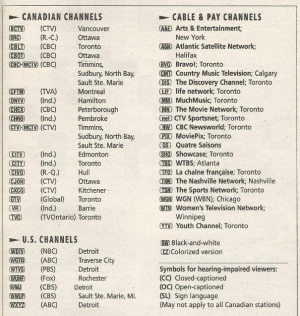
The CANCOM edition, which also served northern Ontario (Sudbury et al), was an example of a TV Guide edition seeking to be all things to all viewers (though not nearly as extreme as editions such as Montana, Northern Colorado, and South Georgia). They ended up just doing station ovals with the call letters within them instead of channel numbers. I'm pretty sure it was also the default terrestrial edition for Sudbury and probably Sault Ste Marie.

1716392473856.png
 
Last edited:
One thing I found kind of annoying as a TV Guide editions collector (when such a thing existed) were the single-market editions that could have easily been appended to neighboring editions, but for some reasons those markets got their own TVG. Examples would be St Louis, Tucson, Las Vegas, and Nashville (which also carried WBKO Bowling Green). Towards the end (2004-2005) some of these editions actually did get folded into larger state editions (Arizona and Nevada). Yet even with the 2004-2005 realignment, for some reason, some relatively small areas still got their own editions, such as Southeastern Pennsylvania and Springfield-Chicopee-Holyoke. The Virginia State edition, while a sensible concept, for some reason didn't even include WVVA-6 Bluefield, even though its circulation area actually included Mercer County WV and adjacent parts of Virginia where WVVA was the "local" station.

With the rebirth of OTA viewing (accompanied by streaming video), regional editions of TVG (and similar magazines) could actually make a comeback, if it made economic sense, of course. To this day, I find it awkward to have to go online to search up TV listings, and I'd welcome a TVG-like magazine with channel numbers. They could easily do the diginets separately, as their programming rarely varies from market to market, and network affiliate subchannels could appear as, for instance, "10-1" and "10-2" for WIS-NBC and WIS-CW respectively.

I have been geeking out on TV Guide editions for over 50 years now, and I see no reason to stop, even though here in 2024 it's solely an exercise in nostalgia. Viewers still watch basically the same OTA stations that they did back then, and again, a resurrection of TVG editions might find enough readers to justify it, though probably without the excellent (and sometimes very intellectual) articles that set TVG apart back in the Annenberg days.
 
One thing I found kind of annoying as a TV Guide editions collector (when such a thing existed) were the single-market editions that could have easily been appended to neighboring editions, but for some reasons those markets got their own TVG.
First of all, I don’t see any revival of a printed TV Guide in an era where that info can be found online. Any such desire is pure nostalgia.

I grew up in Austin, Texas in the 1960s and early 1970s, and the TV Guide there had multiple market listings: Austin, San Antonio, Waco-Temple, Corpus Christi, the lower RGV, and Laredo. This was long before there were any “cable” listings.
probably without the excellent (and sometimes very intellectual) articles that set TVG apart back in the Annenberg days.
I recall that in the 1960s and 70s TV Guide had many well written and intelligent articles about all aspects of the industry; no ”lowest common denominator” stuff. There were even some explaining the business and technical side of TV as well. I remember one article about a DXer somewhere in New England who had a modified TV setup for receiving signals from Europe when TransAtlantic ionospheric skip kicked up. Also had Q&A columns for viewer inquiries.

Unfortunately TV Guide was significantly dumbed down in the 1980s and I lost interest in the publication.
 
It was common in some border areas for two editions to be carried side by side in grocery stores and newsstands, with somewhat crude overstamps on the logo (presumably made by the local magazine distributor) to indicate which edition it was, to allow viewers to get listings for adjacent markets not listed in the home edition. I've even seen the out-of-market edition signified with a colored mark along the edge of the pages, as though someone took a marker or even spray paint to flag it as the out-of-market edition. You would also have a "cable" stamp over the logo, and in eastern Kentucky, the Carolina-Tennessee edition had a "C-T" stamp. It's entirely possibly that areas of Missouri that got STL or KC stations received those cities' editions with some kind of overstamp, to be sold alongside the Missouri edition.
I never saw any such thing in Columbia. Since Columbia was, and still is, the largest city in the region, I doubt there were special editions for any of the surrounding cities.

The other difficulty is that the cable lineups in the region varied, based on system capacity, whether the system was connected to the cross-state CARS-band relay that existed in those days, and negotiations with local TV stations. This was especially true in Columbia, which got cable last, and thus had a midband system before any other city in the region - hence Satellite Program Network, CBN, HBO, the very early days of ESPN, etc. But, for instance, the Columbia system did not import St. Louis' independent KPLR, which Moberly and Jefferson City did have, while it did import Kansas City's independent KBMA/KSHB. Moberly and Jefferson City, at least for the earlier years of cable TV, also imported the big three network affiliates from Kansas City, which Columbia never had on cable. Mexico imported the St. Louis and Hannibal-Quincy stations. Fulton probably imported the St. Louis stations but I don't know for sure. The CARS-band relay was originally for the Moberly and Jefferson City systems but the Columbia system was eventually able to buy into it and get an FCC waiver to connect to it, much to the consternation of local broadcasters - and publishers - who fought hard against the introduction of a cable-TV system to Columbia.
 
First of all, I don’t see any revival of a printed TV Guide in an era where that info can be found online. Any such desire is pure nostalgia.

I grew up in Austin, Texas in the 1960s and early 1970s, and the TV Guide there had multiple market listings: Austin, San Antonio, Waco-Temple, Corpus Christi, the lower RGV, and Laredo. This was long before there were any “cable” listings.

I recall that in the 1960s and 70s TV Guide had many well written and intelligent articles about all aspects of the industry; no ”lowest common denominator” stuff. There were even some explaining the business and technical side of TV as well. I remember one article about a DXer somewhere in New England who had a modified TV setup for receiving signals from Europe when TransAtlantic ionospheric skip kicked up. Also had Q&A columns for viewer inquiries.

Unfortunately TV Guide was significantly dumbed down in the 1980s and I lost interest in the publication.
There are various publications that seek to emulate the TV Guide format, though I don't think any of them have been all that successful. I subscribed to TV Weekly a few years ago, thought from their advertising that they would furnish local channels (or at least those from Charlotte, which I can get at night and sometimes otherwise), but it was a generic network format similar to TV Guide. I didn't renew the subscription.

TVG did indeed have very good articles in the 1960s and 70s, they were of the caliber of The New York Times or Time magazine. Then it gradually morphed into celebrity gossip and fluff pieces, which is how it remains today in the re-imagined national format. I don't even bother with it anymore, though you can get it on the cheap through subscription promotions.
 
Delaware, so far as I am aware, also never had its own edition. It would have been kind of pointless

Unlike Wyoming and South Dakota there's never been any TV markets (or major networks with affiliates except for PBS) within Delaware to begin with making it moot.

I never saw any such thing in Columbia. Since Columbia was, and still is, the largest city in the region,

At first I thought you were talking about Columbia SC and was going to respond back but now I realize you’re talking about Columbia Missouri.🙈😅
 
I also once had the map of the U.S. showing the regions TV Guide had local editions. Unfortunately, I don't have it anymore. It is interesting to see the evolution of TV Guide as television itself evolved. I believe TV Guide began with only a dozen or so editions with its April 1953 debut.

In its early days, TV Guide covered all of Southern New England with a single edition. Boston, Hartford, Providence, Springfield, New Haven and Waterbury all in one edition. But there were fewer stations in those days. Only a few UHF stations. Only WGBH-TV in Boston was an "Educational" station. No listing for Channel 6 in New Bedford. What is now WLNE didn't sign on until 1962.

As more TV stations came on the air, TV Guide had to split its editions and increase them. I even once had a Hawaii edition. (With the time zone difference, it seemed Honolulu stations constructed their own schedules regardless of the timetable used by the rest of the country.)

Wikipedia has a good write up on TV Guide and its customs for listings and channel identification.
 
Unlike Wyoming and South Dakota there's never been any TV markets (or major networks with affiliates except for PBS) within Delaware to begin with making it moot.


At first I thought you were talking about Columbia SC and was going to respond back but now I realize you’re talking about Columbia Missouri.🙈😅

True WRT Delaware, but there have been at least two editions (Northern Ohio and Western New York) that didn't have any major stations within their circulation area, but were rather kind of "infill" editions that collated stations from several markets. At one time the Northern Ohio circulation area was bizarrely gerrymandered, stretching all the way from Sandusky down past Zanesville almost all the way to Marietta. Bottom line, it was intended to corral Toledo, Cleveland, Columbus, and Wheeling-Steubenville stations into a single edition. It even carried listings for CBET Windsor.


Back
Top Bottom