• Get involved.
    We want your input!
    Apply for Membership and join the conversations about everything related to broadcasting.

    After we receive your registration, a moderator will review it. After your registration is approved, you will be permitted to post.
    If you use a disposable or false email address, your registration will be rejected.

    After your membership is approved, please take a minute to tell us a little bit about yourself.
    https://www.radiodiscussions.com/forums/introduce-yourself.1088/

    Thanks in advance and have fun!
    RadioDiscussions Administrators

TV Guide editions and online resources

I remember that when CNN first started up, there was an "ooh-ahh" factor of having a 24-hour news channel, something new that people weren't used to.

As to the Vermont TVG channels listed page, I notice that it has those weird-looking channel bullets that TVG began using in some editions for a short period of time. They were hard to read and just plain ugly. I wonder whose idea those where, and why. They soon reverted to the more attractive and familiar channel bullets with which we're all familiar.

That "CBCF" network designation is interesting. They later used "R-C", to signify Société Radio-Canada.
 
I think there were some stations in Mountain time that shoved two network morning shows into their broadcast day. Daytime shows all out of pattern, Price is Right in the afternoon in market X and at 8AM in market Y, not shown at all in market Z. It was the wild west for sure in the '70s.
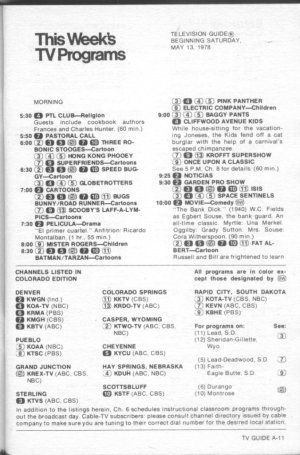
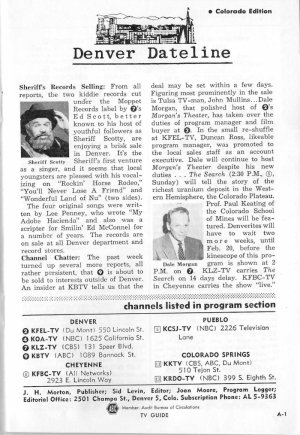
Speaking of the Wild West...Colorado. Note that this was a distinct edition from Denver, something for which Denver-area residents would have been thankful if they had known about it. Even so, Denver stations were listed in the Colorado edition, too, probably because of cable carriage.

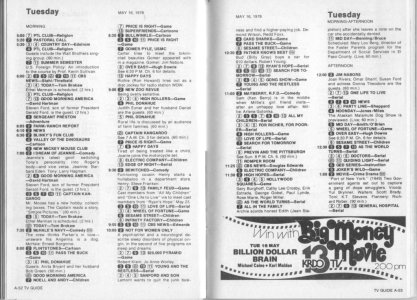
This 1978 edition shows that Grand Junction's KREX-TV aired Today at 7 am, Good Morning America at 8 am, and Captain Kangaroo at 9 am. KREX is the channel 5 with the lines through the bullet.

colo-ed-tvg-may16-1978-daytime.jpeg
This edition was, to use a technical term, a mess, as can be seen from the channel listings. Also note absolutely no UHF channels.
colo-ed-tvg-may13-1978-channels.jpeg
It appeared that KTVS, KYCU, and KSTF (black 3, black 5, black 10 respectively) followed almost exactly the same schedule, so I don't know why TV Guide didn't collapse them. TV Guide was somewhat inconsistent about this sort of thing. In New Mexico, TV Guide carried separate listings for Carlsbad's KAVE-TV even well after it became a satellite of El Paso's KELP-TV. On the other hand, the Missouri edition never carried separate listings for Sedalia's KMOS-TV during the time (1961 to 1978) that it was a satellite of KRCG-TV in Jefferson City.

In the Colorado edition, there were no separate listings for KREY-TV (channel 10, Montrose) or KREZ-TV (channel 6, Durango), which were satellites of KREX-TV. So I see some inconsistency even within the same edition!
 
8AM timeslot for Price is Right on KEVN-7 in Rapid City (the white bullet) vs. 9AM on KMGH (black bullet 7), and I believe KREX aired it in the 4:00 hour.
KREZ Durango was in the New Mexico TV Guide. No KREY-10, and I can't recall if KCWS-3 was added to the Colorado edition when it went to air.
Sterling 3 and Scottsbluff 10 were semi-satellites of KYCU-5 Cheyenne. Eventually ch 3 went to UPN // KTVD and is the current KCDO. I wonder how much viewership it actually got in NE Colorado vs. KCNC/KMGH. I've never found a newscast from KTVS, only have seen IDs via sporadic-E skip recordings.

KMOS Sedalia (commercial era) was in the Kansas City edition, with K.C. locals, KQTV-2, and WIBW-13.
 
8AM timeslot for Price is Right on KEVN-7 in Rapid City (the white bullet) vs. 9AM on KMGH (black bullet 7), and I believe KREX aired it in the 4:00 hour.
KREZ Durango was in the New Mexico TV Guide. No KREY-10, and I can't recall if KCWS-3 was added to the Colorado edition when it went to air.
Sterling 3 and Scottsbluff 10 were semi-satellites of KYCU-5 Cheyenne. Eventually ch 3 went to UPN // KTVD and is the current KCDO. I wonder how much viewership it actually got in NE Colorado vs. KCNC/KMGH. I've never found a newscast from KTVS, only have seen IDs via sporadic-E skip recordings.
Actually, KREZ would have been in the New Mexico edition only after KRQE bought it. It's not in NM editions from the 1970s.

KMOS Sedalia (commercial era) was in the Kansas City edition, with K.C. locals, KQTV-2, and WIBW-13.

It's actually more complicated than that. The "commercial era" was 1954-1978, with visual power of just slightly more than 14 kw. Its coverage was basically Pettis County and maybe Saline County on a good day. Its real purpose from 1961-1978 was to keep a third commercial VHF station out of the Columbia-Jefferson City market - which worked only until 1971 when KCBJ-TV took its chances with a UHF signal in Columbia.

  • As an independent, 1954-1958, KDRO-TV, its original call letters, was not listed (in any edition).
  • KDRO-TV became an ABC affiliate July 20, 1958, with the assistance of Kansas City's KMBC-TV, which later bought it. By October of that year, KDRO-TV was listed in the Kansas City edition. It was early in 1959 that KDRO-TV became KMOS-TV, which it still is today.
    • Note that, despite what you may read on Wikipedia, KMOS was not a satellite of KMBC, even when the KMBC interests owned it. KMOS only carried ABC programming from KMBC, typically signing on much later in the day than KMBC (usually 11 or 11:30 am). Otherwise, KMOS had its own local programming.
    • It appears that, from comments made later by KRCG-TV management, that KMBC invested very little in the Sedalia station.
  • The "purchase" of KMOS-TV by KRCG-TV Jefferson City closed on August 29, 1961 at 11:30 am. Thus, KMOS became a CBS affiliate at that time.
    • At first, KMOS came on the air later than KRCG each day. Later they were more in synch.
    • Almost all KMOS programming duplicated that of KRCG. There was occasional local programming, and KMOS still had a local 10 pm newscast. I only saw it once in Columbia, probably in 1972, on a night with heavy tropo.
    • Channel 6 was so much not a factor in most of the market that the FCC went right ahead in 1973 and licensed KCOU in Columbia at 88.3, which later moved to 88.1 to escape class D status. This caused problems when KMOS finally went to full power. Too late; KCOU got there first.
    • Channel 6 got a notation in the Missouri edition of TV Guide, and disappeared altogether from the Kansas City edition.
    • I put "purchase" in quotes because Metromedia actually gave the license to KRCG, with KRCG paying just over $200,000 for the studio and transmitting facility in Sedalia.
  • The license was donated to what was then Central Missouri State University in 1978. KRCG wanted to go up to full high-band VHF power but couldn't as long as it co-owned KMOS.
    • CMSU upgraded it to full power with a taller tower, and went on the air December 22, 1979 as a PBS member station.
    • Shortly thereafter, KMOS started appearing in both the Kansas City and Missouri editions.
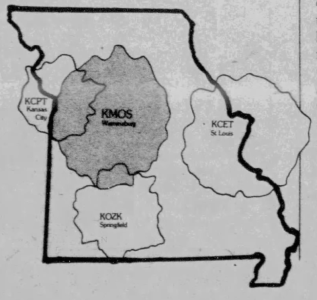
The map of Missouri PBS stations below was published around the time KMOS was about to go back on the air in 1979 (note that it got the call letters of St. Louis PBS station KETC wrong). You can see why KMOS would have been listed in both the Kansas City and Missouri TV Guide editions.

Missouri-PBS-Coverage.png
 
Speaking of the Wild West...Colorado. Note that this was a distinct edition from Denver, something for which Denver-area residents would have been thankful if they had known about it. Even so, Denver stations were listed in the Colorado edition, too, probably because of cable carriage.

This 1978 edition shows that Grand Junction's KREX-TV aired Today at 7 am, Good Morning America at 8 am, and Captain Kangaroo at 9 am. KREX is the channel 5 with the lines through the bullet.

View attachment 7085
This edition was, to use a technical term, a mess, as can be seen from the channel listings. Also note absolutely no UHF channels.
View attachment 7086
It appeared that KTVS, KYCU, and KSTF (black 3, black 5, black 10 respectively) followed almost exactly the same schedule, so I don't know why TV Guide didn't collapse them. TV Guide was somewhat inconsistent about this sort of thing. In New Mexico, TV Guide carried separate listings for Carlsbad's KAVE-TV even well after it became a satellite of El Paso's KELP-TV. On the other hand, the Missouri edition never carried separate listings for Sedalia's KMOS-TV during the time (1961 to 1978) that it was a satellite of KRCG-TV in Jefferson City.

In the Colorado edition, there were no separate listings for KREY-TV (channel 10, Montrose) or KREZ-TV (channel 6, Durango), which were satellites of KREX-TV. So I see some inconsistency even within the same edition!

This is the Everything Bagel of TV Guides. I didn't know such a wide-ranging edition ever even existed. This looks to have been the mothership of the Northern Colorado (Rapid City/Cheyenne/Casper) and Southern Colorado editions. In all likelihood I'll be scouring eBay in the next day or two, to try and find a full edition from this era. This is arguably the most interesting edition of TVG ever.

There's a fair amount of consistency in the channel bullet schemes, with Denver and the KWGN stations in black bullets, and everything else in white bullets, except for KREX which is its own thing entirely (three channel 5s, pretty much had to be). The KWGN stations seem to have run fairly decent local news schedules. KOTA and KDUH seem to have run identical schedules, but it's odd that KOTA is listed as CBS/NBC, while KDUH (call letters signifying the Duhamel family which owned KOTA) is listed as ABC/NBC. Yet more Scottsbluff/Hay Springs submarket madness. (Fun fact, in the 1970s I actually DXed KDUH one time from Kentucky during an e-skip opening, I recall a midday newscast with three men standing at separate pillar-like podiums. Not clear whether that was KOTA being rebroadcast, or a local Nebraska thing.)

This was an edition badly in need of a split.
 
I remember that when CNN first started up, there was an "ooh-ahh" factor of having a 24-hour news channel, something new that people weren't used to.

As to the Vermont TVG channels listed page, I notice that it has those weird-looking channel bullets that TVG began using in some editions for a short period of time. They were hard to read and just plain ugly. I wonder whose idea those where, and why. They soon reverted to the more attractive and familiar channel bullets with which we're all familiar.

That "CBCF" network designation is interesting. They later used "R-C", to signify Société Radio-Canada.
I'm a better writer than this. I promise. I didn't catch this before I posted it, and it's now too late to edit.
 
More on KDUH, which is now KNEP, and is an NBC affiliate that, curiously, is also broadcast on a subchannel of KGWN, this while being a semi-satellite of KNOP in North Platte. Even more curiously, Gray has a second station in the Scottsbluff area, KSTF, which rebroadcasts KGWN.

KNEP - Wikipedia

Strangest TV (sub)market ever.
 
Some time ago, KNEP/KDUH was just a semi-satellite of KOTA Rapid City (ABC). KDUH 4 also had a full-fledged news department.
For much of the first 20 or so years, KDUH was licensed to Hay Springs (near Rushville). That changed in the '80s I think, to Scottsbluff. The signal was seen by a lot of TV DXers each summer given the midwest location, much like KTVS.
KSTF has been a KGWN semi-satellite or satellite the whole time.
 
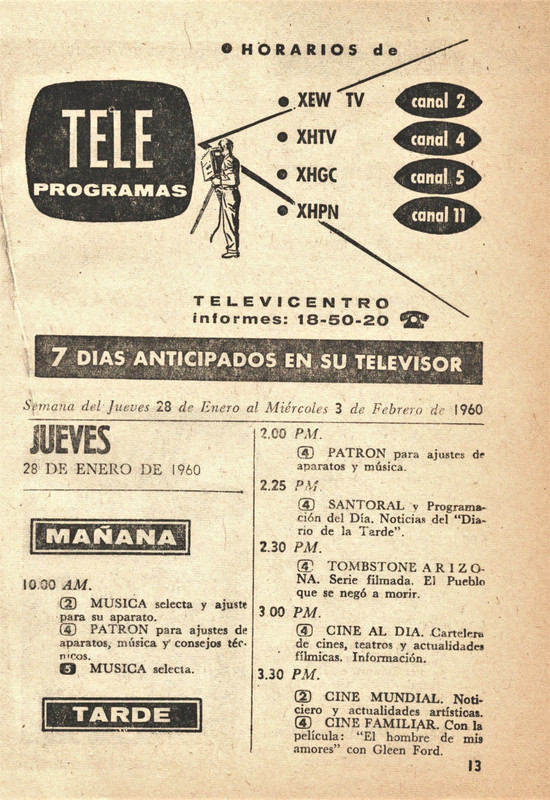
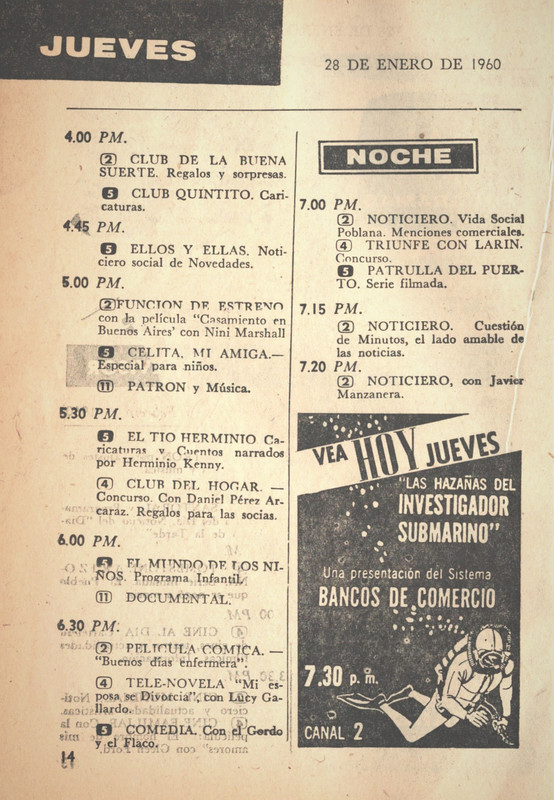
That's a fairly adequate knock-off of TV Guide. Interesting that channel 5 is in a black bullet, and the other four stations are in white bullets.

As a kind of side note, TV Guide equivalents in Europe almost universally list each station in its own column, except for one such magazine I saw from (I think) Italy, the listings are never interlocked. And they never use channel numbers, just network names.
 
This is the Everything Bagel of TV Guides. I didn't know such a wide-ranging edition ever even existed. This looks to have been the mothership of the Northern Colorado (Rapid City/Cheyenne/Casper) and Southern Colorado editions. In all likelihood I'll be scouring eBay in the next day or two, to try and find a full edition from this era. This is arguably the most interesting edition of TVG ever.
One thing to be careful of: there was a separate Denver edition that carried only Denver stations. I don't know exactly when this split happened, so it's something to be mindful of.

There's a fair amount of consistency in the channel bullet schemes, with Denver and the KWGN stations in black bullets,
?? - KWGN was channel 2, an independent in Denver, and you can probably guess who owned it from the call letters. It didn't have anything to do with the stations way outside Colorado.

This was an edition badly in need of a split.
But what could they do, really? Denver/Colorado Springs is a logical grouping, though there's not that much overlap between them (thanks to the Palmer Divide). The Cheyenne station probably could be received in the northern Front Range cities (Fort Collins, Greeley, etc.) so it makes sense to have it in the Colorado edition. Casper probably was pulled in due to Cheyenne. As for Grand Junction, that station was in a one-station market and needed a home somewhere. That said, if it had been up to me, I would have left out Rapid City altogether.

When they were figuring this out in 1955, it wasn't quite so difficult.

TVG.Colorado.1955.02.05.jpeg
Note the complaint about a network show, probably CBS, not being carried live in Denver but carried live in Cheyenne!

Colorado Springs and Pueblo appeared to be separate markets back then, based on the network alignments.

(February 5, 1955 issue)
 
Last edited:
One thing to be careful of: there was a separate Denver edition that carried only Denver stations. I don't know exactly when this split happened, so it's something to be mindful of.

I realize there was a separate Denver edition. It was later sandwiched in between the Northern Colorado and Southern Colorado editions after the split. I'm assuming it was kind of an "island" within the earlier Colorado edition.

?? - KWGN was channel 2, an independent in Denver, and you can probably guess who owned it from the call letters. It didn't have anything to do with the stations way outside Colorado.
No, but to keep matters consistent (looking at you, Montana Edition!), it had a black bullet like all the other Denver stations. It had common ownership with WGN Chicago.

But what could they do, really? Denver/Colorado Springs is a logical grouping, though there's not that much overlap between them (thanks to the Palmer Divide). The Cheyenne station probably could be received in the northern Front Range cities (Fort Collins, Greeley, etc.) so it makes sense to have it in the Colorado edition. Casper probably was pulled in due to Cheyenne. As for Grand Junction, that station was in a one-station market and needed a home somewhere. That said, if it had been up to me, I would have left out Rapid City altogether.

In my mind's eye (sure do wish I had that 1976 TVG editions map back), Rapid City was within that one part of the Lower 48 that was not designated as having any TVG edition at all. TVG probably figured "these folks need a TVG too, let's just throw Rapid City stations into the Colorado edition". It made a certain kind of sense to have western South Dakota and eastern Wyoming in the same edition, moreover, these areas also got Denver on cable, so might as well have the whole array of viewing options within one edition of TVG. And then there are Scottsbluff, Hay Springs, and Sterling to consider. Seems to me a fairly intuitive way to provide one TVG for all of that area.

When they were figuring this out in 1955, it wasn't quite so difficult.

View attachment 7099
Note the complaint about a network show, probably CBS, not being carried live in Denver but carried live in Cheyenne!

Colorado Springs and Pueblo appeared to be separate markets back then, based on the network alignments.

(February 5, 1955 issue)

I don't know where I read this, but I think they were. Back in those days, TV markets weren't as clear-cut as they later came to be. Fast-forward to 2024 and they're pretty much carved in stone.
 
[of Pueblo and Colorado Springs]

I don't know where I read this, but I think they were. Back in those days, TV markets weren't as clear-cut as they later came to be. Fast-forward to 2024 and they're pretty much carved in stone.
Looking at KOAA's history cards, one can see that the station operated at relatively low power (under 14 kw) until 1959, at which time it also moved to a site NE of Pueblo. By 1969 it had gotten FCC approval for dual-city identification with Colorado Springs. I also recall that KOAA had a translator for Colorado Springs on channel 30 (K30AA). KOAA is now sited on Cheyenne Mountain but the translator, now K30JM-D, is also still there, apparently being used for ATSC 3.0.

The upshot is that the market likely consolidated a few years after that TV Guide was published. By 1960, one of the Colorado Springs newspapers shows listings for channels 5, 11 (KKTV), and 13 (KRDO), each with a separate network. KCSJ-TV changed calls to KOAA-TV in 1962.
 
Looking at KOAA's history cards, one can see that the station operated at relatively low power (under 14 kw) until 1959, at which time it also moved to a site NE of Pueblo. By 1969 it had gotten FCC approval for dual-city identification with Colorado Springs. I also recall that KOAA had a translator for Colorado Springs on channel 30 (K30AA). KOAA is now sited on Cheyenne Mountain but the translator, now K30JM-D, is also still there, apparently being used for ATSC 3.0.

The upshot is that the market likely consolidated a few years after that TV Guide was published. By 1960, one of the Colorado Springs newspapers shows listings for channels 5, 11 (KKTV), and 13 (KRDO), each with a separate network. KCSJ-TV changed calls to KOAA-TV in 1962.
KOAA long advertised itself as "5/30", to reflect both the main channel and their Colorado Springs translator. The translator still exists (as K30KM-D) but with the advent of digital, they can now use PSIP to show as "5-1", thus making it transparent to the viewer that they aren't the parent KOAA station (and KOAA is no longer on OTA 5 either).

Another fun fact, I also DXed KOAA in the 1970s in Kentucky during an e-skip opening. Back in those days, there were several low-VHF stations east of the Rockies that weren't impossible to pick up when e-skip conditions were right. I once got KTWO Casper WY in a basement with a single rabbit ear.
 
That's a fairly adequate knock-off of TV Guide. Interesting that channel 5 is in a black bullet, and the other four stations are in white bullets.

As a kind of side note, TV Guide equivalents in Europe almost universally list each station in its own column, except for one such magazine I saw from (I think) Italy, the listings are never interlocked. And they never use channel numbers, just network names.

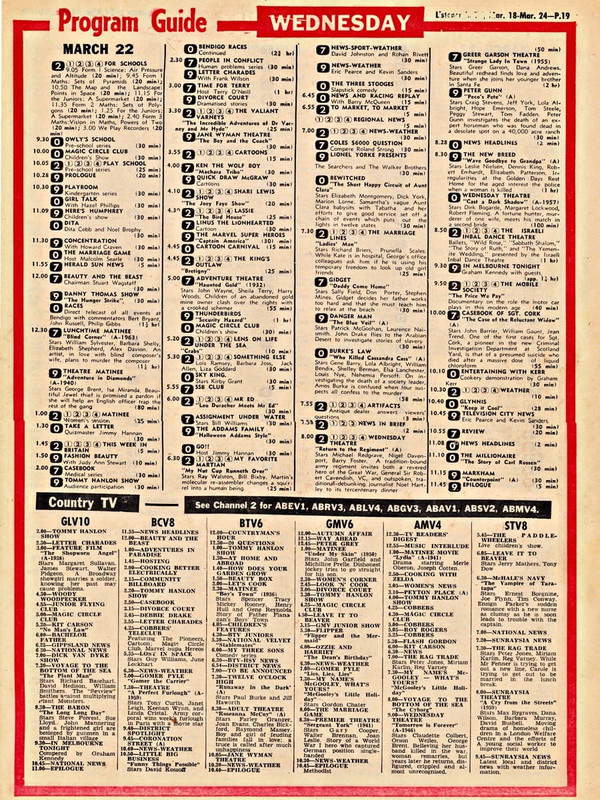
From 1967, here are listings for the Australian state of Victoria, courtesy of TelevisionAU at MediaSpy. The Melbourne stations are listed in the U.S. bullet-based style, while the non-metropolitan Victorian stations (which were then the only commercial stations in their respective markets) are listed in the European style, with a separate column for each station. Eventually, all Australian TV listings publications would move entirely to the European style. You may need to click on the image (twice) to enlarge it:

 
From 1967, here are listings for the Australian state of Victoria, courtesy of TelevisionAU at MediaSpy. The Melbourne stations are listed in the U.S. bullet-based style, while the non-metropolitan Victorian stations (which were then the only commercial stations in their respective markets) are listed in the European style, with a separate column for each station. Eventually, all Australian TV listings publications would move entirely to the European style. You may need to click on the image (twice) to enlarge it:


This is great, thanks for providing it. Just skimming through Television Factbook, it looks like the main networks generally did broadcast on the same channels (7 and 9) in major cities, I'm assuming, to be in tandem and to be able to brand as "Seven", "Nine", and so on. (And, yes, there was a channel 0.) I've always found it interesting that the major Australian commercial networks brand by channel number and not by acronym or name. Israel does something similar.

I'm also assuming that channel 2 was ABC (Australian Broadcasting Corporation), though in their branding, they use ABC and, so far as I am aware, not "2".
 
This is great, thanks for providing it. Just skimming through Television Factbook, it looks like the main networks generally did broadcast on the same channels (7 and 9) in major cities, I'm assuming, to be in tandem and to be able to brand as "Seven", "Nine", and so on. (And, yes, there was a channel 0.) I've always found it interesting that the major Australian commercial networks brand by channel number and not by acronym or name. Israel does something similar.

I'm also assuming that channel 2 was ABC (Australian Broadcasting Corporation), though in their branding, they use ABC and, so far as I am aware, not "2".
The history of Australian TV is fascinating. It's the only major country I can think of where commercial and government TV were both created simultaneously - at the dawn of TV there in 1956, the biggest cities each had two commercial operators and ABC.

The modern Seven, Nine and Ten networks accreted gradually, starting with informal connections between the big-city commercial stations and eventually adding affiliations with smaller independent stations around the country.

In the last 25 years or so, it's turned into a mirror of Canada: each of the commercial networks ended up owning its stations in the big cities (Sydney, Melbourne, Adelaide, Perth) and in some cases the rural affiliates as well, so most of the old local brandings went away and everything is "Seven Darwin" or "Nine Canberra." There's local news in the big cities and not much else local left out there.

And the channel assignments are strange, too - there was the old channel 0 (which largely got moved to 10), plus the weirdness of channel 5A.

It's still a little unusual on a global level in that a lot of the DTV transmitters are on high-VHF (which starts on channel 6 there) instead of being exclusively UHF.

I'd love to do some tower hunting there!
 
This is great, thanks for providing it. Just skimming through Television Factbook, it looks like the main networks generally did broadcast on the same channels (7 and 9) in major cities, I'm assuming, to be in tandem and to be able to brand as "Seven", "Nine", and so on.

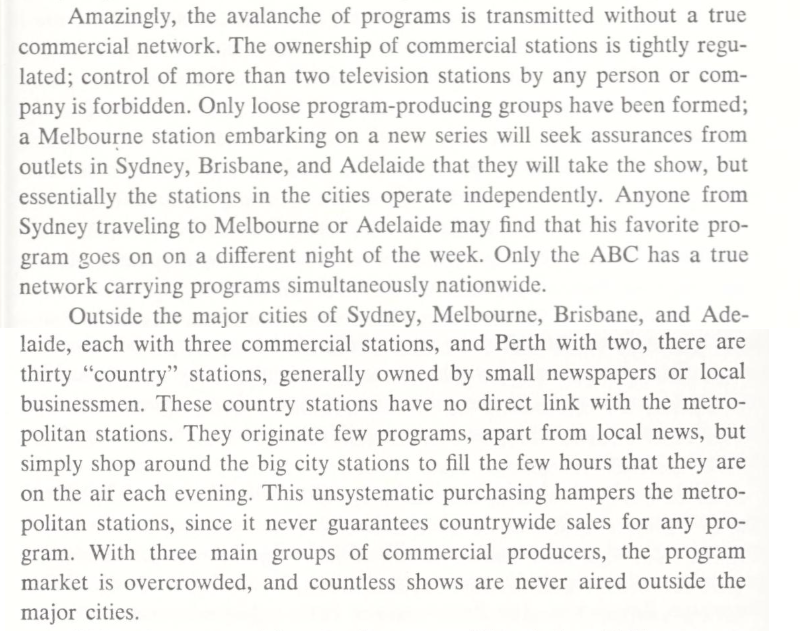
In the early years, Australia's "networks" were really more ad hoc program exchanges, as Timothy Green explains in Universal Eye, his 1972 book about TV around the world:


That began to change later on with the advent of true networks. Curiously, ADS7 and SAS10 in Adelaide found themselves in a bit of a pickle in the 1980s: Because of ownership changes, ADS7 would affiliate with Ten and SAS10 would affiliate with Seven. Compared to the other metro markets, this placed the stations on the "wrong" channels, so in 1987, they swapped their RF channel numbers: ADS7 became ADS10 and SAS10 became SAS7. This is how the swap was reported on the two channels' evening newscasts:


I'm also assuming that channel 2 was ABC (Australian Broadcasting Corporation), though in their branding, they use ABC and, so far as I am aware, not "2".
Yes, the ABC broadcast on Channel 2 in the main metro markets. "ABC" was (and is) their primary on-air brand, but they would occasionally also use "Channel 2," as in this news promo shown in movie theaters:


Back
Top Bottom