• Get involved.
    We want your input!
    Apply for Membership and join the conversations about everything related to broadcasting.

    After we receive your registration, a moderator will review it. After your registration is approved, you will be permitted to post.
    If you use a disposable or false email address, your registration will be rejected.

    After your membership is approved, please take a minute to tell us a little bit about yourself.
    https://www.radiodiscussions.com/forums/introduce-yourself.1088/

    Thanks in advance and have fun!
    RadioDiscussions Administrators

Saving AM Radio

Chattanooga has some of the fastest internet connection speeds in the world, thanks to a fibre-optic network installed by the government-owned electric company, EPB.
The state blocked them from expanding that outside of Chattanooga because Republican donors like Comcast said there would be none of that. Knoxville, where I live is building out a similar system and I can't wait to give Xfinity the heave-ho.
 
Like I said,

“At some point broadband will need to become a utility and made available to everyone.”

Doubt it. Public utilities (power and water) provide the basics for human existence and safety. The Internet doesn't.

Don probably thinks that because telephone service was regulated as a utility for much of its existence, the Internet will eventually be classified as one as well. The reality is that the FCC's previous attempts to do so were thwarted, and even state public utilities regulators have been forced to give up significant areas of oversight.

Case in point: Once upon a time, local telephone service in California was subject to rate tariffs with the state Public Utilities Commission. Not for a couple of decades now, though ... the CPUC is limited to dealing with matters like billing errors or custo,er discrimination. Even the administration of low-income "lifeline" service is out of their hands now.

Don's wishful thinking is just that. It would be a 180° reversal of the deregulation that has found so much favor in recent years.
 
Doubt it. Public utilities (power and water) provide the basics for human existence and safety. The Internet doesn't.
If you talked to regulators before the 1930s-1940s, they wouldn't have considered power to have been "a basic for human existence and safety."

The fact that we see it that way now is the result of progressive politics in that era, which led to agencies such as the TVA and REA and the electrification of rural America.

There's absolutely a good case to be made that solid broadband connectivity is just as vital in the 21st century as power and telephones were in the 20th.

At a bare minimum, it would be nice to see legislation that establishes the right of municipalities to build their own broadband capacity for their citizens. If commercial providers also want to serve those same areas, great - but they shouldn't be able to buy lawmakers to ban municipal broadband projects.
 
Telephone service is still a regulated utility. A lot of what the FCC does has to do with telephone service.
Which is an interesting point. Now that most carriers are sunsetting copper landlines in many communities, is the government going to require carriers to provide smartphones and services? Or is the government?
 
Which is an interesting point. Now that most carriers are sunsetting copper landlines in many communities, is the government going to require carriers to provide smartphones and services? Or is the government?

What seems to be happening is the phone companies are selling that service to other smaller companies.

Here's an article on the subject:


AT&T applied for a waiver that would allow it to stop servicing traditional landlines in California. AT&T and Verizon previously stated they want to be fully operational on newer infrastructure within the next few years.

That’s part of a sweeping move by phone service providers to replace older copper wire-based telephone systems lines, also known as Plain Old Telephone Service (POTS), with faster and more advanced technology that doesn’t work with landlines.
 
Telephone service is still a regulated utility. A lot of what the FCC does has to do with telephone service.

But not in the way that it used to. I moonlighted for one of AT&T's predecessor companies back in the late 1990s when the shift was starting to take place. (I doubt that you also did, so please take into account my personal observations from back then.)

In order for Don's dream to come true, the FCC would need to have broadband service classified as a common carrier. Attempts to do so have failed. The Commission's role in telephone service has dwindled to investigating unauthorized changes in a customer's long distance company and the retirement of copper-based parts of the telephone network.

In fact, AT&T as it now exists includes not only the long distance network that it was left with after the court decision and agreement ("divestiture") of 1982 to break up the Bell System, but several of the Baby Bells ... Pacific Telesis, Southwestern Bell, Ameritech, SNET and Bell South. For that matter, Verizon was created by a merger of GTE and two other Baby Bells ... NYNEX and Bell Atlantic, but they spun off their wireline service to Frontier, which also acquired the former SNET from AT&T.

The FCC had little to say about any of the above that changed the outcome. So much for their role in "regulation".

Internet service will never come close enough to being regulated to the point where Don's prediction will be fulfilled.
 
Which is an interesting point. Now that most carriers are sunsetting copper landlines in many communities, is the government going to require carriers to provide smartphones and services? Or is the government?

No, and that same logic applies to Don's opinion being faulty.
 
What seems to be happening is the phone companies are selling that service to other smaller companies.

Here's an article on the subject:

I can tell you that Verizon recently jacked up 'business' copper landline services by 100% or more. So, say a radio station uses a traditional POTS line at their transmitter site for remote control. In some areas that line that used to cost <$50 a month, now, or will soon cost over $500 a month.

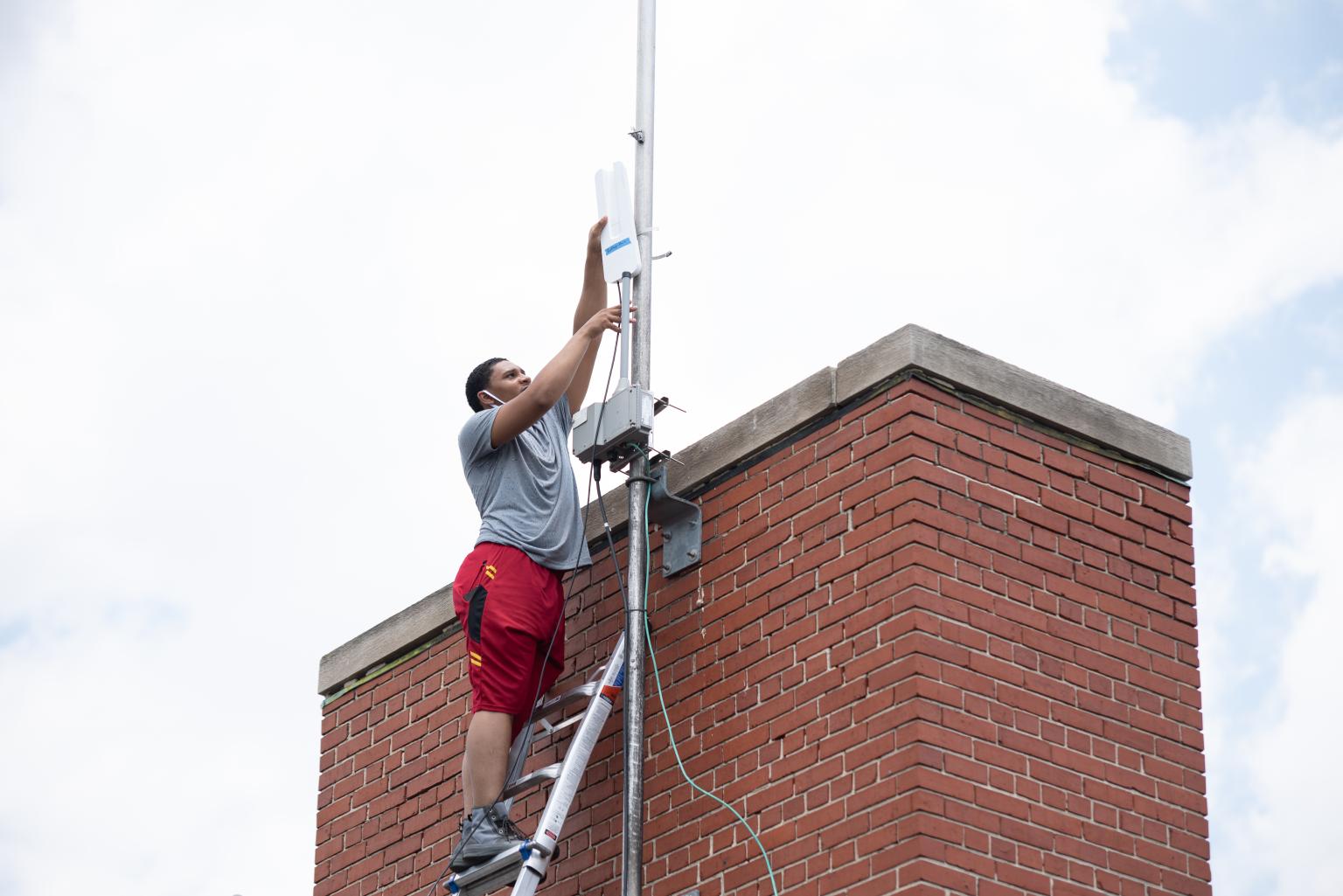
The company I used to work for has several tower/beauty cameras all around Washington, D.C. that use DSL to control the camera. About two years ago Verizon announced without warning that they would no longer be supporting DSL or T1 circuits. We ended up installing Ubquity AirFiber MESH units to each of the cameras which also allow for the cameras to send back 4K video.
 
At a bare minimum, it would be nice to see legislation that establishes the right of municipalities to build their own broadband capacity for their citizens. If commercial providers also want to serve those same areas, great - but they shouldn't be able to buy lawmakers to ban municipal broadband projects.

Even if such a right was established, those same "bought and paid for" lawmakers would find a way to prevent the municipalities from moving forward.

I live in the San Fernando Valley, which is within the city limits of Los Angeles. My electric utility is the city Department of Water and Power. If they could leverage their infrastructure to include broadband, I think they would immediately capture the majority of the households as customers. But if you think for one minute that Charter/Spectrum would go down without a fight -- which might well include court filings to delay the inevitable -- your opinion would be logged in my book as "delusional".
 
At a bare minimum, it would be nice to see legislation that establishes the right of municipalities to build their own broadband capacity for their citizens. If commercial providers also want to serve those same areas, great - but they shouldn't be able to buy lawmakers to ban municipal broadband projects.

Seems to me that happened in Philadelphia. They just couldn't build the infrastructure.


In the early 2000s, Philadelphia aimed to be the first big city to invest in a publicly-owned and operated citywide wireless network. That’s how Wireless Philadelphia, its attempt to make broadband easily accessible and affordable for all Philadelphians through a municipal network, came to be.

The project lacked support from large internet service providers Comcast and Verizon, but ended up accepting a bid from smaller ISP EarthLink.
 
I can tell you that Verizon recently jacked up 'business' copper landline services by 100% or more. So, say a radio station uses a traditional POTS line at their transmitter site for remote control. In some areas that line that used to cost <$50 a month, now, or will soon cost over $500 a month.

The company I used to work for has several tower/beauty cameras all around Washington, D.C. that use DSL to control the camera. About two years ago Verizon announced without warning that they would no longer be supporting DSL or T1 circuits. We ended up installing Ubquity AirFiber MESH units to each of the cameras which also allow for the cameras to send back 4K video.
If copper is being fazed out how will rural areas even get dial up. They will lose all access to any internet.
 
If copper is being fazed out how will rural areas even get dial up. They will lose all access to any internet.

For the most part, the phase out of copper is taking place in urban areas, where businesses (and even a lot of residential customers) have largely already migrated to VoIP and there are fewer and fewer copper landlines in service anyway, due to the increasing tendency for people to make their wireless (cell) their only phone service.

AFAIK, no abandonment of copper is taking place in areas where there does not yet exist a robust replacement infrastructure.
 
Odds are some rural areas, where it's not profitable for a private school company (let alone providing transportation) will have no options if there is no broadband.

One more "we didn't think of that" to happen after the fact. Too many of these ideological "plans" are lacking significant thought about potential unintended consequences.


Back
Top Bottom