• Get involved.
    We want your input!
    Apply for Membership and join the conversations about everything related to broadcasting.

    After we receive your registration, a moderator will review it. After your registration is approved, you will be permitted to post.
    If you use a disposable or false email address, your registration will be rejected.

    After your membership is approved, please take a minute to tell us a little bit about yourself.
    https://www.radiodiscussions.com/forums/introduce-yourself.1088/

    Thanks in advance and have fun!
    RadioDiscussions Administrators

South Jersey new 6 bay antenna on the wvlt tower

just passed the WVLT tower today, noticed a new 6 bay antenna under the normal 3 bay, have not passed it since last summer when it wasn't there...new FM signal, back up or power increase

 
Using a 3-bay antenna for 6000 watts @ 92.1
(2000 watts each).
But 6 bays for only 100 watts @ 92.9
(16.6 watts each) ?

It seems quite a bit unbalanced (inefficient?)
Regarding power consumption...
Although 92.9 is highly directional.

On a related note, Have you seen the directional antenna of nearby 90.5 WVBV (Hope FM) near Hammonton / Egg Harbor City? Their antenna setup is unique, super directional, and optimally setup (literally) using a 4-Yagi Antenna Array, (Class B !!) High up on a Tower off the AC Expressway, Can Focus Nearly All Their Signal (98%) of 21,000 Watts, and Carefully Aimed NW, Pointed ↖️ Optimally Towards Philly & Camden (Medford Lakes / Marlton) For Optimum Results in That Direction.

The Hope FM (WVBV) setup sends almost no signal (2%) SE towards ACY, because the station is currently simulcast on Atlantic City on the same channel (90.5 / WWFP - Which Recently Upgraded to 730 Watts directional, away from NW) and setup so theoretically, they don't (shouldn't) overlap.

.... i.e. ..Midway between their 2 signals, Near the area of Garden State Parkway @ AC Expressway Intersection / Mays Landing / Pomona / ACY Airport.
 
Last edited:
Using a 3-bay antenna for 6000 watts @ 92.1
(2000 watts each).
But 6 bays for only 100 watts @ 92.9
(16.6 watts each) ?

It seems quite a bit unbalanced (inefficient?)
Regarding power consumption...
Although 92.9 is highly directional.
There's a reason: when you use multiple bays, you significantly reduce downward radiation, which is sometimes necessary in order to provide the necessary second-adjacent protection, in this case to WMMR and WXTU.

Also, your math is off. Multiple bay antennas have higher gain, which means lower transmitter output power is needed to yield the licensed ERP.

WVLT uses 5350 watts TPO to make 6 kW ERP - there's some antenna gain, offset by transmission line loss going up the tower.

The 92.9 translator uses 65 watts TPO to make 100 watts ERP - there's more antenna gain with six bays, again offset by transmission line loss.
 
Yup some of that signal naturally leaks thru the cable, so that makes sense (figure like 5 - 10% / adjusting for that loss) and perhaps shorter or thicker cables would perform better.
 
Yup some of that signal naturally leaks thru the cable, so that makes sense (figure like 5 - 10% / adjusting for that loss) and perhaps shorter or thicker cables would perform better.
It doesn't "leak through the cable" - you'd have a bad cable in that case. There's simply signal attenuation that happens along a transmission line, and you're quite correct that the larger the line diameter and the shorter the cable, the less the loss.

For any given type of line, there's a published figure for line loss, measured in dB/foot. That's part of the calculation an engineer does to find up with the correct TPO figure to yield the licensed ERP.
 
Yup some of that signal naturally leaks thru the cable, so that makes sense (figure like 5 - 10% / adjusting for that loss) and perhaps shorter or thicker cables would perform better.
It's not leakage that causes attenuation, it is the natural loss in specific lengths of coaxial cable.

Most FM coax is not the stuff your cable company uses (a solid or stranded conductor, some plastic around it, a mesh of copper threads around that and some insulating and protective plastic to coat it) but solid tubes of copper with an inner central conductor with some kind of dielectric to keep the center conductor in place. All this is generally put into a vacuum or inert gas with zero humidity.

Some high power coax is bigger in diameter than the main water pipes coming into your home.

Talk to someone from your power company about how much generated power is lost in the system that gets it to your home or business.
 
Using a 3-bay antenna for 6000 watts @ 92.1
(2000 watts each).
It's not that each bay is "fed" equal pieces of the total power. The antenna is set up so that the power self-distributes itself across them all due to the way it is designed... sort of like how all the little holes in your shower drain each take an equal portion of the water flowing out.
 
Yes, some of the power generated in the transmitter is attenuated before being sent out by the antenna(s) so the antenna setup gain can make good use of the RF, would be nice to test that for optimum performance.

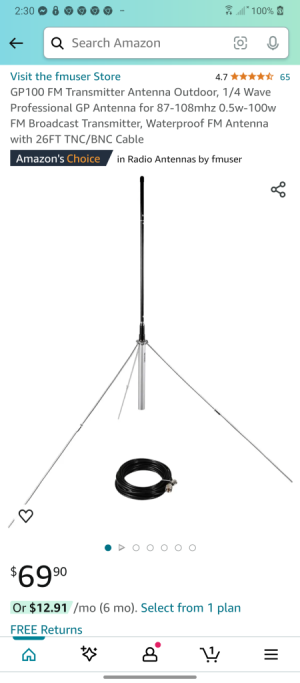
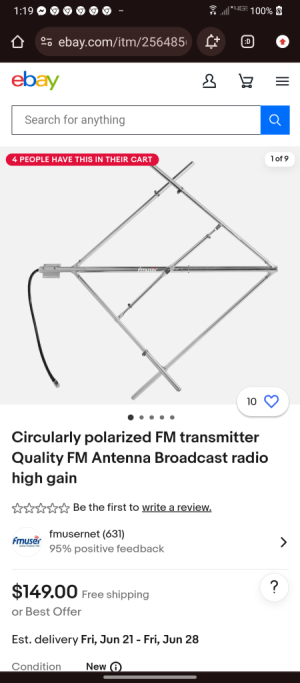
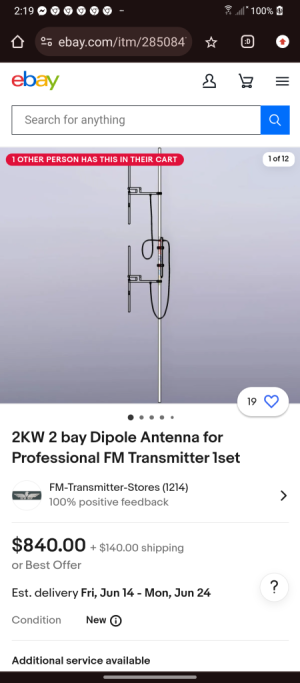
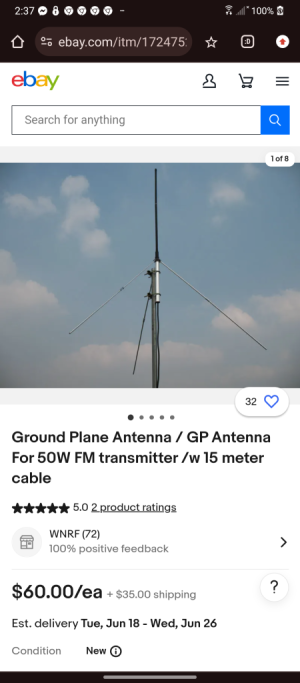
Also, not sure if these could perform just as well (For Low Power Application) but maybe if you're familiar with these examples from China, (see attached files),

Maybe there would there be a difference in performance, for example, using this Horizontal "Ground Plane" Setup...1/4 or 1/2 Wavelength & Cheap, and it Seems Efficient by Design (?!) ...There's also a "polarized" bay setup. Supposedly those can handle 100+ watts, but perhaps not sure how efficient, or if FCC approves for anything besides LPFM status. Thoughts?

I also found a reasonable 2-Bay Dipole that handles up to 2 kW. It seems these are for other setups & not within FCC standards. Other FM Antennas (especially Directional Arrays) Cost way more $$ than these.
 

Attachments

  • Screenshot_20240608-023700.png
    Screenshot_20240608-023700.png
    166.5 KB · Views: 4
  • Screenshot_20240608-023007.png
    Screenshot_20240608-023007.png
    109.5 KB · Views: 4
  • Screenshot_20240608-011957.png
    Screenshot_20240608-011957.png
    133.4 KB · Views: 4
  • Screenshot_20240608-021901.png
    Screenshot_20240608-021901.png
    131.5 KB · Views: 4
Last edited:
Yes, some of the power generated in the transmitter is attenuated before being sent out by the antenna(s) so the antenna setup gain can make good use of the RF, would be nice to test that for optimum performance.

Also, not sure if these could perform just as well (For Low Power Application) but maybe if you're familiar with these examples from China, (see attached files),
Going back to when I built the first FM in northern South America in 1965, here are a couple of anecdotal items:

I had several successful AM stations, each one #1 in its target socioeconomic level. So I was making money, despite there being about 40 other AMs on the dial locally in Quito, Ecuador. My career began at an FM, so I wanted to try to make one work... as the one I started at certainly was the prototype of failure!

I asked for a license. The friend in the Telecommunications Ministry asked, "what for?" and I sort of explained that it was a personal thing, sort of like ham radio to others. He then asked, "How many do you want?". So I got one for each AM, and then 2 independent ones in Quito and a bunch of others all over the country.

To practice, I built 20 watt transmitters to use as STLs for my AMs with the help of some HCJB engineers. I used mostly military surplus parts available locally. Rather than spend thousands for an imported antenna and thousands more in customs, I got some CB antennas like your picture #2 of a vertical radiator with several diagonal counterpoise elements. I cut them down to the FM wavelength of my first trial FM, and used lossy RG cable which is like what your cable guy pulls into your house.

It worked. I had an FM that could send my AM audio from the studio to the transmitter. It was not elegant, but it worked and it tested as clean as any commercial FM rig.

Did all the power get to the antenna? No, a lot was lost in about 50 meters of coax. Was the antenna perfectly matched? No, but it did not produce enough standing wave to knock us off the air.

When I had the three AMs using FM links, the first independent FM was built. Same idea: cheap parts, home-made coils and the like. And the antenna was made using air conditioning copper tubing and electric power line insulators as mounts. We did vertical only, which we never stopped doing as it worked best in the rugged Andes terrain. We used a Philips test bench stereo generator that was modified to take audio as a stereo generator.

We had FM stereo around 1966. We made money within a year.

So yes, you can do it with cheap stuff. It will not cover as well as a good antenna and be as reliable as a good transmitter. But it was home-made and it worked, which was fine when our competitors laughed at us for putting on an FM station.
 
Yes, some of the power generated in the transmitter is attenuated before being sent out by the antenna(s) so the antenna setup gain can make good use of the RF, would be nice to test that for optimum performance.

This is a little confusing and I'm not sure what you're asking.

In an ideal world, every watt that comes out of the transmitter should go straight into the antenna. This is not an ideal world, of course, so there's always some amount of attenuation - but all that attenuation is just wasted power. If there's too much power going to the antenna for some reason, the way to fix that is to turn down the output power on the transmitter, not to deliberately attenuate it along the way. Otherwise, you're just wasting electricity.

I'm also not sure what you mean by "test that for optimum performance." There's not a lot of mystery to FM transmission systems these days. Reputable antenna manufacturers publish the data on their antennas to tell us exactly how much gain their antenna generates, and transmission line loss is a known quantity as well, published by the line manufacturers. So it's all just math: if your antenna has 1 dB gain and you have 2.5 dB loss in your line, your total transmission system gain is actually -1.5 dB loss, and so your transmitter needs to put out 1.5 dB above the ERP to meet your licensed power.

Also, not sure if these could perform just as well (For Low Power Application) but maybe if you're familiar with these examples from China, (see attached files),

Maybe there would there be a difference in performance, for example, using this Horizontal "Ground Plane" Setup...1/4 or 1/2 Wavelength & Cheap, and it Seems Efficient by Design (?!) ...There's also a "polarized" bay setup. Supposedly those can handle 100+ watts, but perhaps not sure how efficient, or if FCC approves for anything besides LPFM status. Thoughts?

I also found a reasonable 2-Bay Dipole that handles up to 2 kW. It seems these are for other setups & not within FCC standards. Other FM Antennas (especially Directional Arrays) Cost way more $$ than these.

You get what you pay for. Those cheap Chinese antennas might work just OK for an LPFM station, but I still would never recommend one to a client, for two reasons.

First, you always want circular (H+V) polarization unless the terms of your license dictate otherwise (usually for protection of a channel 6 TV signal, by using vertical only.) That's the best way to make sure portable and car radios can hear your signal. Those ground plane antennas won't do that for you.

Second, it's false economy. If your antenna is mounted on a tower, expect to pay well into four figures for a climber these days every time you need to send someone up to do antenna work. I don't know about you, but I'd rather pay a little more for a quality antenna from a known manufacturer and send a climber up ONCE to install it, rather than cheap out on an antenna that might fail in a year or two and require a climber to go back up to replace it.

Until you get into high power, reputable antennas aren't all that expensive, even compared to the Chinese cheapies.

And for this specific situation, it doesn't matter whether you use a Chinese cheapie or a reputable antenna - you still need all six antenna bays for this 92.9 translator because that's the only way you can put an antenna at that height and still provide the protection required by FCC rules to WXTU and WMMR at ground level. Fewer than six bays and you have too much downward radiation, which creates interference (at least on paper!)
 
I meant, field testing (Perhaps the whole reason for a CP Before Licensing) Trying different antenna types and setups, some may work better or worse than others, in less than ideal conditions, or power levels. Ground Plane setups I would think for Omni Directional Setups, since the whole point of that types to send all the RF energy radiating toward the horizon in all directions, but without being vertically polarized (difference?) I would think it would limit upward tilt ? (Heck, Maybe Using Parabolic Dishes would be interesting in that case, if that's possible).

I've seen cellular antennas with their "beam" pointed at different angles, so someone standing right under a cell site, wouldn't have as strong a signal as someone a few hundred feet away, but in direct path of the Signal Beam's Aim.

Another Good Example is Field Testing Signal Strength of Multi Tower AM Radio Arrays. I remember long ago driving around the site for 1160 AM near Lakewood NJ (was WOBM, now WJLK) whose site is next to US-9 in Howell NJ, and it sends almost no signal to the north. I remember watching the signal drop in real time, shortly after passing the 4-Tower Site (while still visible) going north on US-9, and was almost gone completely just a few miles up the road, Past 195 into Freehold.

But Flip that 180° and try passing that Site Going South on US-9 almost into Lakewood, Signal Starts Booming while entering their Eastern & SE Lobe, Signal Gain increases noticeably / exponentially, even from the same distance - just going in the other direction. It was that way for many more miles South, as the only strong AM station in that area, Especially the Northern Part of Ocean County NJ.

Now its used to extend 94.3 WJLK's station coverage into Ocean County (on 104.1 W281CK) somehow using 225 watts (not the full 250)? but still gets out well, almost as good as Nearly 1500 watts @ 92.7 (WOBM) which is also on the same tower.
 
Last edited:
I don’t understand any of this stuff but it’s interesting nonetheless. But since this thread started with a conversation about WVLT, I’ve noticed that they cut out sometimes when I’m sitting at a traffic light much like AM radio. But once I’m through the intersection it comes back on. Could this have anything to do with how the tower is set up or is it just that I’m on the fringe of the signal at times? Or both?
 
I was wondering, why couldn't they piggyback off the 92.1 bays,, less work and easier to do all around. I do not think any Philly signals do this, room for many towers, but I know some areas with limited land space to erect more towers do this, the Empire must have more than two signals on one set of bays...
 
I was wondering, why couldn't they piggyback off the 92.1 bays,, less work and easier to do all around. I do not think any Philly signals do this, room for many towers, but I know some areas with limited land space to erect more towers do this, the Empire must have more than two signals on one set of bays...

FM antennas are tuned to specific frequencies, and the spacing between bays is based on the wavelength (and thus the frequency) for which the antenna is designed.

There are broadband antenna designs that can be used for multiple stations at once, but they're not cheap, and they require expensive combiners (big tuned filters) to allow multiple transmitters to feed a single antenna. If space isn't at a premium (as it is in NYC or Chicago), it's usually cheaper to use separate antennas.
 
Status
This thread has been closed due to inactivity. You can create a new thread to discuss this topic.


Back
Top Bottom