• Get involved.
    We want your input!
    Apply for Membership and join the conversations about everything related to broadcasting.

    After we receive your registration, a moderator will review it. After your registration is approved, you will be permitted to post.
    If you use a disposable or false email address, your registration will be rejected.

    After your membership is approved, please take a minute to tell us a little bit about yourself.
    https://www.radiodiscussions.com/forums/introduce-yourself.1088/

    Thanks in advance and have fun!
    RadioDiscussions Administrators

Saving AM Radio

Every crappy AM station I hear on my radio, I just ask, "Please, let me fix you!"

Given the discussion (or is it an argument by now?) you are having with Kelly, I don't believe your "fix" could both comply with the standards as regulated and sound good enough to overcome all of the interference problems which remain a huge stumbling block to being attractive to listeners.

The only "fix" that could be reasonably guaranteed to work -- and even then, not universally -- would be a combination of the following three courses of action:
  1. Mandate that every electric utility company, private or municipal, audit their transmission systems and either repair or replace any infrastructure that causes interference to AM. It would not be difficult for the FCC to justify this as a matter of protecting a licensed service, but the utilities would scream bloody murder.
  2. Force the replacement of any kind of lighting that also causes interference. In the case of branded LED bulbs, have a mandated exchange program between the manufacturer and consumer. For all the rest, subsidize the replacement conditioned on the offending bulbs being surrendered for proper e-cycling.
  3. Similarly, deal with the "wall warts" on the basis of replacement if the product it came with was made (or distributed, or sold) by a company still in business, otherwise subsidize generic replacements and require e-cycling.
This is all going to cost, as contestants on Press Your Luck still scream, "BIG BUCKS!" So now it becomes a question of "how much is too much" in order to keep that band viable. We're talking $millions here ... at the very least.

If we do nothing concrete about this, AM is going to remain the place where small niche ethnic audiences, some religious and talk (including sports-oriented) formats, and musical genres which are so close to death that the listening public already believes they are, end up. And there are a finite number of viable options for AM stations, so there will still be attrition.

And I still believe that translators did not "save" AM, as the FCC had claimed when they approved the "tied license" ones. It just made it easier for AMs to migrate their audience to FM, and I still think that eventually the Commission will let those AMs go silent as well and license the translators as a regular class of service with the current 250-watt ERP and restrictions on subsequent moves, modifications, and sales of same. That will actually do more to reduce interference on AM, since there will be considerably fewer stations with signal overlap (including that caused by atmospheric propagation).
 
Absolutely. It is amazing that Armstrong was given the task of creating a "static free" system by Sarnoff. He came up with FM, but by then Sarnoff had realized that there was to be more money in TV; he did not want FM taking small dollars from consumers when he could get big bucks by selling TV sets. So FM was thwarted and it took Armstrong's brilliant creation about three decades to become useful and viable.

And Sarnoff even gave the appearance of "softening the blow" by proposing that FM be the standard for audio transmission on analog TV ... then proceeded on that basis, leaving Armstrong out in the cold.

Every report I have read on Armstrong's suicide indicates that he was driven to it by the herculean task of fighting RCA in court for patent infringement. A sad end to the life of a brilliant man.
 
David: Do you know in what time period set manufacturers started including FM in their radios?. I seem to recall ,as a child, my Grandfather having this big console with AM, FM and Short Wave in it. And even in the 1950's it looked old and weathered.
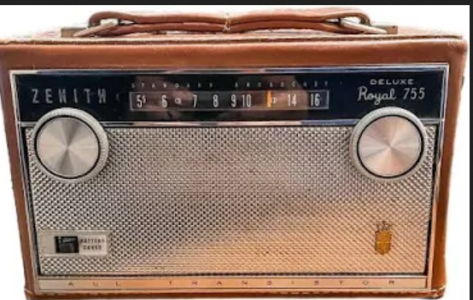
Good question. I know that I bought a Zenith "portable" radio in '59 that had FM. It was an amazing radio, in an all leather wrapped box-style case.

It looked somewhat like this:

1718127654249.png

Before that, I don't know about radios that had FM. But since there were over 1000 FMs on by 1950, obviously there were radios. The interest was so small that by 1960, the number of FM stations had declined to around 700.

I bought mine with my first paycheck from WCUY (FM) so I could listen to the station I did part time at. It took me over two months at a buck ten an hour to pay for it.

Biggest issue: there was no AFC on FM then, and the signals drifted, even on a transistorized radio.
 
  1. Mandate that every electric utility company, private or municipal, audit their transmission systems and either repair or replace any infrastructure that causes interference to AM. It would not be difficult for the FCC to justify this as a matter of protecting a licensed service, but the utilities would scream bloody murder.
There were transmission towers that were an older design and I got more interference on the one station whose music I liked. The power company's response? Listen to FM. Actually, back then FM wasn't nearly as bad.
This is all going to cost, as contestants on Press Your Luck still scream, "BIG BUCKS!" So now it becomes a question of "how much is too much" in order to keep that band viable. We're talking $millions here ... at the very least.
And the AM stations that can't handle the cost ... get the Whammy.
 
Every report I have read on Armstrong's suicide indicates that he was driven to it by the herculean task of fighting RCA in court for patent infringement. A sad end to the life of a brilliant man.
😢
 
I seem to recall ,as a child, my Grandfather having this big console with AM, FM and Short Wave in it. And even in the 1950's it looked old and weathered.

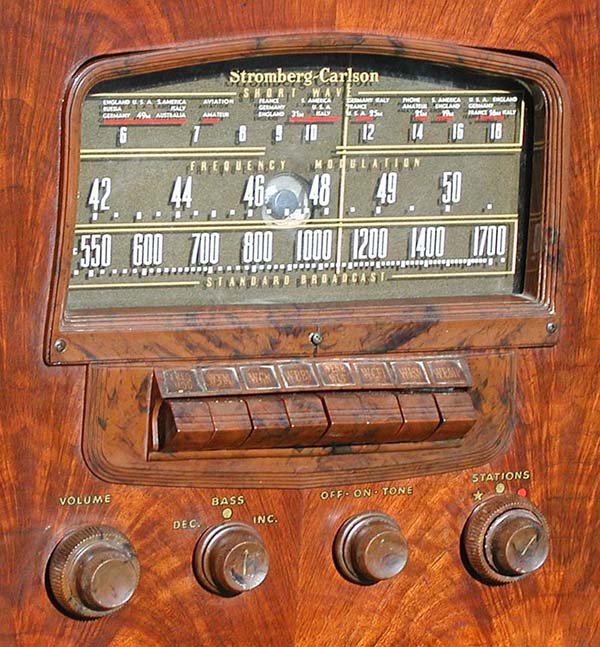
I'm not David (nor do I play him on TV) but that sounds to me as if the console was manufactured during the period when FM was licensed for frequencies in the 42-50mc band. The move to the present band was mandated in 1946, although it took almost two years for every affected station to move.

Here's a picture of a typical console radio's tuning dial from that era. I imagine this is similar to what your grandfather's radio had:
stromberg435md.jpg
 
I'm not David (nor do I play him on TV) but that sounds to me as if the console was manufactured during the period when FM was licensed for frequencies in the 42-50mc band. The move to the present band was mandated in 1946, although it took almost two years for every affected station to move.

Here's a picture of a typical console radio's tuning dial from that era. I imagine this is similar to what your grandfather's radio had:
stromberg435md.jpg
I tried to click on the picture but it does not open.
 
Strange. It displayed as an embedded image here. Perhaps some browser issue.

Here is the page that I linked the image from:
It is the last image on the page.
Thanks for the pictures. My Grandfather's radio was a Zenith. I don't remember much about the FM dial because in those days FM either simulcasted the AM sister or played Classical. As a kid I did not care much about higher fidelity or Beethoven.
But the AM was a beast! I could get 50kw stations from Chicago, Detroit and Cleveland, even in the daytime in Southern Ohio and at night. It was a Radio DXer's dream. I could get 5 New York city stations with no fade. As well as Boston, Philly and WSM Nashville like it was next door.
New Orleans, Dallas, Atlanta, even Denver on a good night.
Didn't have to worry about wall warts and microwave ovens and EV cars in those days!
 
I have. Shitty sounding AM stations are someone's fault. NRSC laid out the parameters for the frequency response and occupied bandwidth of an AM station, and this must be checked yearly. When this does not happen. It's because either the engineer isn't getting paid to do it, or the engineer is apathetic/lazy and thinks it isn't necessary. This is a qualified statement. Any solid state transmitter and audio processor made in the last 40 years is capable of meeting the specifications. If every station spent a few hours a year on audio quality/NRSC, we as an industry could eliminate one of the common complaints that listeners have. We are doing this to ourselves. There really is no excuse for bad sounding AM stations.
I have to say it again: the poor quality sound of AM radio is due to the receivers. Most stations are doing everything they can to make their station more competitive by transmitting the best quality audio for their format. AM sounds bad because your radio sounds bad. It's not the station!
 
I have to add another point. Those of us that have worked in broadcasting, AM radio in particular, know exactly what is going from the console/board into the transmitter, and the antenna system. . No one would invest money to design, manufacture and sell equipment that produces as an end-result, audio that sounds like an old-school carbon microphone telephone system, and then actually get professionals to buy such junk. I understand why the general public thinks the stations sound bad, but people in the industry should know better.
 
99% negative mod on AM is not a particularly good idea. Best to keep it 90-95% to minimize distortion.
I agree only because what the meter reads is often a bit off. Keeping negatives at a bit under 100% makes little real difference and avoids any unseen peaks with carrier supression. I personally don't like positives over 100% either as some of the newer "radio on a chip" receivers don't seem to like them as well as older radios.

Some of the newer radios are software defined radios (SDR) https://www.sciencedirect.com/topics/engineering/software-defined-radio These radios behave a bit differently when subjected to big local stations with intense modulation.

Back when I was doing engineering, whenever we modified the audio chain, or adjusted a unit, we'd go from car to car in the parking lot, listening to each staffer's radio and asking them how it sounded. We also had a set of table and portable radios we'd all listen to. Of course, that was back in the day when an AM could do music and be at the top of the book!
 
I have to say it again: the poor quality sound of AM radio is due to the receivers. Most stations are doing everything they can to make their station more competitive by transmitting the best quality audio for their format. AM sounds bad because your radio sounds bad. It's not the station!
I'd argue it's at least four things:
1. The MW band. It's loaded with noise and is long enough wavelength that it is susceptible to electrical noise and Faraday Cage effects at the receiving point. And noise is cumulative. No better quality radio will fix that.
2. Inconsistent methods of transmission. That included 'narrow-banded' antenna systems or poorly maintained systems not presenting a correct load to the transmitter.
3. SDR receivers programmed for voice grade. And you can't blame the electronics manufacturers for that. Manufacturers need to be cautious about controlling the user experience given all the talk stations on AM, it's not worth loosening the filters when the only thing being transmitted is a human voice and spots.
4. Aggressive audio processing. Again, a double-edged sword. Given the ever-increasing noise floor, stations need every advantage to stay over the noise. That means asymmetrical audio nailed to 99% negative and 124.5% positive. And for voice? Not a problem since few if any serious broadcasters are naive enough to play music on AM, they can take the distortion hit.
 
I'd argue it's at least four things:
1. The MW band. It's loaded with noise and is long enough wavelength that it is susceptible to electrical noise and Faraday Cage effects at the receiving point. And noise is cumulative. No better quality radio will fix that.
2. Inconsistent methods of transmission. That included 'narrow-banded' antenna systems or poorly maintained systems not presenting a correct load to the transmitter.
3. SDR receivers programmed for voice grade. And you can't blame the electronics manufacturers for that. Manufacturers need to be cautious about controlling the user experience given all the talk stations on AM, it's not worth loosening the filters when the only thing being transmitted is a human voice and spots.
4. Aggressive audio processing. Again, a double-edged sword. Given the ever-increasing noise floor, stations need every advantage to stay over the noise. That means asymmetrical audio nailed to 99% negative and 124.5% positive. And for voice? Not a problem since few if any serious broadcasters are naive enough to play music on AM, they can take the distortion hit.
I was talking about quality of receivers. Not man-made or natural noise. And I was referring to stations primarily in major markets.
incidentally, even at near 99% percent negative and high positive modulation, a station can still sound pretty good in a hi-fi type receiver.
 
I agree only because what the meter reads is often a bit off. Keeping negatives at a bit under 100% makes little real difference and avoids any unseen peaks with carrier supression. I personally don't like positives over 100% either as some of the newer "radio on a chip" receivers don't seem to like them as well as older radios.

Some of the newer radios are software defined radios (SDR) https://www.sciencedirect.com/topics/engineering/software-defined-radio These radios behave a bit differently when subjected to big local stations with intense modulation.

Back when I was doing engineering, whenever we modified the audio chain, or adjusted a unit, we'd go from car to car in the parking lot, listening to each staffer's radio and asking them how it sounded. We also had a set of table and portable radios we'd all listen to. Of course, that was back in the day when an AM could do music and be at the top of the book!
indeed David, I think that the existing FCC rules still prohibit negative modulation exceeding 99% as at 100% you're transmitting only the sidebands. Distortion City. You'd need a synchronous detector in radios to make sense of it.
 
I was talking about quality of receivers. Not man-made or natural noise. And I was referring to stations primarily in major markets.
incidentally, even at near 99% percent negative and high positive modulation, a station can still sound pretty good in a hi-fi type receiver.
I suppose by definition someone scraping an aluminum pizza pan with the teeth of a fork would sound good to someone.
The fact is an AM/MW receiver would be used for receiving AM signals on a noisy, inferior band. Pretty good? As compared to what, the pizza pan scenario? I'll give you that.
The facts are that anything on AM is technically and audibly inferior to FM or streaming.
But hey, you could design and manufacture a new kind of AM radio. Call it the 'Turd Polisher 1000'.
 
Last edited:
I suppose by definition someone scraping an aluminum pizza pan with the teeth of a fork would sound good to someone.
The fact is an AM/MW receiver would be used for receiving AM signals on a noisy, inferior band. Pretty good? As compared to what, the pizza pan scenario? I'll give you that.
The facts are that anything on AM is technically and audibly inferior to FM or streaming.
This is not so in all circumstances. Technically yes, but in terms of what you actually hear, not necessarily.
 
I have to say it again: the poor quality sound of AM radio is due to the receivers. Most stations are doing everything they can to make their station more competitive by transmitting the best quality audio for their format. AM sounds bad because your radio sounds bad. It's not the station!
I can attest to this to an extent.

For example, KCBS sounds pretty bad in the car (muffled and difficult to hear if we're driving on a noisy road), but I can tune it in on my Sony SRF-A100, and even in DX/narrow mode, it sounds quite a bit better (it sounds fantastic in local/wideband mode, of course).

So with a decent receiver, stations can still sound OK. Even the less good sounding ones can sound better.

The facts are that anything on AM is technically and audibly inferior to FM or streaming.
In practice, yes.

Under "laboratory" conditions, though, I've found that, again, in wideband stereo mode on my SRF-A100, my Part 15 actually sounds really good. Almost as good as FM, in my opinion (it helps that I have taken great pains to ensure that my processing sounds as good and as transparent as it can, which has taken much trial and error because I learned as I went). I also broadcast in stereo, so that makes a difference too (everything sounds better in S-T-E-R-E-O!!! 😛).

On my car's radio? It sounds about as muffled and indecipherable as KCBS does, so is all that time and effort spent on processing (and transmitting in stereo) a waste? Maybe so, but not to the one or two other people who might care to listen in on a decent receiver.

c


Back
Top Bottom