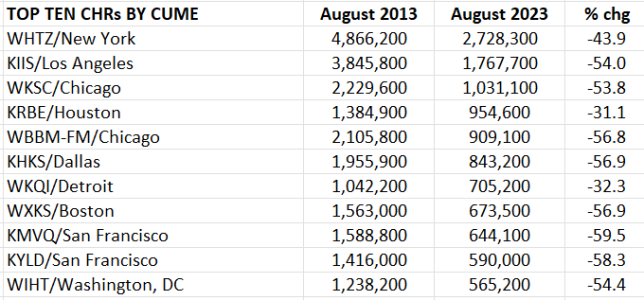
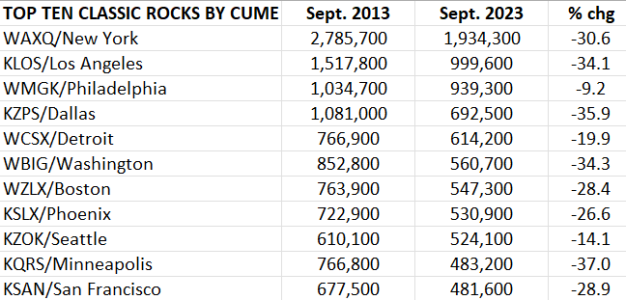
Several people (notably including David Eduardo) have commented on the rather substantial loss in radio listening that has occurred over the past couple of decades, but I've been looking at a way to quantify it. If I want an idea of what radio listening levels used to be, old copies of the "The M Street Radio Directory" included average listenership for radio stations between 6 AM and Midnight for many years -- and that information can provide a baseline to compare to more recent data.
But what to compare that baseline against, since "The M Street Radio Directory" is long gone? Well, All Access provides audience data with their station playlists, along with number of plays. For example, as of right now, the most played song on KHKS in the Dallas/Fort Worth market is "Saturn" from SZA, with 106 plays and a total audience from those plays of 878,900. To get a rough average audience for the station, simply divide 878,900 by 106, which gives an average audience of per play of 8,292. For comparison, the 2000 edition of M Street shows an average audience for that same station of 41,100.
That's a drop of 80%, right? Well, it's not quite as easy as that, because the All Access numbers are going to be somewhat lower because they include they presumably include the average audience from overnight plays when listenership is really low. So the actual drop is presumably a little less...but still...it's going to be a big drop. And, yes, the audience share for KHKS has dropped significantly between 2000 (7.0 share) and 2024 (4.0 share in February)...but nowhere near enough to account for that big a drop.
So how big is the drop. In 2000, it looks like a single share point in the DFW market accounted for an average listenership between 6 AM and Midnight of about 5900 people. In 2024, it looks like a single share point might account for an average listenership over the full day of about 2200 people. Take out the low-rated overnights and maybe that number goes up to 2800 or 2900 people. Notably, that's just under half what it was in 2000 -- and that's despite the fact that there's been some rather dramatic population growth here in that 24 year period.
I tried doing a similar analysis for the Seattle/Tacoma market (where I grew up), with similar results. In the year 2000, a single share point was worth about 4100 listeners average between 6 AM and midnight. Today it looks like a single share point is worth not more than 1400 average listeners on a 24 hour basis (maybe 1800 average listeners when we take out overnights). So that's an even bigger drop -- and, again, this is a market that has been gaining people.
So if that analysis is correct, in both markets I'm seeing that a radio share point is worth less than half what it was 24 years ago in terms of average number of listeners.
To those in the industry, how close is this analysis to the reality?
But what to compare that baseline against, since "The M Street Radio Directory" is long gone? Well, All Access provides audience data with their station playlists, along with number of plays. For example, as of right now, the most played song on KHKS in the Dallas/Fort Worth market is "Saturn" from SZA, with 106 plays and a total audience from those plays of 878,900. To get a rough average audience for the station, simply divide 878,900 by 106, which gives an average audience of per play of 8,292. For comparison, the 2000 edition of M Street shows an average audience for that same station of 41,100.
That's a drop of 80%, right? Well, it's not quite as easy as that, because the All Access numbers are going to be somewhat lower because they include they presumably include the average audience from overnight plays when listenership is really low. So the actual drop is presumably a little less...but still...it's going to be a big drop. And, yes, the audience share for KHKS has dropped significantly between 2000 (7.0 share) and 2024 (4.0 share in February)...but nowhere near enough to account for that big a drop.
So how big is the drop. In 2000, it looks like a single share point in the DFW market accounted for an average listenership between 6 AM and Midnight of about 5900 people. In 2024, it looks like a single share point might account for an average listenership over the full day of about 2200 people. Take out the low-rated overnights and maybe that number goes up to 2800 or 2900 people. Notably, that's just under half what it was in 2000 -- and that's despite the fact that there's been some rather dramatic population growth here in that 24 year period.
I tried doing a similar analysis for the Seattle/Tacoma market (where I grew up), with similar results. In the year 2000, a single share point was worth about 4100 listeners average between 6 AM and midnight. Today it looks like a single share point is worth not more than 1400 average listeners on a 24 hour basis (maybe 1800 average listeners when we take out overnights). So that's an even bigger drop -- and, again, this is a market that has been gaining people.
So if that analysis is correct, in both markets I'm seeing that a radio share point is worth less than half what it was 24 years ago in terms of average number of listeners.
To those in the industry, how close is this analysis to the reality?