
-
Get involved.
We want your input!
Apply for Membership and join the conversations about everything related to broadcasting.
After we receive your registration, a moderator will review it. After your registration is approved, you will be permitted to post.
If you use a disposable or false email address, your registration will be rejected.
After your membership is approved, please take a minute to tell us a little bit about yourself.
https://www.radiodiscussions.com/forums/introduce-yourself.1088/
Thanks in advance and have fun!
RadioDiscussions Administrators
You are using an out of date browser. It may not display this or other websites correctly.
You should upgrade or use an alternative browser.
You should upgrade or use an alternative browser.
June 2024 Bay Area Radio PPM Ratings
- Thread starter HenryOchs
- Start date
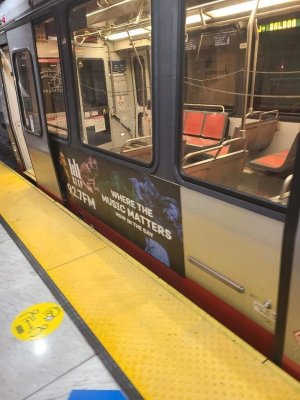

That seems like the worst possible place to advertise. Nearly nobody listens to OTA radio in the subway / metro, and a majority of listening today is in the car; subway users don't drive cars to work.KEXP is trying some outdoor/transit advertising. I think for the first time ever. We'll see if it moves the needle.View attachment 7388

K.M. Richards
Program Director, The Eighties Channel™
That seems like the worst possible place to advertise. Nearly nobody listens to OTA radio in the subway / metro, and a majority of listening today is in the car; subway users don't drive cars to work.
Having some background in public transit myself, the goal of advertising on the exterior of transit vehicles is to get the attention of drivers as they encounter same. It's not targeted at the transit users themselves.
That photo is of a Muni J-Line light rail vehicle (you can see the designation/destination sign quite clearly in the upper right). That line is only subway as it travels under Market St. downtown between The Embarcadero and just west of Van Ness Ave.; its route segment between there and Balboa Park is at ground level as a streetcar.
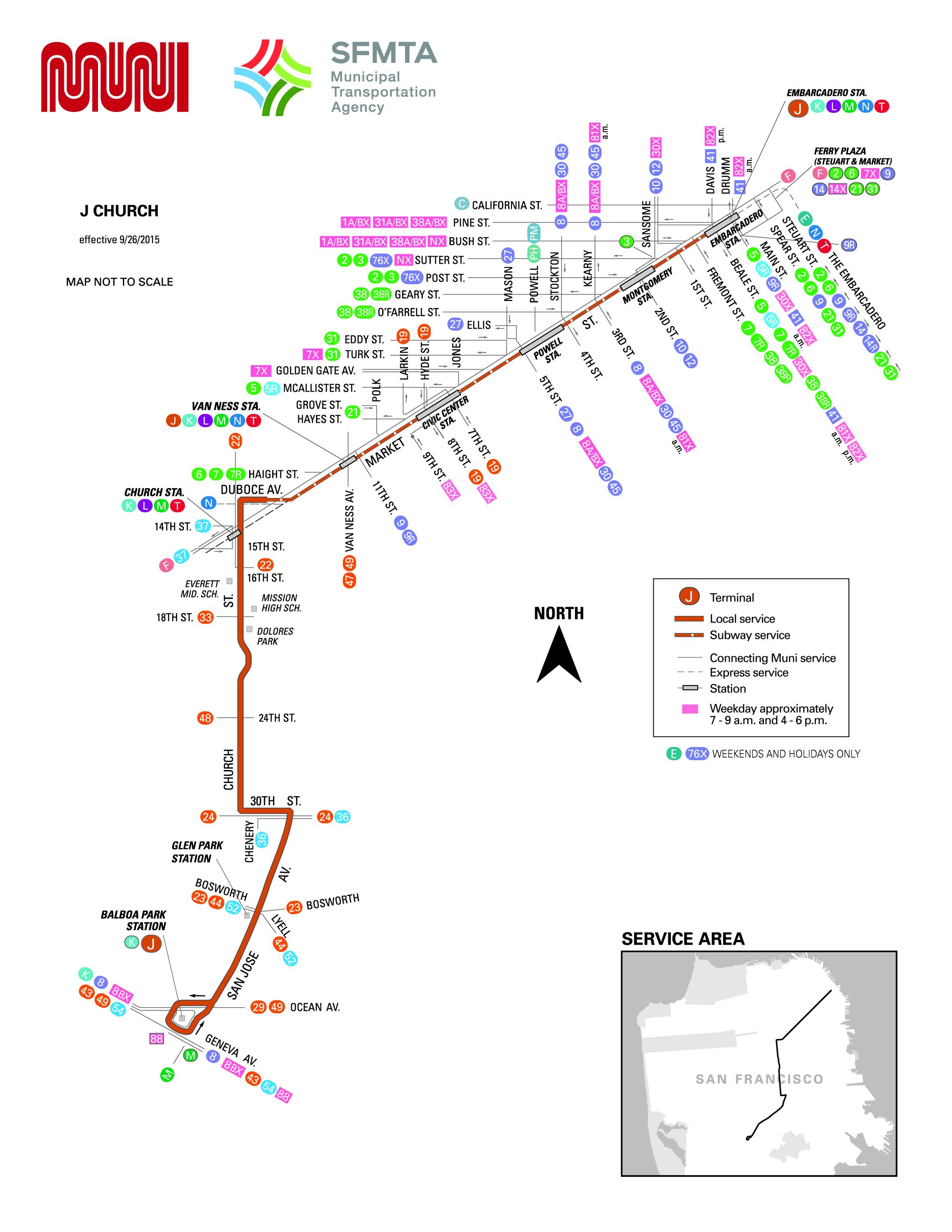
And many of Muni's rail lines operate at least part of their route as streetcars, so the logic makes sense. It's litte different than advertising on the exterior of transit buses.
Now, if they were advertising inside the streetcar, I would agree that would be a waste of money.

And if you're driving on Church St. or San Jose Ave. next to a MUNI light rail or bus, you're receiving a city-grade signal on 92.7, because Sutro Tower is no more than 2-3 miles away. Anyone who spots the bus card and decides to try KEXP on the spot will at least get a signal competitive with the big boy FM's in that area. (Which is less true as you get more distance from Sutro.)That photo is of a Muni J-Line light rail vehicle (you can see the designation/destination sign quite clearly in the upper right). That line is only subway as it travels under Market St. downtown between The Embarcadero and just west of Van Ness Ave.; its route segment between there and Balboa Park is at ground level as a streetcar.

The J and N lines begin street running at Duboce, just north of the Castro. The K, L, M lines begin street running at West Portal. The T begins at King Street before going down Third. All these lines have good visibility to the streetcars. Plus all lines along the Embarcadero are street running. (I believe the L is all street running at the moment.) All they need now are cards on the 38-Geary bus, including the 38L, and much of SF is covered. Maybe the 30-Stockton, too (it’s still running even with the new subway to Chinatown).
Prospective KEXC/KEXP listeners are more likely to see transit cards than they are to see newspaper ads.
Prospective KEXC/KEXP listeners are more likely to see transit cards than they are to see newspaper ads.
But the lettering on the sign is barely readable across a rail platform, and is likely very invisible from passing cars. Signs that a not at an angle to the forward road view are invisible to drivers.And many of Muni's rail lines operate at least part of their route as streetcars, so the logic makes sense. It's litte different than advertising on the exterior of transit buses.
Now, if they were advertising inside the streetcar, I would agree that would be a waste of money.
I was the largest transit advertiser ever in San Juan metro. But I used busses in the era when radio was much more used than today. I counted on busses being seen from intersecting intersections and by people on the streets who listened at home and work.
Of course, home and work listening is minimal now, and radio budgets are far lower.
Last edited:
K.M. Richards
Program Director, The Eighties Channel™
But the lettering on the sign is barely readable across a rail platform, and is likely very invisible from passing cars.
I didn't say it was a great ad, only that it made sense to advertise on the exterior of transit vehicles.
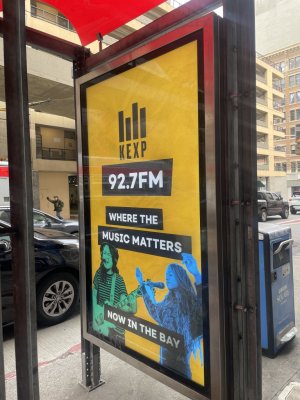
I really hope those ad's work for 92.7

They should also promote their online stream/app on their ads.
They should also promote their online stream/app on their ads.
Right now there is no local online presence. Everything reverts to kexp.org.

Do we have the 6+ ratings for the San Jose market? Curious how the San Jose specific signals fair.

San Jose
Nielsen Audio PPM Monthly Ratings San Jose (Market #39) Population: 1,648,900 Black: 47,200 – Hispanic: 403,500 Average Quarter Hour Share for Persons 6+, Mon-Sun 6AM-Mid All ratings are Copyright © 2005-2024 The Nielsen Company. All rights reserved. Nielsen radio audience estimates and data are...
 radioinsight.com
that’s the PPM, right? Am i mixing up the names?San Jose
Nielsen Audio PPM Monthly Ratings San Jose (Market #39) Population: 1,648,900 Black: 47,200 – Hispanic: 403,500 Average Quarter Hour Share for Persons 6+, Mon-Sun 6AM-Mid All ratings are Copyright © 2005-2024 The Nielsen Company. All rights reserved. Nielsen radio audience estimates and data are...
I’m talking about the demographics, like posted earlier.
You asked for 6+ specific. So that’s what I gave you. It seems like the rankings for the money demos are the ones that proprietary and the few that are shared are just in the top markets. San Jose broken out of the SF market, ranks at number 40.
Most of the Top 50 markets are PPM
Most of the Top 50 markets are PPM
Yes, it is a PPM market. Actually, it is a piece of the San Francisco market that is broken out just for those stations that serve Santa Clara County (which is part of the total SF market). Embedded markets have a bit more sampling balance than random counties in a market so that they meet the MRC standards.that’s the PPM, right? Am i mixing up the names?
As mentioned before, we generally only see those for the largest markets.I’m talking about the demographics, like posted earlier.
I agree, but I'm afraid @K.M. Richards is probably right. Advertisers don't want to target a dead/dying audience. Beautiful Music/Easy Listening suffered a similar fate back in the 80s and 90s.Wishfull Thinking.....So many AM's with almost no rating at all (KTCT, KGO, KNEW, KSFO), why not switch to some sort of 60's & 70's music.
I don't like this, and I wish it were different, but it's the Order of Things.
Eventually, when all commercial stations leave the band, maybe it can be opened up to hobbyists? Maybe expand the Part 15 rules to be more permissive?I think AM radio, unless a legacy station, is genuinely dead. Unless new technology comes out, or we can increase the audio quality, it will be dead for all but a few legacy channels.
I don’t like to say that too, I love radio, and I wish there was a way to “save AM” radio.
It seems like formats like that work better back east for some reason?WMTR 1250 AM in the Morristown, NJ market pulls a 2.6 playing 60's and 70's oldies. It is the #4 station in the market.
Frankly, why not have something like MeTV FM?
c
Stations - especially on the AM band - are increasingly becoming more creative about revenue streams. Time brokerage and listener-supported stations have been around forever, but probably not as much as today. There's no way those of us here on the outside know the effect of sports betting talk on the bottom line, but it must be worth something or it wouldn't be on the air. Radio Disney put together a huge network with no expectation of advertising revenue, it was only there to promote the Disney brand. As the "stick value" of radio stations continues to drop there may be other creative ways to keep the lights on.I agree, but I'm afraid @K.M. Richards is probably right. Advertisers don't want to target a dead/dying audience. Beautiful Music/Easy Listening suffered a similar fate back in the 80s and 90s.
Dave B.
Is FM reception in the Bay Area is much of an issue as it has been in the past? I read that KFRC hung around a little longer because of that.
- Status
- This thread has been closed due to inactivity. You can create a new thread to discuss this topic.