• Get involved.
    We want your input!
    Apply for Membership and join the conversations about everything related to broadcasting.

    After we receive your registration, a moderator will review it. After your registration is approved, you will be permitted to post.
    If you use a disposable or false email address, your registration will be rejected.

    After your membership is approved, please take a minute to tell us a little bit about yourself.
    https://www.radiodiscussions.com/forums/introduce-yourself.1088/

    Thanks in advance and have fun!
    RadioDiscussions Administrators

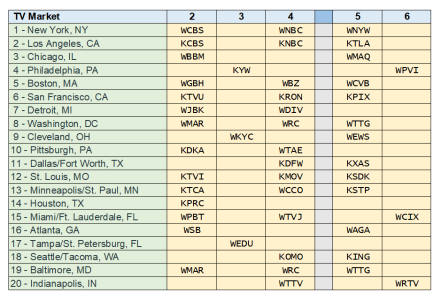
Why so few TV stations on channel 6?

Was it just the possibility of interference to and from FM radio that led to so many major markets not having a full-power TV station on channel 6, or were there other considerations? The lack of channel 3 in most major markets is logical, since using 2 and 4 in that chunk of the VHF-Low band gives you two stations instead of only one. But then why did so few of them end up with a 2-4-6 arrangement instead of 2-4-5? FM radio was so rarely used back in the '40s and '50s that I doubt reserving channel 6 for future expansion of FM was even thought of back then, unlike 60 years later.

tvchart.png
 
Just a guess, as I haven't really researched it, but the Channel 6 allocation often was used in an adjacent, smaller market. Example- Chicago 2-5-7-9-11, Milwaukee 4-6-10-12.
 
No, FM was not a thought. What we now know as TV6 was opened at the same time as what we now know as the FM broadcast band, the summer of 1945. The potential TV applicants would have had no reason to not apply for TV6 based on conflicting FM stations, because no FM stations existed (*).

In many of these largest markets, the TV allocations were in the first batch, before the 1950-52 freeze. Channels 2, 4 and 5 were locked in in NYC and LA very early, with the stations being on the air by the late 40s and permitted for some time before that. These channels would have been selected by the licensees, more or less.

In that era, lower frequency was perceived as better because both the transmitters and receivers were less prone to drift. In that case, channels 2/4/5 was the combination that would have resulted in the most stations with the lowest frequencies within FCC parameters for adjacency.

Was the difference between 5 and 6 that great? Probably not. But if 5 was available, why not use it? And it would have been available in most cases, since there were only ~100 TV stations on the air in the whole country in the early 1950s. In 1950, you could have counted on one hand the number of operating television stations north and west of Chicago.

(*) Some 42-50MHz FM band stations were being reassigned to what we now know as the FM band in 1946 and 47, but these were only a couple dozen in the whole country
 
Just a guess, as I haven't really researched it, but the Channel 6 allocation often was used in an adjacent, smaller market. Example- Chicago 2-5-7-9-11, Milwaukee 4-6-10-12.
True for Los Angeles they have channels 2-4-5-7-9-11-13 however Channel 6 signal was assigned for allocation in Santa Barbara and Tijuana (XETV) analog signal covered both San Diego and Tijuana.

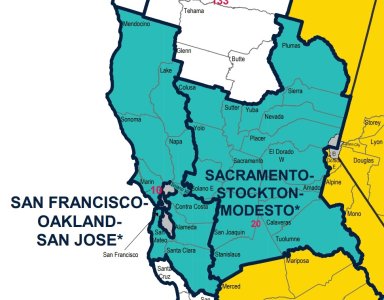
For San Francisco they have channels 2-4-5-7-9-11. Analog Channel 6 in Northern California was allocated to Sacramento (KVIE).
 
True for Los Angeles they have channels 2-4-5-7-9-11-13 however Channel 6 signal was assigned for allocation in Santa Barbara and Tijuana (XETV) analog signal covered both San Diego and Tijuana.
Channel 6 was assigned to San Luis Obispo. Santa Barbara was assigned Channel 3.
 
In many of these largest markets, the TV allocations were in the first batch, before the 1950-52 freeze. Channels 2, 4 and 5 were locked in in NYC and LA very early, with the stations being on the air by the late 40s and permitted for some time before that. These channels would have been selected by the licensees, more or less.

In that era, lower frequency was perceived as better because both the transmitters and receivers were less prone to drift. In that case, channels 2/4/5 was the combination that would have resulted in the most stations with the lowest frequencies within FCC parameters for adjacency.

Was the difference between 5 and 6 that great? Probably not. But if 5 was available, why not use it? And it would have been available in most cases, since there were only ~100 TV stations on the air in the whole country in the early 1950s. In 1950, you could have counted on one hand the number of operating television stations north and west of Chicago.
Right, the earliest stations began in the largest cities. This would have established the pattern of that ideal combination (2/4/5) being selected in almost all the locations whose population sizes would, with time, go on to get them labeled as the top markets. Then, for markets adjacent to those large cities, the obvious choices would have been 3/6 -- to avoid causing heterodyne/interference for viewers living along market boundaries.

Interesting trivia an old-timer once told me. ABC was so convinced that the FCC was going to eliminate the entire VHF-Low band (channels 2-6) after it lopped off VHF channel 1 that it decided to have all its O&O stations elect channel 7. They figured that 7 would wind up becoming the first channel on the dial. Boy were they surprised.
 
Last edited:
Channel 6 was assigned to San Luis Obispo. Santa Barbara was assigned Channel 3.

Not originally. I have copies of the original 1945 allocations, the proposed revisions in that year, 1948, 1949, 1951, and then the final 1952 version.

1945: Neither city was allocated any channels originally. The proposal in September of that year did not change that.
1948 proposal: SLO allocated channel 3, SB allocated channel 6.
1949 proposal (when UHF first added to the mix): SLO allocation moved to 21, SB given 24 and 26. Channel 3 had been allocated the entire time to San Diego. Channel 6 removed because of the Tijuana allocation of same and the likelihood that a signal from there would shoot straight up the coast over the Pacific Ocean and cause interference to both.
1951 proposal: Channel 6 reallocated to SLO, replacing the UHF allocation. SB allocated 20 and 26 as the engineers worked out the "taboos" of channel spacing on UHF (more on that in the article I wrote on deintermixture on the UHF History site). San Diego still had channel 3 but it was now earmarked for educational stations.
1952 table: Channel 6 remained allocated to SLO. Channel 3 removed from San Diego (ETV allocation moved to 15) and reallocated to SB.

So both you and Y2k were right and wrong, depending on your point of view.

Sidebar: Channel 12 in Santa Maria was added after KFRE-TV in Fresno finally gave in to FCC pressure and moved to channel 30 in 1961. Some wanted that assigned to SB (or Ventura) instead, but that would have caused the same problem with the channel 12 allocation in Tijuana as would have channel 6 if it had not been remedied.

 
Not originally. I have copies of the original 1945 allocations, the proposed revisions in that year, 1948, 1949, 1951, and then the final 1952 version.

1945: Neither city was allocated any channels originally. The proposal in September of that year did not change that.
1948 proposal: SLO allocated channel 3, SB allocated channel 6.
1949 proposal (when UHF first added to the mix): SLO allocation moved to 21, SB given 24 and 26. Channel 3 had been allocated the entire time to San Diego. Channel 6 removed because of the Tijuana allocation of same and the likelihood that a signal from there would shoot straight up the coast over the Pacific Ocean and cause interference to both.
1951 proposal: Channel 6 reallocated to SLO, replacing the UHF allocation. SB allocated 20 and 26 as the engineers worked out the "taboos" of channel spacing on UHF (more on that in the article I wrote on deintermixture on the UHF History site). San Diego still had channel 3 but it was now earmarked for educational stations.
1952 table: Channel 6 remained allocated to SLO. Channel 3 removed from San Diego (ETV allocation moved to 15) and reallocated to SB.

So both you and Y2k were right and wrong, depending on your point of view.

Sidebar: Channel 12 in Santa Maria was added after KFRE-TV in Fresno finally gave in to FCC pressure and moved to channel 30 in 1961. Some wanted that assigned to SB (or Ventura) instead, but that would have caused the same problem with the channel 12 allocation in Tijuana as would have channel 6 if it had not been remedied.
That explains it. I was going by the RabbitEars.info listings that showed no updates for California between 1945 and 1952.
 
That explains it. I was going by the RabbitEars.info listings that showed no updates for California between 1945 and 1952.

If you ever want to see those allocation tables, they are available at World Radio History in the following issues of Broadcasting:

1945 (original): December 3, 1945, pp. 76-77
1945 (first proposal): September 24, 1945, pp. 79-80
1948 (second proposal): June 7, 1948, pp. 14, 40, 42
1948 (DuMont alternate proposal): July 5, 1948, pp. 14, 66-67
1949 (third proposal): July 18, 1949, pp. 44, 47, 50, 54-55
1951 (fourth proposal): March 26, 1951, pp. 62-65
1952 (adopted new table): April 14, 1952, supplement, pp. 132-134, 136
1963 (proposed revision): October 28, 1963, pp. 69-72
1965 (adopted revision): June 14, 1965, pp. 86-88, 90
1966 (adopted further revision): February 14, 1966, pp. 70-71
 
And, to finally answer the original question: For all of the reasons given by various contributors above, it was considered to be an unwritten rule at the FCC in those early days to have the maximum allowable allocations in the biggest cities. In most cases, that was 2-4-5-7-9-11-13 (or a variation on same), because adjacent channels could not be used in the same geographic area; the extra gap between channels 4 and 5 allowed for seven allocations in the larger metros.

But in actual practice, only New York and Los Angeles had that exact "perfect" set of allocations. Everywhere else, something got in the way. In San Francisco, to take one example, channel 13 was allocated to Stockton back when KOVR was straddling that market and Sacramento, and when they finally moved east to secure a network affiliation with ABC, the allocation "officially" moved out of S.F.

Chicago couldn't use 13 either, because its assignment to Rockford was too close and had existed there as a channel 12 allocation since the original 1945 table. Since that was its lone allocation and 12 was too close to 11 in Chicago, Rockford got 13 (although in the 1949 proposal, it was replaced by two UHF channels, then was put back in 1951).

There were lots of such exceptions, which is also why UHF became a necessity for television service to get to most of America.
 
But in actual practice, only New York and Los Angeles had that exact "perfect" set of allocations. Everywhere else, something got in the way. In San Francisco, to take one example, channel 13 was allocated to Stockton back when KOVR was straddling that market and Sacramento, and when they finally moved east to secure a network affiliation with ABC, the allocation "officially" moved out of S.F.
Didn't you forget something? Regarding a place that's...enchanting?

I'm referring to Albuquerque/Santa Fe, which has been the same TV market since before I was born.

2 - Santa Fe (activated around 1980 but there were moves as early as 1960 to fire it up as an independent)
4 - Albuquerque (KOB)
5* - Albuquerque (KNME)
7 - Albuquerque (KOAT)
9* - Santa Fe (KNMD, only ever existed as a digital channel, but it was on RF channel 9)
11 - Santa Fe (KCHF)
13 - Santa Fe (KGGM/KRQE)

(By the way, KOB was originally going to be on 2, but in October 1946 asked to switch to 4 due to concerns over amateur-radio interference.)

If you count El Paso and Cd. Juárez together, you almost get to the magic 7 channels:

2 - XEPM Juárez
4 - KDBC
5 - XEJ Juárez
7 - KVIA (originally on 13)
9 - KTSM
13* - KCOS (the original educational allocation was 7*; there was a swap)

Then the question comes about: what happened to channel 11 down there? It's not in the FCC's table of allocations as shown in my 1989 copy of 47 CFR 70-79. Lubbock had a 5 and 13 (and 11) so that's not the limiting factor. As for the Mexican side of the border, one of my Jones Logs from around 1980 shows "XEDI" channel 11 in Juárez. But it never appeared in the TV Factbooks that are available at worldradiohistory.com. In later editions of that directory, the third Juárez station was XHIJ, channel 44. I find no mention of "XEDI" in the El Paso newspaper archives, yet XEJ-TV, XEPM-TV, and XHIJ were mentioned plenty of times. Hmmm.
 
Last edited:
Like I said, a lot of markets came close, but you yourself pointed out what I already knew, which is that 2 and 9 in ABQ were latecomers even though they were in the 1966 allocations table for Santa Fe.
 
Like I said, a lot of markets came close, but you yourself pointed out what I already knew, which is that 2 and 9 in ABQ were latecomers even though they were in the 1966 allocations table for Santa Fe.
Here's what you wrote: "But in actual practice, only New York and Los Angeles had that exact "perfect" set of allocations. Everywhere else, something got in the way." Not so in New Mexico.
 
Detroit got 2-4-7-9 (Windsor)-11 (Toledo)-13 (Toledo). Not sure where 5 is. I guess when the FCC was allocating TV channels, it had to coordinate with Canada and Mexico?

Boston has 2-4-5-7-9 (NH)-11 (NH). 13 is up in Portland ME.

I was surprised when I saw TV Guides for Boise and Spokane. I knew, living near NYC, the same city could have a Channel 4 and Channel 5. But I didn't know you could have a Channel 6 and a Channel 7 in the same city, as Boise and Spokane do. I later learned that the VHF spectrum goes 2-3-4-5, then a space, then 6-7, then a space, then 8-9-10-11-12-13. I'm not sure of any other markets that have both Channel 6 and 7.

Now with digital television, being on UHF is the best (a complete reversal of what was true with analog). But if you must be on VHF, better to be on 8 through 13. Any channel 7 or below gives you poor coverage.
 
Here's what you wrote: "But in actual practice, only New York and Los Angeles had that exact "perfect" set of allocations. Everywhere else, something got in the way." Not so in New Mexico.

Well, that market is a little odd geographically with the Sandia mountain range being between the two cities. Does make it easier to put all the television stations in one place, though.

Never did understand why it took so long for channel 2 to get on the air there.
 
I later learned that the VHF spectrum goes 2-3-4-5, then a space, then 6-7, then a space, then 8-9-10-11-12-13. I'm not sure of any other markets that have both Channel 6 and 7.
The VHF spectrum goes 2-3-4 (54-72 MHz), a 4 MHz space, then 5-6 (76-88 MHz). Between 6 and 7 is an 86 MHz gap that includes FM broadcast, aircraft and public service frequencies, and the 2 meter ham band. Then comes 7-8-9-10-11-12-13 (174-216 MHz).

It was different before and during the war, but the current VHF RF channels have been the same (with Channel 1 at 44-50 MHz, briefly) since late 1945.

 
And, to finally answer the original question: For all of the reasons given by various contributors above, it was considered to be an unwritten rule at the FCC in those early days to have the maximum allowable allocations in the biggest cities. In most cases, that was 2-4-5-7-9-11-13 (or a variation on same), because adjacent channels could not be used in the same geographic area; the extra gap between channels 4 and 5 allowed for seven allocations in the larger metros.

But in actual practice, only New York and Los Angeles had that exact "perfect" set of allocations. Everywhere else, something got in the way. In San Francisco, to take one example, channel 13 was allocated to Stockton back when KOVR was straddling that market and Sacramento, and when they finally moved east to secure a network affiliation with ABC, the allocation "officially" moved out of S.F.

Yes the situation with KOVR beginnings can partially explain why Solano County, California is split between Sacramento and San Francisco TV Markets. However when the lines were drawn they didn't consider Fairfield, California to be one of a few cities to land on the border of two or more TV Markets. But it was partially related to the main goal for Sacramento TV stations to cover the Northern part of the San Joaquin Valley like Stockton and Modesto.


Fairfield population from the 2020 census is 119-120k people. But when the borders for DMA was made the city had 3000 people.
 

Attachments

  • Screenshot_20240827_083911_Drive~2.jpg
    Screenshot_20240827_083911_Drive~2.jpg
    143.7 KB · Views: 4
Status
This thread has been closed due to inactivity. You can create a new thread to discuss this topic.


Back
Top Bottom