• Get involved.
    We want your input!
    Apply for Membership and join the conversations about everything related to broadcasting.

    After we receive your registration, a moderator will review it. After your registration is approved, you will be permitted to post.
    If you use a disposable or false email address, your registration will be rejected.

    After your membership is approved, please take a minute to tell us a little bit about yourself.
    https://www.radiodiscussions.com/forums/introduce-yourself.1088/

    Thanks in advance and have fun!
    RadioDiscussions Administrators

% Reduction - AM reception range - increased noise - 1920 to 2024

Just wondering if the increase in background noise in the AM band between 1920 and 2024 (USA) can easily be quantified as a % loss of signal coverage (using some benchmark of carrier to noise ratio that defines loss of the AM signal)?

If the AM transmitter is at the edge of a metro area, perhaps the % loss would be greater over the metro area and less over the surrounding farmland.

I don't know the spectrum of the "AM" noise, maybe some frequencies have more noise.


Kirk Bayne
 
Just wondering if the increase in background noise in the AM band between 1920 and 2024 (USA) can easily be quantified as a % loss of signal coverage (using some benchmark of carrier to noise ratio that defines loss of the AM signal)?

If the AM transmitter is at the edge of a metro area, perhaps the % loss would be greater over the metro area and less over the surrounding farmland.

I don't know the spectrum of the "AM" noise, maybe some frequencies have more noise.
In the 1930's, stations considered the 0.5 mV/m Medium Wave signal coverage area "usable". Today, using the recommendation of the ITU, the minimum AM Medium Wave signal for reliable noise-free reception is 15 mV/m.

As a sidebar, in rural areas where man made noise is lesser, the percentage of the U.S. population has declined enormously in the last 100 years. So the vast majority of people live in urban areas where signals have to be vastly stronger than ever to be useful.

Anecdotal evidence: I live in a market with 7 operating AM stations. I am well inside the highly populated part of the market, yet not one of those 7 stations can be heard in my home. The local conductivity is so bad that none has a signal capable of overcoming my walwarts and dimmers and solar power system.
 
In the 1930's, stations considered the 0.5 mV/m Medium Wave signal coverage area "usable". Today, using the recommendation of the ITU, the minimum AM Medium Wave signal for reliable noise-free reception is 15 mV/m.

As a sidebar, in rural areas where man made noise is lesser, the percentage of the U.S. population has declined enormously in the last 100 years. So the vast majority of people live in urban areas where signals have to be vastly stronger than ever to be useful.

Anecdotal evidence: I live in a market with 7 operating AM stations. I am well inside the highly populated part of the market, yet not one of those 7 stations can be heard in my home. The local conductivity is so bad that none has a signal capable of overcoming my walwarts and dimmers and solar power system.
50 or 60 years ago, I was told that in the early days of radio, stations with very little power could get out surprisingly well in the daytime, maybe two or three hundred miles! Even in the '60s, that wasn't remotely feasible. I suppose it could have to do with a complete lack of man-made interference but I thought it was astonishing, nevertheless!
 
50 or 60 years ago, I was told that in the early days of radio, stations with very little power could get out surprisingly well in the daytime, maybe two or three hundred miles! Even in the '60s, that wasn't remotely feasible. I suppose it could have to do with a complete lack of man-made interference but I thought it was astonishing, nevertheless!
Depending on the band in the right conditions, it's possible at just the right place with the most efficient antenna at the particular frequency.
 
In the 1930's, stations considered the 0.5 mV/m Medium Wave signal coverage area "usable". Today, using the recommendation of the ITU, the minimum AM Medium Wave signal for reliable noise-free reception is 15 mV/m.

As a sidebar, in rural areas where man made noise is lesser, the percentage of the U.S. population has declined enormously in the last 100 years. So the vast majority of people live in urban areas where signals have to be vastly stronger than ever to be useful.

Anecdotal evidence: I live in a market with 7 operating AM stations. I am well inside the highly populated part of the market, yet not one of those 7 stations can be heard in my home. The local conductivity is so bad that none has a signal capable of overcoming my walwarts and dimmers and solar power system.
https://files.catbox.moe/82w36i.wav is my indoor AM reception as of 11:50 AM this morning in the city of Covina (CA) on a DX-286 being rotated around in the air 3 feet from a running desktop PC (to which the DX-286 was directly connected via a 3" headphone jack patch cable to make the recording -- as well as to make sure the DX-286's AM reception would be maximally obliterated). Stations heard: 570, 640, 710, 790, 980, 1020, 1070, 1110, 1150, 1580.

I must be living on ultra-conductive ground because in spite of being indoors, three feet from a computer, and with a direct connection to that computer, I got the results I did. (And the hums heard all vanish completely when the cable is not connected.)
 
I used to be the chief of a 50KW AM station and I would get lots of phone calls and emails about noise on the band from people in the coverage area who should be able to receive the station fine. LED lighting and solar panels or those belonging to neighbors were the first suspects.
But the manufacturers and group owners have done their own part to screw things up as well. The MDCL or modulation dependant carrier reduction saved stations about 20% on their electricity bill but it let the noise creep up and could be very bad in places.
It was one of those ideas that looks good on paper but came with a different kind of cost in practice. The big group that I once worked for abandoned it in NYC and in my market as well. It was good to also be able to turn off the IBOC in my market as well once the last of the old IBOC exciters finally failed.
 
Depending on the band in the right conditions, it's possible at just the right place with the most efficient antenna at the particular frequency.
I got the impression that this had nothing to do with dx-ing. It was simply a fact of life. There was a well publicized event where they wanted to find out if KGW could be received inside the Oregon Caves. Obviously, it couldn't, but apparently, there was no problem just outside of them! I'm pretty sure this was when they were still 500 watts but I could be wrong, certainly not more than 1KW.
 
I got the impression that this had nothing to do with dx-ing. It was simply a fact of life. There was a well publicized event where they wanted to find out if KGW could be received inside the Oregon Caves. Obviously, it couldn't, but apparently, there was no problem just outside of them! I'm pretty sure this was when they were still 500 watts but I could be wrong, certainly not more than 1KW.
One thing will remain for all time: You can't cheat physics.
 
Nobody has mentioned ground conductivity. That says a lot about reception range
And even that's relative. As an example, many of the AM stations in the Seattle/Tacoma market are on an island surrounded by salt water. You would think that would be an advantage. In reality, stations on the South end of the island have a good groundwave to the South, but not so good to the North. The same goes for stations on the North end of the island don't particularly do well to the South. The reason? The island itself has terrible ground conductivity.
 
50 or 60 years ago, I was told that in the early days of radio, stations with very little power could get out surprisingly well in the daytime, maybe two or three hundred miles!
In the 20's and 30's and even most of the 40's, most radio listening was after sunset when skywave was prevalent. So stations depended on night signals for most of their income and audience.

In some parts of the nation, like much of the Great Plains, stations like WNAX, 5 kw on 570, covered much of 6 states in the daytime. But the same power in parts of Tennessee, AL, GA and NC would barely cover a couple of local counties due to poor ground conductivity.

Daytime coverage was and is dependent on the soil or ground conductivity of the region. Those 5 kw that will go 200 miles in Iowa won't go 30 miles on Long Island, then or now.
 
I must be living on ultra-conductive ground because in spite of being indoors, three feet from a computer, and with a direct connection to that computer, I got the results I did. (And the hums heard all vanish completely when the cable is not connected.)
Actually, there are three zones of conductivity in the LA area, starting with fairly decent conductivity near the ocean and extending some miles inland. It drops dramatically to the east of central / downtown LA, and then drops again going part way out the San Gabriel Valley. So in Covina, you are in very low conductivity zones, which explains why you could only get the very strongest signals in the market, despite there being a number of lower power ones on higher frequencies that are close to you.

You say you heard "Stations heard: 570, 640, 710, 790, 980, 1020, 1070, 1110, 1150, 1580."

You are not getting stations like 670, 740, 870, 900, 930, 1190, 1120, 1230, 1260, 1280, 1300, 1330, 1390, 1460, 1480, 1430, 1540, 1650 and several others that are in the LA market.
 
Actually, there are three zones of conductivity in the LA area, starting with fairly decent conductivity near the ocean and extending some miles inland. It drops dramatically to the east of central / downtown LA, and then drops again going part way out the San Gabriel Valley. So in Covina, you are in very low conductivity zones, which explains why you could only get the very strongest signals in the market, despite there being a number of lower power ones on higher frequencies that are close to you.

You say you heard "Stations heard: 570, 640, 710, 790, 980, 1020, 1070, 1110, 1150, 1580." You are not getting stations like 670, 740, 870, 900, 930, 1190, 1120, 1230, 1260, 1280, 1300, 1330, 1390, 1460, 1480, 1430, 1540, 1650 and several others that are in the LA market.
The band has now gone to its nighttime patterns and powers, so I'll have to re-check those extra frequencies tomorrow. But many of them are in fact receivable indoors for me. For the sake of keeping my recording short (hope the link worked), I only "spot checked" the dial, jumping to the frequencies that immediately came to mind.

For now, I can say I do know that I clearly hear 740, 830 (Orange County), 870, 900, 930, 1190, and 1540 during the day. Saul's 1260 in particular is just strong enough to understand the lyrics of all the Taylor Swift music he's now playing. Several stations in the graveyard range, with Asian and Spanish programming, are also there, but I cannot remember any of their frequencies at all.

I'm looking at the FCC's highest resolution version of the image in my link above (the .TIF version) and see the three regions you're referring to. But it looks like Covina may actually be in the middle "8" region. That might help to explain this.
 
In some parts of the nation, like much of the Great Plains, stations like WNAX, 5 kw on 570, covered much of 6 states in the daytime. But the same power in parts of Tennessee, AL, GA and NC would barely cover a couple of local counties due to poor ground conductivity.
Is there possibly some kind of top 10 or top 20 list of the furthest-reaching AM groundwave signals lurking around in your archives, regardless of wattage? I have always wondered what the top stations were/are in the sense of tuning into one, starting a long drive, and still hearing it clearly 10 hours down the road.
 
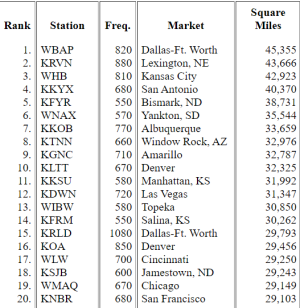
In 1999, legendary radio historian James Duncan produced this list of the 20 largest AM signals in the nation, as calculated by Daytime 2-millivolt land signal over the US:
View attachment 7687
KKSU is gone - it shared time with WIBW, which bought out KKSU about 22 years ago.

KLTT’s being on the list blows me away with the indication that it covers more ground than KOA, which is no slouch itself.
 
You are not getting stations like 670, 740, 870, 900, 930, 1190, 1120, 1230, 1260, 1280, 1300, 1330, 1390, 1460, 1480, 1430, 1540, 1650 and several others that are in the LA market.
The band has now gone to its nighttime patterns and powers, so I'll have to re-check those extra frequencies tomorrow.
Okay, here is what I found scanning the band between 3:15 PM and 3:45 PM today in exactly the same physical location and environment as yesterday. This time I went about things the way an ordinary listener would: no physical wired connection for recording audio between the radio and anything else. Otherwise I still rotated the receiver for each frequency to find the best signal strength before noting it down, and it was the same radio (DX-286), still 3 feet from the same desktop PC + LCD as yesterday -- both still powered on, of course.

Other environmental considerations: 6 feet in front of me in the same room, and also powered on: a large LCD TV, two Roku players (wall warted), some WDTV multimedia players (wall warted), an ATSC tuner (in standby), and a DVD recorder (in standby). Directly above me through an 8 foot ceiling, another powered up desktop PC with LCD monitor, an 802.11 router (on), a cable modem (on), another powered Roku with wall wart, and another LED TV (standby). No interior lights on anywhere, central air conditioning running. Surrounded by woodframe houses in a typical suburban tract development with above-ground power lines and with a pole with a transformer in one corner of my back yard. The room I'm in adjoins that back yard.

5 stars = 100% quieting
4 stars = light white noise
3 stars = medium white noise (same amplitude as music/speech)
2 stars = high white noise (but 100% word recognition)
1 stars = mostly white noise (recognize presence of male vs. female speech and vs. music, but word comprehension is 0%)
½ stars = recognize presence of faint audio but cannot discern if speech or music
¼ stars = recognize presence of "something" (random scratches of white noise louder than background white noise, but verified to not be adjacent station splatter)

So for example 1½ stars = 50% word recognition.

540 ** / spanish
570 **** / english
590 ** / english religion
600 ** / english
640 ***** / english
670 *½ / non-english unknown (post-scan radio-locator.com lookup: iranian)
690 ** / spanish
710 ***** / english
740 ***½ / english religion
790 ***½ / english
830 **** / sports
860 *½ / spanish
870 ****½ / english
900 ***½ / spanish
930 **** / english
950 ** / spanish
960 *½ / english
980 ****½ / spanish
1000 ** / english
1020 ***** / spanish
1050 ½ / ?
1070 ***** / english
1090 *** / english
1110 ***** / english
1150 ***** / english
1190 **** / asian
1220 ***½ / spanish
1230 **½ / japanese?
1240 *½ / spanish
1260 **½ / wildcard
1280 *** / english religion
1290 *½ / english
1300 **** / asian
1330 ** / spanish
1350 *¼ / english sports
1390 **** / spanish
1410 *½ / spanish music
1430 **½ / asian
1440 ** / english "black information network riverside"
1460 **½ / spanish
1480 **½ / asian
1490 ½ / ?
1520 ¼ / ?
1540 ****½ / asian
1580 ***½ / english
1600 *** / asian
1650 ***½ / asian
1670 *½ / spanish

Same by strength:

640 ***** / english
710 ***** / english
1020 ***** / spanish
1070 ***** / english
1110 ***** / english
1150 ***** / english
870 ****½ / english
980 ****½ / spanish
1540 ****½ / asian
570 **** / english
830 **** / sports
930 **** / english
1190 **** / asian
1300 **** / asian
1390 **** / spanish
740 ***½ / english religion
790 ***½ / english
900 ***½ / spanish
1220 ***½ / spanish
1580 ***½ / english
1650 ***½ / asian
1090 *** / english
1280 *** / english religion
1600 *** / asian
1230 **½ / japanese?
1260 **½ / wildcard
1430 **½ / asian
1460 **½ / spanish
1480 **½ / asian
540 ** / spanish
590 ** / english religion
600 ** / english
690 ** / spanish
950 ** / spanish
1000 ** / english
1330 ** / spanish
1440 ** / english "black information network riverside"
670 *½ / non-english unknown
860 *½ / spanish
960 *½ / english
1240 *½ / spanish
1290 *½ / english
1410 *½ / spanish music
1670 *½ / spanish
1350 *¼ / english sports
1050 ½ / ?
1490 ½ / ?
1520 ¼ / ?

Station radio-locator.com says I should hear in my zipcode but don't: 610
Stations radio-locator.com says I shouldn't hear in my zipcode but do: 860, 950, 1240, 1350, 1410

If these results are impossible in the "8" zone that the FCC map seems to place me in, then I must either be on a vein of higher ground conductivity, or the DX-286 is a miracle machine, or perhaps a mixture of both.

 
Anecdotal evidence: I live in a market with 7 operating AM stations. I am well inside the highly populated part of the market, yet not one of those 7 stations can be heard in my home. The local conductivity is so bad that none has a signal capable of overcoming my walwarts and dimmers and solar power system.

Most of your city is in one zip code. I don't know exactly where your place is, but if you plug the main zip into V-Soft, KNWZ (970) is the only AM that has more than 3.5 mV/m of signal strength, which isn't going to get the job done reliably inside any structure.

It shows 13.37 mV/m for KNWZ, but that is from the reference coordinates, so it might be less depending on the precise location inside the zip code. And it is just an estimate regardless. I wouldn't be surprised if it overestimates real world signal strengths in most cases.
 
Status
This thread has been closed due to inactivity. You can create a new thread to discuss this topic.


Back
Top Bottom