• Get involved.
    We want your input!
    Apply for Membership and join the conversations about everything related to broadcasting.

    After we receive your registration, a moderator will review it. After your registration is approved, you will be permitted to post.
    If you use a disposable or false email address, your registration will be rejected.

    After your membership is approved, please take a minute to tell us a little bit about yourself.
    https://www.radiodiscussions.com/forums/introduce-yourself.1088/

    Thanks in advance and have fun!
    RadioDiscussions Administrators

Audio processing

@DavidEduardo this one is probably for you...a serious question:

Prior to multi-band processing, did most AM stations simply do limiting and compression on a flat audio signal, or were some stations boosting frequencies for depth, presence, or clarity until the arrival of multi-band in the 70s?
 
Last edited:
@DavidEduardo this one is probably for you...a serious question:

Prior to multi-band processing, did most AM stations simply do limiting and compression on a flat audio signal, or were some stations boosting frequencies for depth, presence, clarity, prior to the advent of those processors in the early 70s?
In my experience (and through the 60's and 70's I was my own chief engineer in both Ecuador and Puerto Rico) we used non-equalized "flat" devices. The exception was the CBS Laboratories Dynamic Presence Equalizer which tried to enhance the "presence" band to make stations sound clearer. It would be a match with an Audimax an Volumax.

It was around the mid-70's that we got things like crossover networks combined with two or three LA-3-A processors and, then, the multiband devices.
 
In my experience (and through the 60's and 70's I was my own chief engineer in both Ecuador and Puerto Rico) we used non-equalized "flat" devices. The exception was the CBS Laboratories Dynamic Presence Equalizer which tried to enhance the "presence" band to make stations sound clearer. It would be a match with an Audimax an Volumax.

It was around the mid-70's that we got things like crossover networks combined with two or three LA-3-A processors and, then, the multiband devices.
That sounds interesting with the LA-3A processors on crossovers for broadcast radio. That was always my favorite go to dynamics processor for recording vocals when I was a recording engineer. One time I got ahold of a Gates StayLevel and used that a bunch for big rock and roll guitars on a record that did well. So cool that recording studio compressor/limiters were being used for radio and then a radio processor was being used for recording. One time in the '90s, I bought an early Manley Variable Mu compressor at a price that I knew that I could always re-sell it for. This one had the original nickel metal face plate. I listened to it at home a bunch on lots of CDs and realized that I could get 8 db of gain reduction from it without even beginning to hear the device pull at the music. For those of you that have no clue, that means I could turn up the level by 8 db after the limiter. That means 8 db louder which in the audio world is a lot. I installed it ahead of an early generation digital CRL processor that hadn't lived up to the hype that they had promoted it with. Everybody that listened liked that combination but when the radio station got behind on their payments for my services and became unpleasant to deal with the Manley came out of the air chain.
 
I always thought the AM stations that ran crossed over LA3's sounded too smashed and non-linear. LA3's are great studio compressors used for mics or effects, not for radio.

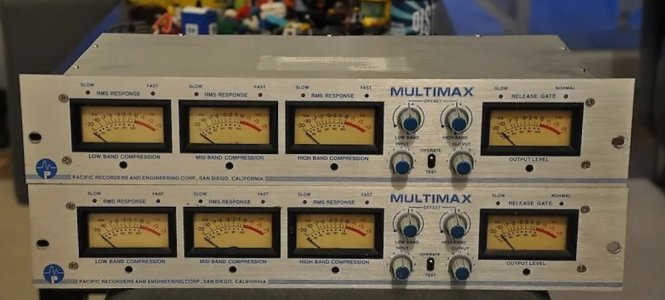
My favorite 'steam' powered multiband audio processor of the day was the Pacific Recorders and Engineering Multimax:
PR&E Multimax.jpg

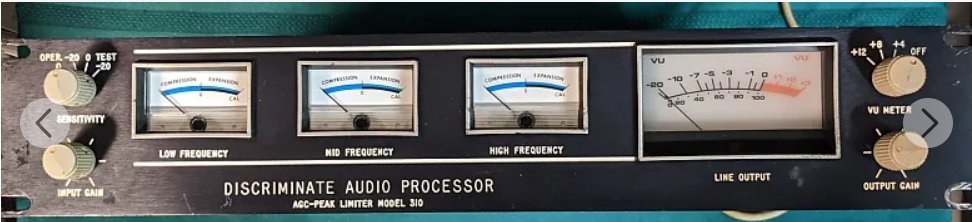
My second favorite was the good ol' Dorrough 310, because one can get inside and modify all the attack and release times depending on the format:
Dorrough 310.jpg

Thank goodness those days are over!
 
I always thought the AM stations that ran crossed over LA3's sounded too smashed and non-linear. LA3's are great studio compressors used for mics or effects, not for radio.

My favorite 'steam' powered multiband audio processor of the day was the Pacific Recorders and Engineering Multimax:
View attachment 7664

My second favorite was the good ol' Dorrough 310, because one can get inside and modify all the attack and release times depending on the format:
View attachment 7665

Thank goodness those days are over!

At tiny KUKI in Ukiah in 1976, our 20-year-old chief engineer got Mike Durrough to loan us one for "testing" purposes.

I was also 20, the PD and more than a little concerned about sharing the dial with KFRC's incredible home-built nine-band that Bob Kanner had put in their rack shortly before my arrival.

Gotta say, allowing for the difference between 610 and 1400, 5kw and 1kw and all the other cool stuff RKO could afford that we couldn't, Dave tweaked that Durrough to the point where it wasn't a massive disappointment to A/B between them and us.

It was still in the rack when I left 22 months later.
 
My second favorite was the good ol' Dorrough 310, because one can get inside and modify all the attack and release times depending on the format:
View attachment 7665

Thank goodness those days are over!
Rusk used Dorroughs for both KTRH(AM) and KLOL(FM) in Houston. The AM sounded amazing when using a radio capable of wideband reception such as the Sony SRF-A100. The FM was hyped a bit more than it should have been but I guess that was a commercial imperative.
 
@DavidEduardo this one is probably for you...a serious question:

Prior to multi-band processing, did most AM stations simply do limiting and compression on a flat audio signal, or were some stations boosting frequencies for depth, presence, or clarity until the arrival of multi-band in the 70s?
At the stations I worked for in the late 60's and early seventies the norm was a compressor followed by a limiter . At that time you had to do a Proof of performance once ever 14 months or so in which you took the compressing/limiting tube out of these units and made a tone sweep to be sure everything was flat on am or matched the 75db boost on fm. I don't remember the lowest frequency we had to measure on AM but the highest was 7,500 hrz ( we called it cycles in those days ) FM highest was 15,000.hrz. A lot of stations cut carts with the music on them and added EQ to match the sound from song to song. Many EQ'd the mikes to boost highs but generally the broadcast chain was flat ( except for fm ) in those days
 
Last edited:
Has anyone had good experiences with the Gates STA level?
We had one at the first station I worked at. It had only two speed settings, fast and slow. Had I been the chief then I would have changed the recovery speed to make it faster than manufactured but I wasn't so I couldn't. Ever try the Level Devil?
 
After 1980 several FM stations and a couple of AMs too had the "graphic equalizer" in the equipment rack. Had to put a lock panel in front of the panel to keep people from "making the station sound better". I always took a Polaroid picture of the settings just in case someone found the key.
 
How did FMs handle it?
That was a different issue. The problem was the 75us boost in the audio line forced FM's to modulate low to avoid high frequency peaks from pinning the mod monitor. since especially during voice material voice peaks came through too fast for a human to catch them and reduce volume. I remember being at a station during a broadcast of a ball game and when the play by play guy called for an ID the local announcer hit the mike. It slammed the mod monitor right over. The assumption early on in the 50's and early 60's was put as little processing in the chain as possible. The reason for the 75us boost was many tube radios of the time had trouble getting past the noise level at high frequencies. Before multiband processors somebody about 1963 or so figured out to put the premphasis network between the compressor and the limiter and set the limiter for fast attack. When a high frequency peak came along the limiter would slam it down and so we were able to modulate FM alot higher without going over 100%. That was followed by multiband processors that handled the highs allowing average modulation on FM to be much higher. Orban, Gates etc followed
 
Does anyone remember the black faced Marti CLA-40A compressor limiter? Producer and artist Nile Rodgers loved putting bass guitar through that device because of how the pre-emphasis and de-emphasis equalization curves affected the compression.
 
Does anyone remember the black faced Marti CLA-40A compressor limiter?
As a broadcast limiter, they were complete garbage. They weren't fast enough to stop high frequency peaks, but those peaks would cause them to over limit everything else. One of the worst pumping limiters ever made.
 
As a broadcast limiter, they were complete garbage. They weren't fast enough to stop high frequency peaks, but those peaks would cause them to over limit everything else. One of the worst pumping limiters ever made.
If you looked at the design of that limiter, it was more like auditorium and theater sound system leveling devices which had no concern about little details like overmodulation or fidelity.
 
If you looked at the design of that limiter, it was more like auditorium and theater sound system leveling devices which had no concern about little details like overmodulation or fidelity.
My high school station had two of those piles of crap as the only limiting ahead of the Collins FM exciter with internal stereo generator card. Audio got to the TX site via two ma bell 'broadcast' telco lines. The Telos amps that the phone company used weren't flat frequency response with one having like a 3dB bump right at 8khz, and the other at 5 and 7khz. That meant those junk CLA-40's would be literally galloping up and down side to side if a high hat on drums were used. Adding insult to injury, the crappy stereo generator 15khz low pass filter would ring like crazy, causing the mod monitor to bang against the stops while the mid and low range would disappear.
One of the best days of my youth, was literally tossing those CL40's off the roof.
 
My high school station had two of those piles of crap as the only limiting ahead of the Collins FM exciter with internal stereo generator card. Audio got to the TX site via two ma bell 'broadcast' telco lines. The Telos amps that the phone company used weren't flat frequency response with one having like a 3dB bump right at 8khz, and the other at 5 and 7khz. That meant those junk CLA-40's would be literally galloping up and down side to side if a high hat on drums were used. Adding insult to injury, the crappy stereo generator 15khz low pass filter would ring like crazy, causing the mod monitor to bang against the stops while the mid and low range would disappear.
One of the best days of my youth, was literally tossing those CL40's off the roof.
You hated them on the air but then you have heard lots of records produced by Nile Rogers that had the bass guitar patched through a CLA-40. A strange paradox.
 
You hated them on the air but then you have heard lots of records produced by Nile Rogers that had the bass guitar patched through a CLA-40. A strange paradox.
And artists used to intentionally overload tube amplifiers to get a fuzzy distorted effect. The Beatles, Revolution comes to mind.
It doesn't mean it's useful for anything else.
 
And artists used to intentionally overload tube amplifiers to get a fuzzy distorted effect. The Beatles, Revolution comes to mind.
It doesn't mean it's useful for anything else.
There’s MGMT, which uses old-type tube limiter/compressors and other types of ancient equipment to create forms of distortion that they treat as if it’s a musical instrument. An example of the MGMT sound is “Kids” which was an alternative hit in 2008-2009 and still gets played as a recurrent on alt stations.
 
Status
This thread has been closed due to inactivity. You can create a new thread to discuss this topic.


Back
Top Bottom