
-
Get involved.
We want your input!
Apply for Membership and join the conversations about everything related to broadcasting.
After we receive your registration, a moderator will review it. After your registration is approved, you will be permitted to post.
If you use a disposable or false email address, your registration will be rejected.
After your membership is approved, please take a minute to tell us a little bit about yourself.
https://www.radiodiscussions.com/forums/introduce-yourself.1088/
Thanks in advance and have fun!
RadioDiscussions Administrators
You are using an out of date browser. It may not display this or other websites correctly.
You should upgrade or use an alternative browser.
You should upgrade or use an alternative browser.
KOLA is having its best year ever.
- Thread starter 30james
- Start date

It is doing well in 35-54, which is where PUMM is still strong.KOLA is 10.6 share double digits overall for the month of September. What makes kola so special that it's is attracting 18 year old to 49 and 25 and 49 year olds I don't have the numbers in front of me so I'm relying only on the overall shares.
Any thoughts?
Remember, a 10 share today has about the same rating as a 3 share two decades ago.
KOLA rimshots LA. You can hear them all the way down to Long Beach Red contour including also Anaheim 2 bad they don't subscribe to LA area it would be nice to see
Thanks DavidIt is doing well in 35-54, which is where PUMM is still strong.
Remember, a 10 share today has about the same rating as a 3 share two decades ago.

K.M. Richards
Program Director, The Eighties Channel™
KOLA rimshots LA.
Which is why ...
they don't subscribe to LA area it would be nice to see
Not to them, since none of their advertising business comes from L.A.
You know how much more that would cost them? Certainly more than the resulting sales.
The LA subscriber can see the data. It is not particularly strong, as looking at the 70 dbu and 65 dbu contours will show, in the LA market. It does do OK in much of the San Gabriel Valley, but beyond that it is not really a good easy to use signal.KOLA rimshots LA. You can hear them all the way down to Long Beach Red contour including also Anaheim 2 bad they don't subscribe to LA area it would be nice to see
Your Right k.m. thanks for pointing that out.Which is why ...
Not to them, since none of their advertising business comes from L.A.
You know how much more that would cost them? Certainly more than the resulting sales.

As nearly all under 30s have ceased using radio for their new music discovery, radio's customer base has shrunk to being essentially people who grew up on radio and desire to still hear the hits of their youth. Since focus on currents is less of a ratings driver, that clears the path somewhat for classic hits stations to achieve "best year ever" type results. As ratings are relative to the market in general, which post #2 above explained is less than a third of the total market size of active users of radio that existed in this media market two decades ago, hence a station like KOLA can look good as the proverbial big fish in a smaller pond. If those 70% of listeners were hypothetically still actively using radio, it's likely many of them would not be seeking classic hits formatted stations, and thus KOLA would have a smaller relative share of that scenario's total market pie.KOLA is 10.6 share double digits overall for the month of September. What makes kola so special that it's is attracting 18 year old to 49 and 25 and 49 year olds I don't have the numbers in front of me so I'm relying only on the overall shares.
Any thoughts?
K.M. Richards
Program Director, The Eighties Channel™
As nearly all under 30s have ceased using radio for their new music discovery, radio's customer base has shrunk to being essentially people who grew up on radio and desire to still hear the hits of their youth.
The flaw in that hypothesis is that there are a significant number of 25-34s who prefer 80s music to any other decade, and that is driving up the numbers for Classic Hits stations. (In Albuquerque, about a third of KRKE's audience is in that demo.)
You got the data wronng.As nearly all under 30s have ceased using radio for their new music discovery, radio's customer base has shrunk to being essentially people who grew up on radio and desire to still hear the hits of their youth. Since focus on currents is less of a ratings driver, that clears the path somewhat for classic hits stations to achieve "best year ever" type results. As ratings are relative to the market in general, which post #2 above explained is less than a third of the total market size of active users of radio that existed in this media market two decades ago, hence a station like KOLA can look good as the proverbial big fish in a smaller pond. If those 70% of listeners were hypothetically still actively using radio, it's likely many of them would not be seeking classic hits formatted stations, and thus KOLA would have a smaller relative share of that scenario's total market pie.
PUMM or Persons Using Mass Media (radio and streams of radio) is around 85% of all persons 18 and over. In Y2K it was 94%. So the loss of people who don't use radio at all is just about 9% of the total 18+ universe.
Yes people are using radio less hours a week. But they are using it. And, yes, that is a big problem. But you are confusing PUMM with cume.
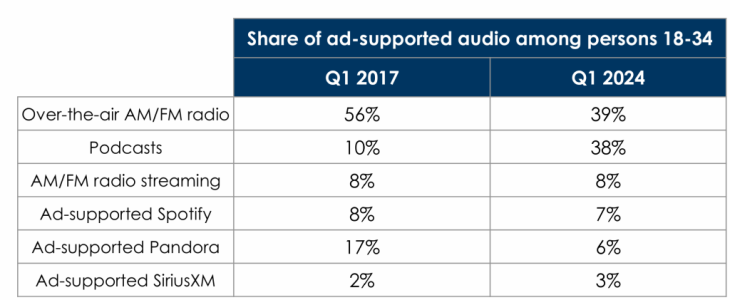
My reference is to new music discovery among under 30s - who have vastly moved away from radio for this purpose. You are referencing PUMM, and what remains of the utilization of mass media by persons in that demo - is likely more for sports and other purposes (NPR perhaps) than for new music discovery. Edison Research's "Share of Ear” shows a steep drop for radio over these past seven years. Streaming of radio has remained stable, but use of traditional radio by persons 18-34 via the broadcast signal is dropping significantly. As such, with new music discovery utilization going away, the remaining music utility via over-the-air AM/FM radio is by those (typically older) seeking more familiar music.You got the data wronng.
PUMM or Persons Using Mass Media (radio and streams of radio) is around 85% of all persons 18 and over. In Y2K it was 94%. So the loss of people who don't use radio at all is just about 9% of the total 18+ universe.
Yes people are using radio less hours a week. But they are using it. And, yes, that is a big problem. But you are confusing PUMM with cume.
K.M. Richards
Program Director, The Eighties Channel™
I agree with your explanation about "share of ear" ... except your characterization of AM/FM users being "typically older".
That is something that cannot be drawn as a conclusion using a chart labeled "18-34".
That is something that cannot be drawn as a conclusion using a chart labeled "18-34".
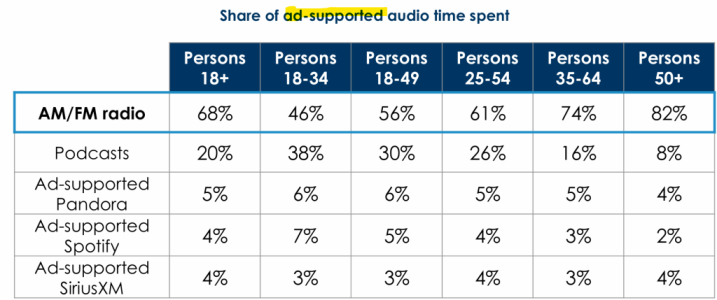
Recognizing the pro-radio bias of posters on this board, the hard truth is radio is no longer the "It" medium for America's youth. Radio listeners are "typically older". Notice the share that radio attracts in this grid (also from Edison Research's Share of Ear) is by far the lowest for the 18-34 demo. Yet, what this chart fails to include is subscription services. Spotify on this grid is the ad-supported version. Add in the subscription (ad-free) version of Spotify and Apple Music and Amazon Music, and the share going to AM/FM for the 18-34 demo will be quite smaller still. All this is to help explain to the OP (30james) that KOLA benefits from being more on target for what remains of an audience still using radio for music consumption.I agree with your explanation about "share of ear" ... except your characterization of AM/FM users being "typically older".
That is something that cannot be drawn as a conclusion using a chart labeled "18-34".
K.M. Richards
Program Director, The Eighties Channel™
Recognizing the pro-radio bias of posters on this board ...
Have you checked out what this site's name is?

... the hard truth is radio is no longer the "It" medium for America's youth. Radio listeners are "typically older". Notice the share that radio attracts in this grid (also from Edison Research's Share of Ear) is by far the lowest for the 18-34 demo.
View attachment 7778
Hmmmm. Your "proof" seems to also indicate that the gap between AM/FM radio and even podcasts for 18-49 is only slightly higher than one-half of what radio's percentage is. If you are trying to imply that radio use is tragically down because of podcasts and streams, then my answer to you is no.
What I see, despite your somewhat clumsy attempt to prove otherwise, is that radio still attracts a higher percentage of saleable demographics than any of the alternatives. So what if radio isn't where the younger demos "discover new music"? They obviously still find reasons to listen anyway.
And yes, we program to the demographic that listens, and that is why Classic Hits gets numbers. KOLA's numbers are good because they do exactly that. Your data about listeners outside of the typical CH demo is close to being off-topic.
No, it is actually "heavy users of radio are typically older". There is still considerable use of radio across the board, but younger users spend a lot less time.Recognizing the pro-radio bias of posters on this board, the hard truth is radio is no longer the "It" medium for America's youth. Radio listeners are "typically older".
You are using Time Spent Listening set of data. I am using a cume based comparison. Younger audio consumers spend less time with radio, but they do use it in surprisingly large percentages of the youth demos.
- Status
- This thread has been closed due to inactivity. You can create a new thread to discuss this topic.