• Get involved.
    We want your input!
    Apply for Membership and join the conversations about everything related to broadcasting.

    After we receive your registration, a moderator will review it. After your registration is approved, you will be permitted to post.
    If you use a disposable or false email address, your registration will be rejected.

    After your membership is approved, please take a minute to tell us a little bit about yourself.
    https://www.radiodiscussions.com/forums/introduce-yourself.1088/

    Thanks in advance and have fun!
    RadioDiscussions Administrators

Recreate 80' WHTZ chain

Hi, I'm Dylan and I'm new to this forum
I'm 47, I'm from France and became a radio fan since my childhood, at that time my was hosted a show on Skyrock
When I was around 11 years old I went many times at this radio station with my dad and one of favorite hobby was spending my time in the engineering room with this AGK headphone on my head... I was so impressed by the sound of the radio station, every songs, jingles, voices sounded so damn good.
All these lights on those analog processing equipment was so beautiful to see...

I remember that my dad telling me many times that all the credit of the magic of the sound of Skrock was assigned to this american technical consultant.
The funny story was the name of that guy, a certain Frank Foti... FFoti1

It was around 1991-92 and I will never forget those moments

Since that day I'm in love with processing, I'm forgot to mention that I'm not engineering, just a sound processing enthusiast
To honor this souvenirs, I've decided to buy some gears and trying to recreate at home this sound that makes me so happy every time
I have on my hard drive around 2000 songs from the 80s that I ripped as WAV files from my CD collection, most of this CDs are US and Japan 1st press albums and singles from US Top 40...

Today I need your help, advises, because my dream is attempting to approach the sound of Z100 in the late 80s

The chain I will build consist of the following elements:

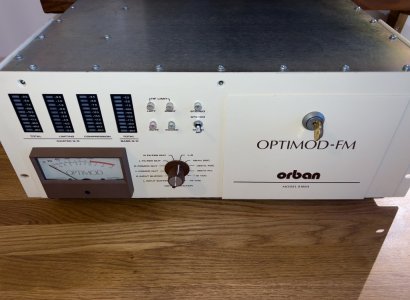
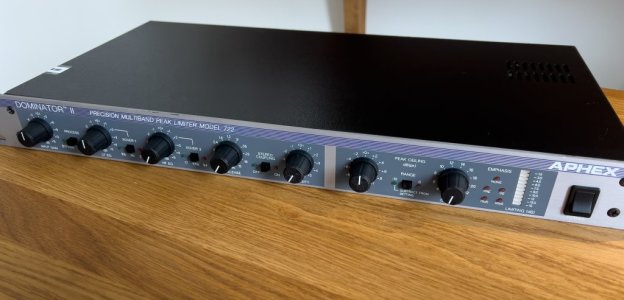
Mac (with Apogee Symphony card) — > BBE Sonic Maximizer 802 — > Orban Spatial Enhancer 222A — > Orban Spring Reverb 111B — > Audio Prism Texar/Gentner — > Optimod 8100A — > Aphex Dominator 722

I already get at home the BBE 802 and Optimod 8100 (led version) and I just bought Orban 111B, Audio Prism 2 Gentner and an Aphex Dominator 722, all those gears are coming to France soon
I just need to find now the Orban Spatial Enhancer 222A and I think I will ready to build something that is almost similar to Z100

Once again I'm not engineer but as an autodidact I think I clearly understand what happened when I turn knobs on those type of devices

I will need your advise on what can we be the best order of the chain and how I can connect and setup the Dominator 722 with the 8100. I know that the Aphex gets lot of emphasis fonctions but I don't know how can I put it in the best way with the 8100: cards, jumpers etc

I'm considering as a rookie so don't blame me please!
 
I’m not looking to discourage your effort. I’ve tried to do something similar. But remember, there are several elements of what went into that sound that you’re leaving out. One, the air studio end of things. How was the air mic processed? How was the music played. It certainly wasn’t from a Mac in those days. Was it CD? Vinyl? Cart? If cart, what make of cart? What tape? Bias? Was the audio recorded to cart processed in any way? Some stations would EQ, compress or both. And two, the transmitter end. What was in line after that processing chain? What type of transmitter? They do have different “sounds.” Some more warm than others. And of course, what type of air monitor were you listening through at that radio station? The headphones too for that matter. I wish you well in your quest. You’ll get close. I can understand that desire to hear it "like it sounded then.” But as I’ve told my wife time and again, as much as I can try to recreate it, there are far too many outside elements to ever absolutely match that sound I experienced and loved. And you can darned near drive yourself crazy obsessing over the effort.
 
You totally right and I want super humble in my approach, I already know that I would be probably far from what it was back in 1987 for example.
In the meantime I do think that my CD collection not remastered played out of my Mac with an Apogee soundcard is a pretty good start.
I will not have that mic problem because all I want for now is only music.
There is no doubt that transmitters play a role on the final result but I do think that this chain BBE Sonic Maximizer 802 — > Orban Spatial Enhancer 222A — > Orban Spring Reverb 111B — > Audio Prism Texar/Gentner — > Optimod 8100A — > Aphex Dominator 722 if it's well configured can give something cool

I'm trying for now to get all those gears and also trying to find good aircheck tapes to have a clear idea of what it sounds at this period, not easy because all I found on YouTube is mostly poor tuner reception on poor K7 encoded into mp3...

Thanks for your response, that always help
 
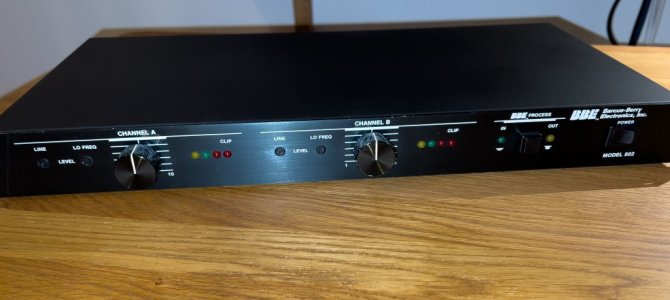
BBE 802.jpg

I already found the BBE 802, I would love to know if you think that this unit was insert in the chain before the Audio Prism?
It works really well and add lot of bass and trebles so I think it's really important to know where it was inserted in the chain
My thoughts would add it just at the very beginning of the chain after the source/mixer but I'm not sure at all
 
You need to determine what WHTZ was using for source material in 1987. Was all the music coming from CD (rare but growing at that time), or were they still playing analog music---vinyl recorded to tape cartridge for playback?

If they were still using analog source material, your end result will sound different. But it might be close enough for what you want.

Bonne chance!
 
I found this video from Kid Kelly back in the days in the studio of Z100
I think it was recorded around 1990 and we clearly see that most of songs and jingles are played directly from carts
it is obvious that source even if it's ripped from CDs on production give a warm analog add before chain processing
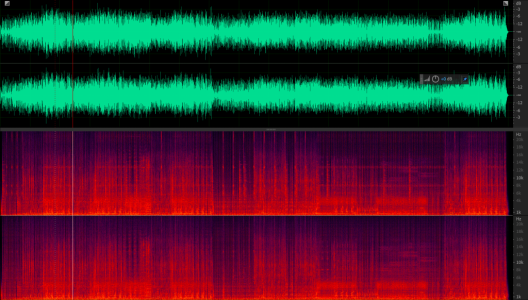
I can't do the same thing but I'm really meticulous with sources. One again albums, singles that I collect from my childhood are not remastered and gives most of the time beautiful clear and dynamic sound (cf below)

Merci Michael

Audition.png
 
I thought using spring reverb was more of a 60's and maybe 70's thing?

Listen those attach files, you can hear really well the Z100 reverb on this INXS song
On this particular part of the song the voice of the singer on the original recording is really raw without any reverb
I found this on internet archive website, we can hear the reverb on music program, on host voices and even on commercials!
View attachment INXS.mp3
View attachment INXS (original).mp3
 
Last edited:
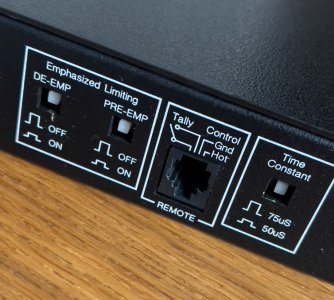
The order of your air chain looks perfect, with the sole exception of the 722 following the Optimod. Are you deemphasizing the Optimod's output before sending it into the 722, perhaps to experiment with strange and novel processing effects?

Otherwise, in broadcasting, the 8100's output would never be followed by anything other than the exciter/transmitter. This is because the Optimod's output is tightly peak-controlled via its own, internal dual-band limiting --> pre-emphasized HF limiting --> distortion-canceled HF clipping --> FCS overshoot compensator. Feeding such pre-emphasized output into a 722 would severely mangle things.

Assuming you really want to use both the 722 and Prisms, I would experiment with placing the 722 either directly before or directly after the Prisms.

Also, yes, a small amount of reverb was sometimes added to music (but usually not to DJ mics, unless a station truly wanted to sound 1960s as radiofan said). Adding small amounts of reverb only to the music would help it to sound fuller and richer when followed by multiband processing. This is because when multiband compression is in strong gain reduction (which is most of the time), the barely-audible amount of reverb you've added is gain-reduced back down below the audibility threshold. So you only perceive it briefly during the fraction-of-a-second-long "potholes" in loudness between loud sounds. That has the effect of helping the music to seem "larger" and "richer" without all the instruments and vocals being made to sound like they are drowning under reverb. The listener only consciously notices the reverb's presence in particular moments like that in your clip -- where there's a quiet arrangement of just a few or even one dry voice or instrument.

A conceptually similar trick is done for DJ mics, where side-chaining is used to perform extra gain reduction, triggered by the DJ's voice, only on the music, and not on the DJ's voice itself. This helps to prevent the DJ's voice from sounding like it is drowning in the music itself. With precise synchronization, the music "ducks down and out of the way" of each vowel and sibilant in the jock's speech.
 
Last edited:
Incidentally, if you really want the dense sound characteristic of the era you're remembering, you will probably need to find the Optimod XT/2 chassis to accompany your 8100. However, the combination of the Prisms and the 8100 was often employed to create a competitively dense sound. So if you like what you hear with just those two, you may not need to get an XT/2 ... unless you want the exact sound it was known for.

I wish the old processing clips thread and server were still alive. They had some marvelous comparisons of the 8100 operating with and without the XT/2.
 
The order of your air chain looks perfect, with the sole exception of the 722 following the Optimod. Are you deemphasizing the Optimod's output before sending it into the 722, perhaps to experiment with strange and novel processing effects?

Otherwise, in broadcasting, the 8100's output would never be followed by anything other than the exciter/transmitter. This is because the Optimod's output is tightly peak-controlled via its own, internal dual-band limiting --> pre-emphasized HF limiting --> distortion-canceled HF clipping --> FCS overshoot compensator. Feeding such pre-emphasized output into a 722 would severely mangle things.

Assuming you really want to use both the 722 and Prisms, I would experiment with placing the 722 either directly before or directly after the Prisms.

Also, yes, a small amount of reverb was sometimes added to music (but usually not to DJ mics, unless a station truly wanted to sound 1960s as radiofan said). Adding small amounts of reverb only to the music would help it to sound fuller and richer when followed by multiband processing. This is because when multiband compression is in strong gain reduction (which is most of the time), the barely-audible amount of reverb you've added is gain-reduced back down below the audibility threshold. So you only perceive it briefly during the fraction-of-a-second-long "potholes" in loudness between loud sounds. That has the effect of helping the music to seem "larger" and "richer" without all the instruments and vocals being made to sound like they are drowning under reverb. The listener only consciously notices the reverb's presence in particular moments like that in your clip -- where there's a quiet arrangement of just a few or even one dry voice or instrument.

A conceptually similar trick is done for DJ mics, where side-chaining is used to perform extra gain reduction, triggered by the DJ's voice, only on the music, and not on the DJ's voice itself. This helps to prevent the DJ's voice from sounding like it is drowning in the music itself. With precise synchronization, the music "ducks down and out of the way" of each vowel and sibilant in the jock's speech.

This is one of the big first question

I would love to use it as an XT2 but I'm not sure how can configure it and if I have to do some improvement on the 8100
If yes I will have to request the help of an engineer because all I do myself are my own cables, so I will need exeternal expertise
This is also why I'm posting this here, because I know there are lots of talented guys here and I'm sure all your advises will help me a lot!

Your comment along at just the right time because I've receive today the 722

edit: I found these from Frank Foti
"Howe Phase Chaser (used to maintain consistent mono, because the format was all cart)
Texar Audio Prisms (early version, with single LED bargraphs) Hand delivered by Mr. Glen Clark himself!
EXR Exciter (like an Aphex Aural exciter. Used for sparkle) This was permanently "borrowed" from WMMS, Cleveland.
Barefoot Optimod 8100 (left over from WVNJ)
CP-803 composite clipper (Jim Somich came up with the idea of allowing the red LED to illuminate!)
Continental 802A exciter
That was the original airchain, and remained that way until 1986, when the same left-handed kid from the land of WMMS, began modifying the Aphex Dominator, model 700. Also, the EXR exciter was replaced with an early version Barcus-Berry, we added a Rev-5 reverb to the chain, and experimented with stereo enhancement.
When the modified Dominator was added, later known commercially as The Vigilante, we eliminated the guts of the 8100. At first, we used the Optimod clipper cards #8 & #9 and its stereo generator, but later on, the same kid from Cleveland built his own clipper."

"The airchain consisted of a set of early Texar Audio Prism's, an EXR Exciter, modified 8100, and a CP-803. That was in 1983. From there it evolved into what later got my company started, as that's where the Vigilante was born. (I still have that unit too!) Once that happened, we only used the stereo gen from the 8100. The Vigilante did the multiband limiting, preemphasis, and final limiting. That's sometime in 1985/1986. The chain was not played/tweaked with all that often. We'd set it, and pretty much forget it
That was the original airchain, and remained that way until 1986, when the same left-handed kid from the land of WMMS, began modifying the Aphex Dominator, model 700. Also, the EXR exciter was replaced with an early version Barcus-Berry, we added a Rev-5 reverb to the chain, and experimented with stereo enhancement."


IMG_5742.jpg

IMG_5746.jpg
 
Last edited:
I see. Interesting! So you actually want to re-create the final Frank Foti WHTZ sound as it existed in the Vigilante era. I guess I hadn't considered that as your goal, because Frank's modifications to the Dominator were so extensive that I doubt anybody would be able to re-create them without either Mr. Foti's guidance or a working Vigilante as a reference model. Does this mean Frank set up the air chain at your dad's station with a Vigilante, too?

Perhaps you might consider contacting him? Maybe he would be honored by the depth of your love for his sound and offer advice. There is an e-mail address in this old thread for somebody who worked for Frank and might be able to tell him about this thread.
 
Thanks for those answers @yeoldeschool, to be honest I'm little bit lost because I thought the Dominator was used after the 8100 (same role than an XT2)
After the words of Mr Foti and than some answers here I've the feeling that only cards 7,8 and 9 from the Optimod 8100 was used so the Vigilante was inserted before this last stage
If this scenario is closer to reality, it would be really difficult to reproduce the sound of Z100
I'm not aware of what was modify or changed on the 8100 and from the original 700 but I've seen that my Dominator 722 get same attack/release for the 3 bands if I'm not mistaken. I think this thing can be improve and maybe a lot more
I will try to talk to him but please if you know someone who wants to sell the Vigilante I would very happy to talk
I'm also looking for an Orban 222A

It is hard to remember what was the air chain of Skyrock at that time but I remember well to see many BSS DPR 402, maybe 8 units one below each other
I was around 11 years old and those light reminds me a christmas tree

Thanks again for your precious help
 
Thanks for those answers @yeoldeschool, to be honest I'm little bit lost because I thought the Dominator was used after the 8100 (same role than an XT2)
After the words of Mr Foti and than some answers here I've the feeling that only cards 7,8 and 9 from the Optimod 8100 was used so the Vigilante was inserted before this last stage
According to the words you quoted, he said that even cards #8 and #9 (clipping/FCS) were eventually eliminated in the end, once he built his own clipper. That, by the end, the only thing the Optimod did was stereo generation (card #7). (The Optimod had a very high quality stereo generator, so it would have made sense to keep it even if all it still did was stereo.)

There's a block diagram in ftp://ftp.orban.com/8100A1/8100A1 Manual_Section_1-3.pdf if you aren't aware (PDF scanned page 17).

I will try to talk to him but please if you know someone who wants to sell the Vigilante I would very happy to talk. I'm also looking for an Orban 222A
I do not, but I wish you luck!

It is hard to remember what was the air chain of Skyrock at that time but I remember well to see many BSS DPR 402, maybe 8 units one below each other I was around 11 years old and those light reminds me a christmas tree
That made me remember this video from 14 years ago!


Edit: Another one that also looks christmasy, simply for having 6 prisms in one place at the same time combined with all the Optimod's lights (skip to 2:50 for light out mode):

 
Last edited:
Maybe you can contact Scott Shannon. Scott was very involved In WHTZ.
There was a film made on WHTZ by Scott, about the station.
It was out a few years ago.

Maybe someone here in group would know how to contact him.
 
Maybe you can contact Scott Shannon. Scott was very involved In WHTZ.
There was a film made on WHTZ by Scott, about the station.
It was out a few years ago.

Maybe someone here in group would know how to contact him.

I have buy the DVD From Worst to First recently and it gave me more motivation for this home project!
Thanks!
 
I see. Interesting! So you actually want to re-create the final Frank Foti WHTZ sound as it existed in the Vigilante era. I guess I hadn't considered that as your goal, because Frank's modifications to the Dominator were so extensive that I doubt anybody would be able to re-create them without either Mr. Foti's guidance or a working Vigilante as a reference model. Does this mean Frank set up the air chain at your dad's station with a Vigilante, too?

Perhaps you might consider contacting him? Maybe he would be honored by the depth of your love for his sound and offer advice. There is an e-mail address in this old thread for somebody who worked for Frank and might be able to tell him about this thread.

Frank Foti answered me and told me that he made on the 700 will not works on the 722
I don't have no more information for now but I'll try to find a Aphex 700 in good condition
Thanks!
 
According to the words you quoted, he said that even cards #8 and #9 (clipping/FCS) were eventually eliminated in the end, once he built his own clipper. That, by the end, the only thing the Optimod did was stereo generation (card #7). (The Optimod had a very high quality stereo generator, so it would have made sense to keep it even if all it still did was stereo.)

There's a block diagram in ftp://ftp.orban.com/8100A1/8100A1 Manual_Section_1-3.pdf if you aren't aware (PDF scanned page 17).

I found this on another thread on this forum really interesting:
"I worked at a station where we installed one of Frank Foti's early efforts, the "Vigilante" (a hotrodded Aphex Dominator as I recall) in front of a stock 8100. The recommended installation was to run the Vigilante audio into the 8100's test jacks and flip the input switch to "test". This bypassed the front end of the 8100 so that the only active components were the clippers and the stereo generator. All of the heavy duty audio smashing and thrashing was done in the Vigilante.

An unanticipated side effect was that the front end of the 8100 was still powered up and you could still feed audio into it, although it was only making the meters move and not going anywhere otherwise. I had some fun cranking all the unused knobs to eleven and driving the gain reduction meters into the pins. "Yeah it's loud and it's legal, any other questions?"
 
That description applies to the earlier version of the Vigilante, before it did its own final clipping. After the Vigilante was updated with distortion masked clipping of its own, the 8100 was only used for pure stereo generation.

Glad to hear you got through to Frank. Have you ever heard about https://www.261.gr/proradio.html? It is an online museum of broadcast audio processors past and present run by a gentleman in Greece. And there is some nice information on how the Dominator 700 was modified to create the Vigilante at https://www.261.gr/Jim Somich Processing 3.html. (Edit: the source appears to be https://www.thebdr.net/a-history-of...n-their-own-words-learning-from-the-pioneers/)

And there is additional information about how the Vigilante worked in this old thread as well as this old thread.
 
Last edited:
Status
This thread has been closed due to inactivity. You can create a new thread to discuss this topic.


Back
Top Bottom