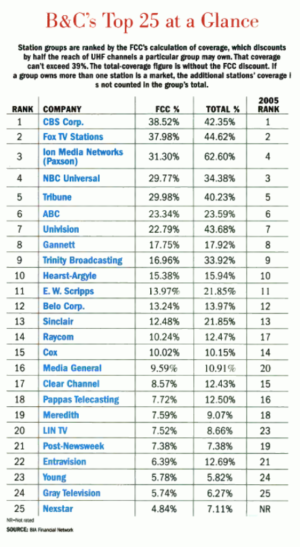
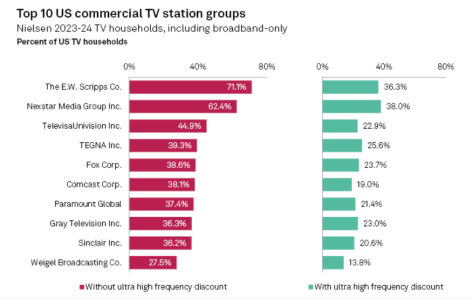
Bits of both like CBS divested several stations over the years seen on this list. Some of them were former UPN, CW and My TV affiliates at the time CBS owned them. They are WTVX, WNDY, WUPL, WWHO, KAUT, and in rare cases they sold CBS affiliates like KEYE, WFRV and KUTV to meet the limits at that time.The growth of Nexstar, Sinclair and Gray was amazing. Of course, mostly by acquisition.
I do wonder what happened to CBS/Paramount and Fox Broadcasting. They were near the limit in 2009's list, but well below it in the list Huff provided. Were there divestures, or just regulatory changes?
It's entirely political. There have been attempts to eliminate the discount and there's been tremendous pushback from the operators who would be negatively affected as a result.Of course, as Huff's inclusion of current data proves, the UHF discount is now an unfair factor. It was put in place by the FCC during the analog era, which has become a faded memory receding in the rear view mirror. That was an era where UHF reception was, for many viewers, problematic; ironically, UHF is now the preferred transmission band for digital television, and station groups are now getting credit for being on the channels they now want to be on.
Other than the headache that would be created by a large amount of grandfathering, I do not for the life of me understand why the Commission hasn't eliminated that yet.
It's entirely political. There have been attempts to eliminate the discount and there's been tremendous pushback from the operators who would be negatively affected as a result.
What was Pappas Telecasting and what happened to it? I also had no idea that Post and Newsweek were involved in owning TV stations.
Thanks for explaining!
Why am I not surprised?
Hope she didn’t get filleted for it!Mignon Clyburn was the only one who spoke the truth.