
• Get involved.
    We want your input!
    Apply for Membership and join the conversations about everything related to broadcasting.

    After we receive your registration, a moderator will review it. After your registration is approved, you will be permitted to post.
    If you use a disposable or false email address, your registration will be rejected.

    After your membership is approved, please take a minute to tell us a little bit about yourself.
    https://www.radiodiscussions.com/forums/introduce-yourself.1088/

    Thanks in advance and have fun!
    RadioDiscussions Administrators

Do American Stations Need to Protect Other Stations Not in North America?

On the San Francisco board, a question was asked about 810 KGO's directional antenna. We know it protects WGY Schenectady. BLA wants to know if KGO "must also protect the skywave for DZRJ AM 810 in Manila?"

Having a continent to ourselves, I guess the U.S., Mexico and Canada don't require its AM stations to protect anyone other than each other, plus The Bahamas and at one time Cuba. Did Jamaica, the Dominican Republic, Bermuda or any other nearby island nation participate as well?

We do know that Hawaiian stations, despite being 2,500 miles out in the Pacific, do have to protect some West Coast stations and visa-versa. But even that is pushing the boundaries of what an AM station needs to protect.
 
As required by international treaties. Such as the North American Radio Broadcast Agreement (NARBA).
Foreign stations are generally not protected outside of their countries boundaries.
Depending on the service there are restrictions certain distances from another countries boarder.
The treaties spell out procedures.
 
On the San Francisco board, a question was asked about 810 KGO's directional antenna. We know it protects WGY Schenectady. BLA wants to know if KGO "must also protect the skywave for DZRJ AM 810 in Manila?"

Having a continent to ourselves, I guess the U.S., Mexico and Canada don't require its AM stations to protect anyone other than each other, plus The Bahamas and at one time Cuba. Did Jamaica, the Dominican Republic, Bermuda or any other nearby island nation participate as well?

We do know that Hawaiian stations, despite being 2,500 miles out in the Pacific, do have to protect some West Coast stations and visa-versa. But even that is pushing the boundaries of what an AM station needs to protect.
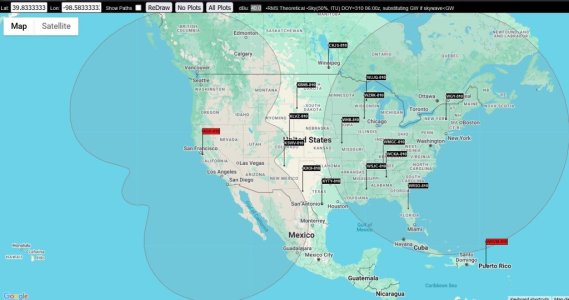
I would think KGO wouldn't have to worry about protecting WGY, but I don't make the rules.
 
I would think KGO wouldn't have to worry about protecting WGY, but I don't make the rules.
The story goes that General Electric owned both stations. WGY was already a Class I-A. But GE wanted KGO to also run 50,000 watts around the clock as a West Coast powerhouse station. The FCC went along with GE's request. WGY was dropped to a Class I-B, even though it kept its same 50,000 watt non-directional transmitter. KGO became a Class I-B as well. Its power was boosted to 50,000 watts but it had to use a directional antenna to protect WGY.

KGO's call letters stand for General electric Oakland, since that city across the bay from San Francisco was where a large GE plant was located.
 
The story goes that General Electric owned both stations. WGY was already a Class I-A. But GE wanted KGO to also run 50,000 watts around the clock as a West Coast powerhouse station. The FCC went along with GE's request. WGY was dropped to a Class I-B, even though it kept its same 50,000 watt non-directional transmitter. KGO became a Class I-B as well. Its power was boosted to 50,000 watts but it had to use a directional antenna to protect WGY.

KGO's call letters stand for General electric Oakland, since that city across the bay from San Francisco was where a large GE plant was located.
The story isn't true, and it's easy to test it against the actual history.

By 1930, GE had transferred control of KGO to NBC, and the actual ownership of the station passed from NBC to the split-off Blue Network in 1943.

By the time KGO went to 50 kW from the Dumbarton Bridge site in 1946, the Blue Network had become ABC. KGO's move from 7500 watts in Oakland to 50 kW came under the same rules as all those postwar increases - because WGY in the east was a I-A clear, KGO became a I-B and needed to protect the I-A at night.

But by then, GE hadn't owned KGO for a decade and a half.
 
They finally got Class 1-A status in 2000 (International Classification). Now a Class A station.
"Comments: bmalpass 3/30/00: 5/23/00: Accepted by IB as a Class A1 facility on 17 May 2000."
 
Having a continent to ourselves, I guess the U.S., Mexico and Canada don't require its AM stations to protect anyone other than each other, plus The Bahamas and at one time Cuba. Did Jamaica, the Dominican Republic, Bermuda or any other nearby island nation participate as well?
The NARBA treaty of the later 1930's included, the US, Canada, Mexico, the Bahamas, Cuba, Haiti, the Dominican Republic, Puerto Rico and the US Virgin Islands and Jamaica. Cuba abrogated in the very early 60's, the Dominican Republic was notorious for making "exceptions", Haiti failed to comply, even authorizing non-10-kHz-interval allocations. None of the Lesser Antilles were part of this, not even the British Virgin Islands.

Bermuda had a "split frequency" on 1235 kHz, so was not in compliance. Mexico decided that "sunrise" for daytimers was uniformly 6 AM and sunset was always 7 PM. The Dominican Republic did not enforce power limits, and many stations had much higher power than their NARBA notification indicated. Jamaica only had a few stations, none with enough power to be an issue, treaty or not. Pre-Castro Cuba was a very good signatory, obeying even the directional antenna notifications... until the communists took over and used AM radio as a weapon.
We do know that Hawaiian stations, despite being 2,500 miles out in the Pacific, do have to protect some West Coast stations and visa-versa. But even that is pushing the boundaries of what an AM station needs to protect.
Same goes for Puerto Rico. I had a monitoring point for 10 kw WQII-1140 that was straight on a line towards Richmond, VA. And Miami, FL, station WQBA had to protect me!
 
Yes KGO protects WGY the original Clear Channel station.

View attachment 8100
What would have been the harm if KGO had been non-directional? There would have been some overlap, but since it wouldn't have been within either stations' core markets, I don't see why it would have mattered. After all, how many listeners would either station have had in Omaha, Kansas City, or DFW?

Given the distance, I don't see how KGO would have interfered with WGY in update New York. And with the larger lobes of KGO going into Canada and Mexico, what would have been the point? How many listeners does KGO have outside northern and central California?
 
What would have been the harm if KGO had been non-directional? There would have been some overlap, but since it wouldn't have been within either stations' core markets, I don't see why it would have mattered. After all, how many listeners would either station have had in Omaha, Kansas City, or DFW?

Given the distance, I don't see how KGO would have interfered with WGY in update New York. And with the larger lobes of KGO going into Canada and Mexico, what would have been the point? How many listeners does KGO have outside northern and central California?
When those rules were written, most radio listening was at night and the Class 1 A stations had listeners in dozens of states. It's not about listening 1500 miles away, it is about the interference that another station can produce inside the useful coverage area of each station. KGO, non directional, could reduce the WGY coverage in Ohio, Illinois, Tennessee, etc... not always, but often enough to make the night signal severely restricted.
 
Even back when owners greatly desired DX reception and broadcasting and the dial was clearer, I can't fathom a fashion by which even a 50,000 east coast station omni would be interfered with by a 50,000 watt west coast omni station at night.
Ignore for a moment that the FCC has no choice but to issue their omni licenses -- AM, FM and (likely) TV -- as if no perturbations whatsoever in terrain existed. What possible overlap between WGY and KGO was the issue? Kansas City? They had their own 810, a 10000 watter, KCMO, one that would give their listeners the correct time.
Moreover, in my layman thrashes and stumblings through the DX hobby, a conclusion is that WGY's latitude affects their reception. They are the worst signal of any 50,000 watt omni AMer I ever tuned in. Once more, the FCC cannot possibly factor in Auroral Indexes any more than it can provide for eSkip or volcanos. So latitude is not an ingredient. WGY gets a nice round FCC circle in the file whether their stick is in the Aleutians. Kingman Arizona or Key West. WGY remains -- corrections welcome, please -- the farthest north latitude 50,000 watt omni AM in the 48. If the Auroral Index is 0 all the time -- no nibbling at all -- they'd get out better all the time. But it ain't, so they don't.
I welcome any corrections on my term paper about reception, hi.
 
When those rules were written, most radio listening was at night and the Class 1 A stations had listeners in dozens of states. It's not about listening 1500 miles away, it is about the interference that another station can produce inside the useful coverage area of each station. KGO, non directional, could reduce the WGY coverage in Ohio, Illinois, Tennessee, etc... not always, but often enough to make the night signal severely restricted.
Yes, but that was 30+ years ago. I used to listen to the 50 kW blowtorches back in those days, especially for sports, but that era is long over thanks to TuneIn and the sports and individual station apps. Is there any reason why such limitations need to continue?
 
When those rules were written, most radio listening was at night and the Class 1 A stations had listeners in dozens of states. It's not about listening 1500 miles away, it is about the interference that another station can produce inside the useful coverage area of each station. KGO, non directional, could reduce the WGY coverage in Ohio, Illinois, Tennessee, etc... not always, but often enough to make the night signal severely restricted.
And I forgot about WHB in KC on 810. They run 5 towers at night. I don't understand why, as long as their market is covered. With tower land being so valuable, multi-tower sites maybe should go away, selling off the excess land and only running one tower 24/7. Seems to me that the days of directional antennas should be made to go away nationwide.
 
And I forgot about WHB in KC on 810. They run 5 towers at night. I don't understand why, as long as their market is covered. With tower land being so valuable, multi-tower sites maybe should go away, selling off the excess land and only running one tower 24/7. Seems to me that the days of directional antennas should be made to go away nationwide.

810 wasn’t used in Kansas City until 1947. This was a drop-in: the new station had to protect the stations already there.

Edit: to make it clearer, KCMO moved from 1480 to 810 in 1947. KCMO swapped frequencies with WHB in 1997.

Second edit: the 810 tower site is in a sparsely-populated area (though within the city limits) that isn’t likely to get much development any time soon.
 
What you get if you don't protect stations is European-style chaos. AM is mostly gone now, but back in the old days you'd have local UK stations unlistenable at night, completely obliterated by 400kW omni co-channel crap from Spain, Romania or Albania.

The poor reception at night due to the poorly coordinated chaos is, in my view, part of what accelerated the decline of AM in Europe faster than in North America. Stations that couldn't be heard at all in peak afternoon drive hours in winter and had no other platform started to look for more reliable platforms - mostly DAB, due to congested FM spectrum. Listeners who wanted to hear their preferred station quickly adopted the alternative platforms.
 
Yes, but that was 30+ years ago. I used to listen to the 50 kW blowtorches back in those days, especially for sports, but that era is long over thanks to TuneIn and the sports and individual station apps. Is there any reason why such limitations need to continue?
No, I am talking about the 30’s and 40’s when there were about 1000 stations or less and few serving the most remote areas and rural zones. If you look at Broadcasting Magazine in the 30’s and early 40’s, stations showed maps of mail response from 30 to 40 states in some cases.

The reason those rules continue to exist is that the laws of physics have not changed and, under certain conditions, very distant signals can seriously affect stations in their immediate coverage area.

My best example comes from listening to the 1-A clear channel in Cleveland, Ohio, just about 18 miles from it s transmitter and hearing a 10 kw station from Venezuela a right under it. Not normal conditions, but an illustration of how even more regular conditions can allow distant stations to interfere very close to a local signal.
 
Last edited:
The story isn't true, and it's easy to test it against the actual history.

By 1930, GE had transferred control of KGO to NBC, and the actual ownership of the station passed from NBC to the split-off Blue Network in 1943.

By the time KGO went to 50 kW from the Dumbarton Bridge site in 1946, the Blue Network had become ABC. KGO's move from 7500 watts in Oakland to 50 kW came under the same rules as all those postwar increases - because WGY in the east was a I-A clear, KGO became a I-B and needed to protect the I-A at night.

But by then, GE hadn't owned KGO for a decade and a half.
I had heard the WGY-KGO story some time ago but I guess it wasn't true. Although there is the matter of WGY dropping from a Class I-A to I-B to accommodate KGO's 50,000 watt presence on the West Coast. If KGO got that boost in 1946 and became a Class I-B while owned by ABC, why was WGY, owned by General Electric until 1983, willing to go along with it?

Sure, as time went by, 50,000 watt stations in the West went on the same frequency as the big I-A stations in the East. But none was Class I-B. KCBS 740 runs 50,000 watts but as a Class II. Same for KFMB 760 San Diego, 50,000 watts at night but as a Class II. KOH 780 Reno, KBOI 670 Boise, KDWN 720 Las Vegas, KTNQ 1020 Los Angeles, all of them full time 50,000 watt stations but all Class II. When KOB Albuquerque won its legal case vs. WABC, it got to broadcast at 50,000 watts full time on 770 but as a Class II. The FCC didn't mix I-As and I-Bs on the same frequency.

WGY didn't have to make any changes to its single-tower antenna. It stayed 50,000 watts non-directional. But it did have to drop its high ranking I-A status when KGO went to 50,000 watts as a co-equal Class I-B.
 
I'm s'sposing that the playing-card deck of AM frequencies began reshuffling -- *again* -- during the addition of the X-Band and then the great AM Renaissance expedition of about a decade ago. Perhaps the big alchemy push in the '60's to get the 250-watt Class IV graveyarders to go to 1000 was the actual first flare; the 60's seemed to have more signal-oriented and driven *radio* people topside than now -- a more patient and better management mix of entertainment plus business if you will.
AM stereo .... miniature signals at night covering the COL's ..... Whole nations doing digital ..... AMers becoming useful solely as laptop dispatchers to feed FM extension speakers: people here will know the dates and the actual chronology of those uphill trudges. Nothing was helping, though.
Moreover, more recently the FCC decreed the AM facilities be 'restructured' -- let's call it what it was (downsized) -- letters for the classifications now instead of numbers. Coupla thousand Maaco paint jobs on the same signals. Tuh. Paperwork.
There must exist skepticism regarding the ability of any esquire on the Commission to pass his or her own 3rd class license exam anymore. The paperwork has even seeped down the hall to the FM side, with the old class A, B and C stations getting their asterisks along with the translators, LPFMs and the general speculation (a snide part of me believes that if Brendan becomes the new FCC chairman that even those foreign language pirates allowed to stay here possibly will become legit for a fee or donation; Class P-1's, P-2's, etc:rolleyes: ...... Hey, you never know).

One more vent left. Later, though. Same topic, same frequency(s).
 
Cuba which is technically in North America have stations that cancel out many of the East coast stations, 100 miles from their transmitter. 710 WOR for example
 
One time while listening to WSM, the propagation briefly shifted. I heard the ending of "Don't sleep in the subway " by Petula Clark. It appears to have come from Cuba by the antenna direction. That only happened once.
 
Status
This thread has been closed due to inactivity. You can create a new thread to discuss this topic.


Back
Top Bottom