• Get involved.
    We want your input!
    Apply for Membership and join the conversations about everything related to broadcasting.

    After we receive your registration, a moderator will review it. After your registration is approved, you will be permitted to post.
    If you use a disposable or false email address, your registration will be rejected.

    After your membership is approved, please take a minute to tell us a little bit about yourself.
    https://www.radiodiscussions.com/forums/introduce-yourself.1088/

    Thanks in advance and have fun!
    RadioDiscussions Administrators

Denver KOA's 100th anniversary

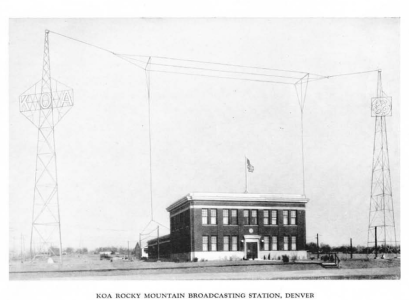
KOA has been on the air for 100 years as of Sunday. General Electric put the station on the air December 15, 1924, from the address then described as 1370 Krameria Street, in east Denver in what had been the Town of Montclair until Denver annexed the area at the turn of the century.
Screenshot from 2024-12-18 17-22-56.png
It looked pretty rural back then. What's there now? Assuming the station faces Krameria Street, the right tower is near 13th Avenue and the left tower in the middle of either 14th Avenue or the Mayfair Center, a small shopping area. Between the building and the right tower would be a Safeway. So, yes, whenever I drive to my neighborhood Safeway, I'm parking where that building was.

KOA moved to another location on Colfax Avenue in 1933 which must have been fairly close-by since Colfax is one block north of 14th and Aurora is just about a mile to the east of this area. KOA moved its transmitter site out to Parker in 1960. The Krameria building later was used by the state highway department until it was torn down, probably some time in the 1950s.

KOA has been mentioning its anniversary on some of its top-of-hour IDs. I don't know of any special programming that's been done. Ross Kaminsky has done some radio history segments on his morning talk show in the past; he mentioned it briefly in yesterday's show, but that appears to be about it so far.

The photo came from a 1926 General Electric publication titled Spanning a Continent, featuring stations WGY, KGO, and KOA, available at worldradiohistory.com.
 
The 1932 Colfax site is the one that was later used by the highway department - and still is!

Scroll down to the bottom for some pictures.
Well, then! I surmised incorrectly about that post-Krameria site! To be fair, the transmitter location in the front of the stack of FCC history cards just gives that second site location as "Colfax Ave., Township 4 South, Colo." which doesn't say much of anything about an actual location. So I looked deeper and saw a 1958 entry that placed the site in Arapahoe County. This means it could not have been in Denver or anywhere close to the original Krameria site, as Denver has been a combined city-county since 1902. Except for a small area near the former Lowry Air Force base, Montclair remained largely undeveloped until after World War II. Montclair has its own interesting history, featuring the uncle of the famous German aviator the Red Baron. (The Wikipedia history of Montclair is accurate, if somewhat incomplete.)

The reference to Tower Road is interesting; I had always assumed Tower Road referred to something at DIA. I guess not! (Shades of KMXA?)

I shouldn't have made too many assumptions; after all, Colfax goes alllllll-the-way east to Strasburg. It's still designated as US 40, by the way, as well as Business Loop 70 (never a good sign) and a few of the old roadside motels are still around, though most are a bit sketchy. One of them, on the north edge of my neighborhood, is being gutted and is intended to become a boutique hotel.

Thanks for pointing out the reports from your trip back almost seven years ago. Even since then, there appear to have been quite a few changes in the market.
 
KOA has been on the air for 100 years as of Sunday. General Electric put the station on the air December 15, 1924, from the address then described as 1370 Krameria Street, in east Denver in what had been the Town of Montclair until Denver annexed the area at the turn of the century.
...

KOA has been mentioning its anniversary on some of its top-of-hour IDs. I don't know of any special programming that's been done. Ross Kaminsky has done some radio history segments on his morning talk show in the past; he mentioned it briefly in yesterday's show, but that appears to be about it so far.
It turns out KOA did have a program about it, on Sunday the 15th at 8 pm, which they promoted on Facebook just one hour before the program was to start. I would have loved to have heard it but it doesn't appear to be archived anywhere. There is an audio montage of some excerpts from KOA's past, also posted on Facebook.
 
It turns out KOA did have a program about it, on Sunday the 15th at 8 pm, which they promoted on Facebook just one hour before the program was to start. I would have loved to have heard it but it doesn't appear to be archived anywhere. There is an audio montage of some excerpts from KOA's past, also posted on Facebook.
Gee, nice promotions plan -- one hour before the broadcast? If I had known about it, I would've tuned in, too.
 
Gee, nice promotions plan -- one hour before the broadcast? If I had known about it, I would've tuned in, too.
Interesting enough, the second KOA building, the one on Tower Road off Colfax in Aurora, featured in an article in this week's Westword. The author, along with two Rapid Transit District directors, took the 15 Colfax RTD bus all the way from downtown to the easternmost end of the route. That route landed him at the historic KOA building, now used by CDOT. Once I'm a little more mobile and the weather nicer, I might try that!

A bus rapid transit (BRT) line is going to replace the 15, most likely to be completed in 2026, but only to CU Anschutz in Aurora, which won't even get it past I-225. Personally, I wish it would be a streetcar line going to Tower Road then up to the airport, but RTD has had a poor track record with light rail. The buses seem OK.

The first KOA building, which also ended up in the hands of the state highway department, is long gone. A Safeway is there now.

The Westword article, by the way: Just the 'Fax: What We Learned Riding the 15 With Two RTD Directors (KOA is mentioned only at the very end.)
 
The King Of Agriculture, I suppose they featured farm, ranch, and agriculture programs in the early days.

And what an interesting tower array....
Remember, back then stations were assigned calls in sort of alphabetical order. When they went to 4-letter ones in 1922, they started at KAAA and WAAA.

Edit: I was wrong on this. See Scott Fybush's later post for more precise schedules and sequences and a very good link to more data.

Stations made up meanings. WSB was the contrived Welcome South, Brother.
 
Last edited:
Remember, back then stations were assigned calls in sort of alphabetical order. When they went to 4-letter ones in 1922, they started at KAAA and WAAA.

Stations made up meanings. WSB was the contrived Welcome South, Brother.
I haven't been able to pinpoint exactly when radio stations were able to choose their own call letters..sometime in the mid to late 1920's maybe?

Note: Again, I was way off. John Schneider gave me an exact example from 1921 of a requested call sign change.
 
Last edited by a moderator:
I haven't been able to pinpoint exactly when radio stations were able to choose their own call letters..sometime in the mid to late 1920's maybe?
Good question. Definitely after the FRC was formed, but it looks like it perhaps began to be "on request" in the last days of the Department of Commerce supervision. I am asking a radio historian who knows more than I do to see if I can be precise.
 
Remember, back then stations were assigned calls in sort of alphabetical order. When they went to 4-letter ones in 1922, they started at KAAA and WAAA.

Stations made up meanings. WSB was the contrived Welcome South, Brother.
They didn't start at "KAAA" or "WAAA," as it happens. The KAA-KCZ callsign block belonged to Germany until after WWII, so the first four-letter K- calls in the US started with KD.

And sequential calls weren't issued in strict AAA-AAB-AAC order. It was actually the third letter that sequenced, so the earliest W--- four-letter calls are all of the form "W-A-," which is why stations like WBAA in Indiana are actually at the very beginning of the sequential list.

Thomas White, as always, has very comprehensive coverage of those sequences at his earlyradiohistory.us site.
 
From Thomas' article at United States Callsign Policies -

The flood of broadcasting service authorizations that began in earnest in December of 1921 served to overload the recycling three-letter land station calls. Before the crunch the Bureau was able to assign three-letter callsigns to about 200 broadcasters.

It was the more saturated East that was the first to feel the pinch. On April 4, 1922 an application from the Times-Picayune of New Orleans broke new ground with the assignment of WAAB (now WJBO, Baton Rouge) as its call. [NOTE: WAAA was skipped as no sign was permitted with the same letter three times in a row.] The progression continued in alphabetical order, with "A" fixed as the third letter, i.e. WAAB, WAAC, WAAD... WBAB, WBAC... etc. This explains why so many pioneers such as WBAP Fort Worth, Texas, WCAU Philadelphia (now WPHT), WEAF New York City (now WFAN), WHAS Louisville, Kentucky, WKAR, East Lansing, Michigan, WMAQ Chicago (now WSCR), WOAI San Antonio, and WTAM Cleveland share this same middle letter. In later years it became the norm for broadcasters to ask for distinctive calls. However, if they had no preference they were assigned calls from blocks used for a variety of radio services. Starting April of 1923 calls centering on "B" were issued, including WBBM Chicago, WCBM Baltimore, Maryland, WLBL Stevens Point (now Auburndale), Wisconsin and WMBD Peoria, Illinois. (WLBL had requested "WLOL", but was told it had to accept a W-B- call). In mid-1928 there was a jump to the middle of the W-D- block, which yielded WHDH Boston (now WEEI) and WRDW Augusta, Georgia. W-E- calls followed beginning in early 1931, including WDEV Waterbury, Vermont, WEEU Reading, Pennsylvania, and WFEA Manchester, New Hampshire. In 1934, W-F- calls started to be assigned, including WMFJ in Daytona Beach, Florida.

The West held out until May 8, 1922, when western broadcasters started sharing the four-letter ship blocks. KDYL in Salt Lake City was both the first authorization and last survivor of this group. When it became KCPX (now KNIT) December 21, 1959 all thirty-three KD-- authorizations from this switchover had either expired or changed calls. The KF-- block, begun June 1922, boasts a few more noteworthies, including KFBK Sacramento, California, Doc. Brinkley's infamous KFKB, KFNF Shenandoah, Iowa (now KYFR), KFQD Anchorage, Alaska, and KFYR Bismarck, North Dakota. The KG-- group was tapped July 1926: KGEZ Kalispell, Montana and KGFX Pierre, South Dakota are two that survive to this day. (A ship station was not as fortunate. KGOV was assigned to the Morro Castle, which went on to burn spectacularly off the New Jersey coast in 1934. However, surprisingly KGOV is currently unavailable for use by broadcasting stations, since it is technically still assigned to the ship, according to the FCC's online Call Sign Search page). KH-- calls were reserved, beginning in 1927, for a new service category: Commercial Aircraft Stations. Surprisingly this group included a short-lived broadcast authorization, KHAC, issued in late 1927 to Flying Broadcasters, Inc. in San Francisco, for "Airplane (unnamed)". The KI-- block was drafted in early 1932, which resulted in KIEV Glendale, California (now KRLA), followed over the next few years by such stations as KIUL Garden City, Kansas, KIUN Pecos, Texas, and KIUP Durango, Colorado.
 
From historian John Schneider regarding station choice of call letters:

"It pretty much happened from the first days of radio broadcasting. 8MK in Detroit was randomly assigned the call sign WBL in 1921, but then requested a change to WWJ in March of 1922. I get the impression that it started as an informal under-the-table process, but soon became an official procedure."

Note that the early regulations did not cover this even when done, but it became a procedure later.
 
Status
This thread has been closed due to inactivity. You can create a new thread to discuss this topic.


Back
Top Bottom