• Get involved.
    We want your input!
    Apply for Membership and join the conversations about everything related to broadcasting.

    After we receive your registration, a moderator will review it. After your registration is approved, you will be permitted to post.
    If you use a disposable or false email address, your registration will be rejected.

    After your membership is approved, please take a minute to tell us a little bit about yourself.
    https://www.radiodiscussions.com/forums/introduce-yourself.1088/

    Thanks in advance and have fun!
    RadioDiscussions Administrators

Shouldn't San Francisco Have Any Local Talk Radio Shows?

Let's compare SF with other large markets for local talk shows on commercial stations...

1. New York: WABC (Red Apple) has local talk shows most of the day. WOR (iHeart) has local talk from morning drive until noon. WNYM (Salem) has Joe Piscopo in mornings.

2. Los Angeles: KFI (iHeart) is all local except for overnight. KABC (Cumulus) has an afternoon show. KRLA (Salem) has a morning show.

3. Chicago: WGN (Nexstar) is all local except overnight. WLS (Cumulus) and WIND (Salem) both have AM and PM drive shows.

4. Dallas (now ahead of SF in market size): WBAP-AM-FM (Cumulus) are a mix of local and syndicated shows. KRLD (Audacy) has two local shows in middays. KLIF (Cumulus) and KSKY (Salem) have local morning shows.

5. San Francisco: KSFO (Cumulus) has NO local talk shows. It uses Armstrong & Getty in AM drive. KTRB (Salem) also has no local shows, even though Salem's stations in other large markets have morning shows. Non-commercial KQED has a locally produced two-hour show in middays. But that isn't a substitute for at least one local show on a commercial talk station in SF.

I understand, market conditions change. KSFO had a few local shows and dropped them one-by-one for financial reasons. KGO had local talk shows. It saw its ratings and profits dwindle and switched to sports betting two years ago.

So what's wrong with San Francisco? How can Dallas have seven local talk shows spread across four stations and SF has none?
 
KSFO had a few local shows and dropped them one-by-one for financial reasons. KGO had local talk shows. It saw its ratings and profits dwindle and switched to sports betting two years ago. So what's wrong with San Francisco?

I think that's your answer. Radio stations have tried, and the audience hasn't supported talk. Even local SPORTS talk is struggling.

My take is that broadcast radio usage is so low in San Francisco that there isn't simply enough audience. It may be a Top 5 market for people, but not in radio usage.
 
I'm a millennial who started listening to KGO during the summer months of 2022 mainly because of Mark Thompson, for whom I've long had an appreciation for his multi-talented persona and still do. I did appreciate how his show incorporated local and national issues, figuring his show's reach extended beyond the Bay Area media market through online streaming and podcasts. I also got somewhat tuned in to the more politically-moderate nationally-syndicated talker Jim Bohannon, for whom KGO started carrying around that same time I started listening. All this made me appreciate how KGO, even up until two years ago, was among the rare breed of terrestrial radio stations anywhere these days with locally-focused and less ideologically-driven talk even though most of KGO's final lineup leaned left like I do.

Only a few months after I started listening to KGO, the station flipped and Bohannon died the month after KGO flipped. While I never liked Brian Sussman to want to listen to his former show on KSFO, it's telling there isn't even a local right-wing talk radio show in this market when even larger markets like NYC and L.A. have local right-wing talkers. Left, right and center, local talk in Bay Area is long gone now.
 
Well there is a local talk show in San Francisco called "Your Call" on NPR affiliate KALW San Francisco. Its not that talk radio is dead in San Francisco its just that if there are listeners to the News/talk format its going towards Public Radio stations like KALW-FM and KQED-FM San Francisco.
Note KALW makes their programming more towards the San Francisco, Oakland and Berkeley crowd while KQED-FM is Bay Area Wide with their programming and it shows in the ratings.


I think that's your answer. Radio stations have tried, and the audience hasn't supported talk. Even local SPORTS talk is struggling.

My take is that broadcast radio usage is so low in San Francisco that there isn't simply enough audience. It may be a Top 5 market for people, but not in radio usage.
Persons Using Radio for LA is about the same as San Francisco. There is not enough difference to make usage a reason for not supporting talk.

(I took Persons Using Mass Media and removed the streams to get the traditional PUR)
 
When Forum was hosted by Michael Krasny, it was a more traditional talk program, in keeping with Michael's history as both a college professor (at SF State U.) and an evening talk show host at KGO. His program was fair, balanced, and all over the topic spectrum. It wasn't only politics. When he retired a few years ago, the powers that be decided to split Forum in to two separate hours with separate hosts, and the second (10-11 am) hour is marketed to other public stations throughout California, so the focus is regional, not just local. The first hour (9-10) remains SFBA-focused, even when the topic is politics. Yes, they may be discussing a national or international story, but they are just as likely to be discussing a very local issue, like the mayor's race, the Oakland recalls or the problems with the San Mateo County sheriff, topics that wouldn't much interest California at large.

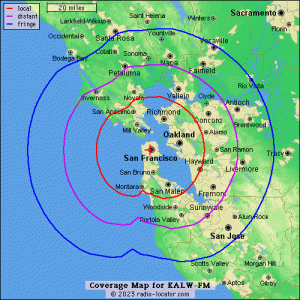
KALW's Your Call plays to its strengths and weaknesses. Their signal covers SF, Oakland and Berkeley well, but as you go southward down the Bay, northward towards Wine Country or eastward over the East Bay hills, the signal becomes increasingly tough to receive, so some of the topics that might have made for good hours relate to areas their signal doesn't cover well.
 
KALW_FM_LU.gif

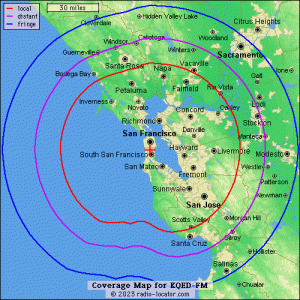
KQED_FM_LU.gif


If one is wondering why KALW-FM is only known by city residents here is some of this. It is erp is 1900 watts compared to the ERP 110kw KQED has. Also KALW-FM is owned by the city of San Francisco via San Francisco Unified School District while KQED is owned by KQED Inc a private non-profit entity. In KQED's case they are Bay Area wide in its coverage which can partially explains why KQED has more listeners than KALW while 91.7 FM focuses on the city itself as its related to their shows.

 
View attachment 8277

View attachment 8278


If one is wondering why KALW-FM is only known by city residents here is some of this. It is erp is 1900 watts compared to the ERP 110kw KQED has. Also KALW-FM is owned by the city of San Francisco via San Francisco Unified School District while KQED is owned by KQED Inc a private non-profit entity. In KQED's case they are Bay Area wide in its coverage which can partially explains why KQED has more listeners than KALW while 91.7 FM focuses on the city itself as its related to their shows.

Radio-Locator signal coverage maps aren’t always accurate. KQED also has KQEI to rebroadcast their programming in Sacramento. @Weiserguy Forum’s first hour also used to run live on SiriusXM’s NPR channel, but I’m not sure if it still does.
 
Radio-Locator signal coverage maps aren’t always accurate. KQED also has KQEI to rebroadcast their programming in Sacramento. @Weiserguy Forum’s first hour also used to run live on SiriusXM’s NPR channel, but I’m not sure if it still does.
Both hours of Forum used to run on S/XM's NPR Now channel, but yes, it's only the second (statewide) hour that is on their schedule anymore, the one hosted by Mina Kim. I don't know the backstory to that, but there is undoubtedly one. Possibly it's that all the other programs on the Now channel are nationally distributed, and they no longer seem to carry any purely local ones anymore. (I remember they used to carry the WHYY program hosted by Marty Moss Cowane -- I've probably just butchered the spelling of her name, sorry about that -- but it too is gone from their schedule.)
 
My take is that broadcast radio usage is so low in San Francisco that there isn't simply enough audience. It may be a Top 5 market for people, but not in radio usage.
It's that way in any city with a huge tech industry base. Including Seattle.
 
It's that way in any city with a huge tech industry base. Including Seattle.
Indeed.

I wanted to say more about this point, but everything I tried ended up reading like an anti-tech screed *sigh*

So I'll miss KGO instead. They may have had their issues with failing to keep up with the times and in the end suffered a slow, miserable death by a declining audience and a company that didn't seem to care, but in their time, I found their talk to be very solid and reasonably well balanced, if not distinctly left-leaning, as @El Zilcho pointed out.

Even after the big purge when Cumulus tried to remake KGO into a shoddy KCBS sound-alike ("some news, some of the time"), there were still some decent hosts that I enjoyed (Pat Thurston, for example, was very good; she's a news anchor at KCBS now).

c
 
Last edited:
It's that way in any city with a huge tech industry base. Including Seattle.
There. Is only insignificant difference in the usage of radio across PPM markets. In general, variations in radio usage time per week has more to do with the. Average commute time of people, not changes in the percentage of people working remotely.
 
Y2kTheNewOldies- Radio Locator maps are better than nothing. However in most cases they do not reflect real-world coverage. For an accurate determination of real-world signal coverage hire or employ an engineer or technical specialist to provide the information you need.
 
KYSP is local talk, right?

I'd argue that KKIQ morning show is pretty much local talk too with how little music it plays. It sure functions that way.
 
Cumulus is apparently going to rename 560 am as KZAC while 810 is renamed as KSFO in 2025. Yes Cumulus is removing the KGO Call letters for obvious reasons.
 
Y2kTheNewOldies- Radio Locator maps are better than nothing. However in most cases they do not reflect real-world coverage. For an accurate determination of real-world signal coverage hire or employ an engineer or technical specialist to provide the information you need.
I think the biggest misunderstanding, Greg, is in the concept of "protected" contours on AM. On that band, signals have historically been protected well into areas where today's radios and today's man-made noise make reception impossible. But we still see those maps that cover 30 states and bits of Mexico or Canada!

AM has the disadvantage today(1) of having night skywave that causes tiny signals from half way across a continent to potentially interfere with a bigger station far, far away. So we see those maps that show not coverage but protection areas; it is mostly about skywave (which all of us except AM DXers wish would go away).

(1) Not, of course, AM's only disadvantage. :rolleyes:
 
Not, of course, AM's only disadvantage. :rolleyes:
There's electrical interference that doesn't seem to diminish. I've noticed that such interference can prevent an AM radio from locking onto an HD signal. It makes sense when you think about it - error correction can only get you so far - but it means that HD isn't likely to be the solution to AM's problems, leaving aside the limited take-up.
 
Status
This thread has been closed due to inactivity. You can create a new thread to discuss this topic.


Back
Top Bottom