
Apologies, deleting a duplicated reply.

-
Get involved.
We want your input!
Apply for Membership and join the conversations about everything related to broadcasting.
After we receive your registration, a moderator will review it. After your registration is approved, you will be permitted to post.
If you use a disposable or false email address, your registration will be rejected.
After your membership is approved, please take a minute to tell us a little bit about yourself.
https://www.radiodiscussions.com/forums/introduce-yourself.1088/
Thanks in advance and have fun!
RadioDiscussions Administrators
You are using an out of date browser. It may not display this or other websites correctly.
You should upgrade or use an alternative browser.
You should upgrade or use an alternative browser.
Lexington, KY (December 7, 1981)
- Thread starter Bluenoser
- Start date
Wow! Amazing that MATV array is still standing there after all these years. If you return and can snap a photo, could you post it on this forum? Thanks!Funny you mentioned that. I was over there last week inspecting sterilizers. I looked up to the roof of the original building, and the MATV array is still there, 8 stories up.
Several cut to channel UHF yagi's and one of them distinctly aimed west.
They don't use that system anymore as Spectrum Cable supplies TV and internet to the entire campus.
Yes, I can confirm that as well that Crosley looked into buying WLEX, but its coverage overlapped with WLW-T. But I agree with another member's question -- why didn't that apply to WLW-D and WLW-C at the time?
That was me. In the area around Hillsboro and Washington Court House, all three stations could have been received. That's probably true of Springfield as well.
Wow! Amazing that MATV array is still standing there after all these years. If you return and can snap a photo, could you post it on this forum? Thanks!
I wasn't able to find it with a Google Street View of the UK hospital campus. What was the exact address of the building?
Wow! Amazing that MATV array is still standing there after all these years. If you return and can snap a photo, could you post it on this forum? Thanks!
Actually, I found this. Was this it?
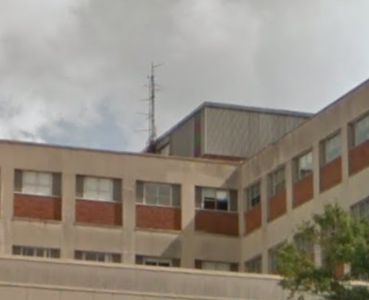
Attachments
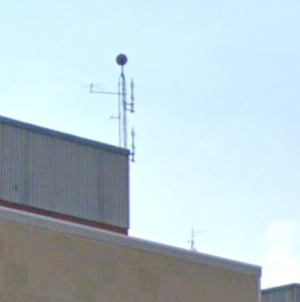
Last edited:
Oddly enough, though, you can't make it out with an aerial 3D view:
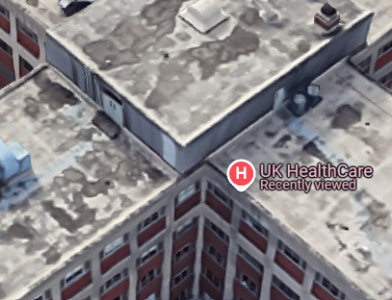
Don't know if 3D imagery on Google Street View makes use of some kind of dithering (or whatever you call it) that could obscure or even eliminate something thin like a TV antenna tower, but after having found what I am assuming is the tower last night, I worked my one last good nerve today trying to retrace exactly where I'd found it. The Chandler building is a drab institutional behemoth, and from the street, all the buildings (and the windows) look alike.
FWIW, it's at (approximately) 788 Rose Street in Lexington, if anyone else cares to look at it in-application.
Don't know if 3D imagery on Google Street View makes use of some kind of dithering (or whatever you call it) that could obscure or even eliminate something thin like a TV antenna tower, but after having found what I am assuming is the tower last night, I worked my one last good nerve today trying to retrace exactly where I'd found it. The Chandler building is a drab institutional behemoth, and from the street, all the buildings (and the windows) look alike.
FWIW, it's at (approximately) 788 Rose Street in Lexington, if anyone else cares to look at it in-application.
Gravel Switch,Apologies, deleting a duplicated reply.
That photo looks from around Lexington.
Lexington TV viewers wanted Louisville and Cincinnati even after three networks and PBS arrived. Lexington's elevation helped being up on the plateau. There were companies selling home MATV system into the late seventies. It was a high gain log periodic for VHF and high gain UHF on a rotor fed into a preamp then to a distribution amp for up to four sets. When cable arrived they slowly came down but some survived.
Occasionally you see a old MATV package on a building. Most were VHF with stacked Yagi's, low and high band, aimed to Louisville and Cincinnati. Occasionally there was a high gain for UHF added for WDRB. The mast below the Yagi's had corner reflectors for WLEX, WKYT & WTVQ (located next to each other) and KET.
Gravel Switch,
That photo looks from around Lexington.
Lexington TV viewers wanted Louisville and Cincinnati even after three networks and PBS arrived. Lexington's elevation helped being up on the plateau. There were companies selling home MATV system into the late seventies. It was a high gain log periodic for VHF and high gain UHF on a rotor fed into a preamp then to a distribution amp for up to four sets. When cable arrived they slowly came down but some survived.
Occasionally you see a old MATV package on a building. Most were VHF with stacked Yagi's, low and high band, aimed to Louisville and Cincinnati. Occasionally there was a high gain for UHF added for WDRB. The mast below the Yagi's had corner reflectors for WLEX, WKYT & WTVQ (located next to each other) and KET.
They were huge back then. Driving down the street, it seemed like every house had one. Again, partially a holdover from when Lexington only had two stations (WLEX and WKXP/WKYT) that shared CBS. Lexington is right in the cradle where marginal signals from Louisville and Cincinnati can be picked up.
I think the FCC making Lexington a UHF-only market actually hurt the market. I saw some old Broadcasting Yearbooks from the '70s with the maps of TV markets, and there were a lot of counties back then that you'd think would be in the Lexington market, but instead they were in Cincinnati, Louisville, or Charleston/Huntington.
The FCC also made Fort Wayne UHF-only, and that probably kept Fort Wayne from getting a PBS station until much later than other places.
The FCC also made Fort Wayne UHF-only, and that probably kept Fort Wayne from getting a PBS station until much later than other places.
I think the FCC making Lexington a UHF-only market actually hurt the market. I saw some old Broadcasting Yearbooks from the '70s with the maps of TV markets, and there were a lot of counties back then that you'd think would be in the Lexington market, but instead they were in Cincinnati, Louisville, or Charleston/Huntington.
The FCC also made Fort Wayne UHF-only, and that probably kept Fort Wayne from getting a PBS station until much later than other places.
The Lexington market was at first confined to the Bluegrass-area counties, and not even all of those. Franklin County (Frankfort) didn't make it into the Lexington market until the early 1980s, prior to that, it had been in the Louisville market. Cable there still carries the major Louisville stations as well as Lexington. They also carried Cincinnati in the 1970s.
The eastern Kentucky counties tended to fall into the Charleston-Huntington, Tri-Cities, or Knoxville markets until they were nibbled away one by one into the Lexington market, this market fragmentation no doubt due to terrain, the inferiority of UHF reception and tuners at the time (many people would have only had 12-channel VHF sets), and historical viewing patterns. Indeed, even WLOS Asheville got deep into eastern Kentucky, and got as far as London, Corbin, and Manchester via cable and even translators. In the 1970s, the three Lexington stations began a joint marketing campaign, "Lexington Television, a reflection of you", listing all three stations, a case of a rising tide lifting all boats. They also came highly into demand in the northeastern Kentucky counties (Boyd, Greenup, Carter, and Lewis), such that various stations enjoyed 25-49% viewership in some of those counties via cable. This predictably alarmed the Charleston-Huntington stations, which had historically given northeastern Kentucky short shrift in news coverage, and they sought to block carriage. (There was a similar situation in southeastern Ohio with the Columbus and Cincinnati stations.) At one time, the Lexington market reached as far as Harlan County, but that county was eventually absorbed into the Knoxville market (Lexington stations are still carried on cable there). Leslie County is to this day the odd man out, relegated to the Tri-Cities market as an "island" amid Lexington-market counties on several sides. Viewers there do not see Tri-Cities stations as being local to them in any way whatsoever, they'd much prefer Lexington and WYMT.
Wow! Amazing that MATV array is still standing there after all these years. If you return and can snap a photo, could you post it on this forum? Thanks!
Actually I did take a photo but someone beat me to it.
Also the old array is still on top Baptist Health on Nicholasville Rd (Old Central Baptist Hospital) but is no longer in use. I was visiting someone there a few years ago and they have a Direct TV based system. It rained and the signal was lost with a Direct TV message
The first pic is it. The second looks like communication antennas
I would agree. Given that "all channel" TVs were not required until 1964.I think the FCC making Lexington a UHF-only market actually hurt the market. I saw some old Broadcasting Yearbooks from the '70s with the maps of TV markets, and there were a lot of counties back then that you'd think would be in the Lexington market, but instead they were in Cincinnati, Louisville, or Charleston/Huntington.
The FCC also made Fort Wayne UHF-only, and that probably kept Fort Wayne from getting a PBS station until much later than other places.
I can attest to the fact my family still watched Cincinnati and Louisville even when 18, then 27 signed on. We had one of the 30 ft towers with the Finco "bedspring" (400A) antennas. I knew many of my neighbors did the same. And reception was ok, but not perfect. But Black and White TV was more forgiving of a weaker signal.
Additionally, early UHF stations were underpowered.
WKYT when it signed on as WKXP, in 1957, was a whopping 214,000 watts. I'm certain that it and WLEX barely covered the adjacent counties.
There's a high rise at Rose and Vine St in downtown Lexington called Rose Towers. The array is still in place. Not sure if it's still functioning or not.bThey were huge back then. Driving down the street, it seemed like every house had one. Again, partially a holdover from when Lexington only had two stations (WLEX and WKXP/WKYT) that shared CBS. Lexington is right in the cradle where marginal signals from Louisville and Cincinnati can be picked up.
Go flip through the "TV Schedules" section of this forum. "bpatrick" posted many Lexington/Louisville/Cincinnati TV Schedules from the 2 station era prior to WBLG 62s sign on in 1968.They were huge back then. Driving down the street, it seemed like every house had one. Again, partially a holdover from when Lexington only had two stations (WLEX and WKXP/WKYT) that shared CBS. Lexington is right in the cradle where marginal signals from Louisville and Cincinnati can be picked up.
You will truly see just how bad Lexington TV sucked.
And it didn't really improve until Telecable arrived.
(Yes I've lived in the area all my life. I now live south of Frankfort and mainly watch Louisville stations)
Very few CBS programs were cleared on Lexington at the time.
An outdoor antenna was necessary to get full CBS clearance.
Even after Lexington got "The Big Three", network pre-emptions were common. From my memory, WKYT was the worst offender after Garvice Kincaid's bought it. Of course, more revenue from ad spots on local programs vs network programs. I get it.
That old antenna still came in handy.
Here is one of those MATV package 30 ft towers at a nursing home in Versailles that I took earlier this year while I was inspecting their boilers there.They were huge back then. Driving down the street, it seemed like every house had one. Again, partially a holdover from when Lexington only had two stations (WLEX and WKXP/WKYT) that shared CBS. Lexington is right in the cradle where marginal signals from Louisville and Cincinnati can be picked up.
The nursing home was built in 1958.
Note the 2 UHF antennas below the VHF High and low band antennas. Presumably for 18 and 27.
The Blonder-Tongue distribution equipment is also in the boiler room mounted on a large piece of plywood.
It was plugged in and powered up, tubes glowing inside the metal enclosure!
Doubt it was being used, though. Wish I had snapped a pic of it!
Attachments
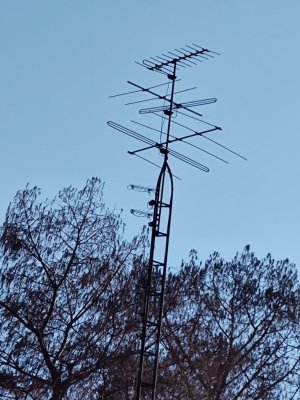
Yep, that is the MATV array as I remember it on top of the Chandler Medical Center, and you can see the cut-to-channel antenna (the one on the top of the mast) aimed west for WDRB. Thanks!
Amazing the distribution equipment was plugged in and powered up as I be VERY surprised if it was still being use.Here is one of those MATV package 30 ft towers at a nursing home in Versailles that I took earlier this year while I was inspecting their boilers there.
The nursing home was built in 1958.
Note the 2 UHF antennas below the VHF High and low band antennas. Presumably for 18 and 27.
The Blonder-Tongue distribution equipment is also in the boiler room mounted on a large piece of plywood.
It was plugged in and powered up, tubes glowing inside the metal enclosure!
Doubt it was being used, though. Wish I had snapped a pic of it!
There was a bunch of coax tangled and I would say when cable became available in Versailles, the antenna and distribution cabinet were bypassed.Amazing the distribution equipment was plugged in and powered up as I be VERY surprised if it was still being use.
I would agree. Given that "all channel" TVs were not required until 1964.
I can attest to the fact my family still watched Cincinnati and Louisville even when 18, then 27 signed on. We had one of the 30 ft towers with the Finco "bedspring" (400A) antennas. I knew many of my neighbors did the same. And reception was ok, but not perfect. But Black and White TV was more forgiving of a weaker signal.
Additionally, early UHF stations were underpowered.
WKYT when it signed on as WKXP, in 1957, was a whopping 214,000 watts. I'm certain that it and WLEX barely covered the adjacent counties.
This is about as good as an antenna page gets: