
-
Get involved.
We want your input!
Apply for Membership and join the conversations about everything related to broadcasting.
After we receive your registration, a moderator will review it. After your registration is approved, you will be permitted to post.
If you use a disposable or false email address, your registration will be rejected.
After your membership is approved, please take a minute to tell us a little bit about yourself.
https://www.radiodiscussions.com/forums/introduce-yourself.1088/
Thanks in advance and have fun!
RadioDiscussions Administrators
You are using an out of date browser. It may not display this or other websites correctly.
You should upgrade or use an alternative browser.
You should upgrade or use an alternative browser.
Which format will be the next to go?
- Thread starter jp1996
- Start date


College radio
70's Oldies. It's just about aged out now.
While expensive to run, All News still bills over it's weight. It's going to be around a while longer--in major markets.All news.

And it has never worked in any place other than huge markets where short TSL can still get a station into the top group that gets on ad buysWhile expensive to run, All News still bills over it's weight. It's going to be around a while longer--in major markets.
In practicality, the main tentpole formats are adapting to the markets they're in, adjusting playlists in ways that fit the way people use radio. So the Rock format doesn't play as much current music as it once did. Country is very currents-based. There are lots of sub-genres, especially in Urban. What is Hot AC in one market might be more CHR in another. So it's not as simple as it sounds. It costs a lot of money to change or drop a format. It's cheaper and more efficient to make minor adjustments.
Which radio format will be the next one to go the way of the dodo, or get to a point where it's only a scant few stations actually playing it, ala BM/EZ?
If I were guessing, I'd say AAA.
The Big A, however, is correct when he says formats are adapting to their markets. Oldies no longer means what it did 20 years ago, but it never went away. Neither does Top-40/CHR. The playlists change and evolve constantly. Most of the mainstay formats that are around today will probably always be around in some form or another, though they might not sound anything alike down the road. Also possible is that we won't really notice when one format goes away. A good example of that is the AOR format from the 70's and 80's. It evolved into multiple different formats as the FM dial created more plentiful options in the 80's and early 90's, and the heritage AOR's either stayed the course too long and went away or evolved into one of the new formats. AOR, however, no longer really exists.
AOR, however, no longer really exists.
Mainly because the "A" in AOR no longer exists. People don't buy or even stream albums. It's all a song-based business.
I remember when 1440 WMAX Bay City, Michigan attempted doing all news, serving the Tri City area of Saginaw, Midland, and Bay City. They had live, local news anchors, supplemented by CNN, and an airplane for traffic reports. It sounded really good, but was too expensive to operate. "MAX NEWS TIME, 2:52..."And it has never worked in any place other than huge markets where short TSL can still get a station into the top group that gets on ad buys
I agree, AOR, the way we knew it, has splintered. However, most of the buyers of "new vinyl" releases are millennials, and Gen-Z. Record collector conventions are often standing room only. Target is selling vinyl records. New releases on "Record Store Day" has people lined out the door. Not everyone is satisfied by a collection of downloads.Mainly because the "A" in AOR no longer exists. People don't buy or even stream albums. It's all a song-based business.
I agree, AOR, the way we knew it, has splintered. However, most of the buyers of "new vinyl" releases are millennials, and Gen-Z.
I mean albums in any form: Vinyl, CD, or even streaming albums. It's a fraction of the sales pie.
Yes, but while small relative to overall sales, physical album sales (even cassette tapes are enjoying a minor comeback) have remained fairly robust, so there's clearly still a decent demand for something other than streaming subscriptions and digital downloads.I mean albums in any form: Vinyl, CD, or even streaming albums. It's a fraction of the sales pie.
c

All news.
Four out of the top ten billing radio stations in the nation (USA), including WTOP at #1, are all news. It's not going anywhere,
From what I read, the top billing radio station was WLTW. If your talking ratings, WTOP trails WAMU in average quarter hour share. All news isn't going away tomorrow but the format has lost stations, it has lost 24/7 stations and it has lost listeners, many of them to public radio news and information stations.
Your definition of "fairly robust" and mine appear to be different. Below is RIAA data for physical album sales for 30 years ending in 2023, in 2023 inflation adjusted dollars. CDs are in orange, cassettes are in light blue and vinyl albums are in dark blue.Yes, but while small relative to overall sales, physical album sales (even cassette tapes are enjoying a minor comeback) have remained fairly robust, so there's clearly still a decent demand for something other than streaming subscriptions and digital downloads.
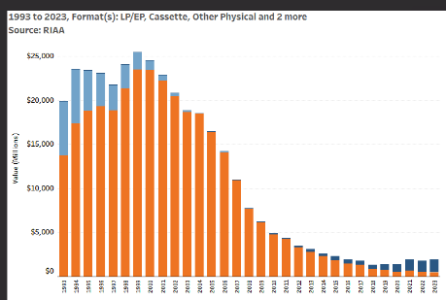
Album sales are down 92% from the peak in the late 90s.
From what I read, the top billing radio station was WLTW. If your talking ratings, WTOP trails WAMU in average quarter hour share.

BIA Reveals US Radio's Highest Billing Stations Of 2023 - Radio Ink
Hubbard Radio's WTOP in Washington, DC, has once again claimed the top spot as the highest billing radio station in the US for 2023.
 radioink.com
A new list should be published next month. I would expect WTOP to remain at the top.
Huh, I guess so!Your definition of "fairly robust" and mine appear to be different.
I think what I meant by robust was that while physical album sales are a tiny fraction of what they once were, it seems they have stabilized a bit over the past few years, perhaps due to Gen Z's curiosity and Millennials' nostalgia, among other things.
Maybe this will translate somehow into a renewed interest in terrestrial broadcast radio someday?
c
How about CHR/Pop? The 12-24 crowd doesn't listen to radio at all. The stream or use online services such as Pandora. On top of that, many CHR/Pop stations across the country are catering to an older audiences by playing songs that are over 20 years old (Nelly's "Hot in Herre" comes to mind).
For decades, the target of CHR has been adult women, mostly 25-44.How about CHR/Pop? The 12-24 crowd doesn't listen to radio at all. The stream or use online services such as Pandora. On top of that, many CHR/Pop stations across the country are catering to an older audiences by playing songs that are over 20 years old (Nelly's "Hot in Herre" comes to mind).
- Status
- This thread has been closed due to inactivity. You can create a new thread to discuss this topic.