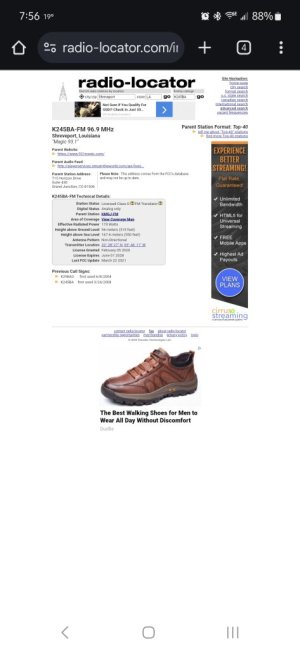
There has been a very long running issue at the FCC where it comes to translator primary stations. It existed in CDBS and it exists in LMS. To understand this, you have to understand how these databases work. CDBS, LMS and for that matter REC Networks' eLMS databases are relational databases. There are different tables within the database that where items are linked together using "keys". For CDBS, an integer representing an application ID was used to represent each version of an application filed (amendments would get a new application ID). For LMS and eLMS, this application ID was represented by a 32 byte hexadecimal number.
In addition to the relational tables for application data, there was also an independent table that managed facility ID numbers in CDBS, LMS and eLMS. Application tables can use the facility ID number to key off of the facility table.
In CDBS, the primary station for a translator was stored in the facility table as a separate entry. This data was manually changed by staff. It was very simple, just one field (assoc_facility_id). This field was used also used for main stations in the cases of TV satellites and for main studio waivers.
In CDBS, only certain application types would ask for the primary station.
Sometime after 2008, a new table was added to CDBS (int_translator). This table was much more robust and allowed for the storage of not just the primary station's facility ID, but also information on delivery method and even call sign and community. Since this table is keyed to the application ID, the data that was in this table is directly linked to that application and does not reflect subsequent changes made through informal notifications which were commonplace at that time.
From this point forward, information on primary stations appeared in two separate places in the database.
With the enactment of the Local Community Radio Act, Section 6 required the FCC to impose regulations in regards to potential interference to translator inputs on third-adjacent channels. This resulted in an amendment to
§73.827(a) that created what we called the "Potential Interference Area" (PIA). At the time, the FCC did put out a public notice encouraging FM translator owners to assure that their primary station data was updated with staff. Again, informal notifications.
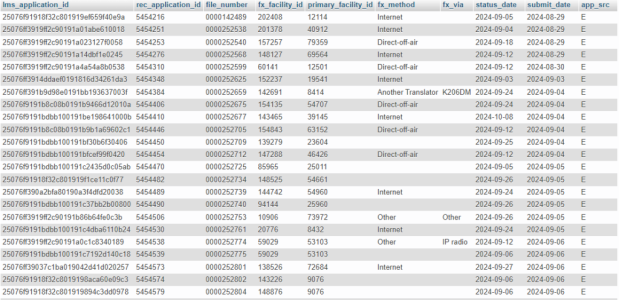
Similar functionality came over to LMS. The LMS facility table had primary_station field. At the application level, primary station data was in the application_facility table (afac_primary_station_facility_id).
Notifications of primary station changes were done informally until a recent release of LMS which accommodated a new form for the filing of notifications of changes to primary stations.
REC's eLMS database, which only provides full engineering support for FM at this time obtains its data by reading the actual application text instead of depending on waiting for staff to update the LMS table. In our FM Engineering table (fmeng), we read all of the fields from the application (primary station, station type, delivery type and delivery other).
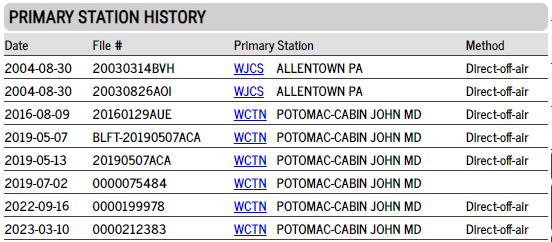
eLMS also maintains a separate table (primary_facility) which serves as our master table for compiling the data from the different sources (including carried over CDBS data as well as real-time data parsed by eLMS).
This is what constructs the primary station log on the left side of the screen at FCCdata.
The only times when primary station was gathered by translator licensees was in engineering applications (CPs, modifications, license to cover) as well as in renewal applications. Until only recently, primary station changes were done through a mechanized, machine readable application form and in the past were done manually by staff in the facility table and likewise, there was a conflict between the facility table and the data in the application tables. We must note that in the old days prior to the LMS form, we had to depend on (1) the translator licensee actually notifying the FCC of a primary station change and (2) staff actually making the entry change on the facility table.
Prior to REC implementing eLMS, FCCdata was also victim of this conflicting data as we used the FCC daily data dump to update the information. We may show one station as the primary station in the header (that comes from the facility table) and another in the engineering detail (which was the primary station specified on that application). This drove to a lot of confusion. This confusion is what drove the implementation of the primary station table when REC created the eLMS database. eLMS actually was designed to address this, and many other shortcomings that happened with the transition from CDBS to LMS for FM radio.
For more information on eLMS, see:

recnet.com
For our writeup and last raw data for CDBS, see:
recnet.com
If you miss the old CDBS public view and you want to play with it, locked in time to the very end, visit:
REC Historical CDBS Search Tool
cdbs.recnet.com
Enjoy