
What about launching a pile of money into the Bay?What about trying a syndicated music service with some kind of mix of older and newer music?

-
Get involved.
We want your input!
Apply for Membership and join the conversations about everything related to broadcasting.
After we receive your registration, a moderator will review it. After your registration is approved, you will be permitted to post.
If you use a disposable or false email address, your registration will be rejected.
After your membership is approved, please take a minute to tell us a little bit about yourself.
https://www.radiodiscussions.com/forums/introduce-yourself.1088/
Thanks in advance and have fun!
RadioDiscussions Administrators
You are using an out of date browser. It may not display this or other websites correctly.
You should upgrade or use an alternative browser.
You should upgrade or use an alternative browser.
560
- Thread starter K108 Sacramento
- Start date

That deserves a citation.They can turn in the ticket for 1050 then.
Do you know of any billionaires that want to become millionaires?What about trying a syndicated music service with some kind of mix of older and newer music?

Gill Gross on FB is reporting that Cumulus turned off 560.
There should also be better reception of Seattle's KVI 570. Down here in SoCal's SFV we can frequently hear it underneath LA's KLAC's Night DA.pattern. Whereas KVI is ND 24/7.The net result would probably be clearer reception of KUZZ from Bakersfield on 550. I was able to receive it a few times in Oakland even with 560 being present.
You're late to the party. See post #170.Gill Gross on FB is reporting that Cumulus turned off 560.

i scrolled back, i swear and didnt see it.You're late to the party. See post #170.
See post #189. It does refer to SDRs; I'd love to know what the situation is like at my former Oakland location, but it looks like it will be some time before I'm back in the Bay Area. But I guess there's no rush on this.There should also be better reception of Seattle's KVI 570. Down here in SoCal's SFV we can frequently hear it underneath LA's KLAC's Night DA.pattern. Whereas KVI is ND 24/7.
Oh joy! The excitement builds around the opportunity to DX dying radio stations following the demise of a signal. Sad, it’s like seeing a new view created after a building is destroyed.See post #189. It does refer to SDRs; I'd love to know what the situation is like at my former Oakland location, but it looks like it will be some time before I'm back in the Bay Area. But I guess there's no rush on this.
Last edited:
It is kind of like that, I hate to say.Oh joy! The excitement builds around the opportunity to DXing dying radio stations following the demise of a signal. Sad, it’s like seeing a new view created after a building is destroyed.
It’s been eerie to see the views in the Palisades here in LA due to the now empty lots. I’m not negating the loss of homes by comparing it to radio which is different .
For a Bay Area old-timer, hearing static on 560 has got to be tough. I know I’d feel that way if I still lived up there.
For a Bay Area old-timer, hearing static on 560 has got to be tough. I know I’d feel that way if I still lived up there.
Red Apple is well run. But as David E. Has pointed out on this forum, their ratings zoomed up by having mostly live and local radio with the exception of Mark Levin whose syndicated.By the time they turned in WFAS's license, Cumulus had largely destroyed whatever value was left in 1230 with their great idea of running it 100% in digital. There's still a bit of hope for 560, since they've had an audience up until recently. (Even after launching the 810 simulcast, with 810 being the vastly superior signal, large numbers of listeners stayed put on 560 to hear their favorite wingnut programming.)
That's not even mentioning that they're such sharp programmers that they had to evacuate from the largest market in the country. I mean, if Red Apple could do what Cumulus couldn't, they should turn in all their licenses and invest the savings in a mattress.

For the record, WABC runs four hours of syndicated shows on weekdays: two hours of Brian Kilmeade at 10 a.m. and two hours of Mark Levin at 6 p.m. Everything else is live and local, although a few shows are syndicated by Red Apple but based at WABC.Red Apple is well run. But as David E. Has pointed out on this forum, their ratings zoomed up by having mostly live and local radio with the exception of Mark Levin whose syndicated.
The four highest cume commercial talk stations in the U.S. are nearly all local. #1 KFI Los Angeles is all local from 5 a.m. to 10 p.m., with Coast to Coast overnight. #2 WSB Atlanta only runs Hannity for three hours in the evening. Erick Erickson is syndicated but based at WSB. It reruns daytime shows overnight. #3 WKXW New Jersey is all local, no syndication, no infomercials but it plays classic hits on weekends. And WABC is #4, according to the January cume ratings.
What those of you all dreamy-eyed and drooling about WABC forget is that KGO tried local talk after picking up the pieces from the all-news experiment in 2014 and stuck with it until October 2022 when the sports-betting format took over rather suddenly.
What management would try what hadn't worked twice before yet a third time? Certainly none that intended to stick around.
What management would try what hadn't worked twice before yet a third time? Certainly none that intended to stick around.

Let me come back to something I think just kinda sailed by.
Here are the shares for the most recent period, released last week, of AM stations that do not have an FM simulcast:
KSFO: 1.4
KTCT: 0.2
KKSF: 0.1
Total: 1.7
Some of you might remember my "AM Mall" analogy---comparing the Bay Area's AM band to a shopping mall at two data points...1978 and 1985---47 and 40 years ago, with pictures:
This is what it looks like now:
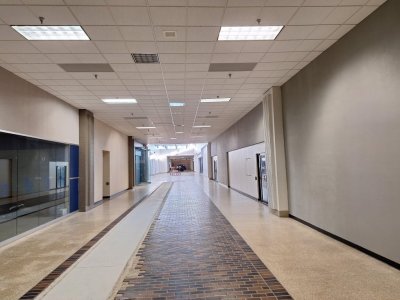
The big stores are dead and gone:
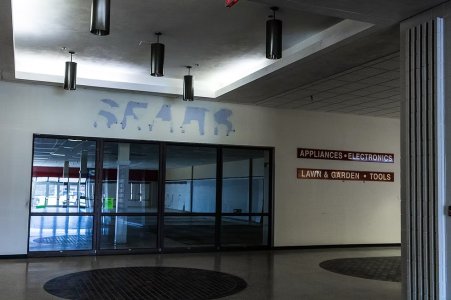
It's over. KSFO will bump along on 810 with a whole number until it doesn't, and from there, if whoever owns it is interested in seeing how long it takes to drop below a 0.1, that's up to them. But, as a practical matter, for most people, AM radio isn't a thing in San Francisco.
Here are the shares for the most recent period, released last week, of AM stations that do not have an FM simulcast:
KSFO: 1.4
KTCT: 0.2
KKSF: 0.1
Total: 1.7
Some of you might remember my "AM Mall" analogy---comparing the Bay Area's AM band to a shopping mall at two data points...1978 and 1985---47 and 40 years ago, with pictures:
This is what it looks like now:
The big stores are dead and gone:
It's over. KSFO will bump along on 810 with a whole number until it doesn't, and from there, if whoever owns it is interested in seeing how long it takes to drop below a 0.1, that's up to them. But, as a practical matter, for most people, AM radio isn't a thing in San Francisco.
Where I live in Campbell, reminds me of the former Vallco in neighboring Cupertino. Also an apt analogy as radio goes.Let me come back to something I think just kinda sailed by.
Here are the shares for the most recent period, released last week, of AM stations that do not have an FM simulcast:
KSFO: 1.4
KTCT: 0.2
KKSF: 0.1
Total: 1.7
Some of you might remember my "AM Mall" analogy---comparing the Bay Area's AM band to a shopping mall at two data points...1978 and 1985---47 and 40 years ago, with pictures:
This is what it looks like now:
View attachment 8715
The big stores are dead and gone:
View attachment 8716
It's over. KSFO will bump along on 810 with a whole number until it doesn't, and from there, if whoever owns it is interested in seeing how long it takes to drop below a 0.1, that's up to them. But, as a practical matter, for most people, AM radio isn't a thing in San Francisco.
Plus possible 1 share for Non-subscribing KTRB.Let me come back to something I think just kinda sailed by.
Here are the shares for the most recent period, released last week, of AM stations that do not have an FM simulcast:
KSFO: 1.4
KTCT: 0.2
KKSF: 0.1
Total: 1.7
Some of you might remember my "AM Mall" analogy---comparing the Bay Area's AM band to a shopping mall at two data points...1978 and 1985---47 and 40 years ago, with pictures:
This is what it looks like now:
View attachment 8715
The big stores are dead and gone:
View attachment 8716
It's over. KSFO will bump along on 810 with a whole number until it doesn't, and from there, if whoever owns it is interested in seeing how long it takes to drop below a 0.1, that's up to them. But, as a practical matter, for most people, AM radio isn't a thing in San Francisco.
SF went from one of the strongest AM markets in 1980s and 1990s to one of the worst now, especially compared to LA.
Most of it is natural erosion, but it accelerated by simulcast launches. AM cume significantly was killed off by KCBS launching a simulcast in 2009 and KNBR in 2019. With less "hitting the AM" button happing, all we had left was an aging KGO & KSFO audience.
Most of it is natural erosion, but it accelerated by simulcast launches.
The simulcasts didn't cause the erosion. It's the other way around. It's now happening on FM.
At one time, KNBR was a 6 share station on AM only. Now it's half of that with FM. That's why Cumulus is cutting back.
It didn’t cause the erosion, it accelerated it for AM. The overall erosion in AM/FM radio is another matter. Of course spoken word formats on FM take music choices away. This is all just trying to plug holes in the Titanic which as been sinking for a few years and has a few years to go.The simulcasts didn't cause the erosion. It's the other way around. It's now happening on FM.
At one time, KNBR was a 6 share station on AM only. Now it's half of that with FM. That's why Cumulus is cutting back.