• Get involved.
    We want your input!
    Apply for Membership and join the conversations about everything related to broadcasting.

    After we receive your registration, a moderator will review it. After your registration is approved, you will be permitted to post.
    If you use a disposable or false email address, your registration will be rejected.

    After your membership is approved, please take a minute to tell us a little bit about yourself.
    https://www.radiodiscussions.com/forums/introduce-yourself.1088/

    Thanks in advance and have fun!
    RadioDiscussions Administrators

TV Guide editions and online resources

I noticed a moment ago, that the North Dakota TVG didn't list Dickinson stations in 1975 (02/01), but they did in 1983 (06/18), this per Matt Sittel's TVG channels listed pages site. Moreover, once they did start listing Dickinson stations, there was a blurb at the top of the right-hand page that said channels 2 and 7 were listed Central Time (Dickinson is on Mountain Time):


I am thinking that the TVG "dead zone" in that part of the country consisted of the counties in North and South Dakota (and possibly Nebraska) that were on Mountain Time (sure do wish I had that map back). People in that part of the country, especially if they got their TV from a station in the Central Time Zone, were probably used to being out of sync with the rest of the country, and this would have been just one more obstacle to navigate.

Bottom line, if you lived in the MTZ and got the North Dakota TVG, just subtract an hour, even for satellite stations that originate in your time zone.
 
Yes, Gannett, whose KPNX was not distributed over-the-air in Northern Arizona (as you can see in the TVG lineups above), purchased KNAZ in 1997 and made it a semi-satellite of KPNX, but kept producing separate local news in most dayparts until 2008.

A few KNAZ newscasts are available on YouTube:

1994 (6 p.m.)

1999 (10 p.m., first four minutes only)

2004 (6 p.m.)

In its KOAI days, the station even aired a daily Navajo-language newscast:

 
Last edited:
I'm reminded here of KXGN in Glendive MT. Those very small local stations did yeoman's work in bringing TV to a few thousand people over a large area. Some of the best stories in broadcasting came out of stations such as these.

And on top of all that, KAYS had a satellite in Goodland, KLOE, which at one time produced its own local newscasts.

Now it's all just one big retransmission system for KWCH.
 
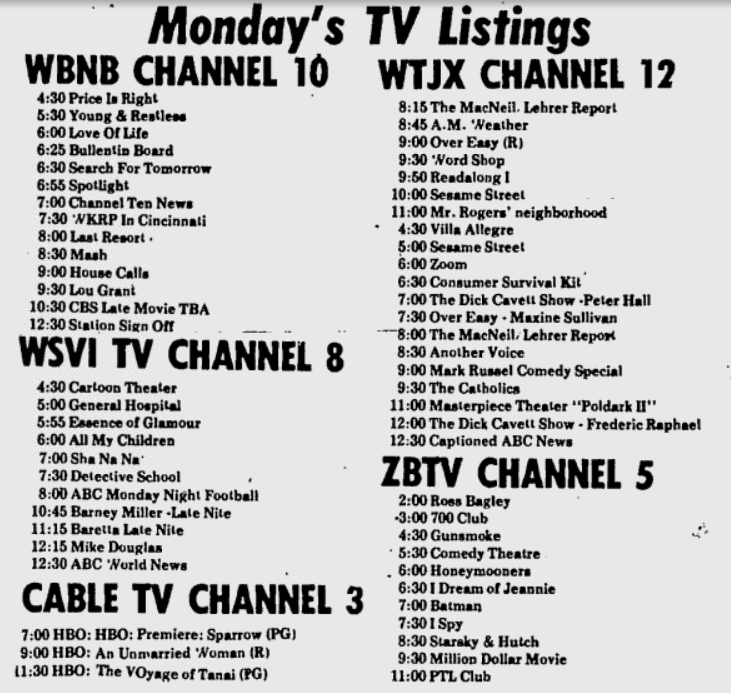
Here are sample TV listings for the U.S. Virgin Islands (including a cable channel and a station from the British Virgin Islands) from a 1980 issue of The Virgin Islands Daily News:

 
Very interesting, thanks for posting this. It's not readily apparent whether WBNB and WSVI are running network programming in tandem with the East Coast feed, which would be the same time part of the year (the USVI are on Atlantic Standard Time and do not observe DST, which would put them in sync with Eastern Daylight Time), and an hour ahead the rest of the year (when the East Coast is on standard time). It would either be that, or time-shifted in some fashion. The USVI now get their CBS and ABC via WCVI-23, and NBC on WVGN-LD-19. WSVI is now Ion and WBNB doesn't exist anymore.

It's also interesting that ZBTV does not seem to run any programming other than from the US, unless Comedy Theater and the Million Dollar Movie have non-US content. (The BVI use the US dollar.)

As a side note, if The Catholics is the Martin Sheen movie set in Ireland, it's very good.
 
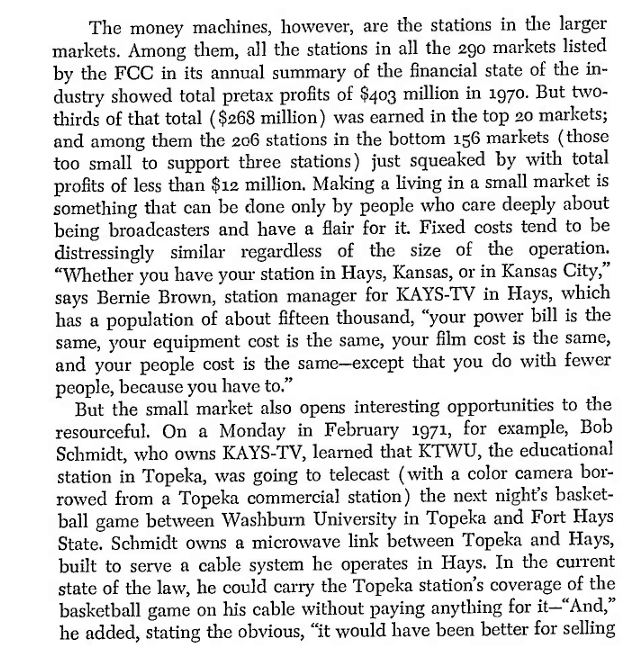
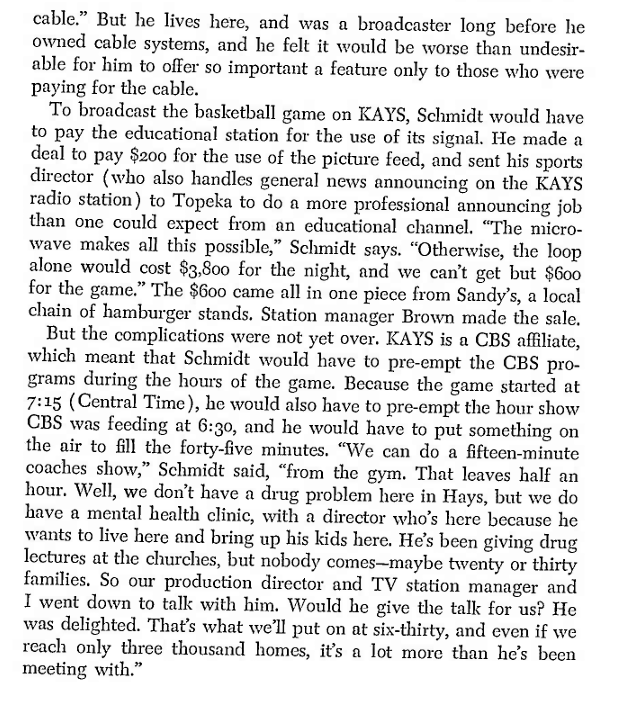
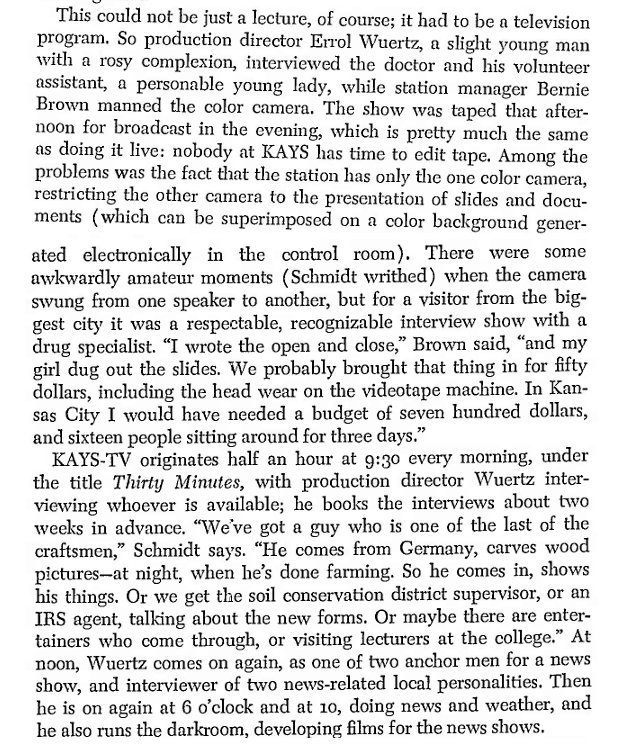
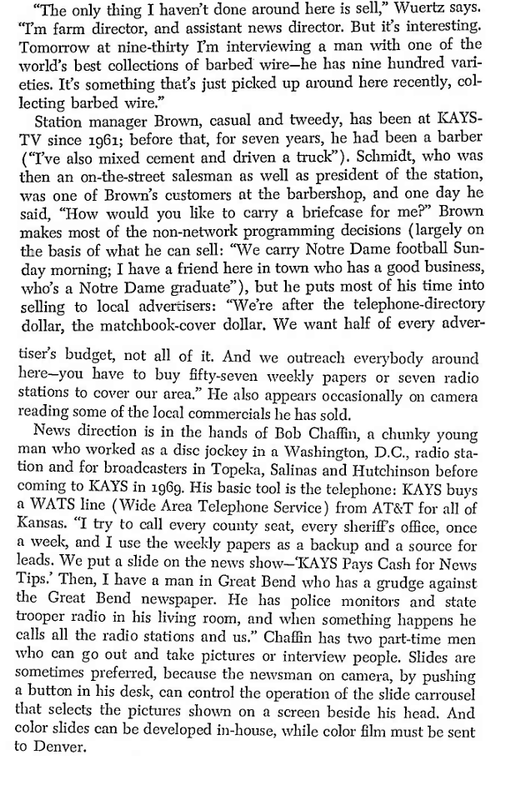
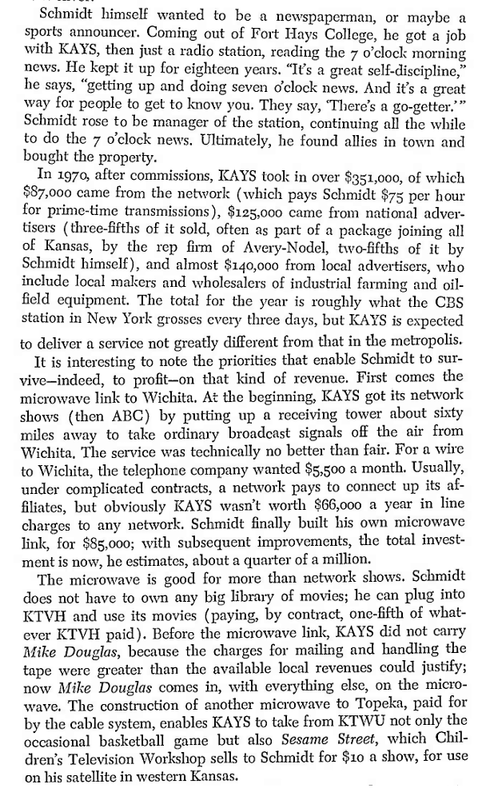
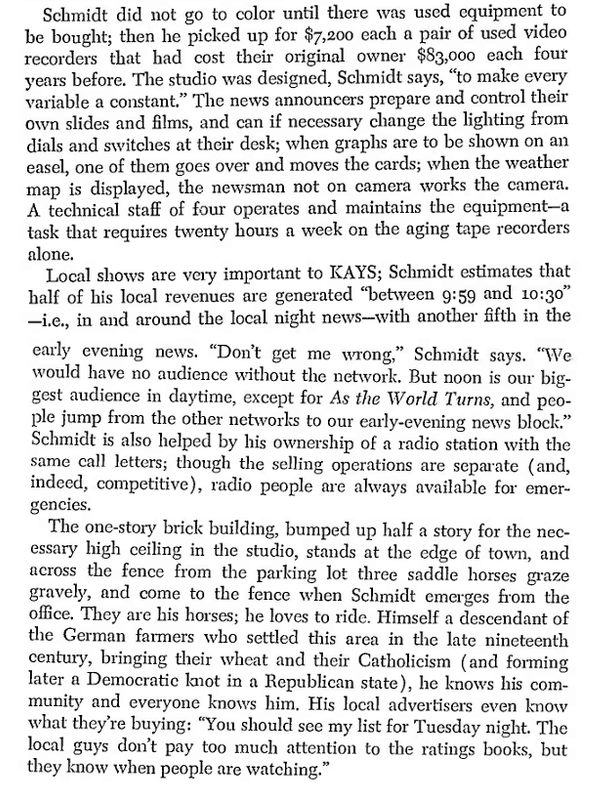
I bring up KAYS because Martin Mayer took an in-depth look at the mom-and-pop station in his 1972 book About Television:

View attachment 8737

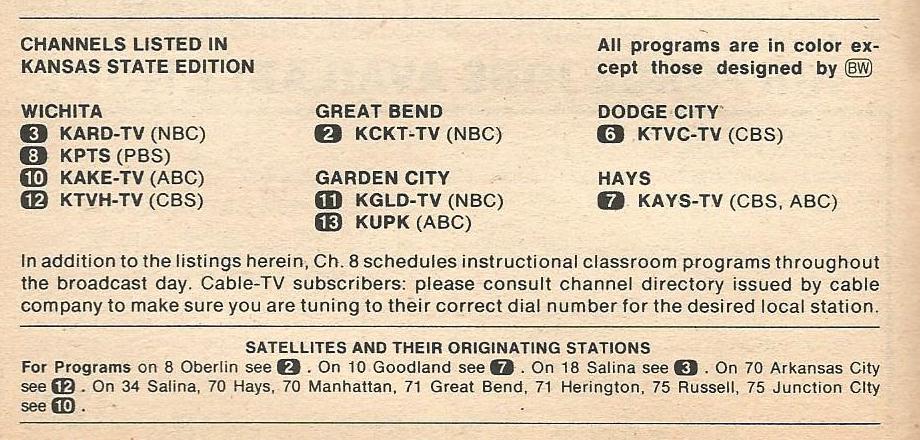
Use to live in Great Bend. The Goodland and Oberlin stations were always listed as "Satellites and their originating stations," even though Hays and Great Bend was also semi-satellites.

Note also the KTVH (12) Arkansas City translator is gone. The other translators listed have all been reassigned frequencies.
 
Thanks for that article on KAYS. Very interesting.
We use to watch KAYS-7 and KCKT -2 at my grandparents farm south of Hays.
 
I actually have a physical copy of that book, although it's been a long time since I looked at it. As I recall, it provides an interesting perspective on several stations at the time it was written in the early seventies. Aside from the section on KAYS in Hays, KS, it also included a comparison of KAYS with the Channel Islands ITV affiliate in the UK. Both were small market stations that were very localized in their approach at the time. For contrast, the author also looked at WTOG in Tampa, FL -- an interesting look at one of the first UHF independent stations to turn a profit.
 
I actually have a physical copy of that book, although it's been a long time since I looked at it. As I recall, it provides an interesting perspective on several stations at the time it was written in the early seventies. Aside from the section on KAYS in Hays, KS, it also included a comparison of KAYS with the Channel Islands ITV affiliate in the UK. Both were small market stations that were very localized in their approach at the time. For contrast, the author also looked at WTOG in Tampa, FL -- an interesting look at one of the first UHF independent stations to turn a profit.

That is an excellent book. Local TV in the seventies was fascinating, it was right before the advent of satellite-delivered programming sources, and stations in various cities tended to be highly individualized, this before the corralling of stations under huge corporate umbrellas such as we have today with Nexstar, Tegna, Sinclair, Gray, and so on. Local news is now pretty plain-vanilla wherever you go, and you see the same syndicated shows everywhere, just with different air times. Occasionally you will have a unique personality such as Mark Mathis or Marty Bass to bubble to the top, but talent, likewise, is pretty homogenized. WIS in Columbia SC goes one step further, and tends to replace departed news talent with virtual clones of whomever preceded them.
 
Local news is now pretty plain-vanilla wherever you go,

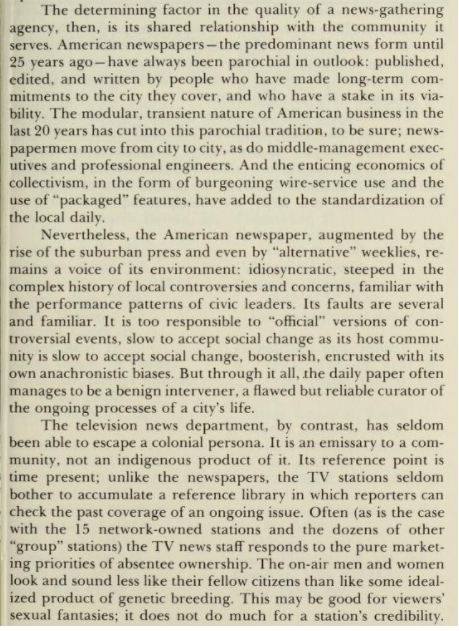
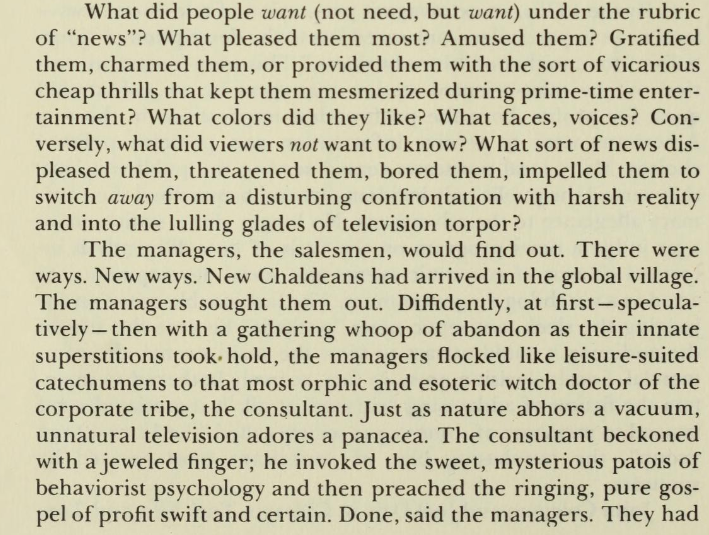
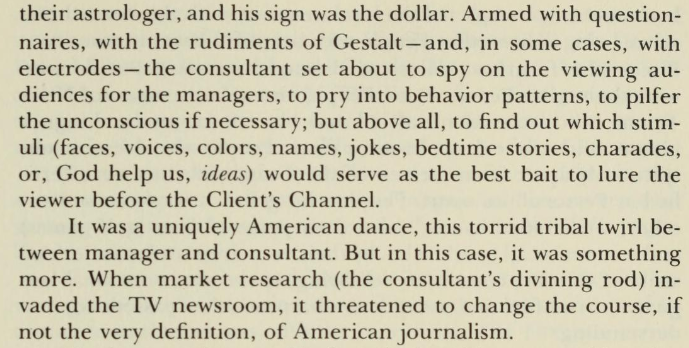
Way back in 1976, TV critic Ron Powers wrote a passionately written book, titled The Newscasters: The News Business As Show Business, about how news consultants and formula-driven news were beginning to debase broadcast journalism at the local level.

An excerpt:


Another excerpt:


Was KXGN included?

Also, in the 1970s, KDIX was effectively a separately-owned satellite of KOTA
KDIX got their ABC programming from KOTA, but still got their CBS programming from the east. I'd have to check schedules from the early 70s, but I don't think they ever stopped being primarily CBS. (And correct me if I'm wrong, but wasn't KOTA ABC/NBC?) My first TV memories are from 1976, watching KDIX for Captain Kangeroo, Price is Right, Match Game 76, etc. My mom watched Young and the Restless since almost the beginning.
 
I noticed a moment ago, that the North Dakota TVG didn't list Dickinson stations in 1975 (02/01), but they did in 1983 (06/18), this per Matt Sittel's TVG channels listed pages site. Moreover, once they did start listing Dickinson stations, there was a blurb at the top of the right-hand page that said channels 2 and 7 were listed Central Time (Dickinson is on Mountain Time):


I am thinking that the TVG "dead zone" in that part of the country consisted of the counties in North and South Dakota (and possibly Nebraska) that were on Mountain Time (sure do wish I had that map back). People in that part of the country, especially if they got their TV from a station in the Central Time Zone, were probably used to being out of sync with the rest of the country, and this would have been just one more obstacle to navigate.

Bottom line, if you lived in the MTZ and got the North Dakota TVG, just subtract an hour, even for satellite stations that originate in your time zone.
KDIX (Dickinson) was added to TV Guide around 1977/1978, that was the only station at the time. Yes, you are correct, it was kind of a "dead" zone until they put Dickinson into the North Dakota edition. Personally, I think it's better to have to adjust the schedule by an hour mentally than to have no listings. It took longer than it should have to get them into the North Dakota edition.
 
KDIX (Dickinson) was added to TV Guide around 1977/1978, that was the only station at the time. Yes, you are correct, it was kind of a "dead" zone until they put Dickinson into the North Dakota edition. Personally, I think it's better to have to adjust the schedule by an hour mentally than to have no listings. It took longer than it should have to get them into the North Dakota edition.
I am trying to resurrect a TVG editions map from almost 50 years ago in my mind, therefore I am just having to guess. The absence of Dickinson and Rapid City stations in the North Dakota and Colorado editions respectively points to that, viz. the "dead zone" being the counties of North Dakota, South Dakota, and Nebraska that were in the Mountain Time Zone. I don't recall what they did about Wyoming.

Agreed, subtracting mentally by one hour (in the case of Dickinson) would be better than having no TVG at all, though that doesn't explain Rapid City, which like Colorado is on Mountain Time. The Northern Wisconsin did something similar for listings directed towards the part of the Upper Peninsula of Michigan that got this edition, and that fell into the Eastern Time Zone. They listed both Marquette stations and WKBD Detroit on Central Time, even though Marquette is on Eastern Time.
 
I am trying to resurrect a TVG editions map from almost 50 years ago in my mind, therefore I am just having to guess. The absence of Dickinson and Rapid City stations in the North Dakota and Colorado editions respectively points to that, viz. the "dead zone" being the counties of North Dakota, South Dakota, and Nebraska that were in the Mountain Time Zone. I don't recall what they did about Wyoming.

Agreed, subtracting mentally by one hour (in the case of Dickinson) would be better than having no TVG at all, though that doesn't explain Rapid City, which like Colorado is on Mountain Time. The Northern Wisconsin did something similar for listings directed towards the part of the Upper Peninsula of Michigan that got this edition, and that fell into the Eastern Time Zone. They listed both Marquette stations and WKBD Detroit on Central Time, even though Marquette is on Eastern Time.

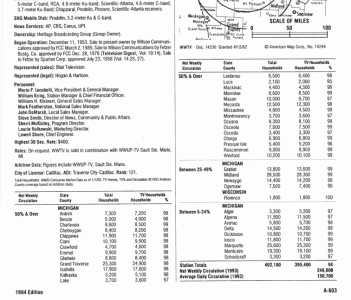
The Northern Wisconsin edition was another strange one as it never added WMQF (which signed on in 2003) or WGKI/WFQX (which replaced WKBD on cable in the UP and Hurley, Wisconsin in 1995) to its listings. It also never had WWTV/WWUP despite that station having cable carriage as far west as Florence, Wisconsin (to the point of having a 25-49% NWC in Florence County, Wisconsin in 1993!)

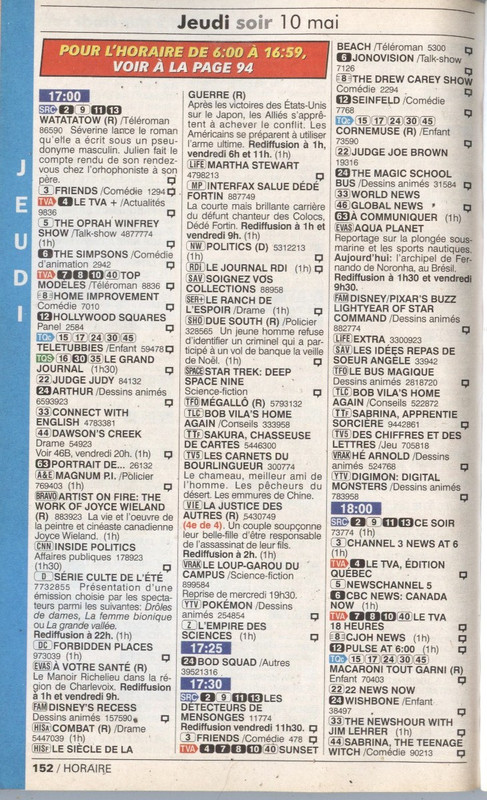
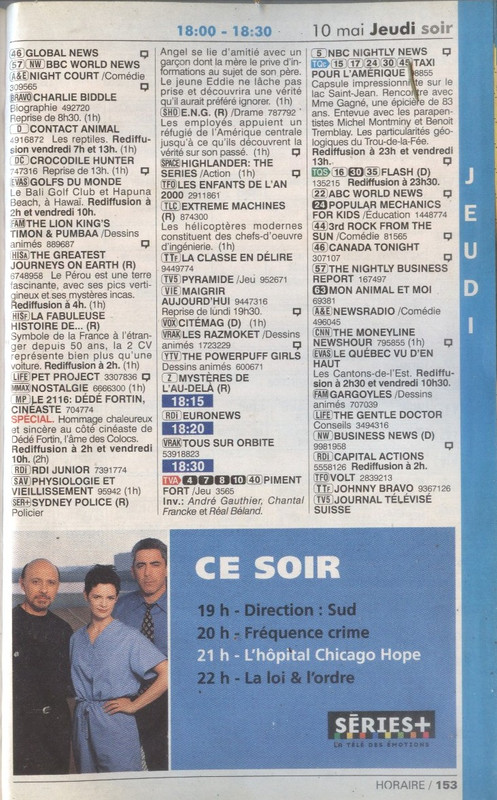
1741737981713.png
 
What in the world was the channel 63 they listed?

That's a good question! In the conversion chart, the broadcast channels only go up to Channel 57 (WCFE). Channel 63 seems to just pop up from nowhere in the listings. I assume it's some kind of local cable-only operation. (It's not included among the cable networks either.)


Back
Top Bottom