
At which point it probably got re-logo'ed for Magic 61.It was back in SF at KFRC in 18 months.

-
Get involved.
We want your input!
Apply for Membership and join the conversations about everything related to broadcasting.
After we receive your registration, a moderator will review it. After your registration is approved, you will be permitted to post.
If you use a disposable or false email address, your registration will be rejected.
After your membership is approved, please take a minute to tell us a little bit about yourself.
https://www.radiodiscussions.com/forums/introduce-yourself.1088/
Thanks in advance and have fun!
RadioDiscussions Administrators
You are using an out of date browser. It may not display this or other websites correctly.
You should upgrade or use an alternative browser.
You should upgrade or use an alternative browser.
Local Layoffs at Audacy (and a Resignation), the 2025 Edition
- Thread starter Joey1986
- Start date

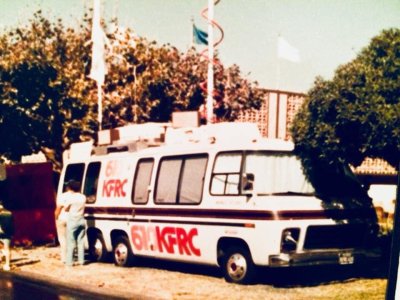
At which point it probably got re-logo'ed for Magic 61.
Not quite. 18 months brought it back to KFRC in spring of '85, and it was treated to KFRC's new logo, updated in its absence:
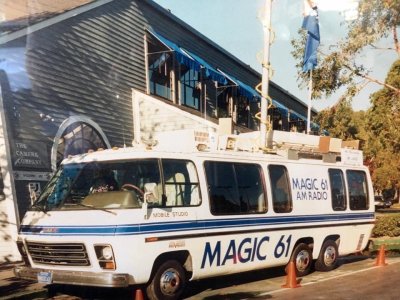
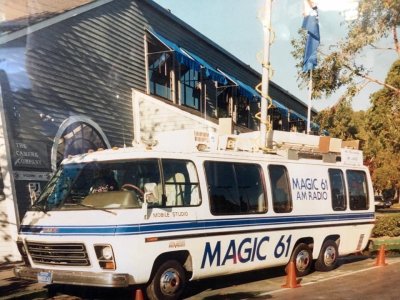
Magic 61 happened in August of 1986:
And when they ditched Magic 61 for the AM/FM oldies simulcast in August of '93, it got one last treatment, this one a wrap rather than a paint job:
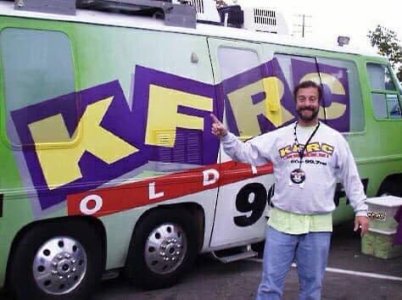
The mobile studio was listed as an asset of 610, not 99.7, so when CBS sold the AM to Family Life Radio in 2005, the vehicle went with, after 24 years in service for KFRC (including its loan to KHJ).
FLR donated it to the NPR station in Monterey, and it was used at the Monterey Jazz festival for a few years before falling into disuse, and being rescued and restored by a former KFRC staffer.
It is now with its second owner since its rescue, also a KFRC alum, and makes appearances at events around Northern California and Nevada. It has its own Facebook page:
 www.facebook.com
Attachments
The union doesn't "only get workers more money." You literally are not aware, and when I told you it is about "wages and working conditions," and gave a handful of examples, you didn't read or understand it. Every TV and Radio station has its own agreements--20+ pages' worth, so don't ask for more details. Stop talking about this.As I said, in the corporate world, workers need representation. The union is one way to do it.
If the only thing the union can do is get workers more money, then that's not a good use of the union. Because, as I said, in radio, there's only so much money. If the union workers eat up all of the staff budget, they're just taking jobs away from everyone else. That's what we've seen at NPR stations where the union has come in. They get their members raises, and in the next budget, the staff gets cut. What's the point?
Awesome. I was a manager too.A great deal of that is due to the near-seventy-percent reduction in radio revenue in the last 25 years (inflation adjusted). Some has to do with the huge increase in FM stations due to Docket 80-90. Some has to do with new media nearly wiping out the use of radio by those under 30. And some has to do with the replacement of home radios with Alexa devices and their equivalents where one can select content verbally with out a need for a radio.
I have worked with three morning show talents who, at some point, were #1 in Los Angeles. I did not enjoy working with any of them, but they were well liked by the audience and my job was "damage control". I did not have time to worry about whether they were nice to the rest of the staff.
In other words, sometimes it is beneficial and sometimes it is not. A good case for an open shop.
Some of us have been PDs or consultants or managers and might disagree. This is not a universal perspective..

Your point being? Or are you just purposely being snarky to me, BigA and several others here?Awesome. I was a manager too.
Because I never worked in a union shop, I've been hanging back. But--it's not just salary.
There are people---people who are or were on this board---who would have been a lot sicker and died a lot sooner without the union health benefits from long careers at AFTRA radio and TV stations. Many are retired comfortably because of the AFTRA pension plan.
I worked for everything from the smallest mom and pop to groups like Journal, Hearst, Emmis, Belo, Bonneville, Nationwide, Scripps and iHeart.
Between PD and ND gigs, I spent a sizeable chunk of my 53 years in management roles, so I get that side of it. But in a lot of cases, I was pushing back against upper management whose poor treatment of the people they held me responsible for sent a lot of them out the door.
"If you don't like it, quit" is a horses***t response if ever there was one. It's a morale-killer, and that kills any chance of good radio.
Maybe the former management people on this board didn't need guardrails to be good managers and good people. I'd sure like to think so, given how long we've all been communicating here. But I promise you, there are a lot of a***holes in GM gigs who absolutely needed lines they'd have to color within.
A final point---a lot of the focus has been on the idea that "If you're talented, you don't need a union." I was and I didn't. But---after the first few places in my career, I was working in places where talent was the smallest part of the operation. There were dozens---and in a couple of shops---hundreds of other people who worked there, too---in jobs where they were seen as far more interchangeable than the folks on mic or on camera.
My last station, CapRadio, unionized last year. I retired before the vote to unionize, but the movement to do so began several months before my wife and I made the decision that I'd retire in January of 2024 instead of March of 2026, as planned. Until we made that decision, I was vocally in support of the unionization.
Even if you subtract the alleged criminality of a previous GM (see the Sacramento board if you're not familiar with what is still an ongoing story), there were abuses in dealing with some of the most talented young journalists and support staff I'd had the honor and pleasure of working with. They needed union protection, and had I stayed for that extra two years and two months, I would have voted to unionize, even though all it would have done is take money for dues from my paycheck.
There are people---people who are or were on this board---who would have been a lot sicker and died a lot sooner without the union health benefits from long careers at AFTRA radio and TV stations. Many are retired comfortably because of the AFTRA pension plan.
I worked for everything from the smallest mom and pop to groups like Journal, Hearst, Emmis, Belo, Bonneville, Nationwide, Scripps and iHeart.
Between PD and ND gigs, I spent a sizeable chunk of my 53 years in management roles, so I get that side of it. But in a lot of cases, I was pushing back against upper management whose poor treatment of the people they held me responsible for sent a lot of them out the door.
"If you don't like it, quit" is a horses***t response if ever there was one. It's a morale-killer, and that kills any chance of good radio.
Maybe the former management people on this board didn't need guardrails to be good managers and good people. I'd sure like to think so, given how long we've all been communicating here. But I promise you, there are a lot of a***holes in GM gigs who absolutely needed lines they'd have to color within.
A final point---a lot of the focus has been on the idea that "If you're talented, you don't need a union." I was and I didn't. But---after the first few places in my career, I was working in places where talent was the smallest part of the operation. There were dozens---and in a couple of shops---hundreds of other people who worked there, too---in jobs where they were seen as far more interchangeable than the folks on mic or on camera.
My last station, CapRadio, unionized last year. I retired before the vote to unionize, but the movement to do so began several months before my wife and I made the decision that I'd retire in January of 2024 instead of March of 2026, as planned. Until we made that decision, I was vocally in support of the unionization.
Even if you subtract the alleged criminality of a previous GM (see the Sacramento board if you're not familiar with what is still an ongoing story), there were abuses in dealing with some of the most talented young journalists and support staff I'd had the honor and pleasure of working with. They needed union protection, and had I stayed for that extra two years and two months, I would have voted to unionize, even though all it would have done is take money for dues from my paycheck.
The union doesn't "only get workers more money." You literally are not aware, and when I told you it is about "wages and working conditions," and gave a handful of examples, you didn't read or understand it. Every TV and Radio station has its own agreements--20+ pages' worth, so don't ask for more details. Stop talking about this.
Once again, I was in AFTRA and at another time, I was in NABET. Before you tell me what I don't understand about unions, read what I've written.
The example you quoted was about the unionizing that's happening now in public radio.
That is a broad and mean statement.I hope any manager who ever opposed a union died an unpleasant death, or someday will.
At Mooney Broadcasting in Birmingham, we inherited a union from the TV station. The work rules were very restrictive and impeded doing the (what would later be called) "Hot AC" format on AM and a rock-CHR on FM. The new airstaff voted unanimously against the union and it was decertified . We went through having tires of management slashed, offensive comments and physical pushing on the sidewalk, and efforts to get advertisers to cancel. The airstaff knew how well Mooney treated similar positions and persons in their other stations, and was very supportive of the decertification.
A few years later, I became GM at an AM/FM in San Juan that was in such bad shape that we had to turn it off, we inherited the infamous Puerto Rican Newspaper Guild. We had 7 union members at the transmitter to cover the full week in very restrictive shifts, including double pay for nights and weekends. The prior airstaff was all union as well, and they got the lowest ratings in the market.
I rebuilt the transmitter site (and everything else) and got commitments from a new airstaff. And then had to sit down with the union.
During the negotiations, before going back on the air, we demanded work rules that made contemporary formats possible and got nowhere. At an NRLB moderated meeting, before going into the meeting room, the union head said to me "I know where you live" and pulled back his suit jacket to show the pistol he was carrying. I told our lawyer, who spoke with the Administrative Law Judge and the NRLB agent, and they had the union guy frisked by the police and his gun removed.
The same union had obviously been responsible for setting the home of the manager of WRSJ on fire just a year prior; the union head had the nickname of "El Bombero" or "The Fireman".
The new on-air staff decertified the union after we qualified with the FCC for remote control of the transmitter.
So if you want me dead, you can join several union organizers who said exactly that to me.
On the other hand, at my own 12 stations in Ecuador, we formed a "House Committee" internally where the staff elected spokespersons and we met at least once a month to go over employee relationships and to discuss things like inflation adjustments in pay and the like. And the staff knew that they could discuss issues with their committee reps to see how to approach management. It worked beautifully, and the monthly meetings often produced operating ideas that improved the stations.
Funny, last year was the 60th anniversary of the first station I built in Ecuador. The living members of the airstaff, the janitor, the messenger and several from the office staff paid my way to Quito to celebrate. I guess they had not heard your angry, bitter statement.Nobody above you in the working world is your friend.
That is definitely an example of when some unions get out of control. But I think working conditions improved for most people because unions existed, even in non union employment.That is a broad and mean statement.
At Mooney Broadcasting in Birmingham, we inherited a union from the TV station. The work rules were very restrictive and impeded doing the (what would later be called) "Hot AC" format on AM and a rock-CHR on FM. The new airstaff voted unanimously against the union and it was decertified . We went through having tires of management slashed, offensive comments and physical pushing on the sidewalk, and efforts to get advertisers to cancel. The airstaff knew how well Mooney treated similar positions and persons in their other stations, and was very supportive of the decertification.
A few years later, I became GM at an AM/FM in San Juan that was in such bad shape that we had to turn it off, we inherited the infamous Puerto Rican Newspaper Guild. We had 7 union members at the transmitter to cover the full week in very restrictive shifts, including double pay for nights and weekends. The prior airstaff was all union as well, and they got the lowest ratings in the market.
I rebuilt the transmitter site (and everything else) and got commitments from a new airstaff. And then had to sit down with the union.
During the negotiations, before going back on the air, we demanded work rules that made contemporary formats possible and got nowhere. At an NRLB moderated meeting, before going into the meeting room, the union head said to me "I know where you live" and pulled back his suit jacket to show the pistol he was carrying. I told our lawyer, who spoke with the Administrative Law Judge and the NRLB agent, and they had the union guy frisked by the police and his gun removed.
The same union had obviously been responsible for setting the home of the manager of WRSJ on fire just a year prior; the union head had the nickname of "El Bombero" or "The Fireman".
The new on-air staff decertified the union after we qualified with the FCC for remote control of the transmitter.
So if you want me dead, you can join several union organizers who said exactly that to me.
On the other hand, at my own 12 stations in Ecuador, we formed a "House Committee" internally where the staff elected spokespersons and we met at least once a month to go over employee relationships and to discuss things like inflation adjustments in pay and the like. And the staff knew that they could discuss issues with their committee reps to see how to approach management. It worked beautifully, and the monthly meetings often produced operating ideas that improved the stations.
Actually, unionizing to collectively bargain with your bosses is the primary reason for ALL American unions in any sector. I have "read what you've written." For someone who claims to have so much experience, you seem to need a lot explained to you, because your posts are patently anti-union and do not show actual knowledge of the purpose, or experience or concerns, of an active, working member.Once again, I was in AFTRA and at another time, I was in NABET. Before you tell me what I don't understand about unions, read what I've written.
The example you quoted was about the unionizing that's happening now in public radio.
On the NPR subject, it's good that NPR is getting unionized, though my previous posts were categorically part of the conversation and through the lens of Commercial radio negotiations. The bad part for many of the NPR individual market contracts is, their corporation is strong-arming the convincing of their (many young, inexperienced team of ) broadcasters into NOT contracting for their earnings go toward Health & Pension--which is the PRIMARY purpose and benefit for having a union contract! All this while NPR continues to make budget cuts and offer retirement buyouts, just like mainstream radio or even newspapers, in recent years. (Side note: this has happened in LA in particular. That rep who continues to sing her own praises while having sold that staff down the river in their first contract nearly 10 years ago should be ashamed of herself for not getting her members full benefits that they PAY her for. But that's just one out-of-touch negotiator. The rest of my 20+ years as a SAG-AFTRA member have been surrounded by the best member-advocates in the business. Here's hoping the other NPR markets have better union reps for the conditions they're dealing with and/or asking for.)
The union benefits are to benefit ALL staff--most especially part-timers who do not have P&H eligibility. The union exists to give these people with irregular schedules another option (just like, originally, for actors), while the NPR negotiators have categorically catered to the full-timers who are eligible for the 503b Retirement plans and such. Sure, take your full-time corporate retirement contribution options if it appeals to you. But as full-time covered union staffers, don't let your fellow staffers who are part-time be left out of such options in any shop contract by letting your corporate overlords and negotiators make you think their offering is better. It's only better for some people.
For someone who claims to have so much experience, you seem to need a lot explained to you, because your posts are patently anti-union and do not show actual knowledge of the purpose, or experience or concerns, of an active, working member.
Then you haven't read my posts, because it's obvious Flipper feels I'm too pro union. Unlike him, I see a reason for unions. I agree when you work for a big corporation like Audacy, employees benefit from having collective bargaining. Absolutely! Individuals are at a major disadvantage working with a corporation, even those who use an agent. So I see the value. But yes, I chose to leave the union because it didn't fit me anymore. It was my choice, and I'm glad I made it. I'm not a member of any union anymore.
On the NPR subject, it's good that NPR is getting unionized
In point of fact, NPR itself has been unionized almost since the beginning. NPR is an AFTRA shop. Bob Edwards was the shop steward when he was there. Some time ago, the technicians and some office workers also unionized.
The bad part for many of the NPR individual market contracts is, their corporation is strong-arming the convincing of their (many young, inexperienced team of ) broadcasters into NOT contracting for their earnings go toward Health & Pension--which is the PRIMARY purpose and benefit for having a union contract! All this while NPR continues to make budget cuts and offer retirement buyouts, just like mainstream radio or even newspapers, in recent years
NPR corporate has absolutely nothing to do with any of its stations. The stations are all independently owned and operated. If you're talking about the LA Bureau, that's a different situation. My comment was about member stations, such as KUOW or KQED. They have nothing to do with NPR's union contract. If people at the bureaus are being strong-armed, they have their own local rep who can deal with that.

Admin note: This thread is steering far away from broadcasting...
Lance, every post regarding unions in the past six days has been about broadcast unions.Admin note: This thread is steering far away from broadcasting...
Then you haven't read my posts, because it's obvious Flipper feels I'm too pro union. Unlike him, I see a reason for unions. I agree when you work for a big corporation like Audacy, employees benefit from having collective bargaining. Absolutely! Individuals are at a major disadvantage working with a corporation, even those who use an agent. So I see the value. But yes, I chose to leave the union because it didn't fit me anymore. It was my choice, and I'm glad I made it. I'm not a member of any union anymore.
In point of fact, NPR itself has been unionized almost since the beginning. NPR is an AFTRA shop. Bob Edwards was the shop steward when he was there. Some time ago, the technicians and some office workers also unionized.
Lol. " NPR corporate has absolutely nothing to do with any of its stations?" You obviously haven't asked anyone who works at KPCC (NPR affiliate) in LA, or any other NPR station across the country, nor have you asked the union reps who they negotiate with, any time they negotiated, or re-negotiate, their contracts. Just stop talking. Someone please stop this guy from spouting uninformed nonsense. It's not contributing literally anything helpful.NPR corporate has absolutely nothing to do with any of its stations. The stations are all independently owned and operated. If you're talking about the LA Bureau, that's a different situation. My comment was about member stations, such as KUOW or KQED. They have nothing to do with NPR's union contract. If people at the bureaus are being strong-armed, they have their own local rep who can deal with that.
Lol. " NPR corporate has absolutely nothing to do with any of its stations?" You obviously haven't asked anyone who works at KPCC (NPR affiliate) in LA, or any other NPR station across the country, nor have you asked the union reps who they negotiate with, any time they negotiated, or re-negotiate, their contracts. Just stop talking.
Raydio, I spent four years (until last January) at an NPR member station. The BigA is correct. NPR is a program producer that member stations buy programming from. That's it. Those stations don't have to buy everything NPR offers and may, can and do carry programs from other public media networks like APM.
Also as BigA notes, the individual stations are owned and operated independently---there are no NPR O&Os. KPCC is owned by Pasadena City College, KCRW by Santa Monica Community College, KPBS by San Diego State University and KXJZ (Capital Public Radio) by Sacramento State University. KQED is owned by a non-profit organization (KQED, inc.) which pre-dates NPR by 18 years.
NPR member stations do get funding from the Corporation for Public Broadcasting, however it is a small amount percentagewise and the vast majority of station funding comes from donations from foundations, businesses and listeners.
Union contracts are negotiated with the General Managers and the Boards of Directors of the individual stations, not CPB nor NPR. The only unions negotiating with NPR are those representing NPR employees.
Someone please stop this guy from spouting uninformed nonsense. It's not contributing literally anything helpful.
You have it backwards. BigA was correct.
You, on the other hand, stated a lot of stuff as facts you were sure about that you couldn't possibly have been because....they're not.
The one place where "ownership" of NPR overlaps with the member stations is in the NPR Board of Directors, which is dominated by representatives of the member stations. Not every member station (or group of stations, like CapRadio) has a rep on NPR's board every term, but over time the board will have representation from some number of the big members, as well as some of the smaller ones. However, that's very different from saying "the stations own NPR", or "NPR owns the stations". And in case a reader has never been on a not-for-profit's board, directors have a fiduciary duty to that organization (i.e., NPR) and can't act solely in the interests of the organization they're employed by (i.e., CapRadio, KQED, KPCC, etc.).
Boards of directors provide governance of the organization, but they do not manage the day-to-day business of the org. That's why there is professional management. (Though as Mike can attest, that system does not always work perfectly.)
Boards of directors provide governance of the organization, but they do not manage the day-to-day business of the org. That's why there is professional management. (Though as Mike can attest, that system does not always work perfectly.)
However, that's very different from saying "the stations own NPR", or "NPR owns the stations".
The point is that NPR doesn't tell its stations what to do as far as hiring or any internal station matters. But the stations have input in what NPR does.
I believe the stations in fact have some ownership rights to the interconnection system that NPR manages.
He announced on his social media a few days ago he is back as an anchor or reporter (or both)Alex Silverman in the newsroom this afternoon, working as the studio breaking news reporter covering the death of Charlie Kirk.