
• Get involved.
    We want your input!
    Apply for Membership and join the conversations about everything related to broadcasting.

    After we receive your registration, a moderator will review it. After your registration is approved, you will be permitted to post.
    If you use a disposable or false email address, your registration will be rejected.

    After your membership is approved, please take a minute to tell us a little bit about yourself.
    https://www.radiodiscussions.com/forums/introduce-yourself.1088/

    Thanks in advance and have fun!
    RadioDiscussions Administrators

When Frank Sinatra Endorsed a Radio Station

davideduardo

Moderator/Administrator
Staff member
From the 1963 Radio Luxembourg annual:
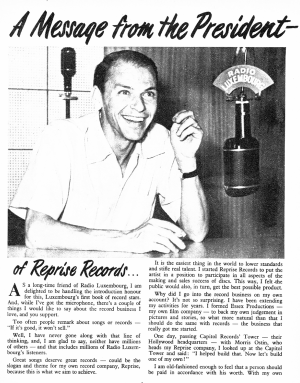
1742936933241.png
Radio Luxembourg, eponymously named for the little nation in Europe, tossed a bunch of hundred thousand watts on longwave and mediumwave towards England with its nighttime early top 40 format.

When did we see Sinatra endorse a radio station? Maybe Radio Luxembourg's cume, projected to be over ten million, had to do with it.
 
When did we see Sinatra endorse a radio station? Maybe Radio Luxembourg's cume, projected to be over ten million, had to do with it.

This was around the time Sinatra soured on American radio. He was very excited when he started Reprise Records. For the first time in his career, he would own and control his music. Then he discovered that US radio stations only paid songwriters and publishers royalties. He went to congress to try to change the copyright laws, but couldn't get it done. So at his next contract with Warner Brothers, he sold them Reprise Records as part of the deal. He continued to record for them for another ten years. But he was never happy about the royalty situation. To this day, his daughter Nancy continues to lobby on behalf of the RIAA to get the labels a royalty.

BTW Radio Luxembourg paid the label royalty, as did all other European countries. So he liked them.
 
This was around the time Sinatra soured on American radio. He was very excited when he started Reprise Records. For the first time in his career, he would own and control his music. Then he discovered that US radio stations only paid songwriters and publishers royalties. He went to congress to try to change the copyright laws, but couldn't get it done. So at his next contract with Warner Brothers, he sold them Reprise Records as part of the deal. He continued to record for them for another ten years. But he was never happy about the royalty situation. To this day, his daughter Nancy continues to lobby on behalf of the RIAA to get the labels a royalty.

BTW Radio Luxembourg paid the label royalty, as did all other European countries. So he liked them.
Great backstory. I was not aware of most of that.

Of course, before Radio Caroline and the pirates, Radio Luxembourg was really the only pop music source for England as the Beeb had little pop programming and what they had was in specific blocks.

What we call the "British Invasion" that arrived with the Beatles was actually a huge birth of a new style of pop music (or "styles" if you follow "Melody Maker" and other music magazines of the era) that was so wide and massive that all kinds of pirate stations cropped up on old ships at anchor offshore or abandoned gun stations called Maunsell Forts on columns outside the national limits in the Thames estuary.

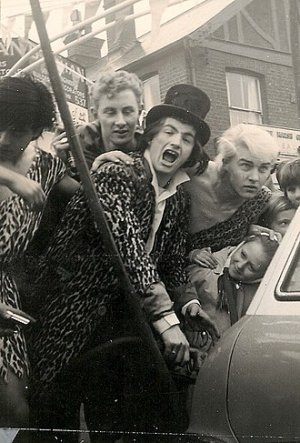
The whole story of British pirate radio is fascinating. Here is an example of those locations on abandoned forts: Maunsell Forts - Wikipedia And one can't but be amused by one pirate, Screaming Lord Sutch, a subject worth Googling.

Here is radio pirate Screaming Lord Sutch: (From Wikipedia)

1742951092526.jpeg
 
Yes it is a fascinating story. I grew up in Europe in the late 60s, and used to listen to Radio North Sea International at night.

As for Luxembourg, their LW station was one of the "stations peripheriques" serving France. Off subject, but the history of French radio and TV broadcasting is a unique and fascinating one.
 
. Off subject, but the history of French radio and TV broadcasting is a unique and fascinating one.
And not complete without Radio Monte Carlo and its 600 kw on Medium Wave and the two 100 kw stations in Andorra.
 
What we call the "British Invasion" that arrived with the Beatles was actually a huge birth of a new style of pop music (or "styles" if you follow "Melody Maker" and other music magazines of the era) that was so wide and massive that all kinds of pirate stations cropped up on old ships at anchor offshore or abandoned gun stations called Maunsell Forts on columns outside the national limits in the Thames estuary.

The whole story of British pirate radio is fascinating.
Decades ago I had a work colleague who had lived in the UK for a while and was familiar with the British pirate radio era. She also had a double LP that included airchecks and jingles from those stations. She let me borrow it, and I made a cassette dub that I still have stashed somewhere.

On a lark, I did an online search, and of course a YouTube video of the record popped up. 100 minutes of pirate radio recordings and history. Here it is:

 
One not-so-well-known fact is that the BBC not only didn't play rock and roll early on, but they were also only allowed to devote a limited number of hours to recorded music, due to pressure from the musicians union. This period was referred to as "needle time."

Article here.
 
One not-so-well-known fact is that the BBC not only didn't play rock and roll early on, but they were also only allowed to devote a limited number of hours to recorded music, due to pressure from the musicians union. This period was referred to as "needle time."

Article here.
And, in the years of James Petrillo's dictatorial leadership of the American Federation of Musicians, the union required most metro area stations that played recorded music to have a proportional amount of live music from a station band or orchestra.

This worked out in the union's favor as in the later 30's and much of the 40's, the hits were songs, not just the specific versions of a song. So there could be a number of recordings of a song, and having a live band do their interpretation was considered "the same". But as time passed, it became most important to have the "hit version" of a song and stations did not want... nor did their listeners... to hear what today we call "covers".

www.worldradiohistory.com has both the AFM magazine from that era as well as a collection of publications about Petrillo and the union.

JAMES CAESAR PETRILLO: Controversial leaderof Musicians' Union

(Thanks for the link and the reference to the Beeb's music policies)
 
And, in the years of James Petrillo's dictatorial leadership of the American Federation of Musicians, the union required most metro area stations that played recorded music to have a proportional amount of live music from a station band or orchestra.
I visited WMAQ during the 60s. They had a DJ or program host and a announcer (both AFTRA), a board operator (CWA) and a guy who played the records (AFM) and another guy who at every legal ID played the NBC chimes (also AFM).

Petrillo is also largely responsible for the demise of big bands. Big bands usually carried a "boy singer," a "girl singer" and a quartet. Singers would get a solo during a number as would other musicians or sections (i.e. woodwind section, brass section...). But in the mid-40s, Petrillo called a strike and AFM members could not record. Many singers went out on their own and recorded without accompaniment. The process had already begun but this established the singer as the draw and reduced the band to (often nameless) back-up status. After the strike, there was a lot less work for musicians (with the possible exception of guitarists and drummers). Petrillo won the battle and lost the war.
 
This was around the time he co-owned KJR in Seattle, wasn't it? Ouch. If I was the manager of KJR at the time, I'd have been reading that ad with a frowning face. Think of what a big print or an over the air Sinatra endorsement could have meant for KJR. Could the royalty problem be why he sold his share of KJR to Danny Kaye?
 
This was around the time he co-owned KJR in Seattle, wasn't it? Ouch. If I was the manager of KJR at the time, I'd have been reading that ad with a frowning face. Think of what a big print or an over the air Sinatra endorsement could have meant for KJR. Could the royalty problem be why he sold his share of KJR to Danny Kaye?
Sinatra co-owned with Kaye and then sold out to the station manager, who partnered with Kaye.
 
Petrillo is also largely responsible for the demise of big bands. Big bands usually carried a "boy singer," a "girl singer" and a quartet. Singers would get a solo during a number as would other musicians or sections (i.e. woodwind section, brass section...). But in the mid-40s, Petrillo called a strike and AFM members could not record. Many singers went out on their own and recorded without accompaniment. The process had already begun but this established the singer as the draw and reduced the band to (often nameless) back-up status. After the strike, there was a lot less work for musicians (with the possible exception of guitarists and drummers). Petrillo won the battle and lost the war.
Thanks for adding this note. As I mentioned, Petrillo's actions affected the radio and music business even after he had lost his total control; your post adds interesting dimension.

The strike in the middle of WW II paralyzed the record industry and was basically a power play. It was not uncommon for his foes to compare him to a certain Italian dictator at the time!

I recommend viewing "Band Leaders" magazine BAND LEADERS: Post-War 1940's magazzine about the big bands which shows the rise of the crooners as soloists... from a consumer perspective. Publications like that enhanced the images of the singers, even if they focused on the bands of the era. (At the bottom of the page are some books about that era, too).

Anecdote: in the later 50's I had to take Friday afternoon dance lessons at a ballroom of a "classy-in-decline" Cleveland hotel. About 200 boys and girls would learn the steps from the band that would play with booze being served later that night. Some of the very big names played for those kids; my mom said it was a privilege to learn to dance with them... I thought it was torture and to this day I 1) dance like a brick with feet and, 2) hate big bands.
 
I know Elvis made an unscheduled appearance at WLOX Biloxi MS to squelch a rumor he was married very early in his career. He did the famous phone interview with Dick Clark when he was in the Army also did the Grand Ole Opry (not well received) but did Elvis ever do any endorsements for a radio station? Supposedly one of the guys at WHBQ was a friend but did he do any phone interviews with radio stations after Col. Parker took over?

I am surprised Elvis never did Cadillac commercials.
 
Thanks for adding this note. As I mentioned, Petrillo's actions affected the radio and music business even after he had lost his total control; your post adds interesting dimension.

The strike in the middle of WW II paralyzed the record industry and was basically a power play. It was not uncommon for his foes to compare him to a certain Italian dictator at the time!

I recommend viewing "Band Leaders" magazine BAND LEADERS: Post-War 1940's magazzine about the big bands which shows the rise of the crooners as soloists... from a consumer perspective. Publications like that enhanced the images of the singers, even if they focused on the bands of the era. (At the bottom of the page are some books about that era, too).

Anecdote: in the later 50's I had to take Friday afternoon dance lessons at a ballroom of a "classy-in-decline" Cleveland hotel. About 200 boys and girls would learn the steps from the band that would play with booze being served later that night. Some of the very big names played for those kids; my mom said it was a privilege to learn to dance with them... I thought it was torture and to this day I 1) dance like a brick with feet and, 2) hate big bands.
There is another thread active now asking if today's kids like oldies (boomer oldies). As a boomer, the big bands were mostly history but thanks to "new media" and to the Glenn Miller and Benny Goodman biopics and some of the 30's and 40's movie musicals I came later to really appreciate the music of the big band era. It is much complex and musically sophisticated than most of the rock era music that followed it. And I don't think there was another singer (then or now) who equaled Crosby's level of musicianship. And has anybody since even come close to being at the top of the movie box office ratings, prime time ratings or music charts at the same time and for a sustained period. If there hadn't been Bing Crosby, would singers still have come to the forefront in popular music?
 
Maybe thru movie musicals but with the costs involved I am sure and established star would likely get the part instead of a total unknown. Records, jukeboxes, and network radio kinda "homogenized" music around Bing's time so folks wanted to hear a certain singer.

Different part of the business but some Country singers "outgrew" their original band or act that they came to Nashville with. Example: Dolly Parton and Porter Wagner
 
Sinatra also would endorse whatever Los Angeles radio station Paul Compton was working for (KHJ until 1965, then bouncing between KFI, KMPC and KGIL with a very brief stint at KRLA when they tried MOR for a few months in 1975).

Compton did an hour on Sundays---"Compton, Sinatra and Strings", and would interview Sinatra (usually recorded in advance) and intersperse some of what Sinatra had to say about the music.

Occasionally, if Frank were in L.A. (or Palm Springs, when Compton was on KFI, whose signal reached PS), Frank would just call in live and say "Let's chat, Paul. Put me on."

Compton usually would get Sinatra to do a plug for the station that could be used in other dayparts.
 
Sinatra also would endorse whatever Los Angeles radio station Paul Compton was working for

Sinatra seemed to have a guy like this in a lot of places. William B. Williams at WNEW NY. who came up with the nickname "Chairman of the Board." Sid Mark in Philadelphia, who died recently, and whose son still hosts a weekly radio show on WPHT. Larry King had a relationship that went back to Miami.
 
BTW Radio Luxembourg paid the label royalty, as did all other European countries. So he liked them.
One of the ways some record labels got around that in the US was to have their artists record songs published by a company owned by the label.
 
Status
This thread has been closed due to inactivity. You can create a new thread to discuss this topic.


Back
Top Bottom