I have a translator operating on a channel that is only three channels away from a full power FM . It appears the full power signal is entering my transmitter and fooling the VSWR into thinking there is a large reflection which results in my translator transmitter shutting down. Is there Anybody out there who can recommend a good model of RF filter I can use to cut down the full power signal at my transmitter antenna? I'm running 250 watts on the translator . TIA

-
Get involved.
We want your input!
Apply for Membership and join the conversations about everything related to broadcasting.
After we receive your registration, a moderator will review it. After your registration is approved, you will be permitted to post.
If you use a disposable or false email address, your registration will be rejected.
After your membership is approved, please take a minute to tell us a little bit about yourself.
https://www.radiodiscussions.com/forums/introduce-yourself.1088/
Thanks in advance and have fun!
RadioDiscussions Administrators
You are using an out of date browser. It may not display this or other websites correctly.
You should upgrade or use an alternative browser.
You should upgrade or use an alternative browser.
Low pass filters
- Thread starter Radio Bob
- Start date

Microwave Filter in Syracuse is my go-to, but any of the big antenna companies (ERI, Shively, Dielectric) can also help you. And it's good practice to put a bandpass filter on any translator output in a crowded area anyway.I have a translator operating on a channel that is only three channels away from a full power FM . It appears the full power signal is entering my transmitter and fooling the VSWR into thinking there is a large reflection which results in my translator transmitter shutting down. Is there Anybody out there who can recommend a good model of RF filter I can use to cut down the full power signal at my transmitter antenna? I'm running 250 watts on the translator . TIA
Thanks Scott love your picsMicrowave Filter in Syracuse is my go-to, but any of the big antenna companies (ERI, Shively, Dielectric) can also help you. And it's good practice to put a bandpass filter on any translator output in a crowded area anyway.
I have a translator located right next to another translator 400 kHz away.I don't think you will find a bandpass filter sharp enough to reject a signal only 600 kHz away. Consider adding 3dB RF attenuator to your transmitter and double the output power to compensate.
MFC made me a two-cavity filter that's doing a nice job of keeping my Flexiva happy without getting much of its next-door neighbor in the mix.
It's spec'd at 20 dB.Translator vs. full power FM. What's the attenuation of your filter at 400khz?

Flexiva actually does pretty good all by itself.It's spec'd at 20 dB.
Field reports better than a Nautel.
You should have a bandpass filter on your transmitter anyway, but it is true that it may not be narrow enough to solve this problem. Shiveley do have some very narrow filters with cross coupling that may be good enough. A notch filter on the unwanted incoming frequency in addition to a bandpass filter would be the best solution. A notch filter can be much narrower than a bandpass filter.
The make of transmitter is not going to make a big difference, though the GatesAir is better than most. Even if the transmitter does not fold back, you will still have the intermodulation with the unwanted carrier to worry about. That would be well outside the FCC specifications. With the unwanted signal causing your transmitter to protect itself, it must be coming into the transmitter at more than -14dBc (which is usually where a transmitter starts to fold back) suggesting the outgoing intermodulation product would be around -24dBc. It should be less than -67dBc at +/- 600kHz.
You could also look at moving your antenna further from the source of the interfering carrier (either above or below).
The make of transmitter is not going to make a big difference, though the GatesAir is better than most. Even if the transmitter does not fold back, you will still have the intermodulation with the unwanted carrier to worry about. That would be well outside the FCC specifications. With the unwanted signal causing your transmitter to protect itself, it must be coming into the transmitter at more than -14dBc (which is usually where a transmitter starts to fold back) suggesting the outgoing intermodulation product would be around -24dBc. It should be less than -67dBc at +/- 600kHz.
You could also look at moving your antenna further from the source of the interfering carrier (either above or below).
Cold Coffee
Banned
Bob, what model of transmitter are you using? I've seen this problem before. It was caused by the transmitter having problems not anything else. Do you have access to another transmitter to test this?
Cold Coffee
Banned
Many of those low-cost antennas for LPFM and translators will reflect two watts when the transmitter is set to 250 watts. That shouldn't cause foldback or shutdown.
RF coupling with the full power is unlikely unless you are just feet from their antenna.
Another possible cause of this problem could be rainwater getting into the connecter of your antenna.
My bet it's your transmitter. You didn't get it from a guy in southwest Ohio, I hope.
RF coupling with the full power is unlikely unless you are just feet from their antenna.
Another possible cause of this problem could be rainwater getting into the connecter of your antenna.
My bet it's your transmitter. You didn't get it from a guy in southwest Ohio, I hope.
Last edited:
Cold Coffee
Banned
This is a 300-watt BW type certified transmitter. Many translators and LPFM's use it.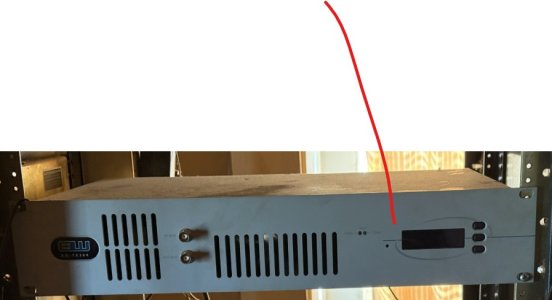
Last edited:
This problem could be caused by instability in the transmitters amplifier. If the transmitter in question is from BW, then they are known for instability. Particularly the V3 versions. Instability is when the amplifier stage oscillates by itself. That will usually only happen when the load is narrowband which can the the antenna, bandpass filter or both. A spectrum analyser is good to have to diagnose this. Typically what you see is a pair of carriers either side of the main frequency spaced 1-3MHz and of the same amplitude. They cause reflected power because they reflect off of the narrowband load.
You can diagnose instability without a spectrum analyser. Turn down the transmitter power and you will find that the reflected power drops suddenly at some point. On high power transmitters it is often mistaken for arcing or insulation breakdown in the antenna system. There is an easy fix which usually works and it does not involve buying a better transmitter! Change the length of the coaxial cable connected to the transmitter output by a few feet (try 3 feet). It can be longer or shorter. It may take a few attempts to find the right length.
And the comment from Cold Coffee about how close the antennas need to be to each other is spot on. They do need to be very close to get enough power transferred to cause the transmitter to shut down.
You can diagnose instability without a spectrum analyser. Turn down the transmitter power and you will find that the reflected power drops suddenly at some point. On high power transmitters it is often mistaken for arcing or insulation breakdown in the antenna system. There is an easy fix which usually works and it does not involve buying a better transmitter! Change the length of the coaxial cable connected to the transmitter output by a few feet (try 3 feet). It can be longer or shorter. It may take a few attempts to find the right length.
And the comment from Cold Coffee about how close the antennas need to be to each other is spot on. They do need to be very close to get enough power transferred to cause the transmitter to shut down.
Good suggestions from all for troubleshooting.
One suggestion is to take a low power meter (such as an HP or Agilent) and measure the actual power coming down your antenna from the adjacent antenna. If it is above a few watts, this could be a problem for the transmitter.
If this is an issue, there is another (probably less desirable way) depending on your power level. You can use a high power isolator on the output of the transmitter. The power from the other station is dumped into a RF load. Downside is that ferrite isolators can cause harmonics and intermodulation issues, so you will probably need a simple low pass filter for this approach and measure the resulting spectrum with a spectrum analyzer. FCC regulations show the acceptable spectrum purity limits.
One suggestion is to take a low power meter (such as an HP or Agilent) and measure the actual power coming down your antenna from the adjacent antenna. If it is above a few watts, this could be a problem for the transmitter.
If this is an issue, there is another (probably less desirable way) depending on your power level. You can use a high power isolator on the output of the transmitter. The power from the other station is dumped into a RF load. Downside is that ferrite isolators can cause harmonics and intermodulation issues, so you will probably need a simple low pass filter for this approach and measure the resulting spectrum with a spectrum analyzer. FCC regulations show the acceptable spectrum purity limits.
Cold Coffee
Banned
The particular BW transmitter pictured above would do what you say. Into a dummy load or broadband antenna, everything appears fine. But into a narrow band antenna cut for frequency it goes crazy.This problem could be caused by instability in the transmitters amplifier. If the transmitter in question is from BW, then they are known for instability. Particularly the V3 versions. Instability is when the amplifier stage oscillates by itself. That will usually only happen when the load is narrowband which can the the antenna, bandpass filter or both. A spectrum analyser is good to have to diagnose this. Typically what you see is a pair of carriers either side of the main frequency spaced 1-3MHz and of the same amplitude. They cause reflected power because they reflect off of the narrowband load.
You can diagnose instability without a spectrum analyser. Turn down the transmitter power and you will find that the reflected power drops suddenly at some point. On high power transmitters it is often mistaken for arcing or insulation breakdown in the antenna system. There is an easy fix which usually works and it does not involve buying a better transmitter! Change the length of the coaxial cable connected to the transmitter output by a few feet (try 3 feet). It can be longer or shorter. It may take a few attempts to find the right length.
And the comment from Cold Coffee about how close the antennas need to be to each other is spot on. They do need to be very close to get enough power transferred to cause the transmitter to shut down.
The power supply in many BW transmitters go soft after about three years at full power. They will last much longer if you operate at half power. Make sure to replace the fans every three years.
It's always a good idea to have a spare transmitter.
As for the transmitter pictured, it was reported stolen by a merchant in Butler County Ohio.
Last edited:
Thanks for the advice and now I get the reference to Ohio on your earlier post LOL. I'm from Northwest Ohio but now live in Florida.The particular BW transmitter pictured above would do what you say. Into a dummy load or broadband antenna, everything appears fine. But into a narrow band antenna cut for frequency it goes crazy.
The power supply in many BW transmitters go soft after about three years at full power. They will last much longer if you operate at half power. Make sure to replace the fans every three years.
It's always a good idea to have a spare transmitter.
As for the transmitter pictured, it was reported stolen by a merchant in Butler County Ohio.
Cold Coffee
Banned
That transmitter put me through a fishing expedition that cost us a lot of money. It seemed to work fine into a dummy load. So, we paid tower climbers to go up and check the antenna and coax. Nothing wrong. We then knew the BW transmitter was at fault. A merchant from Ohio said he would look at it. He then claimed our equipment was stolen. My wife told him he was a thief. I haven't spoke to him since. He operates several LPFM's and full power NCE's.
- Status
- This thread has been closed due to inactivity. You can create a new thread to discuss this topic.