
To prevent any misunderstandings, note that the post referred to the unrelated CBC in Barbados--the Caribbean Broadcasting Corporation.Actually, before 1998, CBC had arrangements with the U.S. television networks to carry some of the shows that weren't already on the CTV and Global schedules.
Not surprisingly, when they discontinued the practice to concentrate 100% on Canadian-produced programming, their ratings went down.

-
Get involved.
We want your input!
Apply for Membership and join the conversations about everything related to broadcasting.
After we receive your registration, a moderator will review it. After your registration is approved, you will be permitted to post.
If you use a disposable or false email address, your registration will be rejected.
After your membership is approved, please take a minute to tell us a little bit about yourself.
https://www.radiodiscussions.com/forums/introduce-yourself.1088/
Thanks in advance and have fun!
RadioDiscussions Administrators
You are using an out of date browser. It may not display this or other websites correctly.
You should upgrade or use an alternative browser.
You should upgrade or use an alternative browser.
TV Guide editions and online resources
- Thread starter IM42A
- Start date
I remember watching an Australian show "Col'n Carpenter" and the title character complains his TV only goes to channel 12 whilst his girlfriends goes up to channel 28
And Channel 28 is the VHF frequency that the multiethnic SBS operated on in the big cities. In fact, the service was initially known as Network 0-28 (the "0" because it was simulcast on RF Channel 0 in some markets for viewers who were not yet able to receive UHF):
This Channel 0 was unrelated to the commercial Channel 0s in Melbourne and Brisbane, which eventually moved to Channel 10 in line with the other Ten Network stations.
This is from CBC Television in Barbados. So far as I'm aware, they had no connection to Canada's CBC. Only the initials were the same.Actually, before 1998, CBC had arrangements with the U.S. television networks to carry some of the shows that weren't already on the CTV and Global schedules.
Not surprisingly, when they discontinued the practice to concentrate 100% on Canadian-produced programming, their ratings went down.
Speaking of Australia's old Channel 0 allocation, here are some 1968 listings from the metro Melbourne edition of TV Week featuring ATV-0:
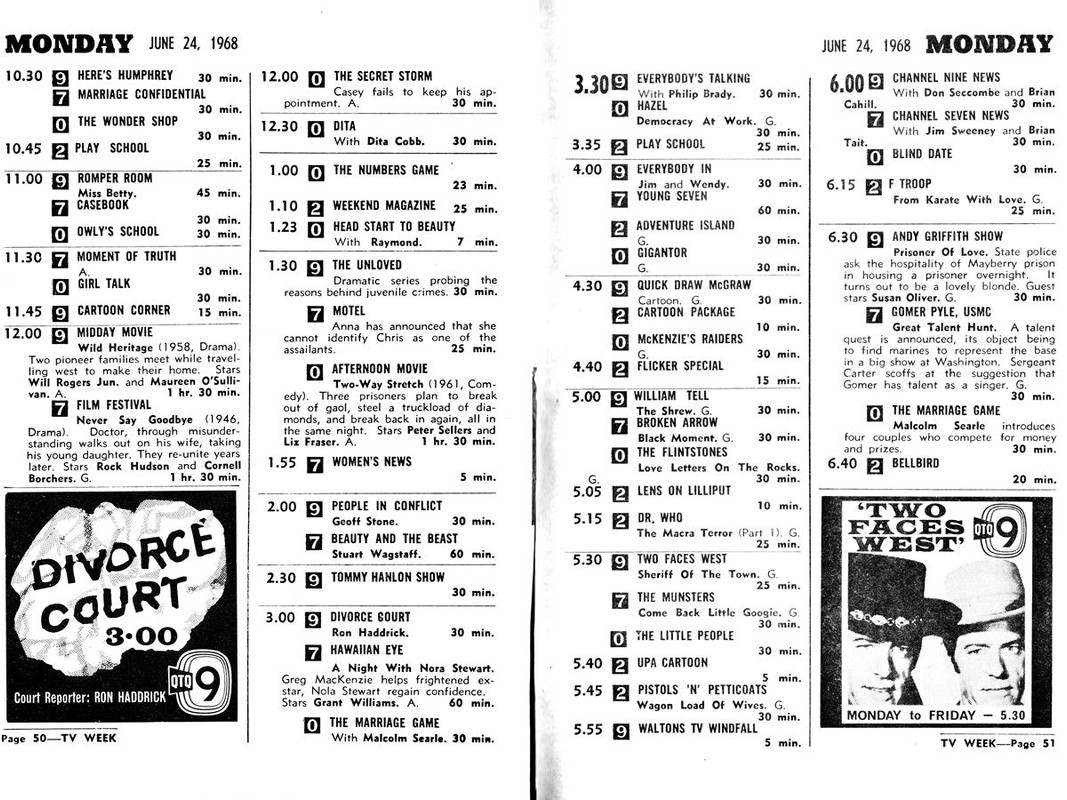
Source: TelevisionAU at MediaSpy
And here's a 1974 ad for the news on TVQ-0 in Brisbane:
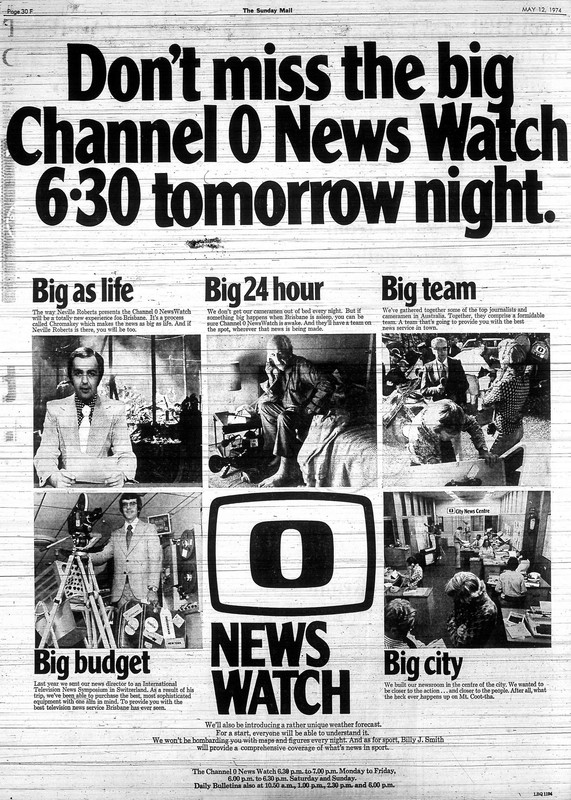
From: Lost TVQ on Facebook
And here's TVQ's 1988 switch from Channel 0 to Channel 10 (ATV in Melbourne had made the same switch in 1980):
Source: TelevisionAU at MediaSpy
And here's a 1974 ad for the news on TVQ-0 in Brisbane:
From: Lost TVQ on Facebook
And here's TVQ's 1988 switch from Channel 0 to Channel 10 (ATV in Melbourne had made the same switch in 1980):
Last edited:
I just noticed that the listings above are from the Brisbane edition and that TVQ is the Channel 0 station listed. Apologies!
Some Slovenian TV listings from 1971 featuring Apollo 15 coverage:
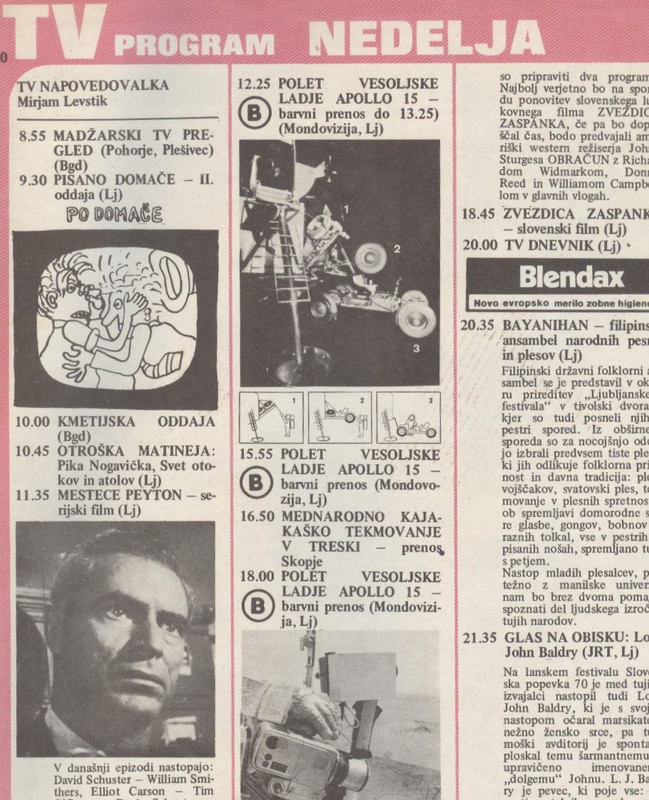
I can understand bits and pieces of this (but only bits and pieces), from halfway knowing Polish and otherwise just being able to suss it out. "Madzarski" is "Hungarian", though oddly enough, the word would be "wegierski" in Polish. "Mestece" is "town", or loosely translated, "place" (obvious from context). "Nedelja" is Sunday ("niedziela" in Polish, see what I mean?). It literally means "the day you don't work".Some Slovenian TV listings from 1971 featuring Apollo 15 coverage:
These words are not pronounced as they look like they would be to an English-speaker.
An interesting excerpt about cross-border TV viewing in 1960s France, where ORTF enjoyed a monopoly on broadcasting, from John Ardagh's The New French Revolution: A Social and Economic Survey of France 1945-1967 (1967):
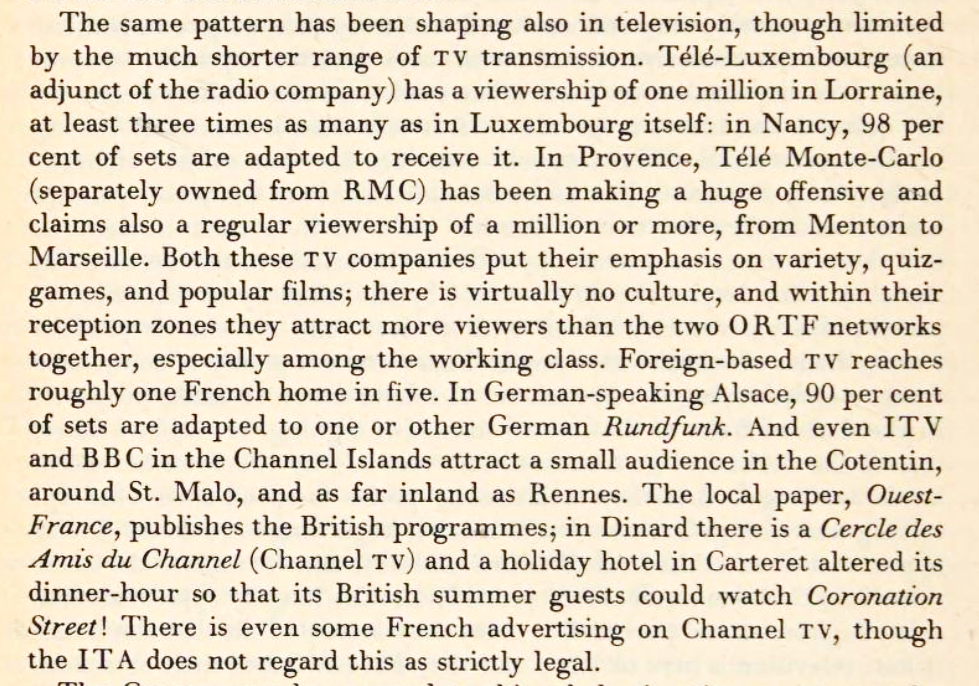
I am assuming that by "adapted" they refer to PAL receivers being adapted to receive SECAM, and/or different line standards (819 lines versus 625). Evidently multisystem receivers weren't common then.
As a kind of side note, the "flicker" that someone accustomed to 60 hz/525 lines (North America), as opposed to 50 hz/625 lines, would perceive when watching TV in Europe (it always jumped right out at me) doesn't exist anymore with digital TV. I noticed in Paris in 2010 "hey, their TV screens don't flicker anymore". You got used to it after a while.
As a kind of side note, the "flicker" that someone accustomed to 60 hz/525 lines (North America), as opposed to 50 hz/625 lines, would perceive when watching TV in Europe (it always jumped right out at me) doesn't exist anymore with digital TV. I noticed in Paris in 2010 "hey, their TV screens don't flicker anymore". You got used to it after a while.
I am assuming that by "adapted" they refer to PAL receivers being adapted to receive SECAM, and/or different line standards (819 lines versus 625).
It was almost certainly the latter, since color broadcasting didn't start in France until late 1967.
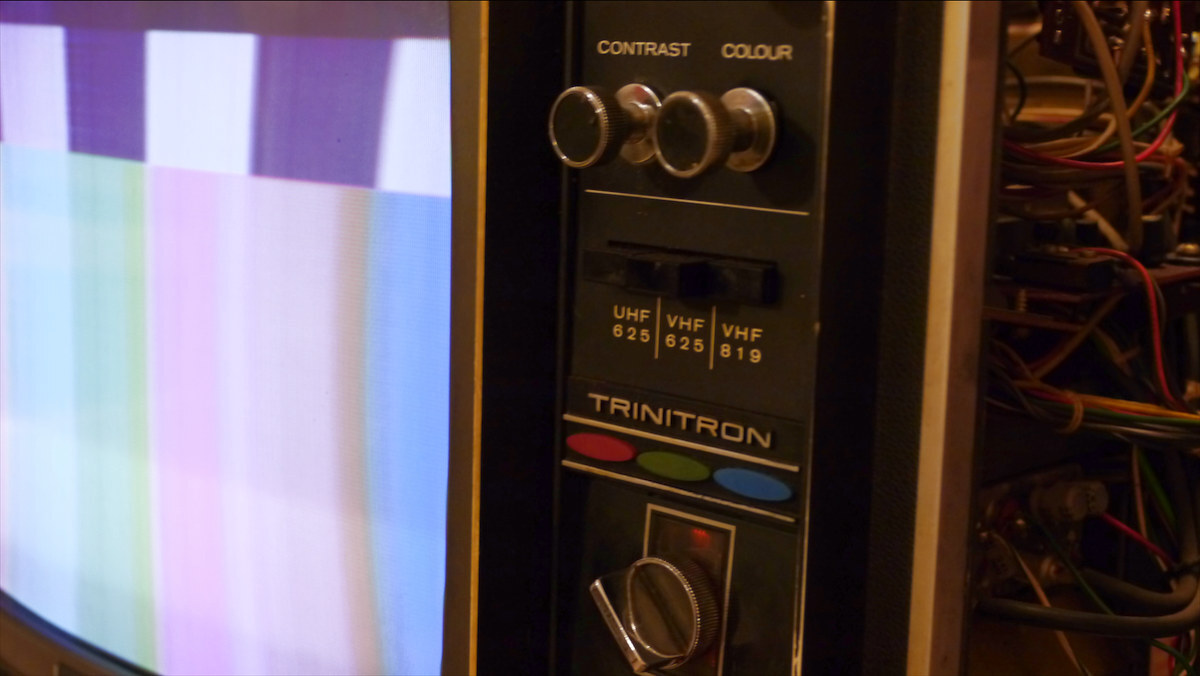
This, by the way, is what a 819-625 switch on a multisystem Sony Trinitron looked like:
Source: Clopos at tvnt.net
Source: Clopos at tvnt.net
This, by the way, is what a 819-625 switch on a multisystem Sony Trinitron looked like:
Source: Clopos at tvnt.net
That is just too cool.
I once had a multisystem Panasonic Sophia analog TV that switched automatically. I used it here in the US for watching PAL/SECAM VHS tapes and DVDs. It also supported NTSC (NTSC to PAL is not as difficult a conversion as PAL to NTSC).
It finally died on me.
That is just too cool.
I once had a multisystem Panasonic Sophia analog TV that switched automatically. I used it here in the US for watching PAL/SECAM VHS tapes and DVDs. It also supported NTSC (NTSC to PAL is not as difficult a conversion as PAL to NTSC).
It finally died on me.
By the mid-1990s, many ordinary VCRs in Europe were able to play back (but not record) NTSC tapes. This enabled Europeans to watch movies and other programming that wasn't released in Europe--a practice that again became more difficult when VCRs were replaced by region-locked DVD players.
By the mid-1990s, many ordinary VCRs in Europe were able to play back (but not record) NTSC tapes. This enabled Europeans to watch movies and other programming that wasn't released in Europe--a practice that again became more difficult when VCRs were replaced by region-locked DVD players.
We got my son's grandparents in Poland a VCR like that. I was surprised to find NTSC playback capabilities on it when we went shopping for VCRs there.
And what is an 819-625 switch?This, by the way, is what a 819-625 switch on a multisystem Sony Trinitron looked like:
Source: Clopos at tvnt.net

K.M. Richards
Program Director, The Eighties Channel™
And what is an 819-625 switch?
It switched the scanning rate between the two European analog transmission modes for color.
PAL was 625 lines per second and was widely used not only in Europe but in Africa and the Asia Pacific regions (Japan was a major holdout in the latter, choosing the North American NTSC 525-line system). SECAM used 819 lines per second because that was how France's monochrome transmissions were configured when it was first developed in 1956 (which had made them already incompatible with receivers in other countries).
Of course, that's all academic now since television broadcasting is universally digital.
SECAM used 819 lines per second because that was how France's monochrome transmissions were configured when it was first developed in 1956 (which had made them already incompatible with receivers in other countries).
A minor correction: SECAM used 625 lines, just like PAL, and the old monochrome 819-line system was gradually replaced by SECAM. (The 819-line transmissions remained in black and white until that broadcasting mode was discontinued.)

It switched the scanning rate between the two European analog transmission modes for color.
PAL was 625 lines per second and was widely used not only in Europe but in Africa and the Asia Pacific regions (Japan was a major holdout in the latter, choosing the North American NTSC 525-line system). SECAM used 819 lines per second because that was how France's monochrome transmissions were configured when it was first developed in 1956 (which had made them already incompatible with receivers in other countries).
Of course, that's all academic now since television broadcasting is universally digital.
Almost - but not quite.
The 819-line French standard was a monochrome standard, and it went into use right after WWII.
Aside from a handful of experimental broadcasts, SECAM color never used 819-line. SECAM in France and neighboring European countries was always 625-line, based on the CCIR 625-line monochrome system that was the European standard after WWII everywhere other than France, Belgium and the UK.
So the 819/625 line switch on this set actually chose between legacy monochrome 819-line French broadcasts, legacy monochrome 625-line that might have been seen in border areas from the Netherlands, Germany, Switzerland or Spain, and 625-line SECAM color broadcasts from France.
There was also some 525-line SECAM color in French territories outside Europe, including the Caribbean, which means yet another variety of multi-standard sets for those areas.
K.M. Richards
Program Director, The Eighties Channel™
Almost - but not quite.
The 819-line French standard was a monochrome standard, and it went into use right after WWII.
Aside from a handful of experimental broadcasts, SECAM color never used 819-line. SECAM in France and neighboring European countries was always 625-line, based on the CCIR 625-line monochrome system that was the European standard after WWII everywhere other than France, Belgium and the UK.
So the 819/625 line switch on this set actually chose between legacy monochrome 819-line French broadcasts, legacy monochrome 625-line that might have been seen in border areas from the Netherlands, Germany, Switzerland or Spain, and 625-line SECAM color broadcasts from France.
There was also some 525-line SECAM color in French territories outside Europe, including the Caribbean, which means yet another variety of multi-standard sets for those areas.
I probably would have known all that if I had been un citoyen français back then.
But at least I got most of it right.
Of course, that's all academic now since television broadcasting is universally digital.
But now we have the various flavors of ATSC, DVB, ISDB, and so on, such that different parts of the world still have different standards. While one standard is often used over broad regions, you still can't use a European TV in North America and vice versa (just one example).
Cuba is now on a different standard than the US, such that DX from there is now impossible without region-specific equipment.