The station was a non-factor, and rarely showed up in the LA ratings. The best the signal ever did was a 1.0 share in 1970 (when it was Country KBBQ)
View attachment 9258
[/QUOTE
Howdy - not a member here but right now I'm listening to some KBLA airchecks my friend, Gary Schnider (RIP) gave me - some of you may know his LuxuriaMusic show Open Mynd Excursion. Despite its low ratings, it was a great station - especially Dave Diamond - his last three hours were outstanding and predated most underground FM what with the long versions of Doors, Seeds, and Stones songs plus lots of Arthur Lee and Love, Rainy Daze, and others. I'm currently listening to The Boston Tea Party's version of "Words" on a Roger Christian aircheck. They were a local Burbank band who all attended Burbank High!
Cheers - Lee in Joshua Tree, CA (former Burbank resident)

-
Get involved.
We want your input!
Apply for Membership and join the conversations about everything related to broadcasting.
After we receive your registration, a moderator will review it. After your registration is approved, you will be permitted to post.
If you use a disposable or false email address, your registration will be rejected.
After your membership is approved, please take a minute to tell us a little bit about yourself.
https://www.radiodiscussions.com/forums/introduce-yourself.1088/
Thanks in advance and have fun!
RadioDiscussions Administrators
You are using an out of date browser. It may not display this or other websites correctly.
You should upgrade or use an alternative browser.
You should upgrade or use an alternative browser.
KBLA 1500 Burbank
- Thread starter alok
- Start date

Here's the last hour of Diamond's last KBLA show (June 16, 1967):
To be fair, B. Mitchel Reed was starting to explore the same long cuts and new bands on his nighttime show on KFWB that spring and summer, as well. And nine days after KBLA flipped to Country, Dave joined KFWB. He and BMR did a few months back-to-back before Reed joined Tom Donahue in putting the music on KPPC.
To be fair, B. Mitchel Reed was starting to explore the same long cuts and new bands on his nighttime show on KFWB that spring and summer, as well. And nine days after KBLA flipped to Country, Dave joined KFWB. He and BMR did a few months back-to-back before Reed joined Tom Donahue in putting the music on KPPC.
I've tried three times today to reset my password. I give up and I have sent a note to them explaining why their site has become useless.
Wow! Some interesting responses to my last post. Let's see how well I can respond.
1) The reason I thought that KFOX-AM was a full-time operation was because I never heard its sign-off. However, I was living in Tujunga in 1970 and 1971 and (mostly) using small Japanese transistor radios with little distance reception. While I could hear KFOX-AM's signal during the middle of the day using my dad's larger receiver, I could not, from my location near the east end of Tujunga, hear that station around sunset or sunrise--there was too much interference from other stations on that frequency.
2) DavidEduardo, thanks for supplying me with the correct terms. I *certainly* should (and do) know them, but every now and then I have a memory block when I'm trying to think of what to write.
3) Michael Hagerty and K.M. Richards: thanks for the notes about full-time stations not always operating full time legally. While the stations I listened to in Los Angeles, Phoenix, and Tucson that operated full time were operating 24 hours a day when I was listening, I do know of places (because my family was always going on camping trips) including Flagstaff and Show Low in Arizona where the full time radio stations operating during the 1970s did not, in fact, broadcast 24 hours a day.
4) To answer K.M. Richards' question, I just looked at the ARSA site and the single survey for KFOX-FM as an R&B outlet comes from January 10, 1966. The frequency listed is 100.3 mHz and per K.M. Richards' previous comments would have come after KFOX-FM moved to 100.3 mHz from 102.3 mHz.
5) While I have had no problems signing into the ARSA survey to this minute, I have noticed that the site does not hold one's sign-in credentials for very long even if one stays on the site. Like both K.M. Richards and Michael Hagerty, I have absolutely no idea what is going on over there.

K.M. Richards
Program Director, The Eighties Channel™
4) To answer K.M. Richards' question, I just looked at the ARSA site and the single survey for KFOX-FM as an R&B outlet comes from January 10, 1966. The frequency listed is 100.3 mHz and per K.M. Richards' previous comments would have come after KFOX-FM moved to 100.3 mHz from 102.3 mHz.
Something's still off. The Wikipedia page for what is now KKLQ had a "freeview" clipping via Newspapers.com of Don Page's column for July 18, 1965 in the Los Angeles Times, and he said KFOX-FM "disgorges country and western music" as of that date.

Programs on FM---a Most Pleasant Sound
Clipping found in The Los Angeles Times published in Los Angeles, California on 7/18/1965. Programs on FM---a Most Pleasant Sound
 www.newspapers.com
Billboard's in-depth look at the Los Angeles Market (February 13, 1965) also says KFOX-AM/FM was simulcasting:
Ditto one year later (March 12, 1966):
And an article in Billboard in the February 5, 1966 issue also references the country format being simulcast:
I even found two full-page ads for them in the October 30, 1965 and October 29, 1966 issues:
Sorry, Ted, but it just doesn't add up. Why would the owners of KFOX/1280 buy KMLA, change the call letters to match and simulcast, then go R&B a year later when the previous KFOX-FM, now KJLH, was doing that format? And wouldn't Billboard have reported all that? They certainly wouldn't have repeatedly reported on a non-existent simulcast in market #2!
And -- most importantly -- why is there no other "proof" if that was indeed the case?
Something's still off. The Wikipedia page for what is now KKLQ had a "freeview" clipping via Newspapers.com of Don Page's column for July 18, 1965 in the Los Angeles Times, and he said KFOX-FM "disgorges country and western music" as of that date.
Programs on FM---a Most Pleasant Sound
Clipping found in The Los Angeles Times published in Los Angeles, California on 7/18/1965. Programs on FM---a Most Pleasant Sound
Billboard's in-depth look at the Los Angeles Market (February 13, 1965) also says KFOX-AM/FM was simulcasting:
Ditto one year later (March 12, 1966):
And an article in Billboard in the February 5, 1966 issue also references the country format being simulcast:
I even found two full-page ads for them in the October 30, 1965 and October 29, 1966 issues:
Sorry, Ted, but it just doesn't add up. Why would the owners of KFOX/1280 buy KMLA, change the call letters to match and simulcast, then go R&B a year later when the previous KFOX-FM, now KJLH, was doing that format? And wouldn't Billboard have reported all that? They certainly wouldn't have repeatedly reported on a non-existent simulcast in market #2!
And -- most importantly -- why is there no other "proof" if that was indeed the case?
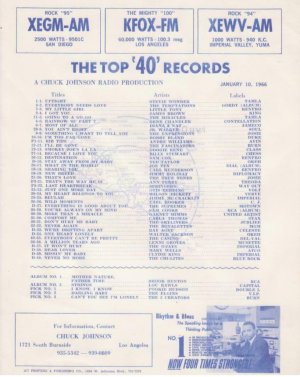
From ARSA. Short-term deal with Chuck Johnson? A mockup for a proposal that never happened?

Let me expand on this one a bit as it's interesting.3) Michael Hagerty and K.M. Richards: thanks for the notes about full-time stations not always operating full time legally. While the stations I listened to in Los Angeles, Phoenix, and Tucson that operated full time were operating 24 hours a day when I was listening, I do know of places (because my family was always going on camping trips) including Flagstaff and Show Low in Arizona where the full time radio stations operating during the 1970s did not, in fact, broadcast 24 hours a day.
I began my interest in radio trying to pick up all the stations of Storer Broadcasting somewhere around 1957 or 1958. I had bought a couple of shares in Storer (I was about 11 years old) and felt it my obligation.
In listening for things beyond my local WJW in Cleveland, I found WWVA in Wheeling and WSPD in Toledo. With a little effort I even found their station in Fairmount, WV and WJBK in Detroit. At that point, I had become a DXer and joined the National Radio Club.
I learned that nearly every station in the country shut down at midnight on Sunday for maintenance. So I could hear things like 1440 in Medford, OR or Riverside, CA. Or KORL in Honolulu on 650. Or New Zealand on 1000 after both Chicago and Seattle signed off. 950 at 4 AM had no North American station on the air, allowing LR3 from Argentina to be an easy catch. Argentina on 1070 or 830 or 870 were also simmple catches, as was 1090 in Uruguay. 1370 at 4 AM found the AST sign on of WIVV from Vieques, PR.
The rest of the week, except for some stations in major markets, most AMs were off at midnight the rest of the week. In Cleveland, 6 of the 8 local AMs in 1959 signed off every night. Outside of larger markets and a few medium ones, fulltime stations went off at 11 PM or Midnight... and maybe a few at 1 AM.
Only as stations found equipment more reliable as well as discovering that being on for early risers helped daytime ratings did station gradually start going to 24 hour a day operation.
When I built my first station in Ecuador in '64, there were no 24 hour stations out of 41 local AM fulltime stations. After a year, I started running 24/7 and then every additional station I built operated that way. But nobody else did!
K.M. Richards
Program Director, The Eighties Channel™
View attachment 9279
From ARSA. Short-term deal with Chuck Johnson? A mockup for a proposal that never happened?
Given all of the evidence that KFOX-FM never dropped the simulcast, I would be inclined to think the latter was the case ... especially since no other such surveys appear to exist.
On a hunch, I searched Billboard one more time and found that Mr. Johnson did launch a R&B format on the two Mexican AMs on July 15, 1966:
The jump to page 31 gives me a lead to follow: Among the list of deejays is Tom Irwin, better known as my friend "Shotgun" Tom Kelly. I will get in touch with him when I have a chance, but my schedule is pretty full the rest of the week so it might have to wait until the weekend.
Something's still off. The Wikipedia page for what is now KKLQ had a "freeview" clipping via Newspapers.com of Don Page's column for July 18, 1965 in the Los Angeles Times, and he said KFOX-FM "disgorges country and western music" as of that date.
Programs on FM---a Most Pleasant Sound
Clipping found in The Los Angeles Times published in Los Angeles, California on 7/18/1965. Programs on FM---a Most Pleasant Sound
Billboard's in-depth look at the Los Angeles Market (February 13, 1965) also says KFOX-AM/FM was simulcasting:
Ditto one year later (March 12, 1966):
And an article in Billboard in the February 5, 1966 issue also references the country format being simulcast:
I even found two full-page ads for them in the October 30, 1965 and October 29, 1966 issues:
Sorry, Ted, but it just doesn't add up. Why would the owners of KFOX/1280 buy KMLA, change the call letters to match and simulcast, then go R&B a year later when the previous KFOX-FM, now KJLH, was doing that format? And wouldn't Billboard have reported all that? They certainly wouldn't have repeatedly reported on a non-existent simulcast in market #2!
And -- most importantly -- why is there no other "proof" if that was indeed the case?
In January of 1966, I was all of 2 years old and cannot therefore verify anything heard on the radio dial at that time. The articles you provided definitely suggest that the survey available at the ARSA site is incorrect, and you may well be correct. (By the way, the #1 song listed on the survey was Stevie Wonder's "Uptight (Everything's Alright)," which suggests that the music is correct for that date and that kind of station.)
For the record, when I did gain access to my dad's AM/FM portable receiver in late 1970, it was (though very fuzzy, given my location) country that I was hearing from KFOX-FM.
Given all of the evidence that KFOX-FM never dropped the simulcast, I would be inclined to think the latter was the case ... especially since no other such surveys appear to exist.
On a hunch, I searched Billboard one more time and found that Mr. Johnson did launch a R&B format on the two Mexican AMs on July 15, 1966:
The jump to page 31 gives me a lead to follow: Among the list of deejays is Tom Irwin, better known as my friend "Shotgun" Tom Kelly. I will get in touch with him when I have a chance, but my schedule is pretty full the rest of the week so it might have to wait until the weekend.
I just read the Billboard piece and I think you've got the answer, K.M.
Chuck Johnson says he became GM of the Mexican AMs in November of 1965, but didn't "initiate R&B programming until July 15."
The playlist is dated January 10.
So it was a mockup. Maybe he used it to pitch potential advertisers, or maybe L.A. stations for brokered time, which, I understand was his primary model. And if that's the case, there may have been other similiar playlists printed with a different L.A. station in that center top position.
If anyone knows Lee Tucker, he's the ARSA member who posted this XEGM/KFOX-FM/XEWV list. He's posted as recently as this January, and posted the list in question on April 8 of 2020.
In fact, we had a post here at RD last year about XEGM from a member using the screenname Multiplex, which said, in part:
XEGM-950 played soul in the evenings from 1965-1968, possibly 1969. Chuck Johnson was the main DJ and time buyer, but there were other jocks.
I think Shotgun Tom Kelly may have done weekends under another name, which I won't mention because it may be his real name.
Chuck Johnson bought time on several Tijuana stations over the years, including 1270, 1550, and, in 1974, 1470.
Full thread here (I let him know that Tom has not made his real name a secret): https://radiodiscussions.com/threads/xeau-xegm-etc.771004/
One last bit from ARSA. There is only one other XEGM survey there, from October 24, 1966, four months after the Billboard piece:
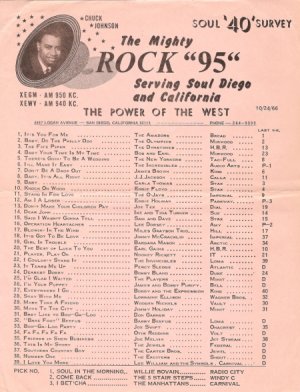
It shows only XEGM and XEWV. This chart was contributed by Gary Pfiefer.
Last edited:
I just read the Billboard piece and I think you've got the answer, K.M.
Chuck Johnson says he became GM of the Mexican AMs in November of 1965, but didn't "initiate R&B programming until July 15."
The playlist is dated January 10.
So it was a mockup. Maybe he used it to pitch potential advertisers, or maybe L.A. stations for brokered time, which, I understand was his primary model. And if that's the case, there may have been other similiar playlists printed with a different L.A. station in that center top position.
If anyone knows Lee Tucker, he's the ARSA member who posted this XEGM/KFOX-FM/XEWV list. He's posted as recently as this January, and posted the list in question on April 8 of 2020.
In fact, we had a post here at RD last year about XEGM from a member using the screenname Multiplex, which said, in part:
Full thread here (I let him know that Tom has not made his real name a secret): https://radiodiscussions.com/threads/xeau-xegm-etc.771004/
One last bit from ARSA. There is only one other XEGM survey there, from October 24, 1966, four months after the Billboard piece:
View attachment 9280
It shows only XEGM and XEWV. This chart was contributed by Gary Pfiefer.
Check with Don Sainte Johnn. He was involved with Chuck Johnson at XEGM. Their studios were in Logan Heights in San Diego and they drove the tapes to Tijuana to be aired. I lived in San Diego at the time and listened.
Don has joined us (thanks to you, Brian!) and has cleared up the question in a second, more recent thread: