• Get involved.
    We want your input!
    Apply for Membership and join the conversations about everything related to broadcasting.

    After we receive your registration, a moderator will review it. After your registration is approved, you will be permitted to post.
    If you use a disposable or false email address, your registration will be rejected.

    After your membership is approved, please take a minute to tell us a little bit about yourself.
    https://www.radiodiscussions.com/forums/introduce-yourself.1088/

    Thanks in advance and have fun!
    RadioDiscussions Administrators

AM/FM simulcast ratings

Need the radio professionals on this board to help me with this one.

Why are AM/FM simulcasts only listed in the ratings as either AM or FM? And, how do we know the allocation of listeners to each band?

Examples here of all-news stations on the west coast: KNX AM-FM in Los Angeles, and KCBS-AM/KFRC-FM San Francisco. In L.A., only KNX *FM* is listed in the ratings. I realize 99% of the time only the FM is identified on-air. But there has to be *some* listening to the AM, it has a much better signal than the FM.

In San Francisco, it's the opposite. The 50kw AM is listed in the ratings, even though presumably more people are tuning into the FM. One difference is that they identify both call letters routinely.

Thanks in advance for answers.
 
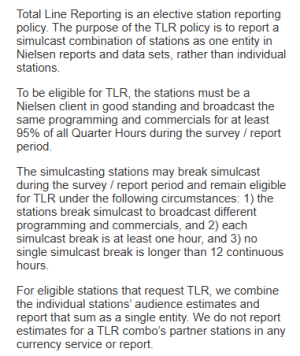
It is called "single line reporting" and Nielsen has offered it for many years now. In a typical AM/FM simulcast, the station gets to decide which one they consider the "primary" and that is how they are listed. For a translator, the parent station is automatically the station listed.

CTListener is correct. That information is proprietary and not considered eligible for the "free of charge" release of 6+/12+ numbers.

And that is the way the stations -- and Nielsen -- want it.

End of discussion ... under the circumstances, asking "why" is pointless, nor is the situation ever likely to change to what you would prefer.
 
Why are AM/FM simulcasts only listed in the ratings as either AM or FM? And, how do we know the allocation of listeners to each band?
Simulcast stations are listed separately by default unless stations choose "Total Line Reporting (TLR)" (as most do). It is the station's discretion as to which station is listed as the primary station.

The breakdown between stations is not known at all - even to subscribing stations in Nielsen software. Stations must request and pay for a separate breakout from Nielsen if they want to see the breakout among a TLR simulcast, which they normally don't do unless there is a pressing need to see whether a simulcast is better off being broken off or not.

Translators are not treated as radio stations, and listening to translators only shows up if that translator is simulcasting the signal of another licensed full power AM, FM or HD, therefore that is the station for which listening is registered.

1749209500980.png
 
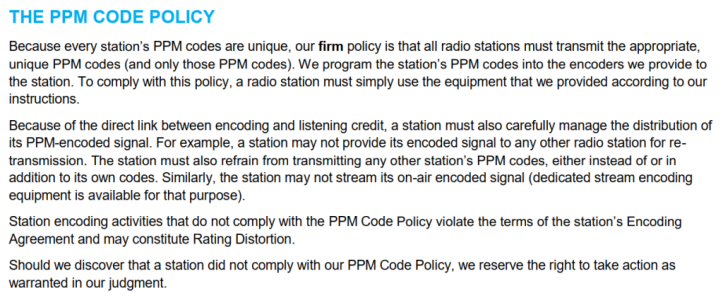
Wouldn't a breakout of AM and FM ratings require a separate PPM encoder for each transmitter? Otherwise with one encoder feeding both transmitters, there would be no way for PPMs to tell the difference between them.
 
Wouldn't a breakout of AM and FM ratings require a separate PPM encoder for each transmitter? Otherwise with one encoder feeding both transmitters, there would be no way for PPMs to tell the difference between them.
To reinforce Huff's post, every AM, FM, HD-2, HD-3, HD-4, individual stream (more than one if content, such as ads, are different) and translator are issued a separate encoder.

For AM/FM simulcasts, each station has an encoder but the station has the choice of having Nielsen list them separately (bad for business) or combined. And the station can choose if it wants the "Master Station" (my term, not theirs) to be the AM or the FM.

For example, there are markets where the FM has different calls than the AM and the AM is the heritage signal. So the station owner may say "list me under the AM" but if both are the same, because FM has a better sales image, they can pick the FM as the master.

Streams and HD's can not, as far as I know, be listed as the master even if they are a full simulcast with an AM or FM.

What many radio aficionados but not professionals don't know is that nearly almost all non-subscribed stations encode, too. The industry hopes all will encode as that helps to show higher average listening levels, such as that expressed as PUR "Persons Using Radio".

Nielsen gives encoders to all stations in a Metro Survey Area, even if not subscribed. And stations that are just outside the MSA can get one for a very moderate cost, and some do that.

And to make this post even longer and more tedious :sneaky: I should mention that encoding with the Nielsen issued device does not necessarily introduce any audio distortion or artifacts. When poster here talk about "hearing the PPM" or something similar, they are referring to stations that use a third party device that enhances the station audio to allow code insertions; when "set at 11" that device can make a station sound quite tedious and horrific.

 
Omnia and Optimod processors can also PPM encode when the stations puts in their SDK code from Nielsen.
And there is hardware-less software based encoding.


Back
Top Bottom