If KHJ was playing "Puppy Love" I guess it's safe to assume they were pretty much straight top 40 in 1972? I ask because from late '71 thru the spring of '73 WRKO was doing, for lack of a better term, an top 40/AOR hybrid format. A toned down (kind of AC-ish) presentation, a lot of LP cuts and nothing even remotely bubblegummy or teen-oriented. Surveys for that time period aren't really reflective of how they sounded...there was a lot they played wasn't listed. You'd hear some album cut by the Allman Brothers followed by "Alone Again Naturally" or something similar.
It was a reaction to something similar WMEX did under John Garabedian in the summer/early autumn of '71. By January WMEX was straight top 40 again, but 'RKO continued the hybrid format for better than a year.
Supposedly Drake flew to Boston to see for himself what they were doing, I'd figured the rest of the RKO chain might have followed suit.
So, this actually began at KHJ.
Ted Atkins, in collaboration with Bill Drake, re-vamped KHJ's approach in late April of 1971, an all-at-once makeover that included the "Motown" jingles (hear them here, from :00:17 to 16:08 )
...a shrinking of the oldies library and a reduction of the number of goldens per hour in weekdays, with album cuts introduced in their place---usually no more than two per hour.
Atkins continued to refine it---the jingles were gone by November of 1971, replaced by the original acapellas. The Drake-voiced jock intros were gone as well, with just the Johnny Mann acapella "KHJ, Los Angeles" and then the jock over the intro of the first record of the hour.
In May of 1972, shortly after "Puppy Love" fell off the chart, there was another refinement. The top of the hour jingle was gone. The jocks did the legal ID live and it was very basic:
"(Time) at KHJ, Los Angeles. This is (name)." Robert W. Morgan was allowed "Good Morgan from Robert W."
Also, that month, Walt "Baby" Love decided to return to WOR-FM and Drake told Ted Atkins he wanted Jimmy Rabbitt in 9-Midnight. Rabbitt proved uncoachable and lasted four shifts spread over six days. He was replaced by WRKO's "Johnny Williams" (Bill Todd), who took the name "Cat Simon" and was 90% as hip as Rabbitt with 0% of the headaches.
Here's the KHJ "Thirty" for the week Rabbitt was there:
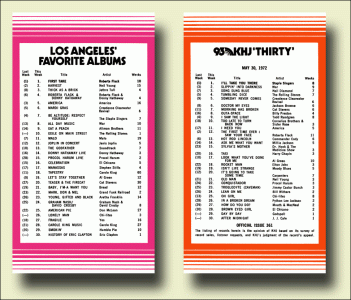
KHJ ignored Sammy Davis, Jr.'s "The Candy Man" and Gallery's "Nice To Be With You", which were #5 and #8 on Billboard, and they turned a cold shoulder to most bubblegum and overly light pop for several months.
Ted Atkins left in the fall, spending some time at KIIS-AM before going to WTAE, Pittsburgh. Drake's lieutenant Bill Watson became KHJ's acting PD and he pretty much kept an even keel, but teen records (including "Crazy Horses" by the Osmonds and "Why" from Donny Osmond) began returning in October of '72.
It was the arrival of Paul Drew at full-time PD at KHJ in March of 1973 that saw the album cuts go away and a return to a pure Top 40 approach, with more jingles, Bill Drake-voiced top of the hour legal IDs ("KHJ, Los Angeles---all hits, all the time.") and virtually constant contests.
Here's Billboard's coverage of the initial changes in 1971:
(page 2)



