• Get involved.
    We want your input!
    Apply for Membership and join the conversations about everything related to broadcasting.

    After we receive your registration, a moderator will review it. After your registration is approved, you will be permitted to post.
    If you use a disposable or false email address, your registration will be rejected.

    After your membership is approved, please take a minute to tell us a little bit about yourself.
    https://www.radiodiscussions.com/forums/introduce-yourself.1088/

    Thanks in advance and have fun!
    RadioDiscussions Administrators

MOYL Format 2025

Well, for a long time, this was true. The older you were, the more likely you enjoyed softer music. Beautiful music stations were originally for the 25-54 crowd.
You're mostly right on this. Beautiful Music was largely enjoyed by people my grandparents age. My grandparents would have been in their 40s when Beautiful Music emerged as a format.

But it turned out, the format specifically for people born in the 1920s and 30s, not for all people aged 40 and up forever.

I would theorize that the preference for "soft music" was simply because that's what my grandparents had always known. When they were growing up, popular music wasn't distributed as recordings, it was distributed as sheet music out of the Sears catalogue. My grandparents heard heard popular when their aunt played it on piano or their dad played it on harmonica. The singers of "standards" largely performed those same songs, and did it better than Aunt Ruby and Uncle Vern.

The same wasn't true of baby boomers, who were much less interested in learning how to play piano to enjoy popular song in the "old fashioned" way. Piano sales in the US fell dramatically during the great depression, and never returned to the highs of the 1920s. Piano sales in 1950 were half of what they had been in 1925, despite a dramatically larger US population.
 
Well, for a long time, this was true. The older you were, the more likely you enjoyed softer music. Beautiful music stations were originally for the 25-54 crowd. Many cities also had commercial classical stations. aimed at mature listeners. NYC, Chicago and San Francisco actually had two commercial FM stations playing classical music. But they eventually aged out or converted to non-commercial, listener-supported operations.

There was Soft Rock for folks who liked rock but preferred something not too upbeat. KNX-FM Los Angeles was the leading station in this format. Several other CBS FM stations followed KNX-FM's lead. There were also the Magic stations that played the softer selections from AOR artists, WMGK Philadelphia, WMJC Detroit, WMJX Boston. For a short time, NYC had a Soft Rock battle between WKTU (before disco) and WYNY. Let's remember, even for mainstream AOR stations, artists who were part of the core included Carole King, Cat Stevens, James Taylor, Carly Simon and Crosby, Stills, Nash & Young.

Then we had Smooth Jazz stations that were very successful. KTWV Los Angeles at one time was one of CBS Radio's highest revenue producers. But that format also faded out.

Today, even stations that had billed themselves as Soft or Lite don't want to say they are anymore. Around 2000, Lite-FM and other soft stations started playing uptempo songs and had their DJs talk over song intros. I'm not sure what happened that nobody wants soft music anymore. I guess we all lead such peaceful, no-stress lives that there's no need for soft music stations now.

Previous generations used music radio as a mood service---a phrase I first heard from Frank Cody, The Wave's first PD.

It's not that way anymore and isn't likely to come back. Frank was aiming for 40-year-olds and that was 38 years ago. The math does itself.

Years ago, the late P.J. O'Rourke did a piece for Rolling Stone on the "sudden prevalence" of old people---in the bank, in the grocery store, in the fast lane in front of him.

The punch line was:

"Hell, I went to The Who concert last week and there were these old farts up on stage."
 
You're mostly right on this. Beautiful Music was largely enjoyed by people my grandparents age. My grandparents would have been in their 40s when Beautiful Music emerged as a format.

But it turned out, the format specifically for people born in the 1920s and 30s, not for all people aged 40 and up forever.

Exactly. It ended when the bulk of the audience crossed 65 and it became too hard to sell. And that was 30 years ago.

I would theorize that the preference for "soft music" was simply because that's what my grandparents had always known. When they were growing up, popular music wasn't distributed as recordings, it was distributed as sheet music out of the Sears catalogue. My grandparents heard heard popular when their aunt played it on piano or their dad played it on harmonica. The singers of "standards" largely performed those same songs, and did it better than Aunt Ruby and Uncle Vern.

Yep.

The same wasn't true of baby boomers, who were much less interested in learning how to play piano to enjoy popular song in the "old fashioned" way. Piano sales in the US fell dramatically during the great depression, and never returned to the highs of the 1920s. Piano sales in 1950 were half of what they had been in 1925, despite a dramatically larger US population.

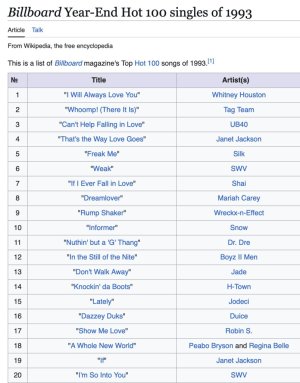
And beyond Baby Boomers---well, here are the Top 20 hits for the year today's 50-year-old graduated high school:

Screenshot 2025-06-27 at 7.13.09 PM.jpeg


Maybe you could make a case for a new-gen "Quiet Storm" format, but maybe not (and really, isn't that what KTWV is now?).

But---and this will make certain heads here explode---what this really says is that in 20 years "Nuthin' but a 'G' Thang" will be too old for any salable audience.

Word.

 
Last edited:
This is about perspective. A few people who still like Percy Faith and Friends and have gone to some length to find a stream that provides that kind of music is just that: a few.

I have enlarged and bolded (and colored the main two words) in that which Chimp needs to read.
 
Chimp, you have to define "a lot".

A streamed service or "station" might only have a hundred or less listeners at any time across the country. An FM station in NYC that is highly rated might have 40,000 or so average listeners. And if you take the format, whichever it is, for your selected NYC station and add the audience of similarly formatted stations across the country, you could easily have a half-million average listeners to that format in the whole U.S.A.

This is about perspective. A few people who still like Percy Faith and Friends and have gone to some length to find a stream that provides that kind of music is just that: a few.

Put that on a full signal FM in a major market and you would likely be lucky to get a 0.1 share and a 0.0 rating.
The station I am talking about has listeners around the world.

And the DJ just said, "We don't dig the rock and roll."
 
The station I am talking about has listeners around the world.

That still doesn't tell us how many, much less justify the assessment "a lot."

If every country on earth had a thousand people who listened to it, that would be 195,000 people---which is equal to the audience of the 14th-place station in Sacramento, California, the 30th largest market in America.

Nobody's telling you not to listen, Chimp. We're trying to get you to stop using absolutes like "a lot" when the fact is that we don't know how many people are listening but that it is, very likely, based on what we know of streaming and the appeal of that music to the audience alive today, very likely not objectively "a lot".

And the DJ just said, "We don't dig the rock and roll."

I would think that would be obvious, but...
 
Heck, play some salsa, merengue, cumbia and vallenato with a touch of Shakira, Daddy Yankee and Pitbull for me. And loud. But stuff the ballads and boleros you-know-where!

Hey, MF, we gonna party!
All sound good as part of the mix. Hips don’t lie, even if they’re prone to be a little more sore now than they used to be.
 
I heard Dee Snider may be the new replacement for Wink Martindale. And David Lee Roth needs a steady gig, I hear.

Wait until the Music of Your Life gets into the Grunge years. With Hip-Hop, Electronica, Hanson and everything else the '90s threw at us.

But it's really just encountering what KIXI, Zoomer Radio and all the programmers of the last great Adult Standards stations have; The new old people of today don't look like your grandparents at all. In fact, they look a lot like...(glances around the people in my circle and myself in the mirror)....Oh crap....

So many questions going forward. But Adult Standards is entering very complex times musically. Some ugly new shocks to our systems are going to have to be accepted. '80s,'90s and 2000s youth were culturally vastly different from those of the '50s, '60s and '70s.

And (Bonus Thought); You thought your grandparent's old folks were a bunch of jaded old grouches when you were a kid? You ain't seen nothing yet next to Gen-X as upper middle-age/elderly people. And these are people my age (57). Yikes!

That's what's most frightening of all.....
 
I heard Dee Snider may be the new replacement for Wink Martindale. And David Lee Roth needs a steady gig, I hear.

Wait until the Music of Your Life gets into the Grunge years. With Hip-Hop, Electronica, Hanson and everything else the '90s threw at us.

But it's really just encountering what KIXI, Zoomer Radio and all the programmers of the last great Adult Standards stations have; The new old people of today don't look like your grandparents at all. In fact, they look a lot like...(glances around the people in my circle and myself in the mirror)....Oh crap....

So many questions going forward. But Adult Standards is entering very complex times musically. Some ugly new shocks to our systems are going to have to be accepted. '80s,'90s and 2000s youth were culturally vastly different from those of the '50s, '60s and '70s.

And (Bonus Thought); You thought your grandparent's old folks were a bunch of jaded old grouches when you were a kid? You ain't seen nothing yet next to Gen-X as upper middle-age/elderly people. And these are people my age (57). Yikes!

That's what's most frightening of all.....
I've heard MOYL play Bon Jovi.
 
So many questions going forward. But Adult Standards is entering very complex times musically. Some ugly new shocks to our systems are going to have to be accepted. '80s,'90s and 2000s youth were culturally vastly different from those of the '50s, '60s and '70s.

"Standards" really isn't "Standards" anymore now. It's still delivering an audience that is more 75+ than it is 55+.

Frankly, I'm not sure there's a case for a "Standards" format for someone 45-55 (and if you want advertising dollars, that needs to be the core audience, with ripples out ten years in either direction). I don't think the people in that age group are in search of a station like that---at least not enough of them to listen all at once, for long enough periods, on a daily basis.
 
So, I spent some time tonight listening to KTWV, Los Angeles ("The Wave"), and truthfully, I think that's Standards in 2025 for an audience under 65.

I mean, in certain markets, it wouldn't work and you'd need to go more mainstream and less rhythmic, but this is a bulls-eye for today's 50-something, especially females.


I've said it before---what we call Standards right now is largely 70s AC---which I programmed. It's the music I aimed for 37-year-olds with and got---48 years ago. Playing Billy Joel, Steely Dan and the Little River Band is what I did. And those people are now 85.

I think the "Standards" format label needs to be retired---The Wave isn't standards--but it fills the same purpose for someone in their 50s today that MOYL and the earliest Standards stations (not to be confused with MOR stations that played that music in the 50s and 60s) did in the late 70s through the early 90s.
 
So, I spent some time tonight listening to KTWV, Los Angeles ("The Wave"), and truthfully, I think that's Standards in 2025 for an audience under 65.

I mean, in certain markets, it wouldn't work and you'd need to go more mainstream and less rhythmic, but this is a bulls-eye for today's 50-something, especially females.


I've said it before---what we call Standards right now is largely 70s AC---which I programmed. It's the music I aimed for 37-year-olds with and got---48 years ago. Playing Billy Joel, Steely Dan and the Little River Band is what I did. And those people are now 85.

I think the "Standards" format label needs to be retired---The Wave isn't standards--but it fills the same purpose for someone in their 50s today that MOYL and the earliest Standards stations (not to be confused with MOR stations that played that music in the 50s and 60s) did in the late 70s through the early 90s.
I think you're right. What used to be termed 'Gold-Based AC' might be what you're describing.
 
Not to open a big can of worms that's not related here, but I think it is related...

It seems to me that "classic hits" is almost like "classic rock-lite," and that's somewhat confusing to me. WDVE and 3WS in Pittsburgh have a lot of playlist overlap, definitely in artists they play.

"Oldies" seemed to include a lot more ballad-type material, and actually shied away from the real heavy stuff.

What changed there?
 
Not to open a big can of worms that's not related here, but I think it is related...

It seems to me that "classic hits" is almost like "classic rock-lite," and that's somewhat confusing to me. WDVE and 3WS in Pittsburgh have a lot of playlist overlap, definitely in artists they play.

"Oldies" seemed to include a lot more ballad-type material, and actually shied away from the real heavy stuff.

What changed there?

The audience.


Back
Top Bottom