• Get involved.
    We want your input!
    Apply for Membership and join the conversations about everything related to broadcasting.

    After we receive your registration, a moderator will review it. After your registration is approved, you will be permitted to post.
    If you use a disposable or false email address, your registration will be rejected.

    After your membership is approved, please take a minute to tell us a little bit about yourself.
    https://www.radiodiscussions.com/forums/introduce-yourself.1088/

    Thanks in advance and have fun!
    RadioDiscussions Administrators

TV Guide editions and online resources

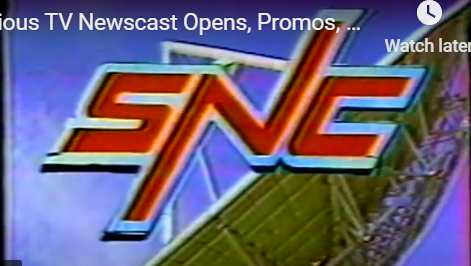
You can see brief clips of SNC regional news updates from several stations here (go to the 2:45 mark is not taken there automatically)--and yes, they looked pretty low-budget, especially compared to the high-tech, polished look of SNC itself:


Yes, they're pretty gross, they have an almost Soviet look to them. Not appealing in the least.
 
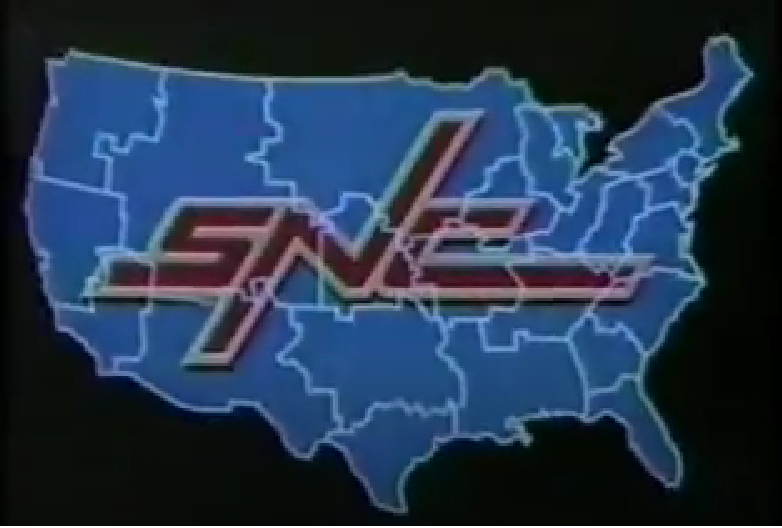
By the way, here's a map of SNC regions from a 1983 promo (with a bizarre absence of the Great Lakes, which makes it pretty hard to make out how the regions were split in that part of the country):

 
Last edited:
I did get to see SNC during tests on my local cable system (detailed in my post about Avenue TV Cable) and it was actually superior to CNN2. The deck was just stacked against them.
I had the opportunity to see SNC from time to time. I thought the channel did a good job. I wouldn't say it was superior to CNN2. SNC was a longer-form news service than CNN2 while also being more structured than regular CNN. Clearly Westinghouse and ABC spent more money on SNC than Ted Turner spent on CNN2. Even though CNN2 was not Turner's primary channel, it was a good product for folks who wanted all the headlines fast.
 
The anchors around the end of the century -- possibly the best remembered -- included David Goodnow, Lyn Vaughn, Chuck Roberts (who spent 28 years at CNN2/Headline News before retiring in 2010), Bob Losure, Lynne Russell, and Don Harrison.

Here's (most of) a CNN obit for Don Harrison from 1998:


And a longer tribute:

 
I remember Don Harrison well. He was the morning anchor on CNN Headline News during a period when I was having to get up around 4:30am PT. I always liked his on-camera presence and personality.

And I happened to be watching the evening he passed, when David Goodnow broke the news of his death.
 
Speaking of news channels, Canada's first 24-hour news operation, CBC Newsworld (now known as the CBC News Network), had a unique format when it launched in 1989. Various dayparts were broadcast from different CBC stations across Canada. Their launch presentation explained the setup:

 
Speaking of news channels, Canada's first 24-hour news operation, CBC Newsworld (now known as the CBC News Network), had a unique format when it launched in 1989. Various dayparts were broadcast from different CBC stations across Canada. Their launch presentation explained the setup:


As a kind of side note (though not totally unconnected), I have noticed in Canadian TV listings that cable companies often carry stations from all throughout Canada, usually on higher channels. I'd like to see that in the US, at least from certain cities. As I've noted before either on here or another forum, I really don't think people would quit watching local stations in favor of those from (for instance) New York, Chicago, Denver, or Los Angeles. It would afford the opportunity for time-shifting if nothing else.

The only place you would run into problems, is if viewers were placed in a DMA that is different from the stations they would actually prefer to watch if they could get them, then DMA boundaries could eventually shift to the detriment of the losing market. Everything in Kentucky south of Boone, Kenton, and Campbell counties, and east of I-75, would be the Lexington market if all of those stations were available in tandem with the out-of-state markets (but then there's Mason County, Maysville, which has cultural and historic ties to both Lexington and Cincinnati, they get stations from both cities but land in the Cincinnati market). Further east, only WSAZ would hold any interest for viewers within commuting distance of Huntington, Charleston might as well be in a foreign country.
 
Actually, the FCC already has a process for communities to petition for inclusion of stations in adjacent DMAs on cable and satellite if they can prove that viewing patterns favor the "non-assigned" DMA stations.
 
Actually, the FCC already has a process for communities to petition for inclusion of stations in adjacent DMAs on cable and satellite if they can prove that viewing patterns favor the "non-assigned" DMA stations.

Yes, they did that for Clarksburg stations in Monongalia and Preston counties in West Virginia (Pittsburgh DMA). Those counties are "neither fish nor fowl", but since a county can only be in one DMA, the preponderance of the viewing goes to Pittsburgh, at least at the moment.

I am wondering if there may be some future shifts in DMAs due to people "cutting the cord" and adopting a mix of streaming options and OTA TV. Once people discover that they have a large assortment of stations and subchannels, possibly more easily received, and more relevant to their local interests, than the stations to whose DMA they are assigned, viewing patterns could shift. Needless to say, no DMA is eager to lose counties, but it would be easier now, than in the days when people relied massively upon cable and "local into local" on satellite. It is not entirely impossible that Monongalia and Preston counties could slide over to the Clarksburg DMA, especially with all four major networks now available in-market.
 
Last edited:
And a correction on my part: when the other ITV regions consolidated into TV Times in 1968, Channel (and only Channel) retained its own separate magazine. Apparently it was a small profit center for a station that, as we've seen, struggled to make money.

And because Channel TV's financial situation was so precarious, it was the only station allowed to stay on air during the 1979 ITV strike, when unions forced other stations to shut down for eleven weeks.

So how did one tiny station survive without network programming? This feature from Channel TV explains what happened:

 
What is the most recent revision of the FCC's significantly viewed stations list?

I have this from the FCC's website:

https://www.fcc.gov/sites/default/files/significantly-viewed-stations.pdf

But then I found this archived website which lists SV out-of-market stations. Some of its listings are quite different from the most recent FCC list:


Perhaps most bizarrely of all, it lists WYMT as being SV in Campbell County TN. The FCC list doesn't even acknowledge WYMT's existence.
 
That document has this disclaimer:
However, this is not the list of stations that the FCC has identified in each county but it is fairly consistent with the FCC study in 2005.

So I wouldn't try to compare them head-to-head.
I didn't catch that part, thanks.

The FCC SV list is a dinosaur and needs to be redone from top to bottom.
 
It’s not often that a TV station gets to report on its own demise, but that was the dominant story on Coast to Coast, the regional newscast from TVS in the UK, on the day in 1991 when the station learned that it had lost its ITV license (as part of a complex license auction explained in one of the reports):


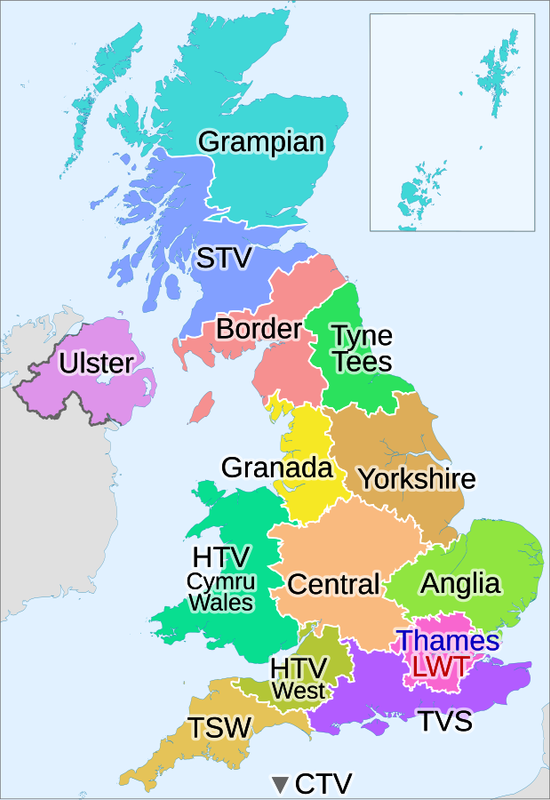
Here is a map of ITV regions at the time; you can see TVS's service area in the south:


This file is licensed under the Creative Commons Attribution-Share Alike 4.0 International license.
Attribution: Dr Greg and NordNordWest
 
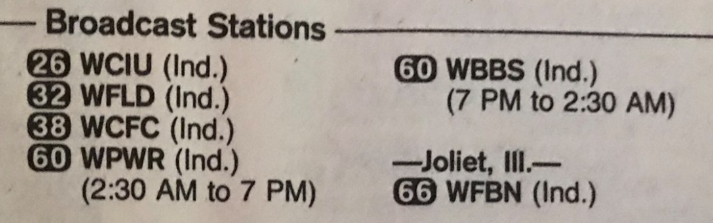
As mentioned in another thread, here's a channel lineup from a mid-1980s Chicago edition of TV Guide, when two different stations, one English-language and the other Spanish-language, shared the same Channel 60 allocation for several years:


Source: http://www.matthewsittel.com/tvg/cl/19850629_chi_cl.jpg

Here's what the switch from one station to another looked like:


In the UK, the flagship London ITV market had separate weekday and weekend licensees for many years. In this 1988 example, Thames Television concludes its broadcast week on a Friday afternoon and hands over the channel to London Weekend Television:


In fact, things were even more complicated than that, since there was a separate national morning contractor, TV-am, which produced a typical morning show during the week and aired current affairs and cartoons on weekend mornings. Its slot was from 6 a.m. to 9:25 a.m.
 
I didn't catch that part, thanks.

The FCC SV list is a dinosaur and needs to be redone from top to bottom.

I agree, some of that list feels like it hasn't been updated since 1972. Such as KQCD being in Dickinson looks completely ignored. Yes, it is a satellite of KFYR, so you effectively get the same programming, but many of the southwest North Dakota counties listed won't get actual KFYR. Especially after the digital conversion.
 
I agree, some of that list feels like it hasn't been updated since 1972. Such as KQCD being in Dickinson looks completely ignored. Yes, it is a satellite of KFYR, so you effectively get the same programming, but many of the southwest North Dakota counties listed won't get actual KFYR. Especially after the digital conversion.

The SV list reflects viewing patterns from 40-50 years ago. They still list WLOS as being a significantly viewed station in Harlan County KY. No doubt that was true at one time, WLOS was the default ABC affiliate for much of southeastern Kentucky due to lack of easily receivable alternatives. I suppose a cable operator there could use the SV list to justify carrying WLOS, but there would be little interest in it anymore. Viewers in southeastern Kentucky would much prefer to get Lexington stations and WYMT.


Back
Top Bottom