I actually purchased TV Times in London in 1990 (still have it around here somewhere) and I am familiar with the format. IIRC they listed the main channels but placed special emphasis upon ITV.What you're seeing here is one of the localized editions of TV Times, which was the program magazine of all the ITV franchisees.
You had to buy both TV Times from ITV and Radio Times from the BBC to get listings for both commercial and BBC TV. It wasn't until the 1970s or later that listings magazines came out in the UK showing all channels.
Each ITV region had its own edition of TV Times, since programming was so varied among the regional operators.

-
Get involved.
We want your input!
Apply for Membership and join the conversations about everything related to broadcasting.
After we receive your registration, a moderator will review it. After your registration is approved, you will be permitted to post.
If you use a disposable or false email address, your registration will be rejected.
After your membership is approved, please take a minute to tell us a little bit about yourself.
https://www.radiodiscussions.com/forums/introduce-yourself.1088/
Thanks in advance and have fun!
RadioDiscussions Administrators
You are using an out of date browser. It may not display this or other websites correctly.
You should upgrade or use an alternative browser.
You should upgrade or use an alternative browser.
TV Guide editions and online resources
- Thread starter IM42A
- Start date

I actually purchased TV Times in London in 1990 (still have it around here somewhere) and I am familiar with the format. IIRC they listed the main channels but placed special emphasis upon ITV.
TV listings in the UK weren't deregulated until 1991, so if you dig out your TV Times, you'll find it listed only ITV and Channel 4.
And a correction on my part: when the other ITV regions consolidated into TV Times in 1968, Channel (and only Channel) retained its own separate magazine. Apparently it was a small profit center for a station that, as we've seen, struggled to make money.

And a correction on my part: when the other ITV regions consolidated into TV Times in 1968, Channel (and only Channel) retained its own separate magazine. Apparently it was a small profit center for a station that, as we've seen, struggled to make money.
Right. HERE's some background on the Channel TV Times (from a 1987 article).
The magazine lasted until 1991.
I wasn't expecting to see the Winston cigarette commercial at 4:04. I'd be interested to know how long cigarette ads continued to air on TV outside the United States, I do know that in 1991 there was a commercial for either Winston or Marlboro on the in-flight entertainment either to or from (don't remember which) Sint Maarten (Dutch West Indies), but of course that is not "television" per se. I didn't see local TV while I was there so I don't know if broadcasters followed suit.
In Europe, cigarette advertising was formally banned on a pan-continental level in 1991, but most countries had cigarette bans in place long before then. In fact, many European countries never allowed cigarette advertising in the first place.
In Asia and Latin America, cigarette advertising lasted a lot longer. I was surprised to still see Marlboro commercials on Mexican television when I vacationed in that country in 1998.
I looked it up online, and cigarette advertising on TV is allowed in Indonesia, but the commercials cannot show people actually smoking, and they have to have warning messages. It has to be in later hours (after 9:30 pm) and cannot show branding (not clear how that works).In Europe, cigarette advertising was formally banned on a pan-continental level in 1991, but most countries had cigarette bans in place long before then. In fact, many European countries never allowed cigarette advertising in the first place.
In Asia and Latin America, cigarette advertising lasted a lot longer. I was surprised to still see Marlboro commercials on Mexican television when I vacationed in that country in 1998.
Here's the only thing I could find, it does show a logo, which to my mind would be "branding", but no smoking and nothing having to do with smoking (you'll have to go straight to YouTube to watch it):
It's worth noting that it is in English. Throughout the world, English has a "cool factor" and is used even if it's not understood by everyone.
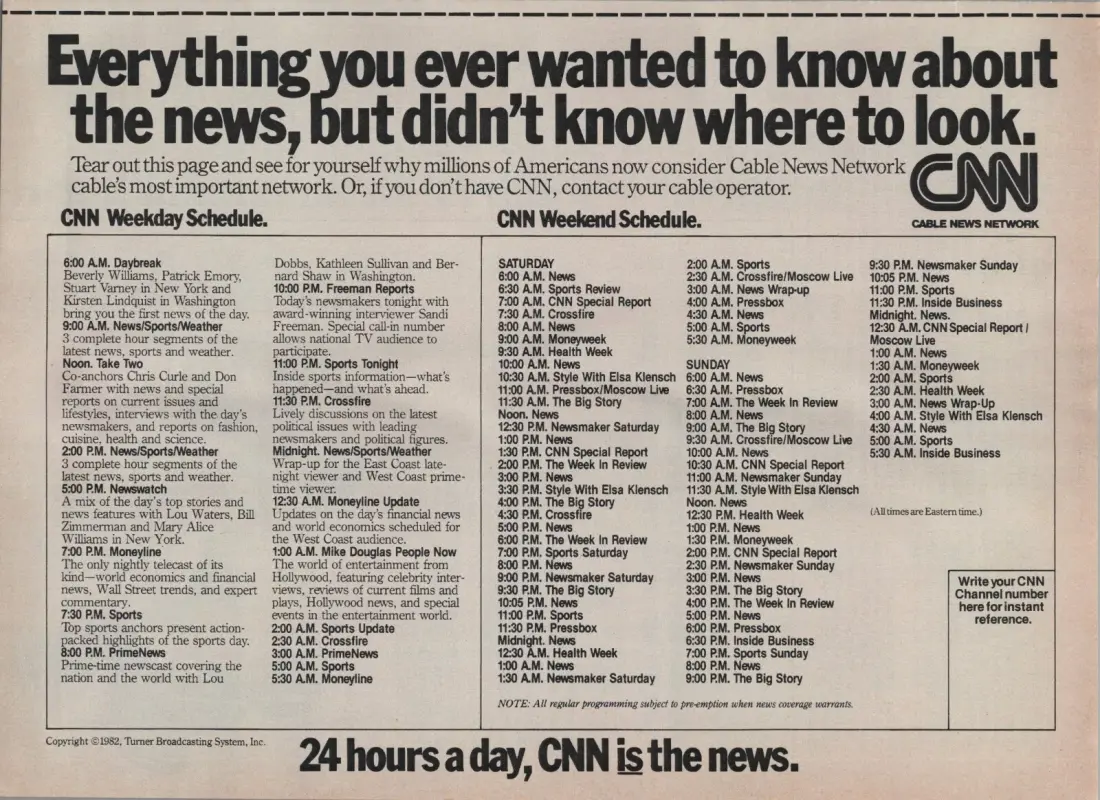
A 1982 magazine ad touting CNN's schedule before the channel was widely listed in TVG and newspaper supplements:
Source: eBay
A similarly conceived pull-out insert was featured in TV Guide at the time, but I can't seem to find it.
A promotional video for CNN made shortly after the channel's 1980 launch:
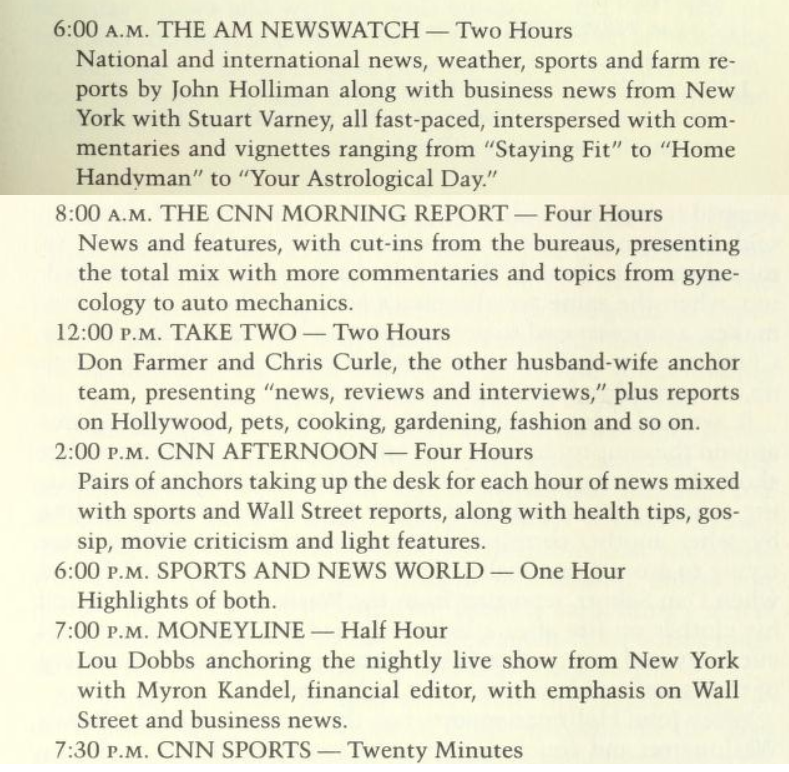
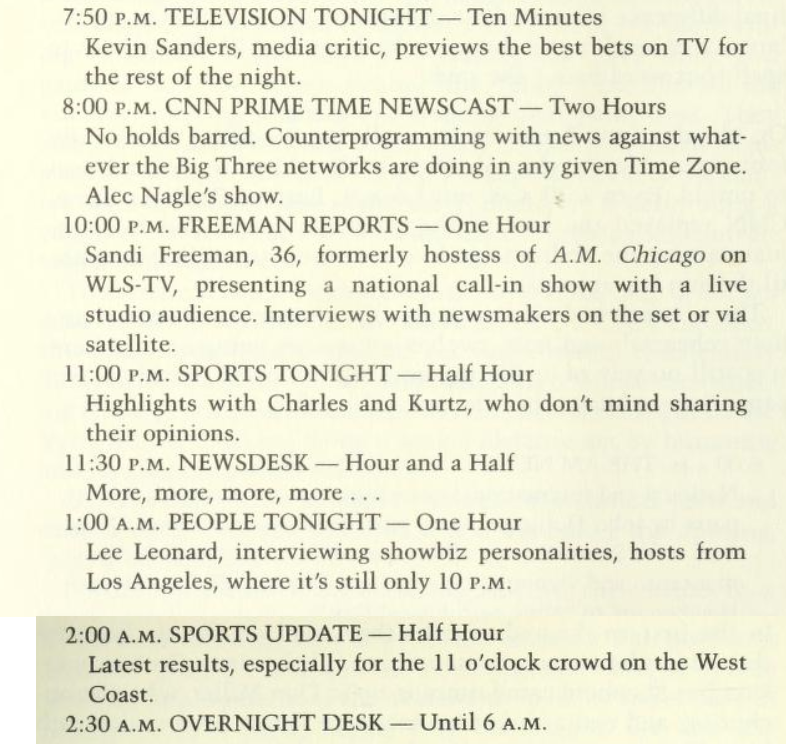
CNN's first schedule from Hank Whittemore's 1990 book CNN: The Inside Story:
Listings for CNN International from a 1997 issue of Austria's TV Media magazine:
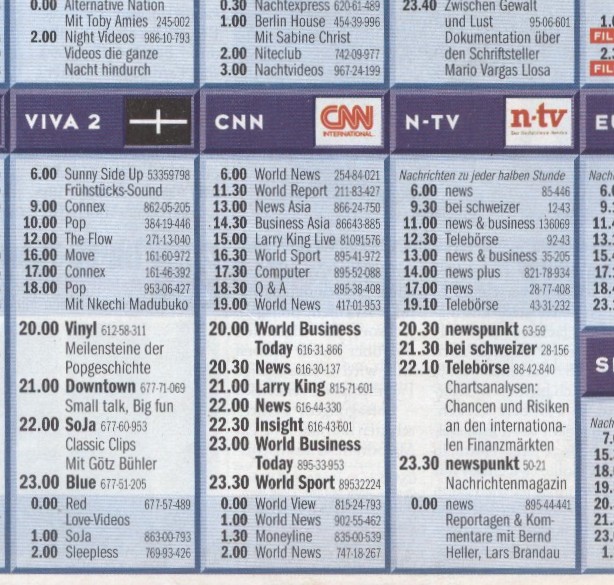
Here are bits and pieces of CNN International (the European feed) from 1993:
And here's the January 1, 1982, launch of CNN2, which later became Headline News (and whose ghost lives on, just barely, as HLN):
Unlike CNN, Headline News didn't have a schedule but instead employed a 30-minute news wheel like most all-news radio stations. Here's a look at that news wheel from a 1993 promo:
Unlike CNN, Headline News didn't have a schedule but instead employed a 30-minute news wheel like most all-news radio stations. Here's a look at that news wheel from a 1993 promo:

K.M. Richards
Program Director, The Eighties Channel™
By the time CNN2 became CNN Headline News, there had already been a near-total turnover in the anchor lineup (and they also adopted a single anchor format, although they went back to dual anchors in 2003, lasting until they started moving away from the news wheel two years later).
The anchors around the end of the century -- possibly the best remembered -- included David Goodnow, Lyn Vaughn, Chuck Roberts (who spent 28 years at CNN2/Headline News before retiring in 2010), Bob Losure, Lynne Russell, and Don Harrison.
The anchors around the end of the century -- possibly the best remembered -- included David Goodnow, Lyn Vaughn, Chuck Roberts (who spent 28 years at CNN2/Headline News before retiring in 2010), Bob Losure, Lynne Russell, and Don Harrison.
By the time CNN2 became CNN Headline News, there had already been a near-total turnover in the anchor lineup (and they also adopted a single anchor format, although they went back to dual anchors in 2003, lasting until they started moving away from the news wheel two years later).
The anchors around the end of the century -- possibly the best remembered -- included David Goodnow, Lyn Vaughn, Chuck Roberts (who spent 28 years at CNN2/Headline News before retiring in 2010), Bob Losure, Lynne Russell, and Don Harrison.
According to CNN: The Inside Story by Hank Whittemore, CNN2 launched with a dual-anchor format because CNN executives believed that the Satellite News Channel, also based on a news wheel format, would launch with a dual-anchor format (which didn't happen).
Speaking of SNC, a joint venture between ABC and Group W, here's a promotional video for the channel's first anniversary. (It wouldn't survive long enough to celebrate its second; its investors gave up and sold it to Turner.)
K.M. Richards
Program Director, The Eighties Channel™
SNC failed for a couple of reasons, none of which had to do with quality of journalism.
First, they were on transponders on a satellite (Westar 5) that few cable systems had a dish for; many were still recouping their investment for their Satcom III-R dish. Only the best-funded systems could afford the luxury of a second or third dish in those early days ... remember, this was the beginning of the cable network "explosion" and there was a huge investment just to get 36 channels down the cable to subscribers.
Second, part of the concept was regional cut-ins, produced at partner television stations (in Los Angeles, KTTV/11 did the hourly Southern California segment) but they were all sharing transponders so every region pre-empted a different part of the hourly clock with their feeds, which would be disastrous if the national feed got covered during a hard news segment. And that also meant cable systems had to have two receivers for SNC and a switcher between them.
Third, Turner was able to promote the hell out of CNN2 on both the SuperStation and CNN. SNC, being a joint venture of ABC and Group W, had very few direct-to-viewer promotion options. In particular, neither did much promotion on their O&O broadcast stations for SNC. It somewhat parallels why NIS failed ... NBC put it on their FMs in all but one market and the industry viewed that as a lack of confidence in their own product.
I did get to see SNC during tests on my local cable system (detailed in my post about Avenue TV Cable) and it was actually superior to CNN2. The deck was just stacked against them.
First, they were on transponders on a satellite (Westar 5) that few cable systems had a dish for; many were still recouping their investment for their Satcom III-R dish. Only the best-funded systems could afford the luxury of a second or third dish in those early days ... remember, this was the beginning of the cable network "explosion" and there was a huge investment just to get 36 channels down the cable to subscribers.
Second, part of the concept was regional cut-ins, produced at partner television stations (in Los Angeles, KTTV/11 did the hourly Southern California segment) but they were all sharing transponders so every region pre-empted a different part of the hourly clock with their feeds, which would be disastrous if the national feed got covered during a hard news segment. And that also meant cable systems had to have two receivers for SNC and a switcher between them.
Third, Turner was able to promote the hell out of CNN2 on both the SuperStation and CNN. SNC, being a joint venture of ABC and Group W, had very few direct-to-viewer promotion options. In particular, neither did much promotion on their O&O broadcast stations for SNC. It somewhat parallels why NIS failed ... NBC put it on their FMs in all but one market and the industry viewed that as a lack of confidence in their own product.
I did get to see SNC during tests on my local cable system (detailed in my post about Avenue TV Cable) and it was actually superior to CNN2. The deck was just stacked against them.

The Columbia, Mo. cable system did have SNC. By then, it was a Group W system. The SNC cut-ins came from WDAF-TV in Kansas City. It was a good service, but the general reaction was, "We already have a news channel. Why do we need another one?" It also didn't help that subscription charges were increased as a result of the addition of SNC, and that Group W had a terrible reputation for customer service. The WDAF-TV cut-ins might have been a nice way of balancing out the fact that the out-of-market network affiliates that were imported were all from St. Louis (note that Columbia just about halfway between the two big metros), but few subscribers noticed.SNC failed for a couple of reasons, none of which had to do with quality of journalism.
First, they were on transponders on a satellite (Westar 5) that few cable systems had a dish for; many were still recouping their investment for their Satcom III-R dish. Only the best-funded systems could afford the luxury of a second or third dish in those early days ... remember, this was the beginning of the cable network "explosion" and there was a huge investment just to get 36 channels down the cable to subscribers.
Second, part of the concept was regional cut-ins, produced at partner television stations (in Los Angeles, KTTV/11 did the hourly Southern California segment) but they were all sharing transponders so every region pre-empted a different part of the hourly clock with their feeds, which would be disastrous if the national feed got covered during a hard news segment. And that also meant cable systems had to have two receivers for SNC and a switcher between them.
Third, Turner was able to promote the hell out of CNN2 on both the SuperStation and CNN. SNC, being a joint venture of ABC and Group W, had very few direct-to-viewer promotion options. In particular, neither did much promotion on their O&O broadcast stations for SNC. It somewhat parallels why NIS failed ... NBC put it on their FMs in all but one market and the industry viewed that as a lack of confidence in their own product.
I did get to see SNC during tests on my local cable system (detailed in my post about Avenue TV Cable) and it was actually superior to CNN2. The deck was just stacked against them.
Here's a 1982 SNC promo spotlighting the regional cut-ins and some of the stations that produced them:
Since SNC was an ABC/Group W joint-venture, I would have expected ABC O&Os to participate, but except from WXYZ in Detroit, that was apparently not the case in most markets (including Los Angeles, San Francisco, etc.)
Since SNC was an ABC/Group W joint-venture, I would have expected ABC O&Os to participate, but except from WXYZ in Detroit, that was apparently not the case in most markets (including Los Angeles, San Francisco, etc.)
More than that, as an article from Broadcasting in 1985, when NBC was considering starting up an all-news service, sounded a cautionary note due to the failure of SNC (https://www.worldradiohistory.com/h...BC-IDX/85-OCR/BC-1985-08-26-OCR-Page-0033.pdf):SNC failed for a couple of reasons, none of which had to do with quality of journalism.
Other contemporary articles indicated that Turner reduced per-subscriber charges for some systems, and even paid for carriage on others, to counter SNC's effort. From November 1983:In 1982 Westinghouse and ABC launched a CNN competitor called Satellite News Channel. About 16 months later and more than $40 million in the red, they sold the service to Turner for $25 million, and Turner pulled the plug. SNC could not generate enough advertising revenue. It did not charge affiliates fees for carriage; in fact, it paid them for channel space.
Turner is still bitter toward many cable operators, who, he said, used the fierce competition between CNN and Group W /SNC Satellite News Channel toforce him to reduce the monthly per-subscriber charge for CNN and, in some cases, pay for carriage. Turner bought out SNC last month for $25 million and shut it down. "The cable operators were sorry to see the little game end," he said. Commenting on the buy-out, Turner said if ABC and Group W "had hung on, they would have bankrupted us in 24 months."
(https://www.worldradiohistory.com/h...BC-IDX/83-OCR/BC-1983-11-14-OCR-Page-0010.pdf)
More than that, as an article from Broadcasting in 1985, when NBC was considering starting up an all-news service, sounded a cautionary note due to the failure of SNC (https://www.worldradiohistory.com/h...BC-IDX/85-OCR/BC-1985-08-26-OCR-Page-0033.pdf):
Got a really stupid question here, what obstacle would there be, for the major networks, all of which have some sort of 24-hour news channel, to offer those news channels as part of cable, satellite, or OTT streaming packages (YouTube, Sling, DirecTV Stream, et al)?
It's something they're already providing online, and they already have a lot of the moving parts (their flagship OTA news programs they do in the first place, streaming or no streaming), so it's not as though it would come at any cost to them --- or would it?
I have basically begun using CBS News 24/7 as a kind of free substitute for CNN or NewsNation (I no longer have cable or an OTT streaming package, and I've never had satellite), and it does everything I'd expect an all-news channel to do.
I wasn't aware of that. Thanks.YTTV does offer the "streaming" news channels from ABC, Fox and NBC.
In a perfect world, I'd like to see network affiliates run their respective news channels on subchannels, but I don't suppose that's going to happen. Scripps News and NewsNet were the closest we ever got to that, and some stations run Newsmax2 and NTD, the latter two being, to say the least, representative of a particular worldview. Ditto OAN Plus, which also appears on some LPTVs.
France24 and NHK also run on some public TV station subchannels.
More than that, as an article from Broadcasting in 1985, when NBC was considering starting up an all-news service, sounded a cautionary note due to the failure of SNC (https://www.worldradiohistory.com/h...BC-IDX/85-OCR/BC-1985-08-26-OCR-Page-0033.pdf):
Other contemporary articles indicated that Turner reduced per-subscriber charges for some systems, and even paid for carriage on others, to counter SNC's effort. From November 1983:
(https://www.worldradiohistory.com/h...BC-IDX/83-OCR/BC-1983-11-14-OCR-Page-0010.pdf)
Here's an account of the CNN-SNC showdown from Hank Whittemore's CNN: The Inside Story (1990).
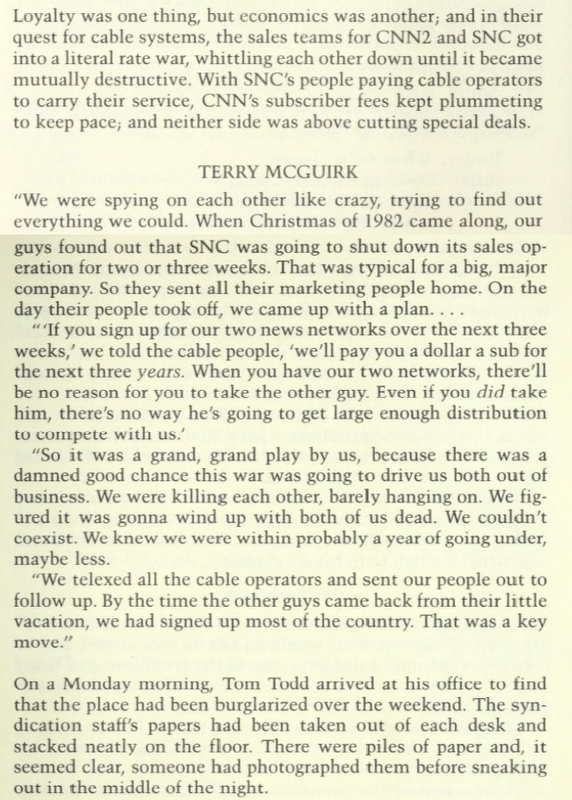
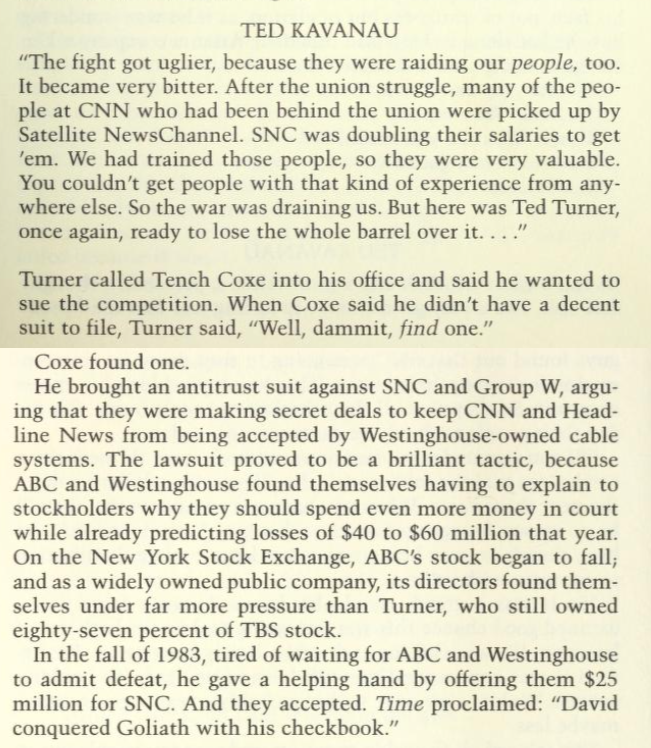
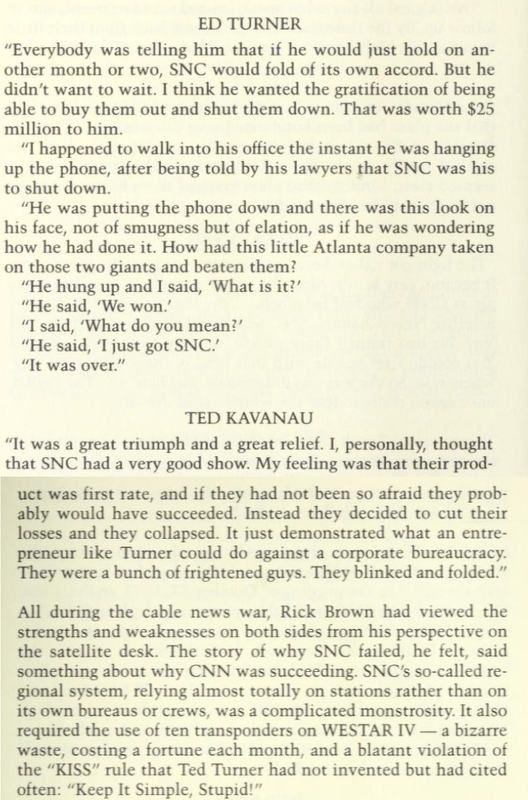
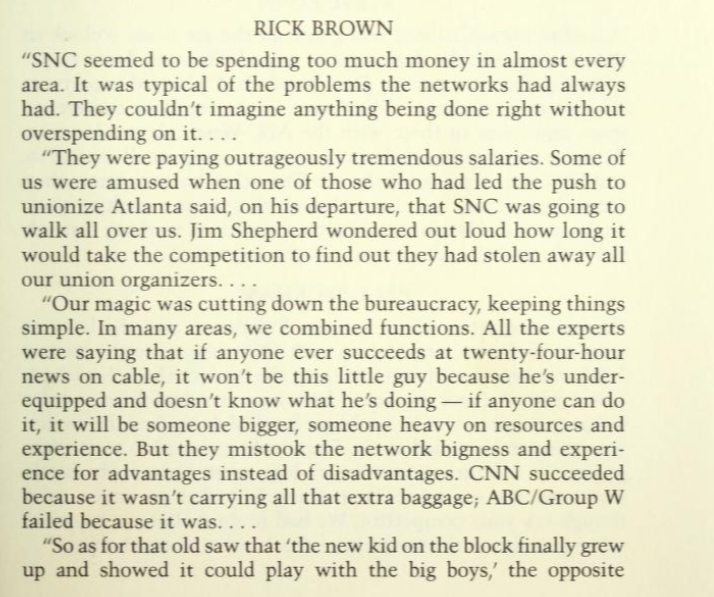
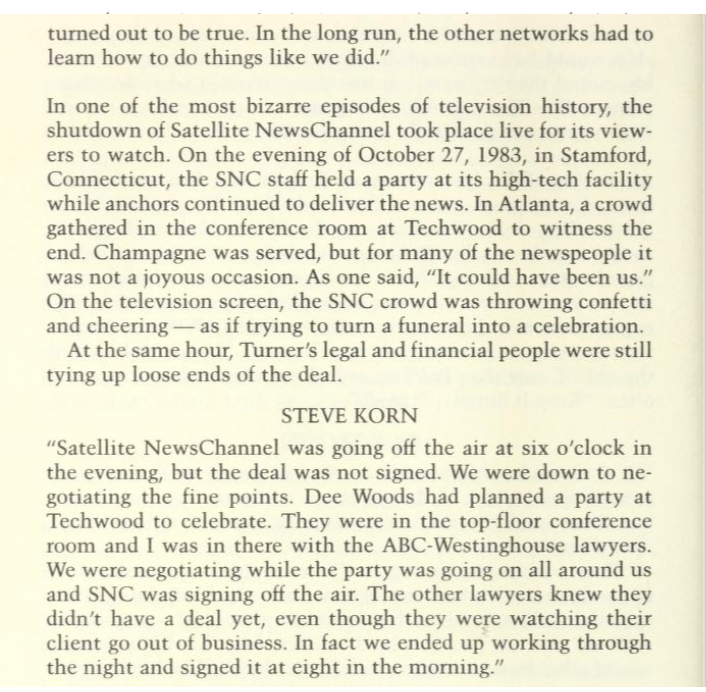
You can watch SNC's final hour here:
Interestingly, the defunct SNC was the just first channel of a planned two-channel operation. Here's Whittemore again:
And on the horizon was SNC2, the more in-depth channel that would compete more directly against CNN. The second service was going to be produced directly by ABC News, meaning that it would become the first cable network to employ a commercial network's programming experience and reportorial depth.
K.M. Richards
Program Director, The Eighties Channel™
It was a nice touch rotating all the on-camera anchors during that last hour.
I thought SNC was superior to CNN2. As discussed previously, they just made missteps and then compounded their mistakes as they went along. I think the biggest error in judgment was the "regional cut in" idea ... an expense that probably should have been held off until SNC was on a more solid footing (and without those ten extra transponders!).
I would hazard a guess, using 20/20 hindsight, that if ABC/Group W had offered cable systems a dish pointed at the Westar bird and then waived the per-subscriber fee for an introductory period, it might have fared better.
I thought SNC was superior to CNN2. As discussed previously, they just made missteps and then compounded their mistakes as they went along. I think the biggest error in judgment was the "regional cut in" idea ... an expense that probably should have been held off until SNC was on a more solid footing (and without those ten extra transponders!).
I would hazard a guess, using 20/20 hindsight, that if ABC/Group W had offered cable systems a dish pointed at the Westar bird and then waived the per-subscriber fee for an introductory period, it might have fared better.
Once in a while, I'd swing my dish from Satcom III-R to Westar 5 to see what SNC was up to. It was good, but the regional cut-in channels weren't much more than rip-and-read with video of car accidents and the like. I thought it might be more logical for ABC affiliates to be paid to feed a five-minute segment directly for truly local news, though I'm sure many owners would see that as dealing with the devil.
Larry Sacknoff saying, "All of a sudden, there's Quaker Oats, sponsoring us" summed it up in the final hour.
Larry Sacknoff saying, "All of a sudden, there's Quaker Oats, sponsoring us" summed it up in the final hour.
It was good, but the regional cut-in channels weren't much more than rip-and-read with video of car accidents and the like.
You can see brief clips of SNC regional news updates from several stations here (go to the 2:45 mark is not taken there automatically)--and yes, they looked pretty low-budget, especially compared to the high-tech, polished look of SNC itself: